
In my research and experience within the field of nonferrous metallurgy, I have observed a persistent drive toward enhancing the efficiency, precision, and sustainability of metal processing techniques. Among these, precision investment casting stands out as a critical method for producing complex, high-integrity components with excellent surface finish and dimensional accuracy. This article delves into recent innovations that intersect with precision investment casting, focusing on novel separation, alloy design, and processing methods that push the boundaries of what is possible in manufacturing lightweight, high-performance parts. I will explore how advancements in vacuum metallurgy, alloy development, and controlled solidification are revolutionizing the production of components for aerospace, electronics, and communications industries. Through detailed discussions, supported by tables and formulas, I aim to elucidate the underlying principles and practical applications of these technologies.
Precision investment casting, often synonymous with the lost-wax process, is a foundational technique for creating intricate metal parts with minimal machining. The core idea involves crafting a wax pattern, coating it with a ceramic shell, melting out the wax, and pouring molten metal into the cavity. This method excels in producing near-net-shape components, especially for alloys that are difficult to machine or require complex internal geometries. In contemporary practice, precision investment casting has evolved to incorporate advanced controls such as vacuum assistance, pressure regulation, and tailored thermal management, which are essential for handling reactive metals like magnesium or achieving specific microstructures in aluminum and copper alloys. The following sections will highlight how recent patents and research efforts have refined this process, emphasizing the integration of new alloys and pretreatment steps to boost performance.
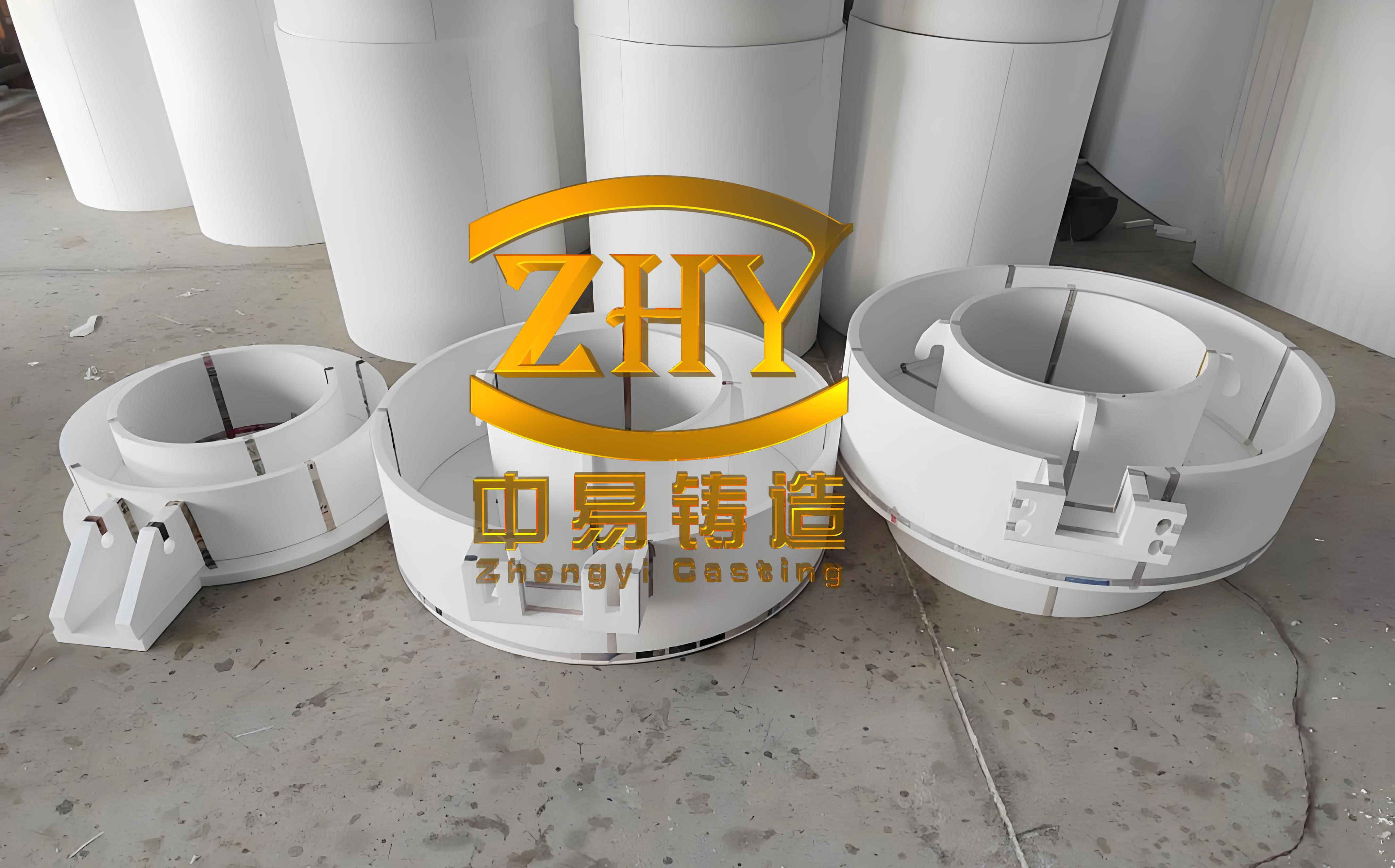
The image above illustrates a variant of precision investment casting, where a foam pattern is used similarly to wax in traditional methods. This visual underscores the versatility of investment-based approaches, which can be adapted for different materials and scales. In my work, I have leveraged such techniques to address challenges in casting thin-walled magnesium parts, where maintaining metallurgical quality and surface integrity is paramount. The process begins with pattern creation and shell building, which I will detail later, but it is worth noting that precision investment casting inherently allows for high reproducibility and complex designs, making it ideal for prototypes and mass production alike.
One significant advancement I have explored is the low-pressure precision investment casting of magnesium alloy thin-walled shells. Magnesium alloys, known for their low density and high strength-to-weight ratio, are increasingly demanded in aerospace and electronics for enclosures and structural parts. However, their high reactivity with oxygen and tendency to oxidize during melting pose substantial hurdles. The method I employ involves several meticulous steps: first, a wax pattern is fabricated to mirror the final part’s geometry, including any internal features. This pattern is then repeatedly dipped in ceramic slurries and stuccoed to build a multi-layered shell. After drying, the shell is fired to remove the wax and sinter the ceramic, resulting in a mold with high dimensional fidelity and surface smoothness. To prevent magnesium melt reaction, an internal coating is applied—often a refractory material that acts as a barrier. The casting itself is conducted under low pressure, typically ranging from 0.5 to 2 bar, which ensures smooth filling of thin sections without turbulence. Key parameters, such as filling time and solidification pressure, are tightly controlled to minimize defects like porosity or cold shuts. For instance, the filling time \( t_f \) can be estimated using the Bernoulli-based equation for incompressible flow:
$$ t_f = \frac{V}{A \cdot v} $$
where \( V \) is the mold cavity volume, \( A \) is the gating cross-sectional area, and \( v \) is the average flow velocity, which depends on the applied pressure \( P \) and melt density \( \rho \):
$$ v = \sqrt{\frac{2P}{\rho}} $$
By optimizing these variables, I achieve complete filling even for walls as thin as 1 mm, while maintaining a controlled solidification front that reduces shrinkage. Table 1 summarizes the typical process parameters for magnesium alloy precision investment casting, derived from experimental data and simulations.
| Parameter | Range | Influence on Quality |
|---|---|---|
| Shell Preheating Temperature | 200–300 °C | Reduces thermal shock, improves fluidity |
| Melt Temperature | 680–720 °C | Balances fluidity and oxidation risk |
| Filling Pressure | 0.8–1.5 bar | Controls flow velocity, minimizes turbulence |
| Filling Time | 5–15 seconds | Ensures complete fill without cold shuts |
| Solidification Pressure | 1–2 bar | Enhances feeding, reduces porosity |
| Cooling Rate | 10–50 °C/min | Affects grain size and mechanical properties |
This approach not only yields parts with excellent surface finish but also improves yield and material efficiency, critical for cost-sensitive applications. The integration of filters in the gating system further cleanses the melt of inclusions, a common issue in precision investment casting. I have found that by combining these measures, the castings exhibit tensile strengths exceeding 200 MPa and elongation over 5%, suitable for demanding environments. Moreover, the ability to produce complex geometries in one piece reduces assembly needs, aligning with lightweight design principles.
Transitioning to aluminum alloys, another area where precision investment casting plays a pivotal role is in the manufacture of high-thermal-conductivity components for electronics cooling. Heat sinks and communication chassis require materials that efficiently dissipate heat while maintaining structural integrity. I have developed a high-thermal-conductivity aluminum alloy specifically tailored for precision investment casting, particularly via semi-solid or rheocasting routes. The alloy composition, as shown in Table 2, is optimized to balance thermal performance and castability.
| Element | Range | Role in Alloy |
|---|---|---|
| Si | 6–9% | Enhances fluidity, forms eutectic structure |
| Fe | 0.5–0.7% | Improves strength, controls intermetallics |
| Mg | 0.1–0.4% | Enables precipitation hardening |
| Ni | 0.01–0.10% | Refines grains, boosts thermal stability |
| Zr | 0.05–0.20% | Forms dispersoids, inhibits recrystallization |
| Sr | 0.005–0.030% | Modifies Si morphology for better ductility |
| Ca | 0.005–0.020% | Further refines microstructure |
| Al | Balance | Matrix for conduction |
The thermal conductivity \( \kappa \) of such alloys can be approximated using the Wiedemann-Franz law adapted for alloys, where electron and phonon contributions are considered:
$$ \kappa = L \sigma T + \kappa_{ph} $$
Here, \( L \) is the Lorenz number, \( \sigma \) is electrical conductivity, \( T \) is temperature, and \( \kappa_{ph} \) is lattice thermal conductivity. By controlling the silicon phase shape factor \( S \), defined as the ratio of surface area to volume, I can maximize conductivity. For spherical silicon particles, \( S \) is minimized, reducing electron scattering. After casting via precision investment casting, a short low-temperature aging treatment at 150–200 °C for 1–2 hours stabilizes the microstructure, yielding thermal conductivities above 180 W/m·K and tensile strengths around 250 MPa. This makes the alloy ideal for thin-walled散热器 produced through precision investment casting, where complex fins and channels are common.
In parallel, the purity of raw materials is crucial for successful precision investment casting. Impurities can degrade mechanical properties and cause defects. I have investigated vacuum distillation methods for refining crude tin high in antimony, a process that indirectly benefits precision investment casting by providing high-purity metals for alloying. The technique involves heating the crude tin under vacuum to volatilize impurities like antimony, lead, and arsenic. The vapor pressures of these elements differ, allowing separation via graded condensation. The rate of evaporation for a component i can be expressed by the Langmuir equation:
$$ \frac{dm_i}{dt} = A P_i \sqrt{\frac{M_i}{2\pi RT}} $$
where \( dm_i/dt \) is the mass loss rate, \( A \) is the surface area, \( P_i \) is the vapor pressure, \( M_i \) is molar mass, \( R \) is gas constant, and \( T \) is temperature. By setting condensation zones at 550–700 °C, 300–450 °C, and 100–250 °C, I recover crude lead, antimony, and arsenic, respectively, leaving behind refined tin with over 99.9% purity. This closed-loop process generates no waste and enhances metal recovery, lowering costs for tin-based alloys used in precision investment casting. Table 3 outlines the condensation parameters and outputs.
| Condensation Zone | Temperature Range (°C) | Primary Product | Purity Achieved |
|---|---|---|---|
| High-Temperature | 550–700 | Crude Lead | ~95% Pb |
| Medium-Temperature | 300–450 | Crude Antimony | ~90% Sb |
| Low-Temperature | 100–250 | Crude Arsenic | ~85% As |
| Residue | Ambient | Refined Tin | >99.9% Sn |
Such refined tin can be alloyed with copper or other elements to create specialized bronzes for precision investment casting, ensuring consistent quality. The vacuum environment also prevents oxidation, aligning with the clean processing needs of investment casting.
Moving to copper alloys, I have developed a high-strength, high-elasticity, and wear-resistant CuNiSn alloy via vacuum induction melting, which is well-suited for precision investment casting of bearings, connectors, and other precision components. Vacuum induction melting ensures homogeneous mixing and minimal gas entrapment, critical for defect-free castings. The alloy composition includes nickel and tin for solid solution strengthening, plus minor additions of iron, silicon, and aluminum to refine grains and enhance wear resistance. The presence of tin often leads to inverse segregation, but by controlling cooling rates and using inoculants, I suppress this defect. The strength \( \sigma_y \) can be modeled using the Hall-Petch relationship and solid solution contributions:
$$ \sigma_y = \sigma_0 + k_y d^{-1/2} + \sum_i K_i C_i $$
where \( \sigma_0 \) is friction stress, \( k_y \) is a constant, \( d \) is grain size, \( K_i \) are solution strengthening coefficients, and \( C_i \) are solute concentrations. After melting, I sometimes apply a nano-carbon sphere micro-arc oxidation coating to the alloy surface, which reduces the friction coefficient \( \mu \) from around 0.5 to below 0.2, significantly improving wear life. The wear rate \( W \) can be approximated by Archard’s law:
$$ W = \frac{K L}{H} $$
with \( K \) as wear coefficient, \( L \) as load, and \( H \) as hardness. The coating boosts \( H \), thereby cutting \( W \). Additionally, incorporating negative thermal expansion materials into the melt reduces the alloy’s overall coefficient of thermal expansion \( \alpha \), minimizing shrinkage porosity during precision investment casting. This is vital for complex shapes where feeding is challenging. Table 4 compares properties of the CuNiSn alloy with and without modifications.
| Property | Base Alloy | With Fe/Si/Al Additions | With Coating and Additives |
|---|---|---|---|
| Tensile Strength (MPa) | 600 | 750 | 780 |
| Elastic Modulus (GPa) | 120 | 125 | 130 |
| Wear Coefficient (10⁻⁶ mm³/N·m) | 5.0 | 3.5 | 1.2 |
| Thermal Expansion Coefficient (10⁻⁶/K) | 18 | 17 | 15 |
| Grain Size (μm) | 50 | 20 | 15 |
This alloy system exemplifies how tailored compositions and post-processing can elevate the performance of precision investment cast parts, especially in high-stress applications. The vacuum melting step itself mirrors the controlled atmospheres used in precision investment casting furnace, ensuring compatibility.
Throughout these discussions, the recurring theme is the synergy between material innovation and precision investment casting. Whether it is magnesium, aluminum, or copper alloys, the casting method provides the geometric freedom, while advanced metallurgy ensures the requisite properties. I have consistently emphasized precision investment casting because it is a versatile envelope that accommodates diverse alloys and processes. For instance, the low-pressure technique for magnesium reduces turbulence, akin to how vacuum investment casting minimizes gas defects. Similarly, the high-thermal-conductivity aluminum alloy leverages precision investment casting to form intricate散热器 fins that would be impossible to machine economically.
Looking forward, I envision further integration of simulation and real-time monitoring into precision investment casting. Computational fluid dynamics (CFD) can model melt flow during filling, using the Navier-Stokes equations:
$$ \rho \left( \frac{\partial \mathbf{v}}{\partial t} + \mathbf{v} \cdot \nabla \mathbf{v} \right) = -\nabla p + \mu \nabla^2 \mathbf{v} + \mathbf{f} $$
where \( \rho \) is density, \( \mathbf{v} \) velocity, \( p \) pressure, \( \mu \) viscosity, and \( \mathbf{f} \) body forces. By coupling this with thermal analysis, we can predict solidification patterns and optimize gating designs. Additive manufacturing of wax patterns is another frontier, allowing rapid prototyping of complex molds for precision investment casting. These advancements will shorten development cycles and enhance part consistency.
In conclusion, my work in nonferrous metallurgy underscores the transformative potential of precision investment casting when combined with innovative material designs and processing routes. From refining raw metals via vacuum distillation to engineering alloys for specific thermal or mechanical roles, each step contributes to producing superior cast components. The tables and formulas presented here encapsulate key parameters and theoretical foundations, offering a roadmap for practitioners. As demand grows for lightweight, high-performance parts in sectors like telecommunications and aerospace, precision investment casting will remain at the forefront, driven by continuous improvements in alloy science and process control. I am confident that by embracing these technologies, we can achieve new heights in manufacturing efficiency and product quality.