
In the production of modern internal combustion engines, the cylinder head stands as one of the most critical and demanding cast components. As a key casting, the cylinder head is subjected to complex thermal and mechanical stresses during engine operation. This necessitates not only excellent casting properties and pressure tightness but also exceptionally high demands on the in-situ mechanical properties of the casting body, requiring sufficient rigidity and strength. The material of choice for such applications is often a high-grade grey iron, specifically engineered to meet these challenges.
To achieve the required in-situ strength levels (often a minimum tensile strength of 300 MPa for grades like HT300), the alloy composition is carefully tailored. Standard additions include chromium (Cr) in the range of 0.20% to 0.40% and copper (Cu) from 0.80% to 1.00%. For particularly demanding applications, further alloying elements such as molybdenum (Mo), nickel (Ni), and tin (Sn) are introduced. The primary function of these alloys is to promote the formation of a pearlitic matrix, refine the pearlite structure, and ultimately enhance the tensile strength of the final grey iron castings. However, a significant challenge arises from the inherent design of cylinder heads. Their structure is extremely complex, featuring drastic variations in wall thickness—from thin sections as narrow as 6.5 mm to massive bosses up to 57 mm thick. To ensure sound castability and meet stringent leak-tightness requirements, a relatively high carbon equivalent (CE) is often necessary. Unfortunately, a high CE generally leads to a reduction in tensile strength, creating a fundamental conflict in the property profile of these grey iron castings.
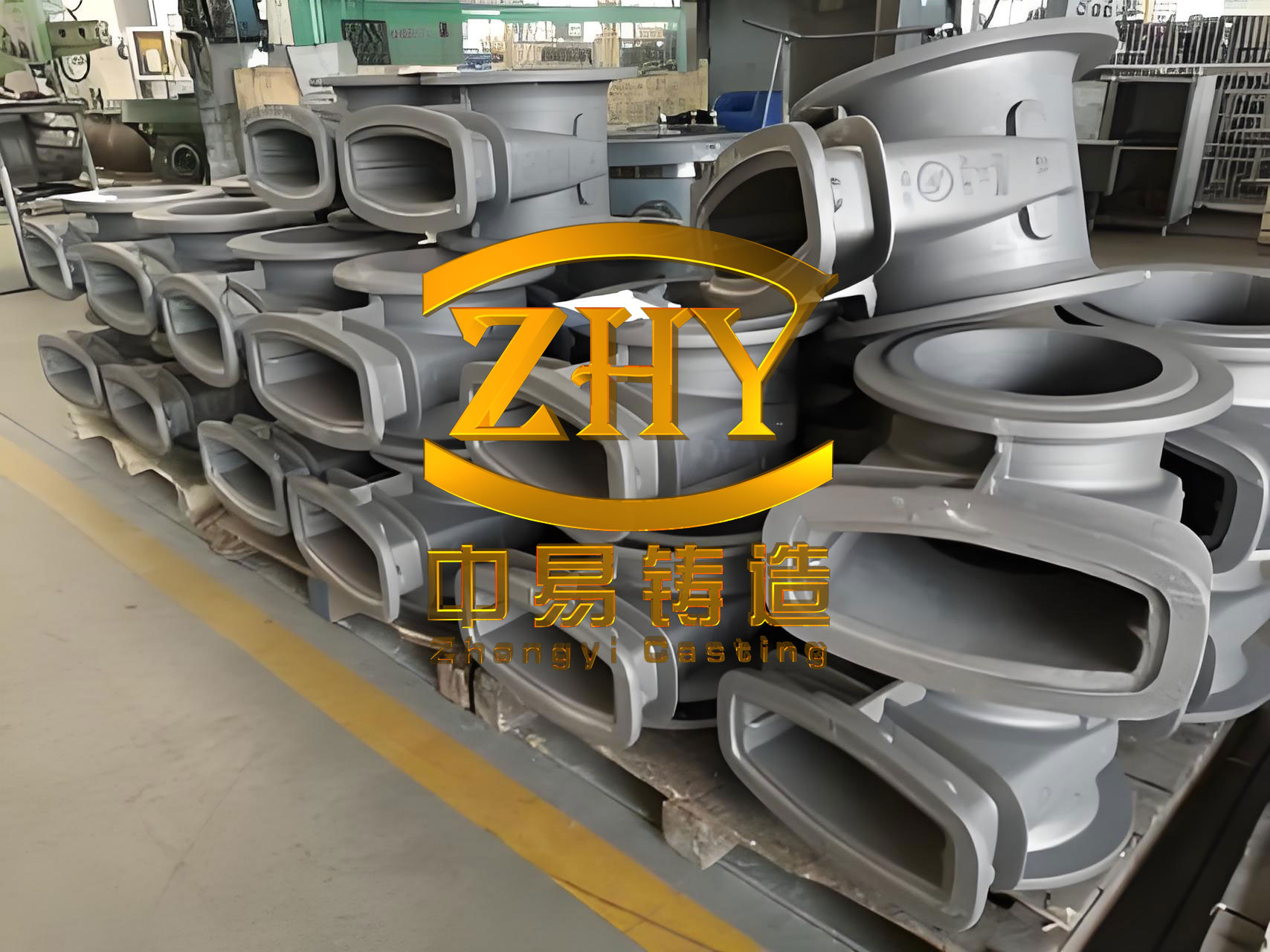
This article, based on first-hand production experience, delves into the methodologies for resolving this conflict. It focuses on analyzing the factors influencing the microstructure of grey iron and presents a systematic investigation into improving the in-situ tensile strength of complex cylinder head grey iron castings. The core of the study revolves around manipulating two key process variables: the charge material ratio and the type of inoculant used during treatment.
1. Production Process and Initial Quality Assessment
1.1 Casting Specifications and Challenges
The subject of this study is a cylinder head casting for a high-end domestic engine, with a specified material grade of HT300 and a weight of approximately 176 kg. The primary production challenge stemmed from its intricate geometry and non-uniform wall thickness. The casting process employed a core assembly method, which, combined with the variable wall thickness, resulted in slow and uneven cooling rates throughout the solidification process. The technical specifications mandated an in-situ tensile strength (σb) of ≥300 MPa and a hardness between 220 to 280 HB, measured directly on the casting body.
1.2 Initial Melting and Treatment Practice
Melting was conducted in a 4-ton medium-frequency induction furnace. The target pouring temperature range was 1380–1400 °C. The chemical composition was controlled within the following ranges post-treatment:
| C | Si | Mn | S | Cu | Cr | Mo | Ni |
|---|---|---|---|---|---|---|---|
| 3.35–3.45 | 1.80–1.90 | 0.80–0.90 | 0.08–0.12 | 0.80–1.00 | 0.30–0.40 | 0.25–0.35 | 0.45–0.55 |
The initial charge makeup and inoculation practice were as follows:
| Scrap Steel | Returns | Pig Iron | Primary Inoculation | Secondary Inoculation |
|---|---|---|---|---|
| 60% | 30% | 10% | 0.50% FeSiBa | None |
1.3 In-Situ Property and Microstructure Results
The tensile strength of grey iron at a specific location in a casting is primarily a function of the local cooling rate, which is dictated by the wall thickness. Thicker sections cool slower, allowing graphite flakes to grow longer, which increases their embrittling effect on the metallic matrix and consequently lowers the tensile strength. Sampling from different locations on the initial production castings confirmed this variance and revealed a critical issue.
| Sampling Point | Tensile Strength (MPa) | Hardness (HB) | Graphite Form | Graphite Size | Pearlite Content |
|---|---|---|---|---|---|
| A (Nominal Wall) | 311 | 234 | 100% Type A | A4 (Medium Flake) | ~100% |
| B (Critical Thick Section) | 287 | 212 | 60% Type D/E | A4 / D8 (Undercooled) | ~90% (Some Ferrite) |
While location A met all specifications, location B failed to achieve the 300 MPa tensile strength requirement. The metallographic analysis provided the root cause: the presence of undesirable undercooled graphite (Type D/E) and a pearlitic matrix that was not fully developed, containing areas of ferrite.
2. Analysis of Defective Microstructure Formation
2.1 Mechanism of Undercooled Graphite Formation
The microstructure of grey iron castings is determined during its solidification (primary crystallization) and subsequent cooling (secondary crystallization). The graphite morphology is primarily established during the eutectic solidification phase. Type D graphite, often called “undercooled graphite,” forms under conditions of high undercooling, typically caused by a combination of a lack of potent nucleation sites and a relatively rapid cooling rate within a specific temperature range. This results in a fine, interdendritic graphite pattern that retains the morphology of the primary austenite dendrites.
The metallic matrix (pearlite vs. ferrite) is formed during the eutectoid transformation. The formation of ferrite is promoted by the presence of fine, undercooled graphite and slow cooling rates through the eutectoid temperature range (approx. 700–800 °C). For location B, solidification simulation and thermal analysis suggested a specific thermal history: rapid cooling above 1000 °C (promoting undercooled graphite) followed by slower cooling below 1000 °C (promoting ferrite formation). This sequence perfectly explains the observed mixed D/E graphite and the associated ferrite patches, which collectively degraded the tensile strength. This can be conceptually described by the interplay of undercooling (ΔT) and nucleation rate (I). A high undercooling with insufficient nuclei (N) favors undercooled graphite:
$$ I \propto N \cdot \exp\left(-\frac{\Delta G^*}{k_B T}\right) $$
Where ΔG* is the activation energy for nucleation. If N is low, significant undercooling (ΔT) is required to initiate solidification, leading to undesirable structures.
2.2 Strategic Countermeasures
To correct the flawed microstructure in these high-performance grey iron castings, a multi-pronged strategy targeting both charge materials and liquid treatment was formulated:
- Implementation of Secondary (Stream) Inoculation: Adding a small amount of inoculant (e.g., 0.10%) during the pouring process introduces fresh, active nucleation sites directly into the metal stream. This counteracts “fade” from the primary inoculation, reduces chill tendency, improves section sensitivity, and promotes the formation of uniform Type A graphite while suppressing undercooled graphite and associated ferrite.
- Optimization of Charge Makeup: Reducing the proportion of pig iron (from 10% to 5% or lower) aims to minimize “genetic inheritance.” Pig iron, especially high-carbon grades, contains coarse native graphite flakes that may not fully dissolve during induction melting (graphite melts above 2000°C). These particles can act as heterogeneous nucleation sites, potentially leading to irregular and coarse graphite in the final casting. Concurrently, increasing the scrap steel ratio lowers the overall carbon content, which inherently strengthens the iron matrix.
- Application of Rare Earth (RE) Containing Inoculants: Rare earth elements like Cerium (Ce) have a very high affinity for sulfur and oxygen. They react to form stable compounds:
$$\text{3FeS} + \text{2Ce} \rightarrow \text{3Fe} + \text{Ce}_2\text{S}_3$$
$$\text{FeS} + \text{Ce} \rightarrow \text{Fe} + \text{CeS}$$
$$\text{3O}_2 + \text{4Ce} \rightarrow \text{2Ce}_2\text{O}_3$$
The products (Ce2S3, CeS, Ce2O3) are high-melting-point, finely dispersed particles that remain suspended in the melt. These particles act as highly effective heterogeneous nucleation sites for graphite, significantly enhancing the graphitization potential even at low addition rates. This leads to a finer, more uniform distribution of Type A graphite and a refined, fully pearlitic matrix.
3. Experimental Trials and Results Synthesis
Three distinct process improvement trials were conducted on production heats to evaluate the effectiveness of the proposed countermeasures. The chemical composition (as per Table 1) was held constant across all trials to isolate the effects of charge and treatment changes.
| Trial No. | Scrap Steel | Returns | Pig Iron | Primary Inoculant | Secondary Inoculant | Core Concept |
|---|---|---|---|---|---|---|
| 1 | 60% | 30% | 10% | 0.50% FeSiBa | 0.10% FeSiBa | Add Stream Inoculation Only |
| 2 | 70% | 25% | 5% | 0.50% FeSiBa | 0.10% FeSiBa | Optimize Charge + Stream Inoc. |
| 3 | 70% | 25% | 5% | 0.40% FeSiRE | 0.10% FeSiBa | Optimize Charge + RE Primary Inoc. |
Samples were taken from the previously problematic B location for tensile testing and metallographic examination. The consolidated results are presented below:
| Trial No. | Tensile Strength (MPa) | Hardness (HB) | Graphite Form | Pearlite Content | Assessment |
|---|---|---|---|---|---|
| 1 | 274 | 195 | 60% Type D/E, 40% A | ~90% (Ferrite present) | Failed. Stream inoculation alone was insufficient. |
| 2 | 309 | 204 | 98% Type A, 2% D | ~100% | Met Spec. Charge optimization greatly improved structure. |
| 3 | 322 | 216 | 100% Type A (A4/A5) | 100% (Refined Pearlite) | Exceeded Spec. Best overall microstructure and properties. |
The results clearly demonstrate a progression in quality:
– Trial 1 showed that merely adding stream inoculation without addressing the fundamental charge makeup or nucleation potency could not eliminate the undercooled graphite and ferrite, resulting in sub-standard strength.
– Trial 2 proved that optimizing the charge ratio (higher scrap, lower pig iron) in conjunction with stream inoculation provided a significant improvement. The graphite was predominantly Type A, the matrix was fully pearlitic, and the tensile strength met the 300 MPa requirement.
– Trial 3, which incorporated the rare earth-bearing primary inoculant along with the optimized charge, yielded the best results. The graphite structure was uniformly Type A, the pearlite matrix was refined, and both tensile strength and hardness were the highest among the trials, comfortably exceeding specifications.
The effectiveness of the rare earth inoculant can be further rationalized by considering its impact on the number of eutectic cells (grains). The final tensile strength (σ) of grey iron is inversely related to the maximum graphite flake length (lmax), which itself is influenced by the number of eutectic cells per unit area (NA):
$$ l_{max} \propto \frac{1}{\sqrt{N_A}} \quad \text{and} \quad \sigma \propto \frac{1}{\sqrt{l_{max}}} $$
Therefore, by dramatically increasing NA through potent heterogeneous nucleation via RE compounds, the graphite is refined, and strength is enhanced. The RE treatment also modifies the surface energy at the graphite/liquid interface, further promoting a finer, more desirable flake morphology in these high-value grey iron castings.
4. Conclusion and Industrial Implications
Through systematic investigation and controlled production trials, a reliable methodology for enhancing the in-situ quality of complex, high-strength grey iron castings like cylinder heads was developed and validated. The key conclusions are:
- Secondary (Stream) Inoculation is a necessary but not sufficient practice. It provides a critical “temperature shock” and introduces fresh nuclei just prior to solidification, reducing the time for nucleation and growth of undesirable phases and improving graphite distribution consistency.
- Charge Makeup Optimization, specifically reducing the percentage of pig iron while increasing steel scrap, is highly effective in mitigating the “genetic inheritance” of coarse graphite structures. This adjustment reduces the potential for flawed nucleation sites originating from undissolved native graphite in the pig iron, leading to a more uniform and desirable Type A graphite formation in the final grey iron castings.
- Rare Earth (RE) Based Inoculants represent the most potent tool among those tested. Their dual mechanism of action—(a) purifying the melt by binding sulfur and oxygen, which improves pressure tightness, and (b) creating a high density of stable, dispersive sulfide and oxide particles that act as superior nucleation substrates—results in a transformative improvement in microstructure. This leads to a refined, uniformly distributed Type A graphite pattern and a fully pearlitic, strengthened matrix, thereby maximizing the attainable in-situ tensile strength.
The synergy of an optimized charge (low pig iron, high steel scrap) combined with a dual-inoculation practice using a rare earth-based primary inoculant followed by a conventional stream inoculant was identified as the most robust and effective process route. This combination reliably ensures that even thick sections of intricate grey iron castings achieve their target microstructure and mechanical properties, resolving the classic conflict between castability (high CE) and high strength. This approach provides a solid foundation for the consistent production of premium-quality cylinder heads and other high-performance grey iron components.