
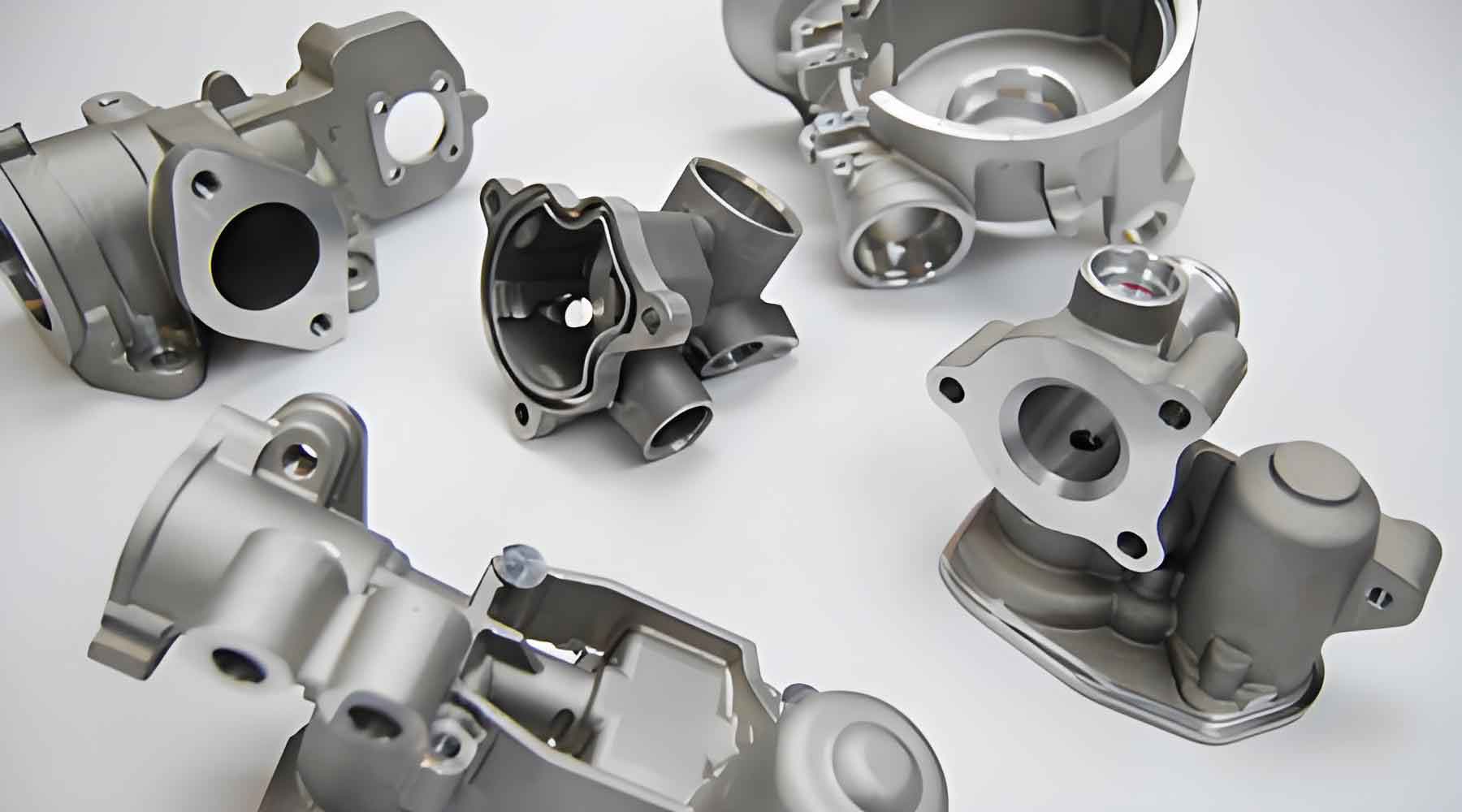
Precision investment casting has evolved significantly to meet the growing demand for high-performance components in aerospace and other advanced industries. The quality of castings heavily depends on shell materials, which account for 60% of defects in final products. This article systematically reviews refractory materials, binders, and additives used in shell fabrication, emphasizing their roles in achieving dimensional accuracy, surface finish, and thermal stability.
1. Refractory Materials for Shell Fabrication
Refractory materials constitute approximately 90% of shell mass and directly determine high-temperature performance. Table 1 compares key surface-layer refractories for precision investment casting:
| Material | Key Properties | Applications |
|---|---|---|
| Zircon-based | High fluidity (η = 1.2–1.5 Pa·s), thermal stability up to 2,650°C | High-temperature alloy components |
| CaO-ZrO2 | Slag resistance (kcorrosion ≤ 0.1 mm/h), thermal shock resistance | Steel casting under vacuum |
| Y2O3 | Low thermal conductivity (λ = 2.7 W/m·K), chemical inertness | Titanium alloy thin-wall structures |
| Al2O3-MgO-CaO | Creep resistance (ε1200°C ≤ 0.5%), lightweight design | High-carbon steel components |
The thermal expansion coefficient (α) remains critical for dimensional control. For zircon-based systems:
$$ \alpha_{ZrO_2} = 7.5 \times 10^{-6} \, \text{K}^{-1} \, (20–1000°C) $$
Composite refractories demonstrate enhanced performance through synergistic effects. The interfacial reaction energy between BaZrO3 and Ti-6Al-4V melt follows:
$$ \Delta G = -RT \ln \left( \frac{a_{\text{TiO}}}{a_{\text{BaO}}} \right) $$
where R = 8.314 J/mol·K and T is the casting temperature (1600–1700°C).
2. Binder Systems Optimization
Modern binders must balance environmental concerns with process efficiency. Table 2 summarizes binder performance metrics:
| Binder | Viscosity (mPa·s) | Drying Time (h) | Green Strength (MPa) |
|---|---|---|---|
| Silica Sol | 15–25 | 2–4 | 1.8–2.5 |
| Ethyl Silicate | 8–12 | 0.5–1 | 1.2–1.6 |
| Hybrid Binder | 10–18 | 1–2 | 2.0–2.8 |
Fast-drying silica sols (FS-III type) reduce layer formation time by 50% through colloidal particle optimization:
$$ \tau_{\text{drying}} = \frac{3\eta \delta^2}{\gamma r} $$
where η = binder viscosity, δ = coating thickness, γ = surface tension, and r = particle radius.
3. Additive Engineering
Additives significantly enhance shell performance through grain refinement and defect control. Key mechanisms include:
| Additive | Function | Mechanism |
|---|---|---|
| CoAl2O4 | Grain refinement | Heterogeneous nucleation: ΔTn = 15–20°C |
| Polyether Defoamer | Bubble suppression | Surface tension reduction: Δγ = 25–30 mN/m |
| Al-Si-Mg | Mineralization | Mullite formation: 3Al2O3·2SiO2 → 3Al2O3·2SiO2 + glass phase |
Optimal additive concentrations follow the Langmuir adsorption model:
$$ \Gamma = \Gamma_{\infty} \frac{Kc}{1 + Kc} $$
where Γ = surface coverage, Γ∞ = maximum adsorption, K = equilibrium constant, and c = additive concentration.
4. Smart Shell Manufacturing
Emerging intelligent systems integrate PLC controls and machine vision for precision investment casting shells. Key parameters monitored include:
$$ \text{Shell Quality Index} = \frac{\sigma_{\text{high temp}} \times \varepsilon_{\text{thermal shock}}}{R_a \times t_{\text{production}}} $$
where σhigh temp = high-temperature strength, εthermal shock = thermal shock resistance, Ra = surface roughness, and tproduction = manufacturing time.
5. Future Perspectives
Precision investment casting is evolving toward:
- Nanocomposite refractories with self-diagnostic capabilities
- Bio-derived binders reducing VOC emissions by ≥40%
- AI-driven process optimization using real-time thermal imaging data
These advancements will enable the production of large (>1m), thin-wall (<2mm) components with dimensional tolerances ≤CT6, meeting stringent aerospace requirements.