
The evolution of metal casting is marked by the continuous pursuit of efficiency, precision, and material performance. Among specialized foundry techniques, centrifugal casting stands out for its unique principle of employing rotational force to shape molten metal. This process involves pouring liquid metal into a rapidly spinning mold, where centrifugal action forces the metal against the mold walls, facilitating filling, solidification, and densification. Based on the orientation of the rotational axis, centrifugal casting is categorized into horizontal and vertical methods. Vertical Centrifugal Casting (VCC), where the mold rotates around a vertical axis, offers distinct advantages including a smaller footprint, superior operational flexibility, and a broader applicability to various material systems and part geometries, including non-axisymmetric shapes. Historically rooted in the production of military components like artillery shells, VCC has matured over decades into a vital process for civilian industries.
The core principle leverages centrifugal force, a pseudo-force directed radially outward from the axis of rotation. The pressure exerted on the molten metal by this force is fundamental to the process’s benefits. It can be described by the equation for centrifugal pressure at a radius \( r \):
$$ P_c = \frac{1}{2} \rho \omega^2 (r^2 – r_0^2) $$
where \( P_c \) is the centrifugal pressure, \( \rho \) is the molten metal density, \( \omega \) is the angular velocity, \( r \) is the outer radius of the metal section, and \( r_0 \) is the inner radius (often the free surface). This pressure promotes a dense, fine-grained structure, drives impurities towards the inner bore for easy removal, and enhances the feeding of shrinkage during solidification.
This article synthesizes recent research progress in Vertical Centrifugal Casting, focusing on three interconnected pillars: Key Enabling Technologies, Advanced Numerical Simulation, and Exemplary Casting Applications. A recurring theme is the synergy between VCC and the **investment casting process**, particularly for complex, high-integrity components. The integration of centrifugal force with the intricate ceramic molds of the **investment casting process** enables the production of near-net-shape parts with exceptional surface finish and dimensional accuracy, pushing the boundaries of what is achievable in precision manufacturing.
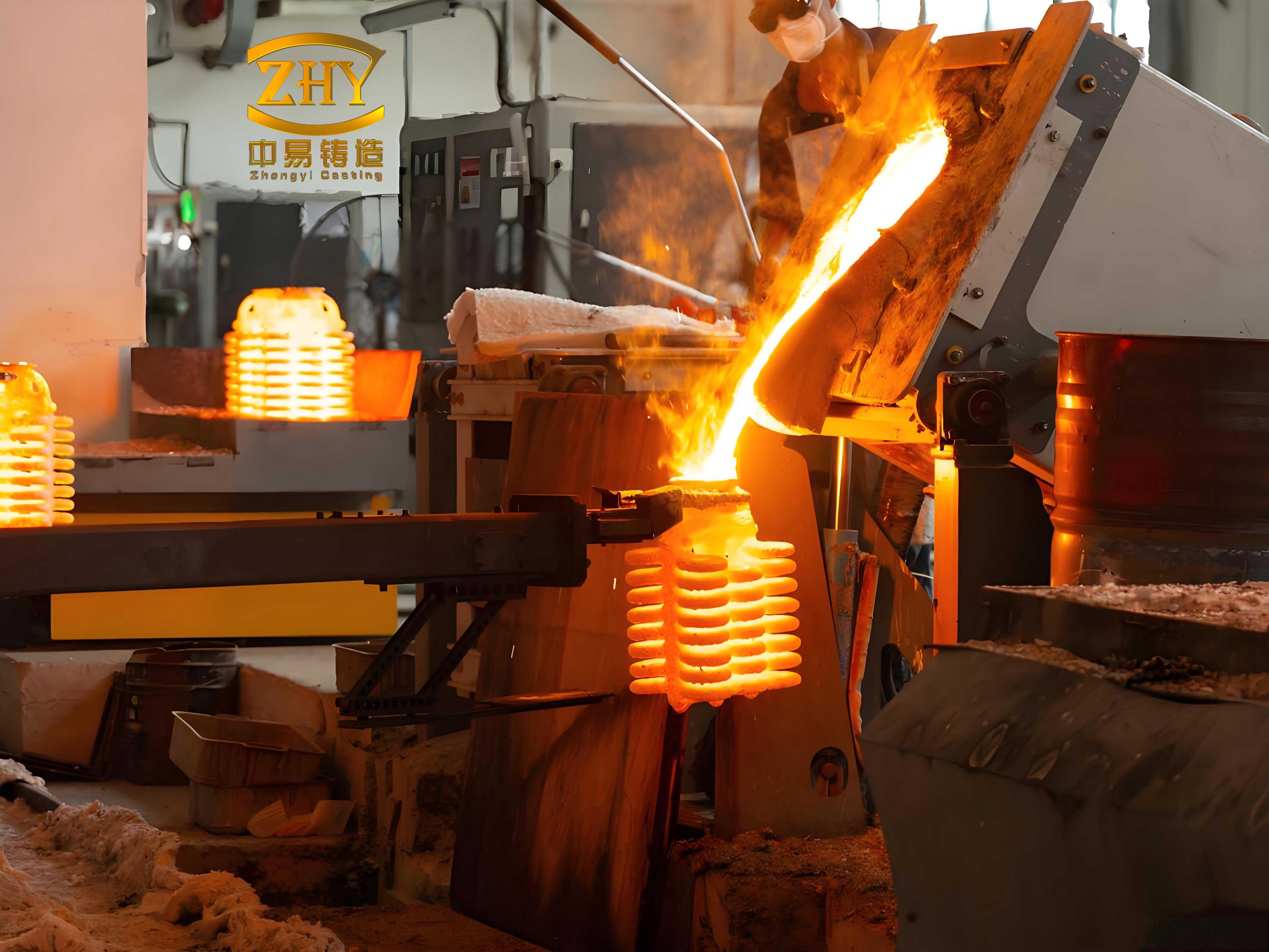
1. Key Enabling Technologies for VCC
The successful implementation of VCC hinges on the meticulous control and optimization of several fundamental technological aspects. These are not isolated factors but form an interdependent system where the choice in one area influences the parameters in another.
1.1 Selection of Castable Alloys
Not all alloys are equally suited for the dynamic environment of VCC. Key material properties must align with the process mechanics to ensure sound castings.
- Fluidity: Adequate fluidity is paramount. The centrifugal force aids mold filling, but the metal must still flow smoothly to replicate complex mold details and avoid mistruns. Alloys with poor fluidity can lead to cold shuts and incomplete filling, especially in thin sections. The enhanced filling capability in VCC sometimes allows for a浇注温度 (pouring temperature) reduction of 5–10°C compared to static gravity pouring, which can benefit grain structure.
- Solidification Range: An alloy with a moderate solidification range is generally preferred. A very wide range can lead to extended mushy zone formation, increasing the risk of centerline shrinkage porosity or “reverse segregation” in thick sections, where solute-rich liquid is forced inward.
- Susceptibility to Centrifugal Segregation: While VCC can intentionally create functional gradients, uncontrolled chemical segregation due to density differences between phases (e.g., in Metal Matrix Composites) must be managed through careful control of process parameters.
Research has extensively focused on light alloys for aerospace, such as titanium and aluminum alloys. For instance, studies on Ti-6Al-4V and γ-TiAl alloys have established models for laminar flow criteria and free surface behavior during centrifugal filling. The free surface in a vertical spinning mold forms a paraboloid of revolution, described by:
$$ z = \frac{\omega^2}{2g} r^2 $$
where \( z \) is the height, \( \omega \) is angular speed, \( g \) is gravity, and \( r \) is radius. This equation dictates the internal geometry of hollow castings and influences feeding paths.
| Alloy Family | Typical Fluidity | Solidification Range | Key Considerations for VCC | Common Applications |
|---|---|---|---|---|
| Aluminum Alloys (e.g., ZL205A, A356) | Excellent | Moderate | Prone to oxide formation; benefits from pressurized filling. Produces fine equiaxed grains with increased转速 (rotational speed). | Engine housings, structural brackets, levers. |
| Titanium Alloys (e.g., Ti-6-4, ZTA15) | Fair to Good | Narrow to Moderate | High reactivity requires inert atmosphere or vacuum. Centrifugal force crucial for filling thin sections in the **investment casting process** for blades and impellers. | Turbine blades, biomedical implants, aerospace components. |
| Steels & Superalloys (e.g., 316L, ZG40Ni35Cr25Nb) | Good | Moderate | High melting point demands robust molds. Excellent for producing dense, high-integrity thick-walled tubes and bimetallic rolls. | Pipes, rollers, valve bodies, high-temperature fixtures. |
| Copper Alloys (e.g., High-Mn Al-Bronze) | Excellent | Wide | Excellent fluidity and wear resistance. Risk of inverse segregation in thick sections requires controlled solidification. | Large marine propeller bushings, bearing surfaces. |
1.2 Casting Process Design
Process design is the blueprint for transforming molten metal into a quality casting. In VCC, it involves an integrated approach to gating, speed, and temperature.
- Gating System Design: The浇注系统 (gating system) is typically top-centered, pouring along the rotation axis. It must be designed as a closed, pressurized system to prevent turbulence and air aspiration. For feeding, the system often incorporates risers, with the modulus (Volume/Surface Area) increasing progressively from casting to ingate to runner to downsprue to ensure directional solidification towards the feeder. In many vertical centrifugal **investment casting process** setups, the central sprue itself acts as a massive thermal riser.
- Determination of Rotational Speed: This is the most critical parameter. Insufficient speed leads to inadequate pressure, poor filling, and segregation. Excessive speed wastes energy, imposes high mechanical stress on equipment, and can cause excessive segregation or even mold failure. The optimal speed is the minimum required to achieve complete filling and sound solidification. Empirical formulas like Caine’s or theoretical calculations based on G-factor (ratio of centrifugal to gravitational acceleration) are used:
$$ G = \frac{\omega^2 r}{g} $$
A G-factor between 40 and 80 is common for many applications, but thin-walled parts or reactive alloys may require different ranges. - Pouring Temperature: As mentioned, can often be slightly lower than in static casting. The exact temperature is alloy-dependent and must be optimized to balance fluidity against increased gas solubility, shrinkage volume, and mold-metal reaction.
| Process Parameter | Increase Leads To… | Primary Defects if Too High | Primary Defects if Too Low |
|---|---|---|---|
| Rotational Speed (ω) | Higher mold-filling pressure, finer grains, stronger centrifugal segregation. | Excessive segregation, hot tearing, mold stress/failure. | Misruns, poor density, macro-porosity. |
| Pouring Temperature (Tpour) | Better fluidity, longer solidification time. | Gas porosity, coarse grains, mold erosion, excessive shrinkage. | Cold shuts, mistruns, surface defects. |
| Mold Temperature (Tmold) | Slower cooling, reduced thermal shock to mold. | Coarse microstructure, lower productivity. | Chill zones, rapid solidification front, potential for cold laps. |
| Pouring Rate | Faster filling, potentially hotter metal in mold. | Turbulence, mold erosion, gas entrapment. | Premature freezing, cold shuts. |
1.3 Mold Selection, Design, and Engineering
The mold in VCC must withstand significant thermal, mechanical, and hydrodynamic forces. Choices range from permanent metal or graphite molds for high-volume production to expendable molds like sand, plaster, or ceramic shells for complex shapes.
- Expendable Molds (Sand, Investment Shells): These are essential for complex geometries. Sand molds require high compaction to resist erosion. A critical requirement for all expendable molds in VCC is that they must be securely contained within a balanced, reinforced flask or “sleeve” that attaches to the centrifuge spindle. This is non-negotiable for safety and dimensional stability. The advent of 3D sand printing has revolutionized this area, allowing for integrated, complex gating and conformal cooling channels within the mold assembly for the **investment casting process**.
- Permanent Molds (Metal, Graphite): Offer high cooling rates, excellent surface finish, and reusability. Graphite is particularly favored for titanium casting due to its chemical inertness and good thermal conductivity. Mold design must include precise calculations for the containment sleeve’s stress under centrifugal load:
$$ \sigma_{\theta} = \rho_m \omega^2 r_m^2 $$
where \( \sigma_{\theta} \) is the hoop stress in the sleeve, \( \rho_m \) is the sleeve material density, and \( r_m \) is its mean radius. Safety factors are crucial. - Balancing and Safety: Any mass imbalance causes severe vibration, leading to non-uniform wall thickness and equipment damage. Modern design employs modular, standardized mold systems and sophisticated locking mechanisms (e.g., cage-bar structures) to ensure safe containment of the molten metal under high G-forces.
1.4 Centrifugal Casting Coatings
Applied to the mold face, coatings serve multiple critical functions: thermal insulation to control solidification rate, protective barrier to prevent metal penetration and improve surface finish, and lubrication to aid casting release.
Formulations are typically water-based dispersions containing refractory fillers (e.g., zircon, fused silica), binders (often colloidal silica or sodium silicate for low gas evolution), and suspending agents. Diatomaceous earth is a prized ingredient for its excellent insulating properties due to its micro-porous structure. However, its organic content can cause gas defects, so calcination and processing to maintain porosity while minimizing volatiles are key research areas. The ideal coating must have low gas generation, good adherence under centrifugal force, and appropriate thermal properties to promote the desired solidification pattern.
1.5 Centrifugal Casting Machine Development
The centrifuge is the heart of the operation. Modern machines are evolving towards greater precision, flexibility, and intelligence.
- Speed Control Fidelity: Precise, real-time control of rotational speed is vital for processes like graded composite fabrication or controlled grain refinement through speed modulation during solidification.
- Dynamic Stability: Advanced vibration-damping systems, robust spindle designs, and real-time balancing monitoring are essential to maintain smooth operation, ensure casting uniformity, and prolong equipment life.
- Innovative Kinematics: Research into superimposing oscillatory or rocking motions onto the primary rotation has shown promise in mitigating the influence of gravity on the free surface, thereby reducing wall thickness variation in tall, hollow castings. The resultant motion can help achieve a more uniform distribution.
- Automation and Integration: Modern machines integrate with automated pouring systems, mold handling robots, and real-process monitoring sensors, creating a more reliable and repeatable production cell for the **investment casting process** under centrifugal force.
2. Numerical Simulation of the VCC Process
Given the complex interplay of rotating fluid flow, heat transfer, and solidification, numerical simulation has become an indispensable tool for process design and optimization, reducing costly trial-and-error.
2.1 Smoothed Particle Hydrodynamics (SPH) Method
SPH is a mesh-free, Lagrangian method particularly adept at modeling free-surface flows with large deformations and splashing—common in the initial mold-filling stage. It discretizes the fluid into moving “particles” that carry field variables (mass, velocity, energy).
For VCC filling simulations, the governing Navier-Stokes equations are solved in a rotating reference frame, incorporating centrifugal and Coriolis forces. The momentum equation in such a frame includes:
$$ \frac{D\vec{v}}{Dt} = -\frac{1}{\rho}\nabla P + \nu \nabla^2 \vec{v} + \vec{g} – 2\vec{\omega} \times \vec{v} – \vec{\omega} \times (\vec{\omega} \times \vec{r}) $$
where \( \vec{v} \) is velocity in the rotating frame, \( \vec{\omega} \) is angular velocity, and \( -\vec{\omega} \times (\vec{\omega} \times \vec{r}) \) is the centrifugal acceleration term. SPH’s ability to naturally track the molten metal’s free surface (the inner bore of the casting) makes it valuable for predicting filling patterns and potential defects like mistruns or air entrapment in complex **investment casting process** molds under rotation.
2.2 Particle Tracking Velocimetry (PTV) and Physical Modeling
Physical simulation using transparent scale models and analogue fluids (e.g., water, glycerin) combined with PTV provides vital experimental validation for numerical models. Tracer particles are introduced into the fluid, and their motion is recorded with high-speed cameras. Advanced image processing algorithms track individual particles to reconstruct full velocity vector fields.
Studies using PTV in VCC configurations have quantitatively shown how increasing rotational speed transitions the flow from a gravity-dominated regime to a centrifugal-force-dominated regime, promoting a smoother, more stable filling front along the outer mold wall. This data is crucial for calibrating and verifying CFD software like FLOW-3D® or ProCAST for centrifugal applications.
2.3 Simulation of Inclusion Transport and Defect Prediction
A critical quality aspect is predicting the fate of non-metallic inclusions (oxides, slag). In the centrifugal force field, inclusions with a density (\( \rho_i \)) different from the melt (\( \rho_m \)) experience a radial buoyancy force:
$$ F_r = \frac{4}{3}\pi r_i^3 (\rho_m – \rho_i) \omega^2 r $$
where \( r_i \) is the inclusion radius. If \( \rho_i < \rho_m \) (e.g., slag), the force is outward, driving inclusions to the outer wall. If \( \rho_i > \rho_m \), they move inward. Numerical models coupling fluid flow (via VOF or SPH) with discrete particle tracking (Lagrangian method) can simulate these trajectories. This allows engineers to design gating systems and select process parameters that efficiently remove harmful inclusions from the final casting volume, a significant advantage in high-integrity **investment casting process** components.
Furthermore, thermal-stress analysis modules can predict solidification shrinkage, hot spots, and the resulting porosity or hot tears. By simulating the entire process—filling, solidification, and stress development—in a virtual centrifugal environment, a robust and defect-minimized process can be designed before any metal is melted.
3. Exemplary Applications of Vertical Centrifugal Casting
The practical value of VCC is best illustrated through its successful application in manufacturing demanding components across industries.
3.1 Bimetallic Composite Rolls
These are core tools in metal rolling mills. VCC is the predominant method for producing them cost-effectively. The process typically involves a sequential pour: first, a wear-resistant outer shell alloy (e.g., high-speed steel or high-chromium iron) is poured into a rotating metal mold and allowed to partially solidify. Then, a tougher, more ductile core iron (e.g., nodular graphite iron) is poured to bond metallurgically with the shell. The centrifugal force ensures a clean, oxide-free interface and a perfectly concentric bonding layer, creating a roll with a hard surface and a shock-absorbing core.
3.2 Cone Section Drums (Centrifuge Baskets)
Used in industrial centrifuges for separation processes, these are large, conical, perforated vessels requiring high structural integrity and precise geometry. Traditional fabrication from welded plates can introduce weak points. VCC allows for the seamless production of these cones. The use of intricate sand cores within the centrifugal mold enables the casting of the precise internal contours and through-holes directly, eliminating welds and creating a part with uniform mechanical properties and corrosion resistance.
3.3 Large-Diameter, Thick-Walled Reducer Pipes
These components, used in high-pressure/high-temperature piping systems in petrochemical and power generation plants, feature a diameter change along their length. Manufacturing them from wrought stock is extremely difficult. VCC excels here. A rotating mold with a correspondingly shaped cavity is used. Alloys like ZG40Ni35Cr25Nb (a heat-resistant cast steel) are poured, and the centrifugal force ensures the formation of a sound, dense microstructure throughout the varying wall thickness. The resulting pipe exhibits excellent high-temperature strength and creep resistance, meeting stringent industry standards.
3.4 Complex, Thin-Walled Aerospace Components via VCC-Investment Hybrid
This represents the cutting-edge synergy of processes. A prime example is the casting of titanium aluminide (γ-TiAl) low-pressure turbine blades. Here, the part is first formed as a precise ceramic shell mold via the standard **investment casting process**. This shell mold is then attached to a vertical centrifugal casting machine. The combination is powerful: the **investment casting process** provides the unmatched geometric complexity and surface finish, while the centrifugal force ensures complete filling of thin, aerodynamic sections and improves the metallurgical density of the intermetallic alloy, which has inherently poor fluidity. The process parameters—especially rotational speed—are finely tuned to achieve this without damaging the fragile ceramic shell.
4. Conclusion and Future Perspectives
Vertical Centrifugal Casting has solidified its position as a versatile and powerful manufacturing technology, evolving from its military origins to become a cornerstone in the production of high-performance industrial and aerospace components. Its strengths—deriving from the intelligent application of centrifugal force—include the ability to create dense, fine-grained structures, produce seamless hollow shapes, fabricate functional gradient materials, and achieve exceptional metallurgical bonding in composite castings.
The future trajectory of VCC is tightly interwoven with broader trends in advanced manufacturing:
- Intelligent and Digital Integration: The full integration of VCC into Industry 4.0 frameworks is imminent. This involves real-time sensor data fusion (temperature, vibration, speed), closed-loop adaptive process control using AI/ML algorithms, and digital twin technology for full virtual process validation and optimization. This will maximize yield, consistency, and equipment utilization.
- Advanced Material Processing: VCC will play a key role in manufacturing next-generation materials, including:
- In-situ Functionally Graded Composites (FGCs): By carefully controlling solidification under centrifugal force, researchers can engineer continuous gradients in composition (e.g., SiC particle distribution in Al matrix) and microstructure, creating tailored properties within a single component.
- Refractory and Intermetallic Alloys: The enhanced filling capability of VCC is crucial for overcoming the casting challenges posed by these advanced, often brittle, high-melting-point materials essential for future energy and propulsion systems.
- Sustainability and Eco-Efficiency: Developments will focus on energy-efficient drive systems, the use of recyclable or bio-based mold and coating materials, and process optimization to minimize scrap and re-melting energy. The high yield and near-net-shape capability of VCC, especially when combined with the **investment casting process**, inherently contribute to sustainable manufacturing by reducing material waste and subsequent machining energy.
- Hybrid and Novel Process Combinations: Beyond VCC-Investment, exploration into combining centrifugal force with other fields (e.g., electromagnetic stirring for further grain refinement, or ultrasonic vibration for degassing) holds promise for breakthrough capabilities in microstructure control and defect elimination.
In conclusion, Vertical Centrifugal Casting is not a static technology but a dynamic and evolving field. Its continued advancement, driven by deeper scientific understanding, digital innovation, and novel material demands, will ensure its critical role in shaping the high-performance components of tomorrow. The synergy with precision mold-making techniques like the **investment casting process** will remain a particularly potent combination for tackling the most complex manufacturing challenges in aerospace, energy, and beyond.