
As a researcher deeply involved in the field of foundry technology, I have witnessed significant progress in vertical centrifugal casting, a specialized method that injects molten metal into a high-speed rotating mold to form castings through centrifugal force. This foundry technology offers numerous advantages, including high production efficiency, low cost, and fine-grained microstructures, making it ideal for manufacturing hollow cylindrical and annular components. Compared to horizontal centrifugal casting, the vertical variant occupies less space, allows for easier operation, exhibits better material applicability, and provides higher process flexibility. Over the decades, vertical centrifugal casting has evolved from its initial military applications, such as producing artillery shells, to widespread use in civilian sectors. In this article, I will delve into the research advancements in vertical centrifugal casting from my perspective, focusing on key technologies, numerical simulations, and typical castings, while emphasizing the role of foundry technology in driving these innovations.
The foundation of vertical centrifugal casting lies in its ability to harness centrifugal forces to achieve dense and defect-free castings. This foundry technology involves rotating the mold around a vertical axis, which creates a parabolic free surface in the molten metal, enabling the production of hollow parts without the need for cores. The centrifugal force not only enhances mold filling but also promotes directional solidification, leading to improved mechanical properties. Over the years, I have observed how foundry technology has adapted to meet industrial demands, with vertical centrifugal casting being applied to complex geometries and high-performance alloys. For instance, in aerospace and energy sectors, this method is used to create components that require high strength and corrosion resistance. The continuous refinement of foundry technology in vertical centrifugal casting has addressed challenges such as alloy selection, process design, and quality control, making it a cornerstone of modern manufacturing.
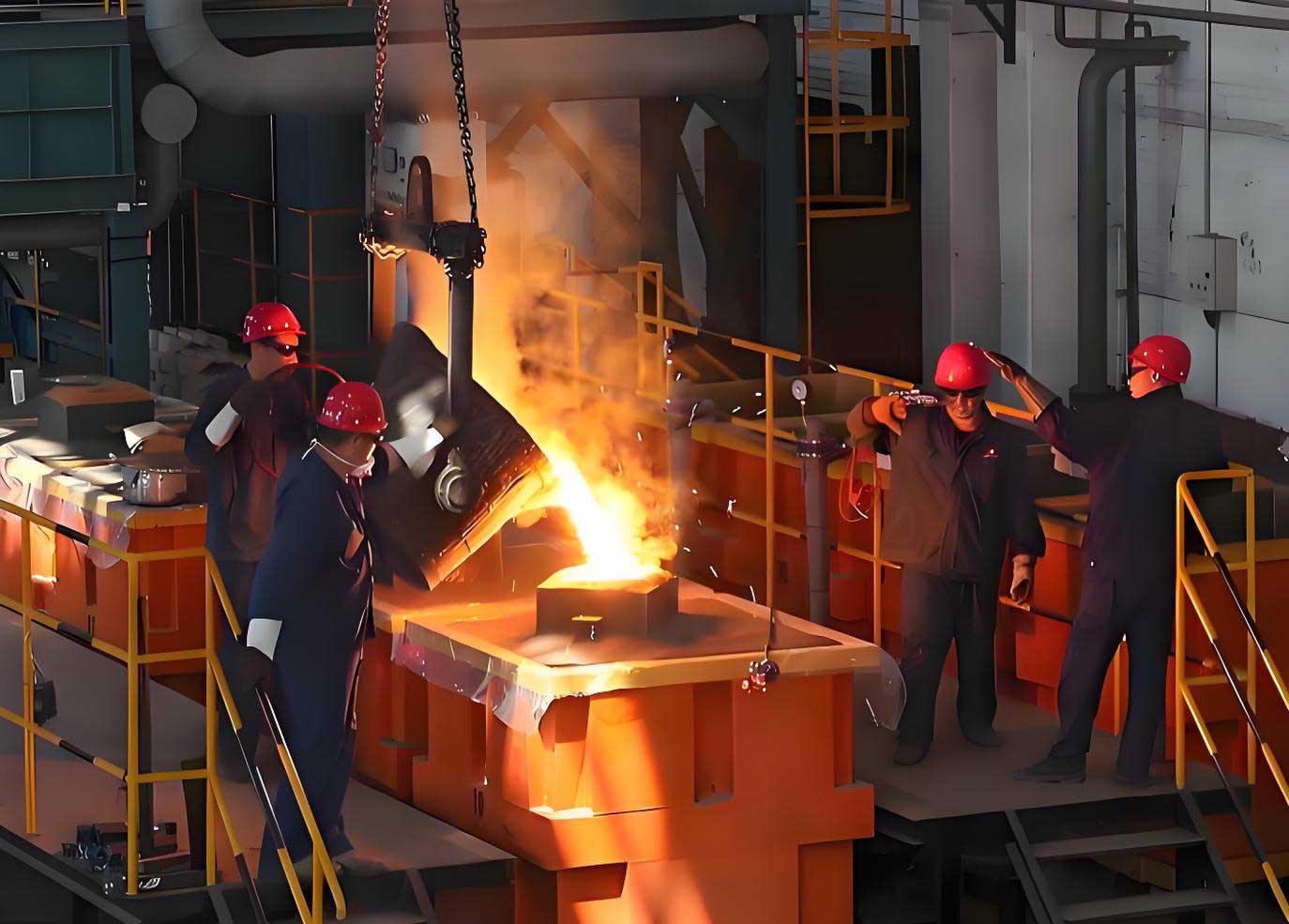
One of the critical aspects of foundry technology in vertical centrifugal casting is the selection of castable metals. The suitability of an alloy depends on its fluidity and solidification range, which directly influence the filling and solidification behaviors. Metals with high fluidity, such as certain aluminum and titanium alloys, can better fill mold cavities under centrifugal forces, reducing defects like incomplete filling or porosity. For example, in my work with titanium alloys, I have found that a moderate solidification range is essential to avoid issues like annular shrinkage bands, which can compromise mechanical properties. The relationship between fluidity and centrifugal force can be expressed using equations that model flow behavior. For instance, the critical velocity for laminar flow in centrifugal casting can be derived as:
$$ v_c = \frac{\mu}{\rho \cdot r \cdot \omega} $$
where \( v_c \) is the critical velocity, \( \mu \) is the dynamic viscosity, \( \rho \) is the density, \( r \) is the radius, and \( \omega \) is the angular velocity. This equation highlights how foundry technology optimizes parameters to ensure smooth filling. Additionally, the tilting angle of the molten metal free surface during filling, which tends to become vertical at high speeds, is governed by:
$$ \theta = \tan^{-1}\left(\frac{r \omega^2}{g}\right) $$
where \( \theta \) is the inclination angle, and \( g \) is gravitational acceleration. Through experimental studies, I have validated that alloys like ZL205A aluminum and Ti-6Al-4V exhibit excellent performance in vertical centrifugal casting when their properties align with these principles. The table below summarizes key properties for select castable metals in this foundry technology:
| Metal Alloy | Fluidity Index | Solidification Range (°C) | Typical Applications |
|---|---|---|---|
| ZL205A Aluminum | High | 50-100 | Thin-walled aerospace components |
| Ti-6Al-4V Titanium | Moderate | 80-120 | Artificial joints and turbine blades |
| 316L Stainless Steel | High | 40-80 | Corrosion-resistant pipes |
Casting process design is another vital element of foundry technology in vertical centrifugal casting, encompassing aspects like gating system design, rotational speed determination, and pouring temperature selection. From my experience, the gating system is typically centered on the rotation axis and must facilitate adequate feeding to prevent shrinkage defects. The design often follows a closed system with progressively increasing moduli from the casting to the sprue, ensuring directional solidification. Rotational speed is a key parameter; it must be high enough to generate sufficient centrifugal force for complete filling but low enough to minimize energy consumption and segregation. The optimal speed can be calculated using the formula:
$$ n = \frac{1}{2\pi} \sqrt{\frac{g \cdot \text{GF}}{r}} $$
where \( n \) is the rotational speed in revolutions per second, and GF is the G-factor, representing the ratio of centrifugal to gravitational acceleration. In practice, I have found that speeds between 600 and 900 rpm are effective for many alloys, such as γ-TiAl turbines. Pouring temperature also plays a crucial role; it is generally set 5–10°C lower than in gravity casting due to the enhanced filling capability from centrifugal forces. For instance, in Ti-43Al-9V alloys, higher pouring temperatures reduce constrained shrinkage but must be balanced against the risk of oxidation. The table below outlines typical process parameters in vertical centrifugal foundry technology:
| Parameter | Range | Influence on Casting Quality |
|---|---|---|
| Rotational Speed | 200–1000 rpm | Higher speeds improve filling but may cause segregation; optimal speeds reduce defects. |
| Pouring Temperature | Alloy-dependent (e.g., 700–1000°C for Al alloys) | Lower temperatures reduce shrinkage but require good fluidity. |
| Gating System Modulus Ratio | 1.2–1.5 | Higher ratios promote better feeding and reduce shrinkage porosity. |
Mold selection and design are fundamental to foundry technology in vertical centrifugal casting, as the mold must withstand high rotational speeds and thermal shocks. I have worked with various mold types, including sand molds, graphite molds, and investment casting shells. Sand molds require high compaction to prevent erosion, while graphite molds offer excellent thermal conductivity and reusability. In recent years, advancements in foundry technology have introduced 3D-printed sand molds, which allow for complex geometries and reduce production time. However, these molds must be housed in reinforced jackets to maintain balance during rotation. From my observations, mold design must account for thermal expansion and stress distribution to avoid failures. The stress in a mold sleeve can be estimated using:
$$ \sigma = \frac{\rho \cdot \omega^2 \cdot r^2}{2} $$
where \( \sigma \) is the tensile stress, and \( \rho \) is the density of the mold material. This equation helps in designing molds that can endure the centrifugal forces. Additionally, the use of standardized and modular mold designs has improved efficiency in foundry technology, reducing costs and lead times. For example, in large-scale productions, preset temperature control techniques ensure consistent mold conditions, enhancing casting quality.
Coatings in centrifugal foundry technology serve to protect the mold, control cooling rates, and improve surface finish. These coatings, composed of refractory materials, carriers, binders, and additives, must exhibit low gas evolution to prevent gas defects in castings. Diatomite is a commonly used refractory due to its microporous structure, which provides insulation and gas storage. However, its gas evolution must be minimized through calcination and processing. In my research, I have formulated coatings with water glass as a binder, which offers low gas emission and good adherence. The performance of a coating can be evaluated based on its insulating properties and gas content, as summarized in the table below:
| Coating Component | Function | Optimal Proportion |
|---|---|---|
| Diatomite | Refractory base for insulation | 60–70% by weight |
| Water Glass | Binder with low gas evolution | 10–15% |
| Additives (e.g., suspending agents) | Enhance stability and application | 5–10% |
Centrifugal casting machines are the backbone of this foundry technology, and their design must ensure precise speed control, stability, and durability. I have encountered various machine types, with vertical machines being favored for their compact footprint and flexibility. Key requirements include accurate speed compliance, responsive调速 control for grain refinement, and robust construction to minimize vibrations. For instance, vibrations can lead to wall thickness variations and equipment damage; thus, damping mechanisms and balanced rotors are essential. The natural frequency of the system can be modeled to avoid resonance:
$$ f_n = \frac{1}{2\pi} \sqrt{\frac{k}{m}} $$
where \( f_n \) is the natural frequency, \( k \) is the stiffness, and \( m \) is the mass. In one project, I implemented a swing-motion attachment to reduce wall thickness deviations in tin alloy castings, demonstrating how innovative machine designs enhance foundry technology. The integration of automation and sensors in modern machines allows for real-time monitoring, further advancing this foundry technology.
Numerical simulation has revolutionized foundry technology by enabling predictive modeling of vertical centrifugal casting processes. Methods like Smoothed Particle Hydrodynamics (SPH) and Particle Tracking Velocimetry (PTV) have been instrumental in analyzing flow behavior and defect formation. In my work, I have used SPH to simulate mold filling, as it handles free surfaces effectively without fixed grids. The governing equations for SPH include the continuity and momentum equations:
$$ \frac{D\rho}{Dt} = -\rho \nabla \cdot \mathbf{v} $$
$$ \frac{D\mathbf{v}}{Dt} = -\frac{1}{\rho} \nabla P + \mathbf{g} + \mathbf{F}_{\text{viscous}} $$
where \( \rho \) is density, \( \mathbf{v} \) is velocity, \( P \) is pressure, \( \mathbf{g} \) is gravity, and \( \mathbf{F}_{\text{viscous}} \) is viscous force. Comparing SPH results with experimental data has validated its accuracy in predicting flow patterns. Similarly, PTV has allowed me to quantify velocity fields in titanium alloy castings, revealing that higher speeds and lower pouring rates promote stable filling. For inclusion movement, I have developed models based on discrete element methods (DEM) to track particle trajectories, which help in minimizing defects. The equation of motion for an inclusion can be expressed as:
$$ m_p \frac{d\mathbf{v}_p}{dt} = \mathbf{F}_{\text{drag}} + \mathbf{F}_{\text{centrifugal}} + \mathbf{F}_{\text{gravity}} $$
where \( m_p \) is the particle mass, \( \mathbf{v}_p \) is its velocity, and the forces include drag, centrifugal, and gravity components. These simulations are integral to optimizing foundry technology, reducing trial-and-error, and improving product quality.
Typical castings produced through vertical centrifugal foundry technology include bimetal composite rolls, cone segment drums, large-diameter thick-walled reducers, and large thick-walled sheaths. In my experience, bimetal rolls combine a wear-resistant outer layer with a tough core, achieved through multiple pouring steps. The process involves calculating the parabolic free surface to ensure uniform thickness. For cone segment drums, the addition of sand cores has eliminated defects like gas pores and shrinkage, showcasing the adaptability of foundry technology. Large reducers made from ZG40Ni35Cr25Nb alloy exhibit excellent mechanical properties, with chemical homogeneity confirmed through sampling. The relationship between wall thickness and internal shrinkage depth in large sheaths can be empirical, as shown in the table below:
| Wall Thickness (mm) | Shrinkage Depth (mm) |
|---|---|
| 100–120 | 4.5–6 |
| 120–140 | 6–8 |
| 140–160 | 8–10 |
| 160–180 | 10–12 |
| 180–200 | 12–14 |
These applications highlight how foundry technology enables the production of high-integrity components for demanding industries. In each case, process optimization through simulation and experimental validation has been key to success.
In conclusion, vertical centrifugal casting represents a sophisticated branch of foundry technology that continues to evolve. From my perspective, future advancements should focus on developing gradient functional materials through controlled centrifugal forces, enhancing digitalization with AI and IoT for smart manufacturing, and advancing multi-physics simulations for greater accuracy. Additionally, sustainability must be prioritized by adopting eco-friendly materials and recycling waste. As foundry technology progresses, vertical centrifugal casting will play a pivotal role in meeting the demands of high-performance applications, driven by innovation and interdisciplinary collaboration. The integration of these elements will ensure that this foundry technology remains at the forefront of precision manufacturing, contributing to industries ranging from aerospace to energy.