
The relentless pursuit of higher performance and efficiency in aeroengines continuously drives the development of components with increasingly intricate geometries and demanding service conditions. Among these, complex thin-walled structures featuring multi-ring and multi-strut configurations are particularly challenging to manufacture. These components must withstand extreme thermal and mechanical loads while maintaining dimensional accuracy and structural integrity. This article presents a comprehensive study on overcoming the pervasive challenges of shrinkage porosity and cavity misrun in such components through a holistic approach encompassing innovative gating system design, advanced simulation, and the integration of modern pattern fabrication techniques within the investment casting process.
The core of our research focuses on a representative aeroengine component cast from a nickel-based superalloy. This alloy is chosen for its excellent castability, superior high-temperature strength, and remarkable resistance to thermal corrosion, making it ideal for critical hot-section parts operating above 1000°C. The component itself is a paradigm of complexity: a large-diameter, thin-walled structure with multiple concentric rings connected by several hollow struts. The wall thickness of these struts can be as low as 1.5 mm. Furthermore, the geometry includes V-shaped annular grooves on both sides and numerous mounting bosses, creating significant variations in cross-section. In conventional investment casting process trials, this component consistently suffered from severe shrinkage defects, particularly in the inner ring regions, and occasional incomplete filling of the delicate hollow struts and narrow grooves. Given the poor weldability of the alloy, these defects led to unacceptably low yield rates, creating a major bottleneck in engine development.
Our methodology was built on a closed loop of design, simulation, and validation. We began by analyzing the root causes of the defects. The primary issue was identified as an inadequate investment casting process design that failed to establish proper thermal gradients and feeding paths during solidification. The traditional top-gating system initially used resulted in unfavorable filling sequences and reversed thermal gradients, where the thinner sections of the casting solidified before the heavier feeders, leading to internal shrinkage.
Material System and Foundry Methods
The alloy used is a high-performance nickel-based superalloy. Its chemical composition is critical for achieving the desired mechanical and metallurgical properties, as detailed in Table 1. The principal alloying elements are chromium (Cr), cobalt (Co), tungsten (W), and molybdenum (Mo), which contribute to solid solution strengthening and microstructural stability. Aluminum (Al) and titanium (Ti) are added for gamma-prime (γ’) precipitation hardening, while hafnium (Hf) improves grain boundary strength and ductility. Minor additions of boron (B) and zirconium (Zr) further enhance grain boundary properties.
| C | Cr | Co | W | Mo | Ta | Al | Ti | Hf | B | Zr | Ni |
|---|---|---|---|---|---|---|---|---|---|---|---|
| 0.15 | 8.40 | 11.00 | 10.00 | 0.70 | 3.00 | 5.50 | 1.00 | 1.50 | 0.015 | 0.050 | Bal. |
To radically shorten the lead time for producing the complex wax patterns, we abandoned traditional metal tooling. Instead, we employed Stereolithography (SLA), an additive manufacturing technology. A photosensitive resin was used to directly fabricate the casting patterns layer by layer. This method produced patterns with excellent surface finish (Ra ~1.2 μm) and sufficient strength for subsequent shell-building steps, effectively decoupling the design iteration cycle from lengthy and costly mold manufacturing.
The ceramic shell was built using a colloidal silica binder system. The primary coat utilized zircon flour and sand, doped with a cobalt aluminate grain refiner to promote a fine, equiaxed surface grain structure. The backup coats employed fused mullite flour and sand of varying granulometry. A standard shell-building sequence of one primary coat, one transition coat, eight backup coats, and one seal coat was followed. After drying, the shell was fired at 850°C in a flash-fire furnace to remove the resin pattern and sinter the ceramic, resulting in a mold ready for pouring.
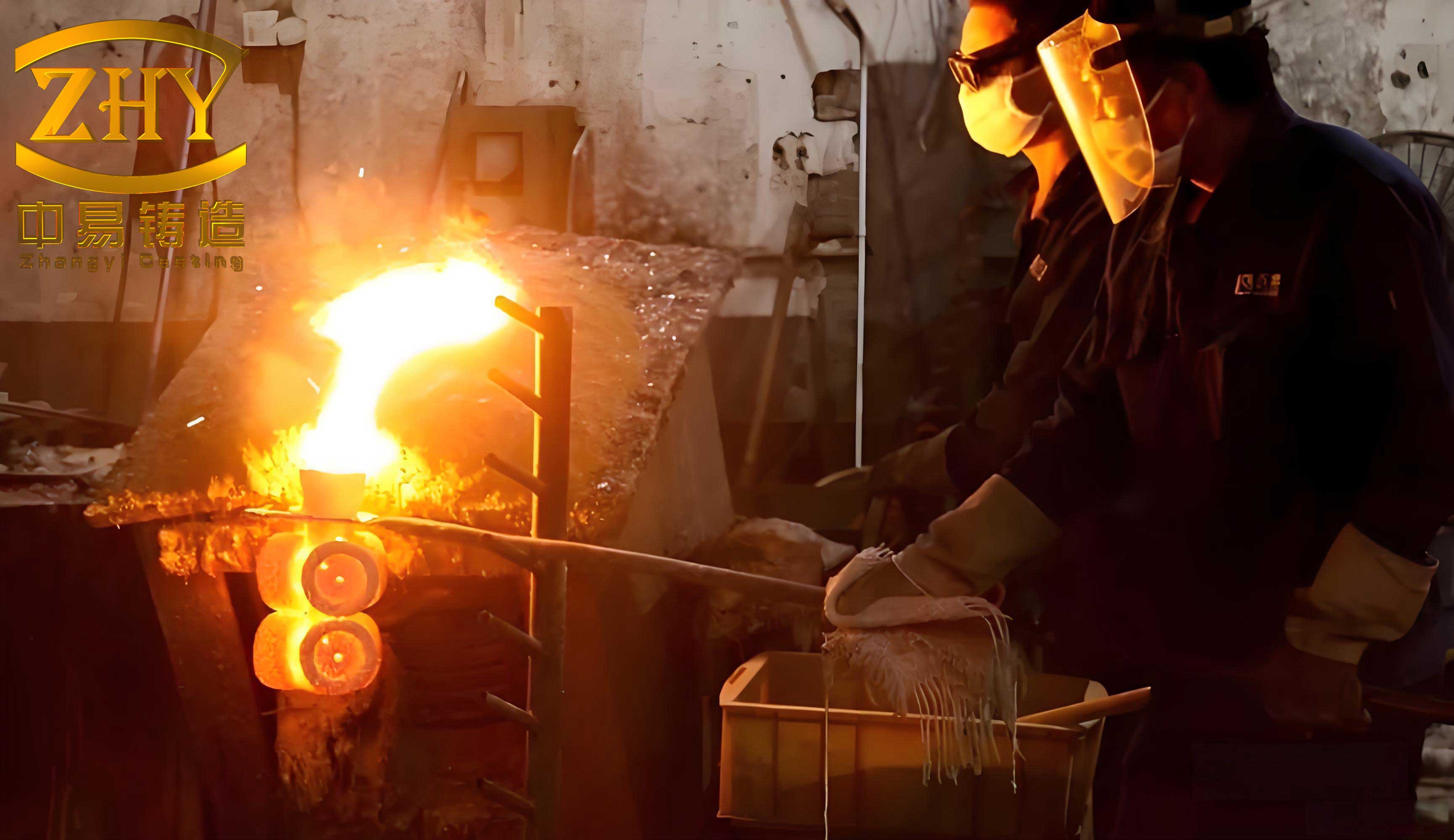
The casting was performed in a vacuum induction melting and gravity pouring furnace. The alloy was superheated to 1550°C and poured into a ceramic shell preheated to 1050°C. After solidification and cooling, the shell was removed, and the castings were cut off from the gating system, ground, shot-peened, and subjected to non-destructive inspection.
Gating System Design Philosophy and Numerical Simulation
The heart of our improved investment casting process lies in the gating system design. We conceived and compared two distinct schemes through rigorous numerical simulation using ProCAST software. The governing equations for fluid flow, heat transfer, and solidification in the simulation include the conservation of mass, momentum, and energy. The flow of the molten metal is treated as an incompressible, Newtonian fluid, described by the Navier-Stokes equations with the Boussinesq approximation for buoyancy:
$$
\nabla \cdot \mathbf{u} = 0
$$
$$
\rho \left( \frac{\partial \mathbf{u}}{\partial t} + \mathbf{u} \cdot \nabla \mathbf{u} \right) = -\nabla p + \mu \nabla^2 \mathbf{u} + \rho \mathbf{g}
$$
where $\mathbf{u}$ is the velocity vector, $p$ is pressure, $\rho$ is density, $\mu$ is dynamic viscosity, and $\mathbf{g}$ is gravitational acceleration. The energy equation accounts for the latent heat of fusion, $L$, released during phase change:
$$
\rho C_p \frac{\partial T}{\partial t} + \rho C_p \mathbf{u} \cdot \nabla T = \nabla \cdot (k \nabla T) – \rho L \frac{\partial f_s}{\partial t}
$$
Here, $T$ is temperature, $C_p$ is specific heat, $k$ is thermal conductivity, and $f_s$ is the solid fraction. The porosity formation model is based on the feeding flow resistance in the mushy zone, often related to the pressure drop, $\Delta P$, described by the Darcy law modifier:
$$
\mathbf{u}_l = -\frac{K}{\mu_l g_l} (\nabla P – \rho_l \mathbf{g})
$$
where $K$ is permeability, dependent on the solid fraction and dendrite arm spacing, and the subscript $l$ denotes the liquid phase.
Scheme 1: Top-Pouring Gate. This was the baseline design, featuring a central downsprue that branched into a horizontal runner connecting to large feeders attached to both the inner and outer rings of the casting. The simulation revealed critical flaws. The filling sequence showed molten metal preferentially filling the outer ring before adequately filling the inner ring, creating an unfavorable thermal gradient. During solidification, the inner ring, with its relatively higher surface-area-to-volume ratio, began freezing first. The simulation of solid fraction evolution clearly showed that the casting body (especially the inner ring) reached a high solid fraction while the gating feeders were still largely liquid. This resulted in a “reverse feeding” scenario, where shrinkage in the heavy feeders drew liquid metal back from the already partially solidified casting, inevitably leading to severe macro-porosity concentrated in the inner ring. The predicted shrinkage porosity (with a criterion of 2% volume fraction) was extensive and unacceptable.
Scheme 2: Novel Combined Top-Side-Bottom Gating System. To overcome these limitations, we designed an innovative, multi-directional gating system. This system incorporated:
- Bottom In-gates: Directly feeding the lower section of the inner ring to ensure its early and rapid filling.
- Side In-gates: Connected to the outer ring at multiple circumferential points to provide balanced, rapid filling of the larger outer volume.
- Top Feeders: Strategically placed over the thickest sections of the outer ring and the hub to act as hot-spots and reservoirs for directional solidification.
The simulation of this new investment casting process design showed a dramatic improvement. The filling time was significantly reduced. More importantly, the filling sequence was rationalized: metal initially filled the inner ring via the bottom gates, then the outer ring via the side gates, finally rising to fill the top feeders. This created a strong, positive thermal gradient from the casting extremities toward the top feeders. The solidification simulation confirmed a classic sequential solidification pattern. The solid fraction maps showed the casting body remained at a lower solid fraction for a longer time compared to the gating system, indicating the feeders were effectively feeding the casting. Consequently, the predicted shrinkage porosity was entirely isolated within the upper feeder heads, with the casting body showing no significant internal defects.
Practical Casting Validation and Results
Guided by the simulation results, we proceeded with the actual investment casting process using Scheme 2. The resin patterns were fabricated via SLA, assembled into clusters with the novel gating system, and used to produce ceramic shells. The alloy was melted and poured under the predetermined parameters (1550°C pouring temperature, 1050°C mold temperature).
After shell removal and finishing, the castings were subjected to extensive inspection. The results validated the simulation predictions. The castings were complete, with no visible cold shuts or misruns. Radiographic inspection (X-ray) confirmed the exceptional internal quality. The hollow struts and the challenging V-shaped narrow grooves were fully formed without any core remnants or blockages. Most significantly, the severe shrinkage porosity that plagued previous trials was eliminated. Only minor, isolated porosity was detected in non-critical areas at the very bottom of the V-grooves, which was deemed acceptable. The surface of the casting exhibited a fine, equiaxed grain structure, a direct result of the cobalt aluminate grain refiner used in the primary coat. The grain size was on the order of millimeters, and crucially, no columnar grains were found growing perpendicular to the aerodynamic edges, which is a strict requirement for such components to avoid premature fatigue initiation.
The success of this trial can be attributed to the synergistic effect of the novel gating design. The bottom gates ensured quick and hot filling of the vulnerable inner ring. The side gates provided a calm, distributed fill for the large outer ring surface area, minimizing turbulence and oxide formation. Finally, the top feeders, now being the last to fill and the hottest metal, established a clear thermal gradient for directional solidification, effectively feeding the entire casting body and forcing porosity into the sacrificial feeder heads.
Theoretical Analysis of Process Improvements
The superiority of the combined gating system can be further explained through fundamental principles of the investment casting process. The key objectives are to achieve complete mold filling and to compensate for solidification shrinkage through effective feeding. These can be quantified by analyzing filling time, thermal gradients, and feeding pressure.
1. Filling Time Analysis: A shorter filling time reduces heat loss and the risk of premature freezing in thin sections. For a gravity-poured system, the filling time $t_f$ can be approximated by considering the balance between hydrostatic head and flow resistance. For a simplified runner of constant cross-section $A_r$, the flow rate $Q$ is:
$$
Q = A_r \cdot v = A_r \cdot \sqrt{2gH}
$$
where $v$ is flow velocity, $g$ is gravity, and $H$ is the effective metal head height. The total casting volume $V_c$ determines $t_f$:
$$
t_f \approx \frac{V_c}{Q} = \frac{V_c}{A_r \sqrt{2gH}}
$$
Scheme 2, with its multiple in-gates (larger total $A_r$) and strategic placement maximizing effective $H$ for different cavity sections, achieved a shorter $t_f$ than the single-point entry of Scheme 1, as confirmed by simulation.
2. Solidification Time and Gradient: The solidification time $t_s$ for a section of modulus $m$ (volume/surface area) is given by Chvorinov’s rule:
$$
t_s = B \cdot m^n
$$
where $B$ and $n$ are constants depending on mold material and metal properties. For sequential solidification, the modulus of the feeder $m_f$ must be greater than that of the casting $m_c$ ($m_f > m_c$). In Scheme 1, the inner ring ($m_{inner}$) had a smaller modulus than the attached feeder, but due to the filling sequence and heat distribution, it lost heat faster, effectively solidifying first ($t_{s,inner} < t_{s,feeder}$), violating the rule. Scheme 2 ensured the feeders had both a larger geometric modulus and remained hotter, satisfying $t_{s,feeder} > t_{s,casting}$ for all sections.
3. Feeding Pressure and Porosity Prediction: The pressure available for feeding in the mushy zone, $P_{feed}$, is critical to prevent shrinkage porosity. It is the sum of atmospheric pressure, metallostatic pressure, and any externally applied pressure, minus the pressure drop required to overcome flow resistance in the dendrite network:
$$
P_{feed} = P_{atm} + \rho g h – \Delta P_{mushy}
$$
where $h$ is the height of liquid metal above the point in question. $\Delta P_{mushy}$ increases dramatically as the solid fraction $f_s$ increases. Scheme 1 created regions (inner ring) where $h$ was effectively negative or very low due to reverse feeding, leading to $P_{feed} < P_{crit}$ (the critical pressure needed to suppress pore formation). Scheme 2 maintained a positive and sufficient $h$ throughout the casting during critical solidification stages, ensuring $P_{feed} > P_{crit}$ everywhere in the casting body, thereby suppressing porosity. This theoretical framework aligns perfectly with the simulated and experimental outcomes.
Integration of Additive Manufacturing and Future Outlook
This study underscores a modern paradigm in advanced investment casting process development: the seamless integration of computational modeling, additive manufacturing for rapid prototyping, and empirical validation. The use of SLA for pattern manufacturing was not merely a convenience but an enabler for rapid iteration. It allowed for the direct fabrication of the highly complex wax pattern inclusive of the novel, multi-branch gating system, which would have been prohibitively expensive and time-consuming to produce via conventional tooling. This integration dramatically compresses the development cycle for complex castings.
The success of this integrated approach opens avenues for further optimization. Future work will focus on:
- Topology Optimization of the Gating System: Using simulation-driven generative design to minimize gating weight while maximizing feeding efficiency, thereby improving yield.
- Advanced Alloy Solidification Modeling: Incorporating microsegregation and precipitation kinetics models for the specific nickel-based superalloy to predict phase formation and potential incipient melting zones.
- Process Window Definition: Utilizing the validated model to perform sensitivity analyses on key parameters like pouring temperature, mold preheat temperature, and shell conductivity to define a robust, defect-free process window for industrial production.
- Extension to Other Processes: Applying the learned principles of controlled multi-directional filling and thermal gradient management to other challenging casting processes, such as counter-gravity or pressure-assisted investment casting process for even thinner-walled components.
In conclusion, the challenges associated with the investment casting process of multi-ring, multi-strut, complex thin-walled aeroengine components can be effectively overcome through a synergistic approach. The design of a novel combined top-side-bottom gating system fundamentally altered the filling dynamics and solidification sequence, establishing a strong directional solidification pattern essential for soundness. This design was virtually proven and refined through detailed numerical simulation, which accurately predicted the elimination of bulk shrinkage porosity. The practical implementation was enabled by modern SLA pattern fabrication, allowing for the rapid realization of the complex gating geometry. The final cast component exhibited excellent metallurgical quality, complete formation of intricate features, and a desirable fine-grained microstructure, fully meeting the stringent requirements for high-performance aeroengine applications. This work provides a validated technical framework and offers significant insights for advancing the capability and reliability of the investment casting process for next-generation complex components.