
The landscape of metal casting is perpetually evolving, driven by demands for higher precision, improved surface finish, superior mechanical properties, and enhanced economic efficiency. Among the various grades of cast iron, ductile cast iron holds a prestigious position due to its exceptional combination of strength, ductility, and wear resistance, making it indispensable for critical components across automotive, heavy machinery, and, as highlighted in the source material, the injection molding industry. For the production of high-volume, relatively small-sized components like hinges, brackets, and levers, traditional green sand or resin sand molding methods often present limitations in dimensional accuracy, surface quality, and production throughput. In this context, the adaptation of the Cold Box Core Assembly Molding process for ductile cast iron castings emerges as a transformative solution. Drawing from extensive practical application, this article details the methodology, technical parameters, and significant advantages of implementing this process, supported by comparative data and fundamental engineering principles.
The core philosophy of this process involves creating precise, high-strength sand molds and cores using the amine-cured cold box technique. These individual cores are then assembled, often in a stacked configuration, to form the complete mold cavity. This shifts the paradigm from crafting a mold around a pattern to assembling a mold from pre-manufactured, geometrically accurate blocks. The implications for repeatability, surface finish, and design flexibility for ductile cast iron parts are profound.
1. Foundational Materials: Selection and Rationale
The success of the Cold Box process is intrinsically tied to the meticulous selection of raw materials. Each component must satisfy specific requirements to withstand the thermal and mechanical stresses of pouring molten ductile cast iron.
1.1 Base Sand: The Skeletal Framework
The base sand provides the structural matrix. For ductile cast iron, which is typically poured at temperatures between 1350°C and 1420°C, high refractoriness is paramount to prevent burning-on and penetration defects. Silica sand (SiO₂) with a purity exceeding 92% is the standard choice. The grain size distribution is a critical compromise:
- Finer Grains: Yield a smoother mold surface, which translates directly to a superior casting finish.
- Coarser Grains: Provide better permeability for gases evolved during the pouring and solidification of ductile cast iron.
A typical and effective specification is a 50/100 mesh sieve distribution. This offers an optimal balance, ensuring enough fine particles for surface detail while maintaining adequate inter-granular spaces for venting. The specific surface area (Ss) of the sand influences resin demand, which can be approximated by:
$$ S_s \propto \frac{6}{\rho \cdot d_{mean}} $$
where $\rho$ is the sand density and $d_{mean}$ is the mean grain diameter.
1.2 Resin Binder System: The Chemical Bond
The cold box process typically employs a two-part phenolic urethane resin system cured by a tertiary amine gas catalyst (e.g., triethylamine, TEA). The resin addition level is a key economic and technical variable.
- Insufficient Resin: Leads to low tensile and compressive strength, causing mold deformation or breakage during handling or metal static pressure.
- Excessive Resin: Increases cost, reduces collapsibility (potentially causing hot tearing in ductile cast iron), and generates more fumes during pouring.
Through systematic testing, a resin addition of 1.6% to 1.9% by weight of sand has been found optimal for most small to medium ductile cast iron castings. The strength development can be characterized by a rapid increase upon gassing, reaching over 90% of its final strength within seconds. The bench life of the resin-sand mixture is also a crucial parameter for production planning.
| Parameter | Specification / Value | Rationale for Ductile Iron |
|---|---|---|
| Base Sand | Silica Sand, >92% SiO₂ | High refractoriness for ~1400°C pouring |
| AFS Grain Fineness Number | 50-60 (50/100 mesh) | Balance of surface finish & permeability |
| Resin Addition (Phenolic Urethane) | 1.6 – 1.9 wt.% | Optimal strength vs. cost & collapsibility |
| Catalyst | Gaseous Triethylamine (TEA) | Fast, room-temperature cure |
| Typical Tensile Strength (After Cure) | > 180 N/cm² | Ensures dimensional stability under metallostatic pressure |
1.3 Core/Mold Wall Thickness: Structural Integrity
The wall thickness of the produced sand cores or mold segments is a design parameter. It must provide sufficient rigidity to resist:
1. The ferrostatic pressure: $P = \rho_{iron} \cdot g \cdot h$, where $h$ is the height of the metal column above the point.
2. Thermal expansion stresses during heating.
3. Handling stresses during assembly and transportation.
A wall thickness in the range of 18-22 mm has proven effective for castings under 50 kg in ductile cast iron. Thinner walls risk deflection or rupture; thicker walls are wasteful, increase weight, and can hinder gas escape from the thicker sand mass, potentially causing porosity in the ductile cast iron casting.
1.4 Refractory Coating: The Protective Barrier
To further enhance refractoriness and prevent metal penetration, a refractory coating is applied. For ductile cast iron, graphite-based washes are highly effective due to their excellent thermal stability and non-wetting properties. The application method is crucial for consistency. Dip coating ensures a uniform, controlled thickness over the entire complex surface of the cold box core. The coating thickness ($t_c$) should be sufficient to act as a barrier but not so thick as to cause peeling or hinder dimensional accuracy. An empirical relation for adequate coverage is:
$$ t_c \approx k \cdot \sqrt{d_{mean}} $$
where $k$ is an application-specific constant. This uniform layer is pivotal in achieving the clean, peel-free surface finish characteristic of castings produced via this process.
2. Tooling, Process Design, and Assembly
2.1 Equipment and Metal Tooling
The process relies on dedicated core shooting machines and precision metal core boxes. The core box, typically made from machined aluminum or cast iron, defines the geometry of the sand piece. Its internal surfaces are highly polished and often feature ejector pins and complex venting channels to ensure the sand is compacted uniformly and gases from the curing reaction are efficiently removed. The accuracy and durability of this metal tooling directly dictate the dimensional consistency of the final ductile cast iron component across thousands of cycles.
2.2 Gating, Feeding, and Stacking System Design
The gating system for cold box assembled molds follows classic hydraulic principles but is often simplified due to the precision of the molds. A common design incorporates a downsprue, an extended U-shaped or trapezoidal runner that acts as a slag trap, and ingates. The high mold accuracy often allows for the elimination of filters and significant reduction in feeder sizes for many small ductile cast iron parts, as the controlled filling minimizes turbulence and oxidation.
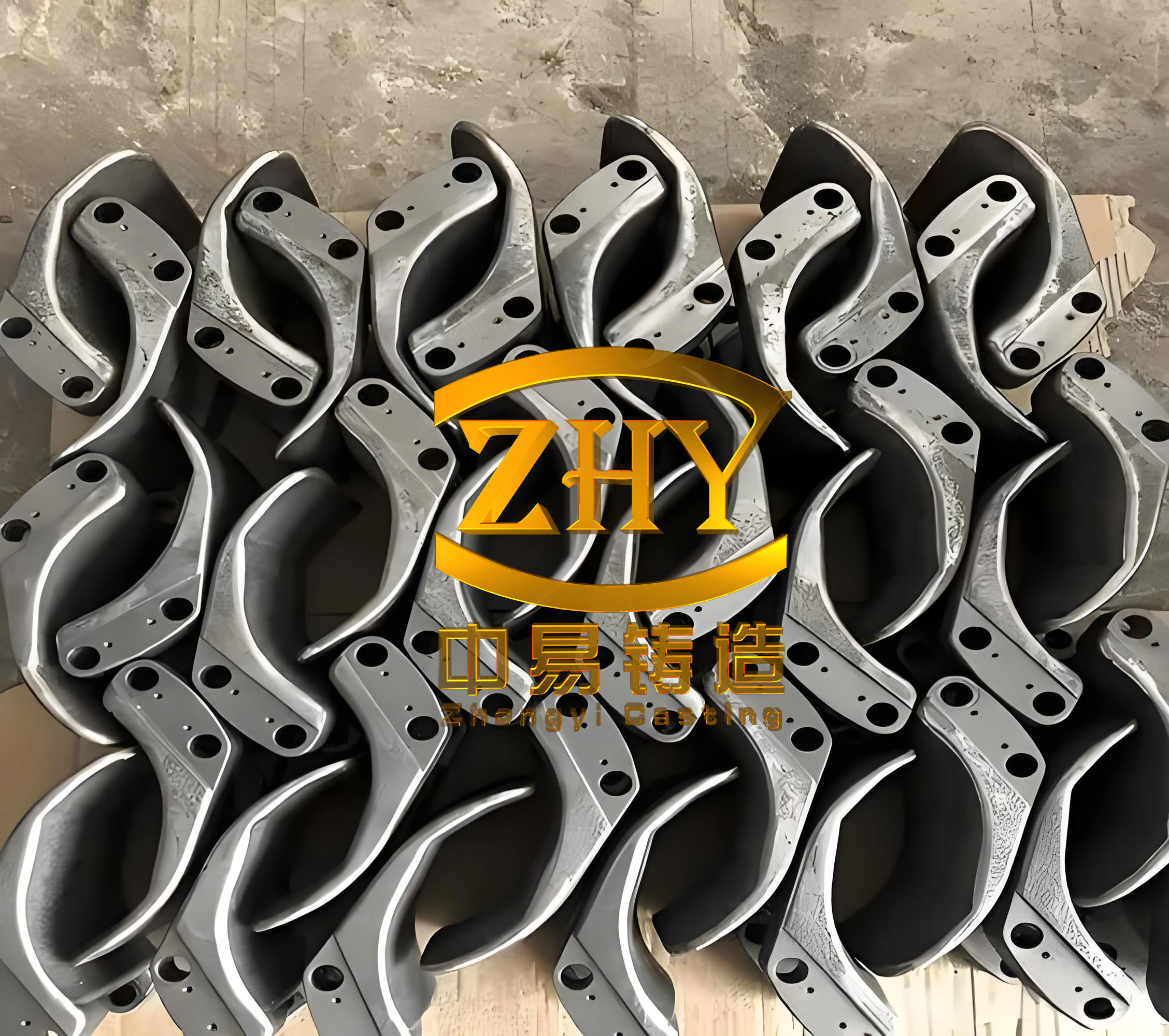
The revolutionary aspect is the stacking methodology. Cores are designed with matching parting planes, allowing them to be stacked vertically. One core acts as the drag for the casting above and the cope for the casting below. Assembly is secured using proprietary adhesives applied at strategic sealing points. This stack molding principle dramatically increases yield per pour and optimizes floor space utilization. The number of layers in a stack can be adjusted based on production needs and the metallostatic head pressure considerations for the specific ductile cast iron grade.
3. Metallurgical Process for Ductile Iron
The mold is only one half of the equation; consistent, high-quality molten metal is essential. The process parameters must be fine-tuned for synergy with the cold box molds.
3.1 Pouring Temperature and Time
A tightly controlled pouring temperature range of 1350°C to 1380°C is recommended. This range balances several factors:
$$ Q_{metal} = m \cdot C_p \cdot (T_{pour} – T_{liquidus}) + m \cdot L_f $$
where $Q_{metal}$ is the heat content, $m$ is mass, $C_p$ is specific heat, $T_{pour}$ is pouring temperature, $T_{liquidus}$ is liquidus temperature, and $L_f$ is latent heat of fusion.
– Lower Temperature: Risks mistruns, cold shuts, and inadequate feeding.
– Higher Temperature: Increases thermal shock to the mold, promotes mold erosion and penetration, and raises energy consumption. The high thermal conductivity of the dense cold box sand necessitates this precise control for ductile cast iron.
Pouring should be rapid but not turbulent, ensuring a smooth fill to avoid entrapping air or degrading the inoculant.
3.2 Inoculation Practice
Successful production of ductile cast iron requires effective inoculation to guarantee the desired graphite nodule count and morphology, thus achieving the required mechanical properties. A multiple-stage inoculation strategy is highly effective:
1. Foundry Inoculation (Ladle): Addition of 0.4-0.6% FeSi alloy (e.g., 75% Si) to the treated iron in the transfer ladle.
2. Late Inoculation (Stream): Critical for thin sections and stack molds, involving the addition of 0.1-0.15% of a potent inoculant (e.g., FeSiCaBa) into the metal stream during mold pouring. This counters fading and ensures a uniform, fine nodule structure throughout the casting, even in the last cavity filled in a stack. The efficiency of late inoculation ($\eta_I$) can be conceptualized as a function of time delay ($\Delta t$):
$$ \eta_I \propto e^{-k \cdot \Delta t} $$
where $k$ is a fading constant.
4. Quantitative Analysis of Results and Economic Impact
The transition from traditional sand molding to Cold Box Core Assembly delivers measurable improvements across all key performance indicators for ductile cast iron components.
4.1 Quality and Microstructure Enhancement
Surface Finish: The combination of a smooth metal core box, fine sand, and uniform coating results in castings with significantly reduced surface roughness. Flash and burrs are minimized due to the precision of core assembly and the rigidity of the molds.
Microstructural Superiority: The rapid and consistent cooling provided by the high-density sand mold, coupled with effective inoculation, promotes excellent graphite formation. Typical microstructure analysis reveals:
– Nodularity: >90% (often exceeding 93%)
– Nodule Count: >200 nodules/mm² (ASTM size 6-7)
– Matrix: Primarily pearlitic or ferritic-pearlitic, as desired, with minimal carbides.
Hardness and Consistency: Brinell hardness measurements taken from casting bodies show tight distributions (e.g., 165-185 HB), indicating uniform solidification and cooling, which is critical for the machining performance of ductile cast iron.
4.2 Defect Reduction and Yield Improvement
The controlled process environment leads to a drastic reduction in typical defects associated with traditional molding for ductile cast iron:
| Casting Defect | Traditional Sand Molding | Cold Box Core Assembly | Improvement Factor |
|---|---|---|---|
| Sand Inclusion / Burn-on | High | Very Low | > 5x reduction |
| Dimensional Variation | Medium-High | Very Low | > 3x improvement |
| Shrinkage Porosity | Medium (requires feeders) | Low (self-feeding designs) | > 2x reduction |
| Cold Shut / Mistrun | Medium | Low | > 3x reduction |
| Overall Scrap Rate | 5-10% | 1-3% | > 60% reduction |
4.3 Productivity and Cost Economics
The gains in productivity are exponential. While a traditional floor molding process might produce 10-20 molds/shifts for complex cores, a cold box core shooter can produce hundreds of identical cores ready for assembly. The decoupling of core production from molding station allows for continuous operation. Daily output for small components can increase from dozens to hundreds of pieces.
The economic benefits are multifaceted and can be modeled. The total cost per casting ($C_{total}$) is a sum of several factors:
$$ C_{total} = C_{metal} + C_{sand/resin} + C_{labor} + C_{energy} + C_{scrap} + C_{machining} $$
The Cold Box process favorably impacts multiple terms in this equation.
1. Metal Yield and Machining Cost Savings: The high precision allows for the casting of smaller holes (e.g., down to ~15 mm diameter) and thinner walls, reducing machining stock. The machining allowance can often be reduced from 4-5 mm to 2-3 mm. This directly saves metal and subsequent machining time. The economic impact of weight reduction for a family of components is substantial:
| Component | Weight (Traditional) (kg) | Weight (Cold Box) (kg) | Reduction (kg) | Reduction (%) | Cost Saving* (per piece) |
|---|---|---|---|---|---|
| Long Hinge | 19.50 | 17.90 | 1.60 | 8.2% | 13.60 |
| Small Hinge | 1.80 | 1.55 | 0.25 | 13.9% | 2.13 |
| Hook Hinge Type A | 9.70 | 8.60 | 1.10 | 11.3% | 9.35 |
| Hook Hinge Type B | 9.30 | 8.20 | 1.10 | 11.8% | 9.35 |
*Assuming a metal cost of $8.5 per kg, including melting and treatment.
2. Integrated Cost-Benefit Model: A simplified model comparing annual production of 10,000 pieces of a sample component illustrates the holistic advantage.
| Cost Factor | Traditional Process | Cold Box Core Assembly | Annual Saving |
|---|---|---|---|
| Metal Cost (Lower Yield) | $85,000 | $78,000 | $7,000 |
| Sand/Resin Cost | $5,000 | $7,500 | (-$2,500) |
| Labor Cost (Higher Touch Time) | $40,000 | $25,000 | $15,000 |
| Scrap & Rework Cost (5% vs 2%) | $6,500 | $2,600 | $3,900 |
| Machining Cost (Higher Stock) | $30,000 | $20,000 | $10,000 |
| Total Estimated Cost | $166,500 | $133,100 | $33,400 |
This represents a potential 20% reduction in total delivered cost per piece, excluding the value of increased capacity and improved quality reputation.
5. Summary of Technical Advantages and Considerations
The application of Cold Box Core Assembly Molding for ductile cast iron presents a compelling package of benefits, though it requires upfront investment and expertise.
| Advantage | Technical/Economic Impact |
|---|---|
| Dimensional Accuracy & Consistency | Enabled by metal tooling. Reduces machining stock, improves assembly. |
| Superior Surface Finish | Direct result of fine sand, smooth core boxes, and coating. Reduces cleaning time. |
| High Production Rate | Decoupled core shooting allows parallel processing. Stack molding multiplies yield per pour. |
| Excellent Casting Integrity | High mold rigidity minimizes wall movement, leading to predictable, sound ductile cast iron castings. |
| Design Flexibility | Complex internal passages and thinner sections become feasible to cast directly. |
| Energy Efficiency | Room-temperature curing eliminates energy for core/mold drying or baking. |
| Consideration / Challenge | Mitigation Strategy |
| High Initial Tooling Cost | Justified by high-volume production. ROI calculated from per-part savings. |
| Amine Gas Handling & Exhaust | Requires closed-loop gassing systems and proper scrubbers for environmental compliance. |
| Sand Reclamation Complexity | Mechanical and thermal reclamation systems are needed to process spent amine-cured sand economically. |
| Size Limitations | Best suited for small to medium-sized castings (typically < 100 kg) due to equipment and handling constraints. |
6. Conclusion
The Cold Box Core Assembly Molding process represents a significant technological leap for the high-volume production of quality ductile cast iron castings. By transferring precision from the foundry floor to the core shooting machine and metal tooling, it delivers unprecedented levels of repeatability, surface finish, and geometric freedom. While the adoption requires investment in equipment, tooling, and process engineering, the quantitative benefits in reduced scrap, lower machining costs, higher productivity, and superior part quality create a powerful economic case. As the market continues to demand lighter, stronger, and more precise components, the integration of this advanced molding technique into the standard repertoire for manufacturing ductile cast iron parts is not merely an option but a strategic imperative for foundries aiming to compete on value, not just cost. The future lies in such synergistic combinations of advanced material science and innovative process technology.