
Introduction
With the rapid development of the automotive industry, the demand for engine cylinder blocks has shifted from mass production to small-batch, customized manufacturing. This transformation necessitates agile production scheduling systems to address challenges such as fluctuating order delivery rates, high machine costs, and dynamic market demands. Traditional scheduling methods, heavily reliant on manual planning, often fail to optimize both time and cost efficiency. This study focuses on developing an agile production scheduling system for an engine cylinder block manufacturing plant, leveraging improved genetic algorithms to enhance scheduling flexibility and responsiveness.
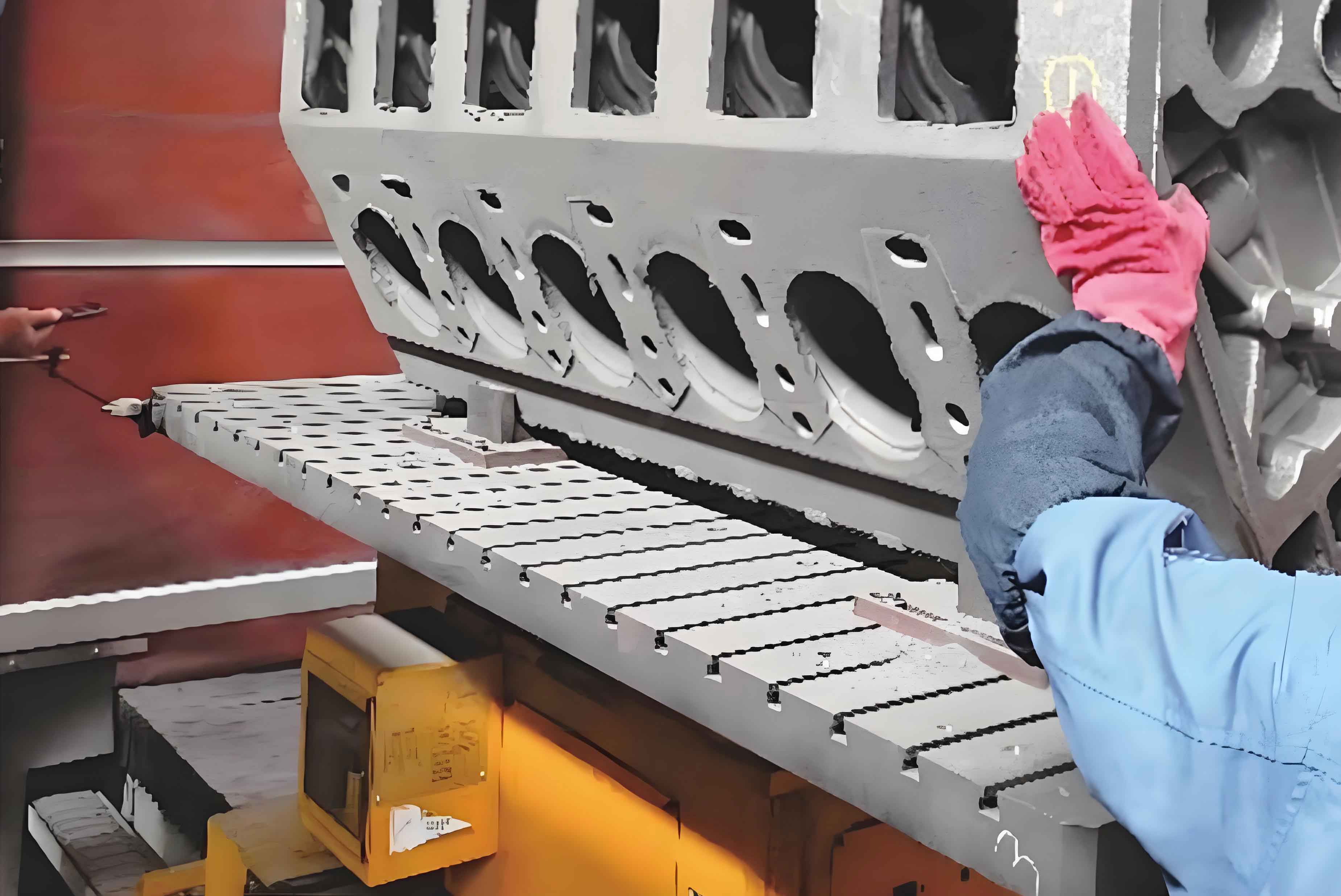
Problem Analysis in Engine Cylinder Block Production
The engine cylinder block manufacturing process involves complex workflows, including precision machining of surfaces, deep-hole drilling, cylinder boring, and assembly. Key challenges identified include:
- Low Order Delivery Rates: Manual scheduling leads to delays due to inefficient resource allocation.
- High Machine Costs: Suboptimal machine utilization increases operational expenses.
- Dynamic Disturbances: Unexpected order changes or equipment failures disrupt production stability.
To quantify these issues, a comparative analysis of machine utilization and costs was conducted (Table 1).
Table 1: Comparative Analysis of Machine Utilization and Costs
| Metric | Current Plant | Benchmark Plant |
|---|---|---|
| Machine Utilization | 60.95% | 65.35% |
| Machine Cost (USD) | 7,720 | 6,540 |
| Order Delivery Rate | 93.19% | 97.53% |
Mathematical Model for Engine Cylinder Block Scheduling
A multi-objective optimization model was formulated to minimize both the total production time and machine costs. Key constraints included machine availability, processing sequences, and dynamic order priorities.
Objective Functions
- Minimize Total Production Time:f1=min(max(ωk))f1=min(max(ωk))where ωkωk represents the completion time of machine kk.
- Minimize Total Machine Cost:f2=min(∑i=1n∑j=1m∑k=1KCijk⋅Xijk⋅Tijk)f2=min(i=1∑nj=1∑mk=1∑KCijk⋅Xijk⋅Tijk)where CijkCijk is the cost per unit time, XijkXijk is a binary decision variable, and TijkTijk is the processing time.
Constraints
- Machine Availability:∑k=1KXijk=1∀i,jk=1∑KXijk=1∀i,j
- Processing Sequence:eij≤bi(j+1)∀i,jeij≤bi(j+1)∀i,jwhere eijeij and bijbij denote the end and start times of operation jj for engine cylinder block ii.
Improved NSGA-II Algorithm for Scheduling Optimization
The Non-dominated Sorting Genetic Algorithm II (NSGA-II) was enhanced to address the multi-objective nature of engine cylinder block scheduling. Modifications included adaptive crossover/mutation strategies and elite retention mechanisms.
Algorithm Enhancements
- Adaptive Crossover Probability:Pc(i)=Pc1+(Pc1−Pc2)⋅iiter_genPc(i)=Pc1+(Pc1−Pc2)⋅iter_geniwhere Pc1=0.8Pc1=0.8, Pc2=0.4Pc2=0.4, and ii is the current iteration.
- Adaptive Mutation Probability:Pm(i)=Pm1+(Pm1−Pm2)⋅iiter_genPm(i)=Pm1+(Pm1−Pm2)⋅iter_geniwhere Pm1=0.1Pm1=0.1, Pm2=0.01Pm2=0.01.
- Elite Retention Strategy:mnopi=∑j=1k(0.5+i3⋅iter_gen)⋅spopij+∑j=k+1n(0.5−i3⋅iter_gen)⋅spopijmnopi=j=1∑k(0.5+3⋅iter_geni)⋅spopij+j=k+1∑n(0.5−3⋅iter_geni)⋅spopij
Encoding and Decoding Strategies
A dual-layer integer encoding scheme was adopted:
- Process Layer: Determines the sequence of operations for each engine cylinder block.
- Machine Layer: Assigns operations to specific machines.
Example Encoding:
| Process Layer | 2 | 4 | 3 | 2 | 1 | 5 |
| Machine Layer | M1 | M3 | M2 | M1 | M5 | M6 |
Case Study and Experimental Results
A real-world case study involving eight types of engine cylinder blocks was conducted. Processing times and costs for each operation were extracted (Table 2).
Table 2: Processing Times (seconds) for Engine Cylinder Blocks
| Block Type | Op1 | Op2 | Op3 | Op4 | Op5 | Op6 | Op7 |
|---|---|---|---|---|---|---|---|
| Type 1 | 110 | 109 | 192 | 282 | 734 | 242 | 140 |
| Type 2 | 117 | 117 | 215 | 289 | 618 | 243 | 140 |
| … | … | … | … | … | … | … | … |
The improved NSGA-II algorithm was implemented in MATLAB, and results were compared against manual scheduling (Table 3).
Table 3: Performance Comparison of Scheduling Methods
| Metric | Manual Scheduling | Improved NSGA-II |
|---|---|---|
| Total Time (seconds) | 5,465 | 4,374 |
| Machine Cost (USD) | 7,720 | 7,251 |
| Machine Utilization | 60.95% | 66.79% |
| Order Delivery Rate | 87.50% | 100% |
The Pareto front obtained from the algorithm demonstrated superior trade-offs between time and cost (Figure 1).
Figure 1: Pareto Front for Multi-Objective OptimizationMachine Cost (USD)Total Time (seconds)Machine Cost (USD)Total Time (seconds)
Agile Scheduling System Development
A client-server-based scheduling system was developed using C# and SQL Server, integrating the improved NSGA-II algorithm. Key modules included:
- Order Management: Prioritizing orders based on urgency and volume.
- Machine Allocation: Dynamically assigning operations to minimize idle time.
- Real-Time Monitoring: Adjusting schedules for unexpected disruptions.
System Workflow:
- Input order details and machine parameters.
- Generate optimized schedules using the NSGA-II solver.
- Visualize results via Gantt charts and cost-time plots.
Table 4: System Performance Metrics
| Metric | Before System | After System |
|---|---|---|
| Scheduling Time | 2,370s | 1,990s |
| Cost Reduction | – | 6% |
| Utilization Improvement | – | 4.16% |
Conclusion and Future Work
This research presents a comprehensive solution for agile scheduling in engine cylinder block manufacturing. The improved NSGA-II algorithm reduced production time by 19.8% and costs by 6%, while the developed system enhanced machine utilization by 5.8%. Future work will explore integrating logistics optimization and real-time IoT-based monitoring to further refine production efficiency.