
In my extensive experience in the field of metal casting, I have come to understand that the study of casting defects is paramount to enhancing the quality and longevity of cast components. Casting defects are imperfections that occur during the casting process, adversely affecting the structural integrity, mechanical properties, and aesthetic appeal of the final product. These casting defects can arise from a multitude of factors, including material properties, process parameters, and environmental conditions. In this comprehensive analysis, I will delve into the common types of casting defects, their underlying causes, and effective preventive measures. My goal is to provide a detailed resource that can guide practical production, minimizing the occurrence of these casting defects and optimizing manufacturing outcomes. I will employ tables and mathematical formulas to succinctly summarize complex relationships, ensuring clarity and depth in the discussion.
The significance of addressing casting defects cannot be overstated. In industrial applications, casting defects lead to increased scrap rates, higher production costs, and potential failures in service. By systematically analyzing each defect, I aim to foster a deeper understanding that enables proactive control in foundry operations. Throughout this article, the term “casting defects” will be frequently emphasized to reinforce its central role in quality assurance. I will explore various categories of casting defects, such as porosity, inclusions, and surface irregularities, each with distinct mechanisms and solutions. The integration of engineering principles and empirical knowledge will form the backbone of this examination.
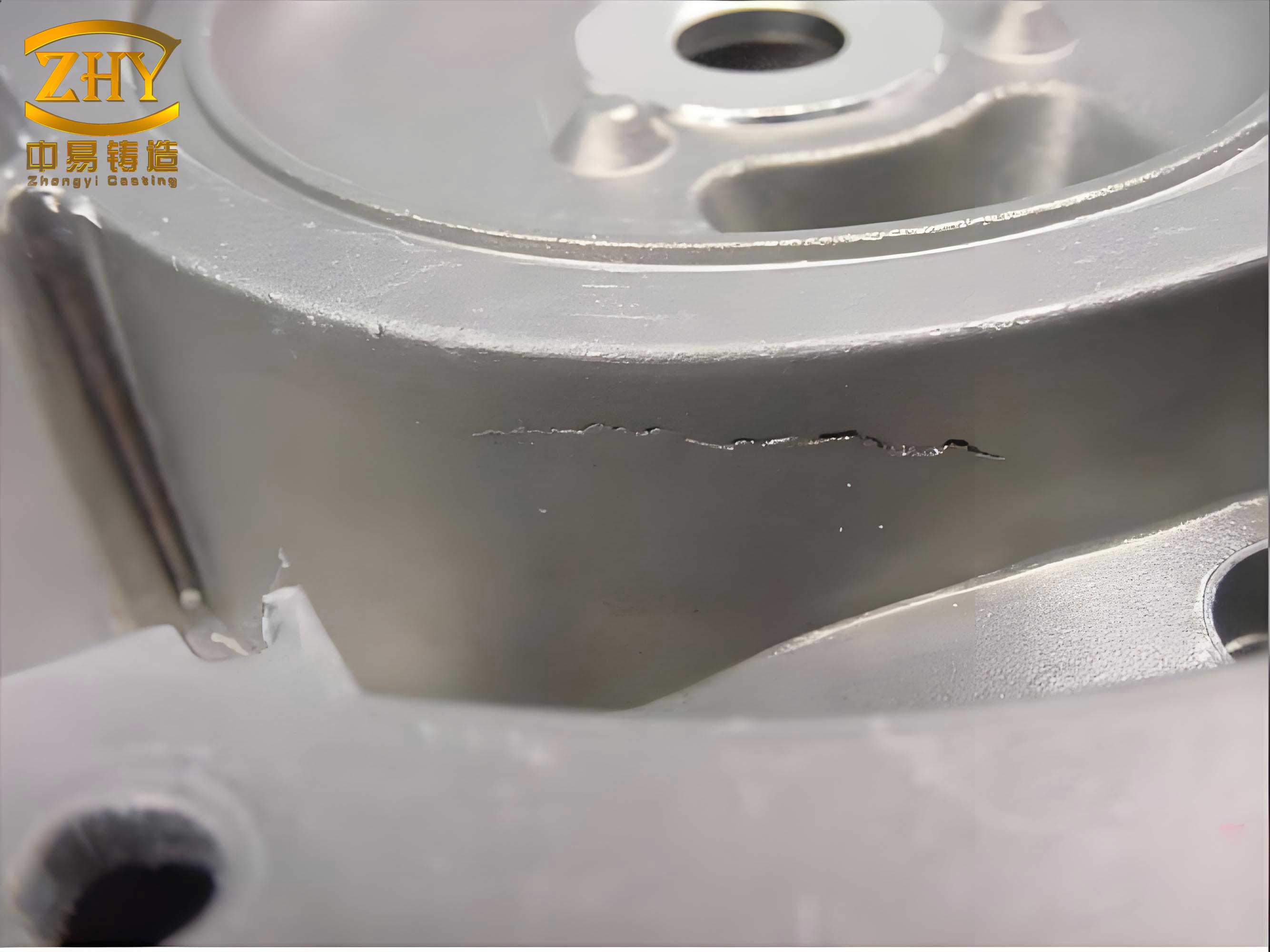
To begin, I will consider the fundamental classification of casting defects. Casting defects can be broadly categorized into internal defects, surface defects, and dimensional inaccuracies. Each category encompasses specific issues that I will dissect in detail. For instance, internal casting defects like porosity and shrinkage cavities are often hidden from view but critically weaken the component. Surface casting defects, such as sand adhesion and scabs, affect the finish and may lead to further deterioration. Understanding these casting defects requires a multidisciplinary approach, blending metallurgy, fluid dynamics, and thermodynamics. In the following sections, I will present a methodical breakdown, starting with gas-related casting defects.
Porosity and Pinholes: Gas-Induced Casting Defects
Porosity and pinholes are among the most prevalent casting defects, resulting from gas entrapment within the metal matrix. These casting defects manifest as voids or small holes, compromising the density and strength of the cast part. Based on formation mechanisms, I classify porosity into three types:侵入气孔 (intrusive gas porosity), 析出气孔 (precipitated gas porosity), and 反应气孔 (reactive gas porosity). Intrusive porosity occurs when external gases invade the mold cavity, precipitated porosity arises from gas liberation during solidification, and reactive porosity forms due to chemical reactions between the metal and mold materials.
The primary causes of these casting defects include dissolved gases in the molten metal that fail to escape, moisture in炉料 (charge materials), and inadequate venting in the mold system. To quantify gas solubility, I often refer to Henry’s Law, which states that the concentration of a gas in a liquid is proportional to its partial pressure: $$ C = k_H \cdot P $$ where \( C \) is the gas concentration, \( k_H \) is the Henry’s law constant, and \( P \) is the partial pressure. During cooling, the solubility decreases, leading to gas precipitation if the melt is supersaturated. This phenomenon is described by the equation: $$ \frac{dC}{dT} = -\alpha \cdot C $$ where \( \alpha \) is the temperature coefficient of solubility. Controlling these parameters is essential to mitigate such casting defects.
Preventive measures focus on reducing gas sources and enhancing gas evacuation. Below is a table summarizing the causes and countermeasures for porosity-related casting defects:
| Causes of Porosity | Preventive Measures |
|---|---|
| High moisture content in炉料 (charge materials) and mold sand | Dry炉料 thoroughly and control sand moisture below 3% |
| Low permeability of mold sand | Use coarser sand grains and optimize compaction to achieve permeability >100 |
| Inadequate drying of cores | Ensure core drying at 200-250°C for sufficient time, followed by proper storage |
| Poor gating system design | Implement tapered sprue and risers at high points to facilitate gas escape |
| Excessive oxidation of molten metal | Maintain reducing atmosphere during melting and use degassing agents like nitrogen |
In addition, I recommend increasing the pouring temperature to improve fluidity, as described by the fluidity length formula: $$ L_f = \beta \cdot \sqrt{T_{pour} – T_{liquidus}} $$ where \( L_f \) is the fluidity length, \( \beta \) is a material constant, and \( T_{pour} \) and \( T_{liquidus} \) are pouring and liquidus temperatures, respectively. By addressing these factors, the incidence of porosity casting defects can be significantly reduced.
Slag Inclusions: Non-Metallic Casting Defects
Slag inclusions are casting defects characterized by the presence of non-metallic compounds within the cast structure. These casting defects act as stress concentrators, leading to premature failure under load. The causes often stem from improper slag removal during pouring or reactions between the metal and mold. In my analysis, I attribute slag inclusion casting defects to factors such as turbulent flow in the gating system and high sulfur content in the melt.
A key aspect is the Stokes’ law, which governs the settling velocity of slag particles: $$ v = \frac{2}{9} \cdot \frac{(\rho_m – \rho_s) \cdot g \cdot r^2}{\eta} $$ where \( v \) is the settling velocity, \( \rho_m \) and \( \rho_s \) are densities of metal and slag, \( g \) is gravity, \( r \) is particle radius, and \( \eta \) is viscosity. To prevent these casting defects, I advocate for calm filling and effective slag traps. The table below outlines strategies:
| Causes of Slag Inclusions | Preventive Measures |
|---|---|
| Turbulent metal flow introducing slag | Design gating with laminar flow; use ceramic filters in the runner |
| High sulfur and phosphorus levels | Refine melt with desulfurizing agents to achieve S < 0.02% |
| Inadequate slag skimming | Employ rotary degassing and add fluxing agents like CaO |
| Poor ladle cleanliness | Preheat ladles and line with refractory coatings to minimize contamination |
Furthermore, controlling the pouring temperature is critical, as higher temperatures reduce viscosity, aiding slag separation. The relationship between viscosity and temperature is given by the Arrhenius equation: $$ \eta = A \cdot e^{\frac{E_a}{RT}} $$ where \( A \) is a pre-exponential factor, \( E_a \) is activation energy, \( R \) is the gas constant, and \( T \) is temperature. By integrating these principles, slag inclusion casting defects can be effectively managed.
Cold Shuts: Incomplete Fusion Casting Defects
Cold shuts are casting defects where two streams of molten metal fail to merge completely, forming a seam with rounded edges. These casting defects weaken the cast part and are often caused by low fluidity or improper gating. In my observation, cold shuts occur when the metal temperature drops below the liquidus before filling is complete.
The thermal dynamics can be modeled using the heat transfer equation: $$ \frac{\partial T}{\partial t} = \alpha \nabla^2 T $$ where \( \alpha \) is thermal diffusivity. To prevent these casting defects, I emphasize optimizing pouring parameters. The table below summarizes the approach:
| Causes of Cold Shuts | Preventive Measures |
|---|---|
| Low pouring temperature reducing fluidity | Increase pouring temperature by 20-50°C above liquidus |
| Insufficient gating cross-section | Enlarge ingate area using the formula: \( A_g = \frac{Q}{v} \), where \( Q \) is flow rate and \( v \) is velocity |
| Slow pouring speed | Adopt bottom pouring or pressurized gating to maintain velocity > 0.5 m/s |
| Gas entrapment hindering flow | Improve mold ventilation by adding vents at dead zones |
Additionally, I recommend tilting the mold during pouring to promote directional solidification, reducing the risk of cold shut casting defects. The fluidity index, defined as the product of temperature and time, can be used to assess flow capability: $$ FI = \int_{0}^{t} (T(t) – T_{solidus}) \, dt $$ Ensuring FI > 1000°C·s is beneficial for avoiding such casting defects.
Shrinkage Porosity and Cavities: Solidification Casting Defects
Shrinkage-related casting defects, including macroshrinkage cavities and microshrinkage porosity, result from volumetric contraction during solidification without adequate feeding. These casting defects are inherent to the casting process and require careful control of thermal gradients.
The total volume change can be expressed as: $$ \Delta V = V_0 \cdot (\beta_l \cdot \Delta T_l + \beta_s \cdot \Delta T_s + \beta_{ph} \cdot \Delta \phi) $$ where \( V_0 \) is initial volume, \( \beta_l \) and \( \beta_s \) are liquid and solid contraction coefficients, \( \Delta T_l \) and \( \Delta T_s \) are temperature ranges, and \( \beta_{ph} \) is phase change contraction with \( \Delta \phi \) as phase fraction. To mitigate these casting defects, I focus on riser design and mold rigidity. The table below provides insights:
| Causes of Shrinkage Defects | Preventive Measures |
|---|---|
| Inadequate feeding from risers | Apply Chvorinov’s rule: \( t_s = k \cdot \left(\frac{V}{A}\right)^2 \), design risers with \( V_{riser} > 0.2 V_{casting} \) |
| High pouring temperature causing centerline shrinkage | Optimize pouring temperature to balance fluidity and shrinkage, typically near liquidus + 30°C |
| Low mold stiffness allowing expansion | Use resin-bonded sand or metal molds with modulus > 5 GPa |
| Poor gating placement creating hot spots | Simulate solidification using finite element analysis to identify and relocate hot spots |
Moreover, I advocate for the use of chills to directionalize solidification, reducing shrinkage casting defects. The heat extraction rate by a chill is given by: $$ q = h \cdot A \cdot (T_m – T_c) $$ where \( h \) is heat transfer coefficient, \( A \) is area, \( T_m \) is metal temperature, and \( T_c \) is chill temperature. Implementing these strategies minimizes shrinkage-related casting defects.
Cracks: Stress-Induced Casting Defects
Cracks are severe casting defects that arise from thermal stresses during cooling or mechanical constraints. These casting defects can be classified as hot tears or cold cracks, depending on the temperature of formation. In my analysis, crack formation is governed by stress accumulation exceeding the material’s strength.
The thermal stress can be estimated using: $$ \sigma = E \cdot \alpha_t \cdot \Delta T $$ where \( E \) is Young’s modulus, \( \alpha_t \) is thermal expansion coefficient, and \( \Delta T \) is temperature difference. To prevent these casting defects, I emphasize uniform cooling and alloy modification. The table below outlines key measures:
| Causes of Cracks | Preventive Measures |
|---|---|
| Sudden section changes creating stress concentrations | Design with gradual transitions and fillet radii > 3 mm |
| High sulfur and phosphorus increasing brittleness | Control alloy composition to S < 0.015% and P < 0.05% |
| Restrained contraction due to mold rigidity | Use organic binders in sand to improve collapsibility |
| Residual stresses from rapid cooling | Apply stress relief annealing at 500-600°C for 1-2 hours |
Additionally, I recommend controlling the cooling rate through mold materials. The cooling rate is expressed as: $$ \frac{dT}{dt} = \frac{k}{\rho c} \cdot \frac{\partial^2 T}{\partial x^2} $$ where \( k \) is thermal conductivity, \( \rho \) is density, and \( c \) is specific heat. By optimizing these parameters, crack casting defects can be avoided.
Sand Burning-on and Chemical Adhesion: Surface Casting Defects
Sand burning-on, also known as metal penetration, is a surface casting defect where metal infiltrates sand grains, forming a rough layer. These casting defects are categorized into mechanical and chemical adhesion based on the mechanism. In my experience, they result from high metal pressure and temperature.
The penetration depth can be modeled using Darcy’s law: $$ d = \sqrt{\frac{2 \cdot K \cdot P \cdot t}{\mu}} $$ where \( d \) is depth, \( K \) is permeability, \( P \) is pressure, \( t \) is time, and \( \mu \) is viscosity. To prevent these casting defects, I focus on sand properties and pouring conditions. The table below summarizes the approach:
| Causes of Sand Adhesion | Preventive Measures |
|---|---|
| High pouring temperature increasing fluidity | Reduce pouring temperature by 20-30°C below standard |
| Low sand refractoriness | Use high-purity silica sand with SiO₂ > 95% or chromite sand |
| Inadequate mold compaction | Achieve uniform hardness > 85 on B-scale using pneumatic ramming |
| Absence of protective coatings | Apply zircon-based paints to form a barrier layer |
Furthermore, adding coal dust to sand reduces adhesion by creating a reducing atmosphere. The reaction can be represented as: $$ C + O_2 \rightarrow CO_2 $$ generating gases that impede metal penetration. This proactive measure effectively combats sand adhesion casting defects.
Sand Wash, Sand Drop, and Sand Holes: Erosion Casting Defects
These casting defects involve the displacement or incorporation of sand particles into the cast surface, leading to irregularities. Sand wash occurs from fluid erosion, sand drop from mechanical failure, and sand holes from loose sand inclusion. In my analysis, they stem from weak mold strength and turbulent flow.
The erosion rate can be described by: $$ E = k_e \cdot \rho \cdot v^3 $$ where \( E \) is erosion rate, \( k_e \) is erosion coefficient, \( \rho \) is density, and \( v \) is velocity. To prevent these casting defects, I enhance mold integrity and flow control. The table below provides details:
| Causes of Sand Erosion Defects | Preventive Measures |
|---|---|
| Low green strength of mold sand | Optimize binder content to achieve tensile strength > 0.3 MPa |
| High velocity metal impingement | Redirect flow using baffles and ensure ingate angle > 45° to the wall |
| Poor core securing | Use chaplets and adhesives to fix cores firmly |
| Moisture condensation in molds | Preheat molds to 100-150°C before pouring to eliminate dampness |
Additionally, I advocate for regular mold inspection to detect loose sand, reducing sand hole casting defects. The probability of sand inclusion can be estimated with statistical models: $$ P = 1 – e^{-\lambda \cdot A} $$ where \( \lambda \) is defect density and \( A \) is area. Implementing strict quality checks minimizes these casting defects.
Sand Scabs: Expansion Casting Defects
Sand scabs are casting defects where the mold surface lifts and cracks, allowing metal to penetrate. These casting defects are caused by sand expansion under heat and steam pressure. In my observation, they are prevalent in green sand molds with high moisture.
The expansion stress can be calculated using: $$ \sigma_{exp} = \gamma \cdot E_s \cdot \Delta T $$ where \( \gamma \) is expansion coefficient, \( E_s \) is sand modulus, and \( \Delta T \) is temperature rise. To prevent these casting defects, I modify sand composition and pouring techniques. The table below outlines strategies:
| Causes of Sand Scabs | Preventive Measures |
|---|---|
| High moisture content generating steam | Control moisture to 3-4% and add cellulose materials to absorb steam |
| Rapid heating of mold surface | Use insulating sleeves or reduce pouring temperature gradient |
| Inadequate mold compaction | Achieve uniform density variation < 5% through vibration compaction |
| Prolonged metal residence | Increase pouring speed to reduce contact time, aiming for fill time < 10 s |
Moreover, incorporating additives like wood flour improves collapsibility, mitigating scab casting defects. The beneficial effect can be quantified by the expansion reduction factor: $$ R = 1 – \frac{\epsilon_{additive}}{\epsilon_{base}} $$ where \( \epsilon \) is expansion strain. By applying these measures, sand scab casting defects are effectively controlled.
Conclusion
In summary, casting defects pose significant challenges in metal casting, but through systematic analysis and proactive measures, their impact can be minimized. I have explored various casting defects, from porosity to sand scabs, detailing their causes and countermeasures with tables and formulas. Key takeaways include the importance of controlling process parameters, such as temperature and flow dynamics, and optimizing material properties. The frequent mention of “casting defects” throughout this article underscores their centrality in quality management. By integrating theoretical principles with practical insights, foundries can enhance product reliability and efficiency. Continuous research and adaptation are essential to address evolving casting defects in advanced manufacturing contexts. Ultimately, a deep understanding of casting defects empowers engineers to produce high-integrity cast components, driving innovation and sustainability in the industry.