
In my extensive experience within the manganese steel casting foundry industry, crack defects in crusher jaw plates represent a critical and persistent challenge. These cracks, often initiated under stress and propagated through various manufacturing stages, ultimately lead to catastrophic failure. This analysis delves into the root causes of such defects across the entire production process—from pattern making and molding to melting, pouring, cleaning, and heat treatment. By adopting a first-person perspective, I aim to share insights and practical strategies to mitigate these issues, emphasizing that a holistic approach is essential for enhancing the crack resistance of high manganese steel components. The inherent properties of high manganese steel, such as poor thermal conductivity and susceptibility to carbide precipitation, make it prone to cracking. Through this discussion, I will integrate tables and formulas to summarize key parameters, ensuring a comprehensive understanding for practitioners in manganese steel casting foundries.
The formation of cracks is not an isolated event but a cumulative result of stressors introduced during manufacturing. In the manganese steel casting foundry, each step—whether it’s design, melting, or heat treatment—contributes to the internal stresses that can initiate micro-cracks. These micro-cracks, though initially minuscule, expand under operational stresses, leading to fracture. My analysis begins with the casting process, where structural design plays a pivotal role. Improper design, such as sharp corners or abrupt section changes, creates stress concentration points. For instance, a poorly designed jaw plate model can lead to micro-crack initiation at stress risers, which then propagate under wear and loading conditions. To counteract this, I recommend redesigning models to incorporate smooth transitions and rounded features, thereby distributing stress more evenly. This principle is fundamental in manganese steel casting foundry practices to prevent先天性 defects.
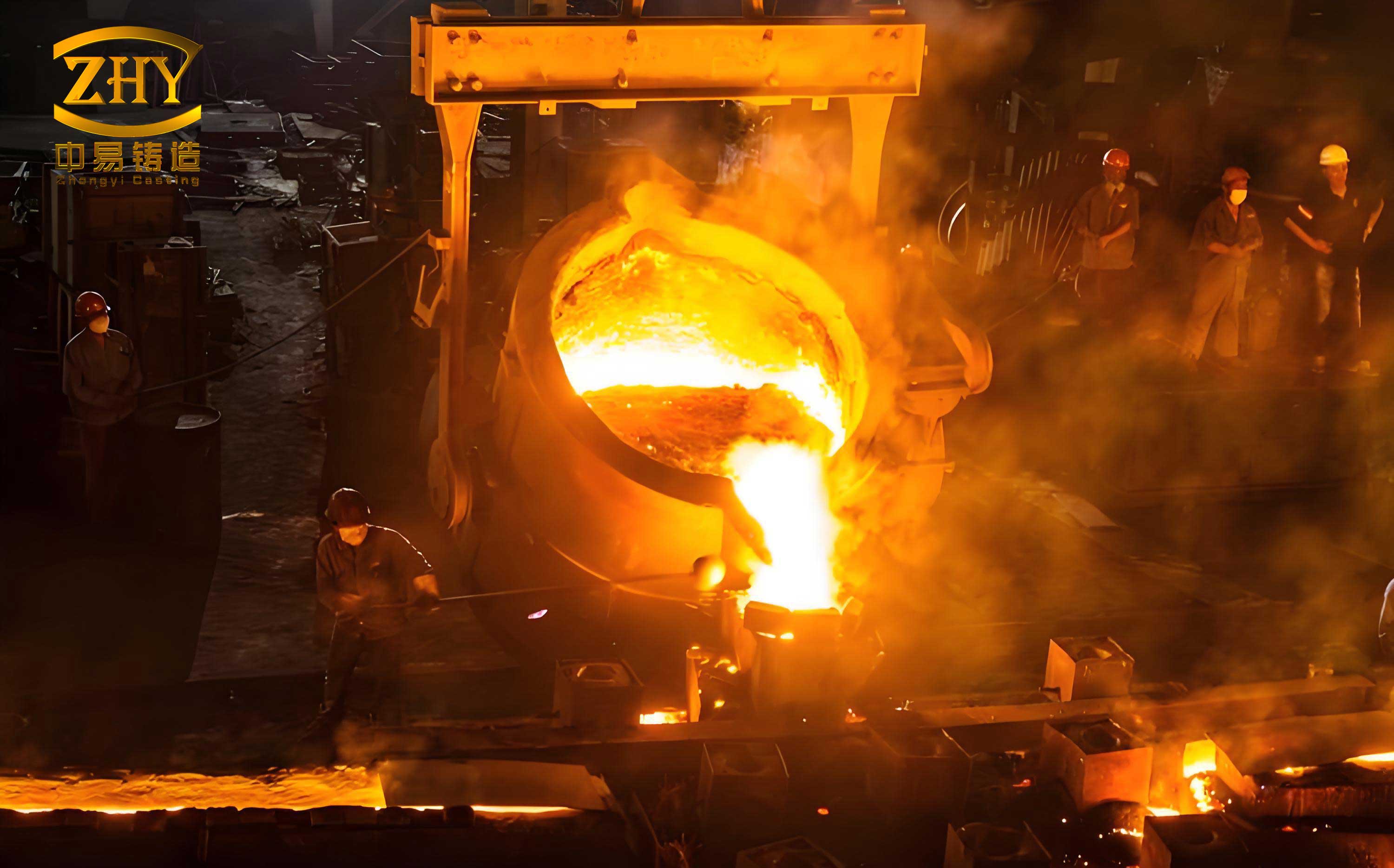
Moving to the melting process, the chemical composition of high manganese steel is a critical factor. Manganese and carbon are key elements that influence austenite stability and hardness. However, an imbalance can exacerbate crack susceptibility. The Mn/C ratio must be carefully controlled, typically between 8:1 and 10:1, as expressed in the formula: $$ \text{Mn/C Ratio} = \frac{[\text{Mn}]}{[\text{C}]} $$ where [Mn] and [C] represent the weight percentages of manganese and carbon, respectively. For thick-section castings, the cooling rate is slower, promoting carbide precipitation; thus, I advise increasing manganese content or reducing carbon content to maintain toughness. Phosphorus is particularly detrimental, as it segregates at grain boundaries and increases hot tearing tendency. In manganese steel casting foundry operations, phosphorus should be limited to below 0.07% for small castings and 0.04% for large ones. Silicon, while useful for deoxidation, can promote carbide formation if excessive; I recommend keeping silicon below 0.8%, and for critical thick parts, between 0.3% and 0.5%.
Non-metallic inclusions, especially MnO, also play a significant role in crack formation. During solidification, MnO precipitates along grain boundaries, reducing impact toughness and increasing hot cracking. In the manganese steel casting foundry, we employ measures such as using calcium carbide slag, ensuring sufficient reaction time (at least 20 minutes), and final deoxidation with aluminum to minimize MnO content. Additionally, higher melting temperatures allow for better slag removal and gas purification, enhancing the steel’s resistance to casting stresses. To summarize these compositional guidelines, I present the following table:
| Element | Recommended Range (%) | Influence on Crack Formation |
|---|---|---|
| Carbon (C) | 1.0–1.4 | High carbon increases carbide precipitation, leading to brittleness. |
| Manganese (Mn) | 11–14 | Maintains austenite stability; Mn/C ratio critical for toughness. |
| Silicon (Si) | 0.3–0.8 | Excessive Si promotes carbides and surface decarburization. |
| Phosphorus (P) | ≤0.07 (small), ≤0.04 (large) | Increases hot tearing and reduces grain boundary strength. |
| MnO Inclusions | Minimized via slag control | Precipitates at grain boundaries, reducing impact toughness. |
The pouring process is another area where cracks can originate. In the manganese steel casting foundry, we prioritize low pouring temperatures to accelerate cooling and refine as-cast grain structure, thereby improving crack resistance. The relationship between pouring temperature (T_p) and grain size (d) can be approximated by: $$ d \propto \frac{1}{\sqrt{T_p – T_l}} $$ where T_l is the liquidus temperature. Lower T_p reduces thermal gradients, minimizing stress. Additionally, gating system design must follow the principle of simultaneous solidification to uniformize temperature distribution. For fixed jaw plates, as shown in structural diagrams, hanging ears can create contraction resistance against molds, generating tensile stresses. I recommend loosening mold fasteners early to allow stress relaxation. Moreover, improper gating can lead to premature solidification, forming a封闭 stress; thus, designs should avoid creating closed loops that hinder contraction.
During cleaning, the as-cast structure is brittle due to austenite and carbide phases, making it susceptible to new cracks. In manganese steel casting foundry practice, we avoid heavy impacts on castings and prohibit flame cutting of gates and risers in the as-cast state, as local heating can induce thermal stresses and crack initiation. Instead, we use mechanical methods like grinding or sawing after heat treatment. This precaution is vital to preserve integrity before water toughening.
Water toughening, or water quenching, is a critical phase where cracks can form or propagate. It consists of solution treatment and quenching. During solution treatment, heating to around 600°C must be gradual to prevent thermal shock. The heating rate (v_h) should not exceed 60°C/h below 600°C, as rapid heating can cause cracking in the brittle as-cast structure. The solution temperature (T_s) typically ranges from 1040°C to 1100°C, with holding time (t_h) depending on chemistry and section thickness. Excessive T_s or t_h leads to grain coarsening, reducing stress resistance. I model this with: $$ \text{Grain Growth} = k \cdot \exp\left(-\frac{Q}{RT_s}\right) \cdot t_h^{1/2} $$ where k is a constant, Q is activation energy, and R is the gas constant. For most jaw plates, t_h should not exceed 2.5 hours. The following table outlines key parameters for water toughening in a manganese steel casting foundry:
| Process Stage | Parameter | Recommended Value | Rationale |
|---|---|---|---|
| Solution Treatment | Heating Rate below 600°C | ≤60°C/h | Prevents thermal shock in brittle as-cast structure. |
| Solution Treatment | Temperature (T_s) | 1040–1100°C | Achieves carbide dissolution without excessive grain growth. |
| Solution Treatment | Holding Time (t_h) | 1–2.5 hours | Depends on thickness; avoids over-aging and brittleness. |
| Quenching | Water Temperature | ≤50–60°C | Ensures rapid cooling to prevent carbide re-precipitation. |
| Quenching | Cooling Rate | Maximized via agitation | Critical for retaining austenite and avoiding embrittlement. |
Quenching itself poses risks if not controlled properly. Water temperature must be kept below 50–60°C to ensure a cooling rate sufficient to suppress carbide re-precipitation. The cooling curve during quenching can be described by: $$ \frac{dT}{dt} = -h \cdot (T – T_w) $$ where h is the heat transfer coefficient, T is casting temperature, and T_w is water temperature. If T_w is too high, cooling slows, allowing carbides to form in the 300–600°C range, reintroducing brittleness. Additionally, uneven entry into the water tank can cause mechanical impact, leading to cracks. In our manganese steel casting foundry, we use tilting mechanisms for smooth immersion to minimize shock. The interplay between cooling rate and carbide precipitation is crucial; I often emphasize that water quality and circulation are as important as temperature control.
Beyond these stages, the overall manufacturing philosophy in a manganese steel casting foundry must integrate quality control at every step. Micro-cracks often originate internally and are overlooked until failure occurs. From a wear mechanism perspective, improving crack resistance aligns with enhancing耐磨 performance. Therefore, process documentation and strict adherence to纪律 are paramount. We develop detailed工艺 files based on empirical data and theoretical models, ensuring consistency. For instance, we monitor chemical composition using spectrometers and implement statistical process control (SPC) charts to track variables like pouring temperature and quenching rate. This systematic approach reduces variability and defect rates.
To further elucidate the relationship between process parameters and crack susceptibility, I propose a comprehensive model. The crack initiation risk (R) can be expressed as a function of multiple factors: $$ R = f(S_d, C_c, T_g, H_r, Q_c) $$ where S_d is design stress concentration factor, C_c is chemical composition deviation, T_g is thermal gradient during solidification, H_r is heating rate in solution treatment, and Q_c is quenching cooling rate. By optimizing each variable through iterative testing in the manganese steel casting foundry, we minimize R. For example, we use finite element analysis (FEA) to simulate stress distributions in jaw plate designs, adjusting geometries before production. This proactive stance is key to preventing defects.
In conclusion, crack defects in high manganese steel crusher jaw plates are multifaceted, requiring a全程 approach for mitigation. As emphasized throughout this analysis, every step in the manganese steel casting foundry—from design to heat treatment—contributes to the final product’s integrity. By controlling chemical composition, optimizing pouring and gating, implementing careful cleaning practices, and rigorously managing water toughening parameters, we can significantly reduce crack incidence. The integration of tables and formulas, as shown, aids in standardizing best practices. Ultimately, the success of any manganese steel casting foundry hinges on establishing correct工艺 files and enforcing strict discipline in their execution. This not only prevents cracks but also enhances overall durability and performance in demanding applications like mining and crushing. Through continuous improvement and attention to detail, we can achieve higher quality and reliability in high manganese steel castings.