
In the mining industry, large excavators rely on high manganese steel casting for critical components like track plates due to their exceptional toughness and work-hardening capabilities under heavy loads. However, the inherent challenges of high manganese steel casting, such as poor thermal conductivity and coarse grain formation, often lead to premature failures, including brittle fractures. As a practitioner in this field, I have encountered instances where track plates made from ASTM A128/A128M E-1 high manganese steel casting fractured after only 600 hours of service, resulting in significant operational downtime and economic losses. This article details our comprehensive analysis of the coarse grain defect in high manganese steel casting and outlines the optimized processes we developed to mitigate this issue, thereby enhancing the reliability and lifespan of these components.
The failure analysis began with a macroscopic examination of the fractured track plate, specifically at the pin ear region. The fracture surface appeared relatively flat and exhibited characteristics of intergranular propagation, with no noticeable plastic deformation. This suggested a brittle failure mode, commonly associated with coarse grain structures in high manganese steel casting. To delve deeper, we conducted a hot acid etching test on samples from the fractured area. The etched surfaces revealed coarse columnar grains and fine cracks along grain boundaries, indicating poor continuity and reduced strength in the matrix. In contrast, samples from non-failed track plates displayed a denser and more uniform microstructure. Further metallographic analysis confirmed the presence of austenite with coarse grains (rated as level 00 according to standard grain size charts) and wide grain boundaries enriched with undissolved carbides. These carbides, aggregated at the boundaries, exacerbated the brittleness and facilitated crack initiation under stress. Based on these observations, we concluded that the premature failure was primarily due to coarse grain formation in the high manganese steel casting, compounded by the presence of undissolved carbides that weakened the grain boundaries.
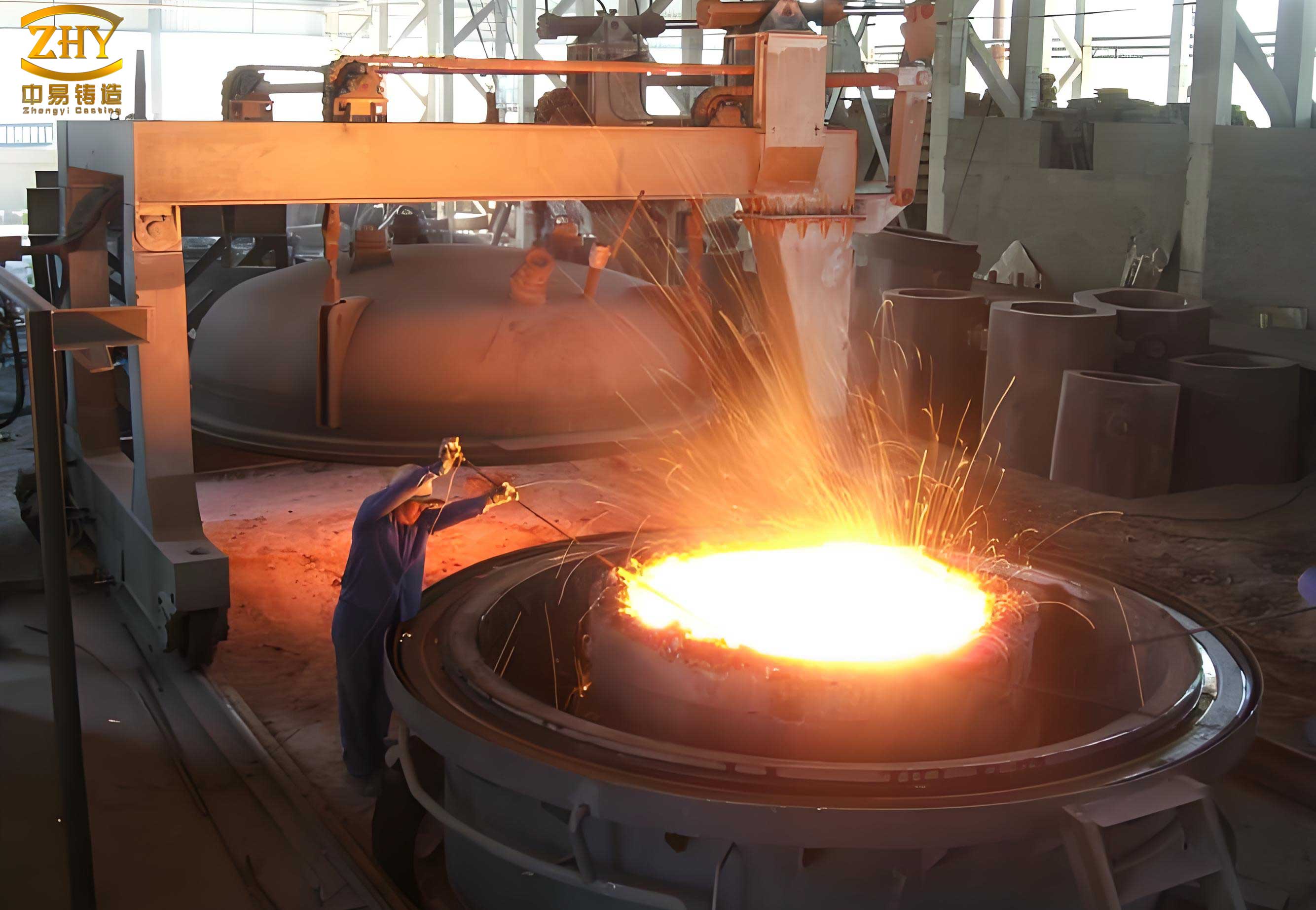
To address the coarse grain defect in high manganese steel casting, we implemented a series of process optimizations across melting, casting, and heat treatment stages. In the melting process, we utilized medium-frequency induction furnaces and employed a charge composition of scrap steel and alloys, along with specialized slag formers for refining. Temperature monitoring was conducted using handheld rapid thermocouples, and final deoxidation was achieved by adding 0.15 wt% pure aluminum before tapping. A key modification was the introduction of rare earth modification treatment: after deoxidation, we added 0.4 wt% rare earth silicon iron (RESiFe-38Ce) alloy, divided into two portions placed in the tapping spout and ladle bottom. This promoted grain refinement during solidification and purified the molten steel, improving the overall mechanical properties of the high manganese steel casting. Additionally, we optimized the pouring temperature based on the liquidus temperature of the material, which is approximately 1375°C for ASTM A128/A128M E-1. The original pouring temperature was calculated using the empirical formula: $$ T = 1485 – 0.3\delta $$ where \( T \) is the pouring temperature in °C and \( \delta \) is the main wall thickness in mm. For a wall thickness of ≥160 mm, this yielded a temperature of 1440°C ± 10°C. However, to reduce superheating and refine the primary grains, we adjusted the pouring temperature to 1420°C ± 5°C, corresponding to a superheat of 40–50°C. This lower temperature helped minimize grain growth in the thick sections of the high manganese steel casting.
In the casting process, we redesigned the gating system to address localized overheating and uneven cooling. Originally, the design featured four ingates, but we increased this to six and repositioned them to enter the mold cavity from both sides of the pin ears rather than the ends. This distributed the molten steel more evenly, reduced thermal accumulation, and promoted uniform solidification. Furthermore, we incorporated exothermic sleeves and sand-coated external chills at thermal centers such as the tracks and pin ears. These chills accelerated cooling in thick sections, facilitating directional solidification and preventing the formation of coarse columnar grains. The table below summarizes the key changes in the casting parameters for the high manganese steel casting:
| Parameter | Original Process | Optimized Process |
|---|---|---|
| Number of Ingates | 4 | 6 |
| Ingate Position | Pin ear ends | Both sides of pin ears |
| Cooling Aids | None | Sand-coated chills at thermal centers |
| Solidification Mode | Random | Directional |
Heat treatment played a crucial role in refining the microstructure of the high manganese steel casting. The original process involved direct austenitization at 1080°C ± 10°C for 5 hours, followed by water quenching. We introduced an intermediate recrystallization stage to promote grain refinement. Specifically, we added a hold at 580°C ± 10°C for 3 hours to facilitate the austenite-to-pearlite transformation, which nucleates finer grains upon subsequent heating. The austenitization stage was split into two phases: 2 hours at 980°C ± 10°C for homogenization, followed by 3.5 hours at 1090°C ± 10°C to dissolve carbides without excessive grain growth. The entire heat treatment cycle can be represented by the following time-temperature profile, where the optimized process includes the recrystallization step: $$ T(t) = \begin{cases} 580^\circ\text{C} & \text{for } t \in [0, 3] \text{ hours} \\ 980^\circ\text{C} & \text{for } t \in [3, 5] \text{ hours} \\ 1090^\circ\text{C} & \text{for } t \in [5, 8.5] \text{ hours} \\ \text{Water Quench} & \text{at } t = 8.5 \text{ hours} \end{cases} $$ This approach ensured complete dissolution of carbides and refined the austenitic grain structure in the high manganese steel casting.
To validate these improvements, we conducted production trials on initial prototypes and batch-produced track plates. Samples were taken from both near-surface and core regions of the pin ears, simulating the failure-prone areas. The results demonstrated a significant enhancement in grain size and mechanical properties. For instance, the grain size improved from level 00 in the failed samples to level 2–3 in the optimized high manganese steel casting, with no undissolved carbides observed. The table below compares the grain size and mechanical properties before and after optimization, highlighting the effectiveness of the process changes:
| Sample Location | Original Grain Size (Level) | Optimized Grain Size (Level) | Yield Strength (MPa) | Tensile Strength (MPa) | Elongation (%) | Impact Energy at -40°C (J) |
|---|---|---|---|---|---|---|
| Near-Surface | 00 | 3 | 421 | 827 | 40.5 | 146 |
| Core | 00 | 2 | 408 | 705 | 32.0 | 140 |
In batch production, we randomly selected three track plates and their corresponding attached samples for grain size evaluation. The results consistently showed grain sizes of level 3 for near-surface regions and attached samples, and level 2 for core regions, confirming the uniformity of the improvement. The attached samples, due to their smaller size and similar cooling conditions, provided a reliable proxy for the actual high manganese steel casting, allowing for cost-effective quality control. Field performance over two years (approximately 12,000 hours) has shown no recurrence of fracture failures, underscoring the durability of the optimized high manganese steel casting.
In conclusion, our investigation into the premature failure of high manganese steel track plates revealed that coarse grain defects were the primary cause, leading to intergranular brittle fracture. Through systematic optimizations in melting, casting, and heat treatment processes, we successfully refined the grain structure of the high manganese steel casting, achieving grain sizes of level 3 at near-surface and level 2 at core regions. The incorporation of rare earth modification, adjusted pouring temperatures, redesigned gating systems, and enhanced heat treatment cycles collectively contributed to this improvement. These measures not only resolved the coarse grain issue but also enhanced the overall quality and service life of high manganese steel casting components. This work provides a practical framework for addressing similar challenges in heavy-duty applications and emphasizes the importance of integrated process control in high manganese steel casting manufacturing.