
In the field of railway transportation, high manganese steel casting plays a critical role in producing durable components such as frogs, which guide trains across tracks. As a researcher focused on metallurgical quality, I have extensively studied the casting defects that plague high manganese steel casting processes. These defects, including shrinkage porosity and inclusions, often lead to premature failure and safety concerns. Through systematic analysis, I identified that traditional vacuum seal molding (V-process) methods introduce significant issues in high manganese steel casting, primarily due to improper solidification control and contamination from external sources. This article delves into the root causes of these defects and presents effective strategies to enhance the metallurgical quality of high manganese steel casting, supported by empirical data, mathematical models, and visual aids.
The high manganese steel casting process for railway frogs typically involves melting steel in induction furnaces, followed by deoxidation and pouring into molds. The chemical composition of high manganese steel casting, as outlined in Table 1, is crucial for achieving the desired mechanical properties, such as high toughness and work-hardening capability. However, deviations in this composition or the casting environment can exacerbate defects. For instance, the presence of elements like silicon and manganese must be carefully controlled to minimize segregation and inclusion formation during high manganese steel casting.
| Element | Range (%) |
|---|---|
| C | 0.95–1.35 |
| Mn | 11.0–14.0 |
| Si | 0.30–0.80 |
| P | ≤0.045 |
| S | ≤0.030 |
Shrinkage porosity is a common defect in high manganese steel casting, arising from inadequate feeding during solidification. The volumetric shrinkage can be described by the equation: $$ V_s = \beta \cdot V_0 $$ where \( V_s \) is the shrinkage volume, \( \beta \) is the shrinkage coefficient (typically ranging from 0.02 to 0.06 for high manganese steel casting), and \( V_0 \) is the initial volume of the molten metal. In complex geometries like frog toes and heels, localized cooling rates create thermal gradients that promote shrinkage. For example, in high manganese steel casting, the solidification time \( t_s \) can be estimated using Chvorinov’s rule: $$ t_s = k \cdot \left( \frac{V}{A} \right)^2 $$ where \( k \) is a mold constant, \( V \) is the volume, and \( A \) is the surface area. If the risers are insufficient or poorly distributed, as in traditional high manganese steel casting, shrinkage defects form preferentially in regions with high volume-to-surface area ratios.
Inclusions in high manganese steel casting primarily originate from ladle sand, molding sand, and deoxidation products. The composition of these sands, as analyzed in Table 2, shows high silicon and magnesium content, which can react with the steel melt to form non-metallic inclusions. During high manganese steel casting, the entrainment of these particles follows fluid dynamics principles. The Stokes’ law equation models the upward velocity of inclusions: $$ v = \frac{2}{9} \frac{(\rho_p – \rho_f) g r^2}{\mu} $$ where \( v \) is the terminal velocity, \( \rho_p \) is the density of the inclusion particle, \( \rho_f \) is the density of the molten steel, \( g \) is gravitational acceleration, \( r \) is the particle radius, and \( \mu \) is the dynamic viscosity. In high manganese steel casting, if the velocity is too low due to high viscosity or small particle size, inclusions remain trapped, leading to defects in critical areas like the rail head and web.
| Material | Si | Mg | Fe | Ca | Al |
|---|---|---|---|---|---|
| V-process Molding Sand | 45.5 | 34.1 | 16.2 | 1.10 | 1.05 |
| Ladle Sand | 45.1 | 6.82 | 7.72 | 22.9 | 11.4 |
To mitigate these issues in high manganese steel casting, I implemented several strategies focused on improving feeding efficiency and melt cleanliness. First, controlling the number and distribution of risers is essential for compensating shrinkage in high manganese steel casting. By adding one to two exothermic risers along the length of the frog, particularly in complex transition zones, the feeding distance is optimized. The theoretical feeding distance \( L_f \) can be expressed as: $$ L_f = \sqrt{\frac{k \cdot \Delta T}{h}} $$ where \( \Delta T \) is the temperature difference, and \( h \) is the heat transfer coefficient. This adjustment in high manganese steel casting ensures that molten metal reaches isolated regions, reducing porosity.
Second, adjusting the vacuum negative pressure in the V-process for high manganese steel casting enhances mold stability. The vacuum pressure \( P_v \) influences the mold strength, which can be modeled as: $$ P_v = \frac{F}{A} $$ where \( F \) is the force holding the sand grains, and \( A \) is the surface area. By increasing \( P_v \) in high manganese steel casting, the risk of mold collapse and sand inclusion decreases significantly, as the higher negative pressure prevents sand erosion during pouring.
Third, introducing ladle bottom blowing with nitrogen in high manganese steel casting promotes inclusion removal and homogenizes the melt. The nitrogen flow rate \( Q_N \) and blowing time \( t_b \) are critical parameters, typically set at 0.4–0.6 MPa for 12–15 minutes. The stirring energy \( E \) from gas blowing can be calculated as: $$ E = \frac{Q_N \cdot \rho_g \cdot g \cdot H}{\rho_m \cdot V_m} $$ where \( \rho_g \) is the gas density, \( H \) is the immersion depth, \( \rho_m \) is the melt density, and \( V_m \) is the melt volume. This process in high manganese steel casting enhances flotation of inclusions and reduces their concentration, as confirmed by reduced defect rates.
Fourth, improving the ladle bottom structure in high manganese steel casting eliminates the source of ladle sand inclusions. By replacing traditional clay-based ladle bricks with aluminum-magnesium-carbon composite materials, the need for ladle sand is removed. This modification in high manganese steel casting directly cuts off contamination pathways, resulting in cleaner steel. The effectiveness of these strategies is evident in post-improvement inspections, where defect densities drop markedly.
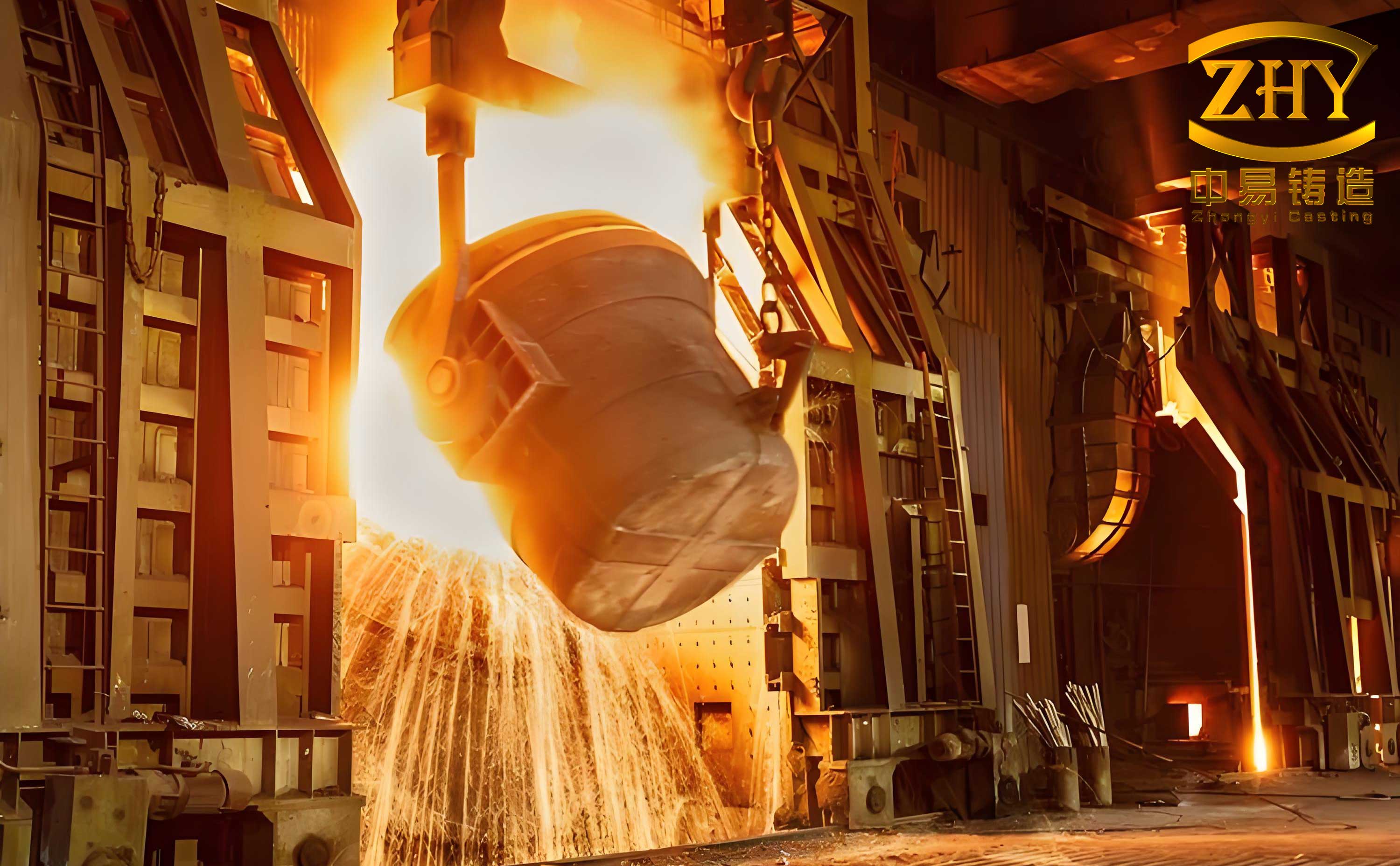
The impact of these improvements on high manganese steel casting is quantifiable through defect analysis. For instance, the inclusion count per unit area \( N_i \) before and after optimization can be compared using statistical models. If \( N_{i0} \) is the initial inclusion count, the reduction ratio \( R \) is given by: $$ R = 1 – \frac{N_i}{N_{i0}} $$ In high manganese steel casting, post-improvement data show \( R \) values exceeding 0.8, indicating a substantial decline in defects. Similarly, shrinkage porosity volume \( V_p \) decreases as riser efficiency improves, following the relation: $$ V_p \propto \frac{1}{N_r} $$ where \( N_r \) is the number of risers. By implementing these strategies in high manganese steel casting, the overall metallurgical quality reaches higher standards, ensuring longer service life and enhanced safety for railway applications.
In conclusion, high manganese steel casting faces significant challenges from shrinkage and inclusion defects, but through targeted interventions such as optimized riser design, vacuum control, nitrogen blowing, and ladle modifications, the quality of high manganese steel casting can be markedly improved. This comprehensive approach not only addresses the root causes but also provides a framework for continuous advancement in high manganese steel casting processes. As research progresses, further refinements in high manganese steel casting will undoubtedly contribute to more reliable and efficient railway components, underscoring the importance of metallurgical excellence in high manganese steel casting.