
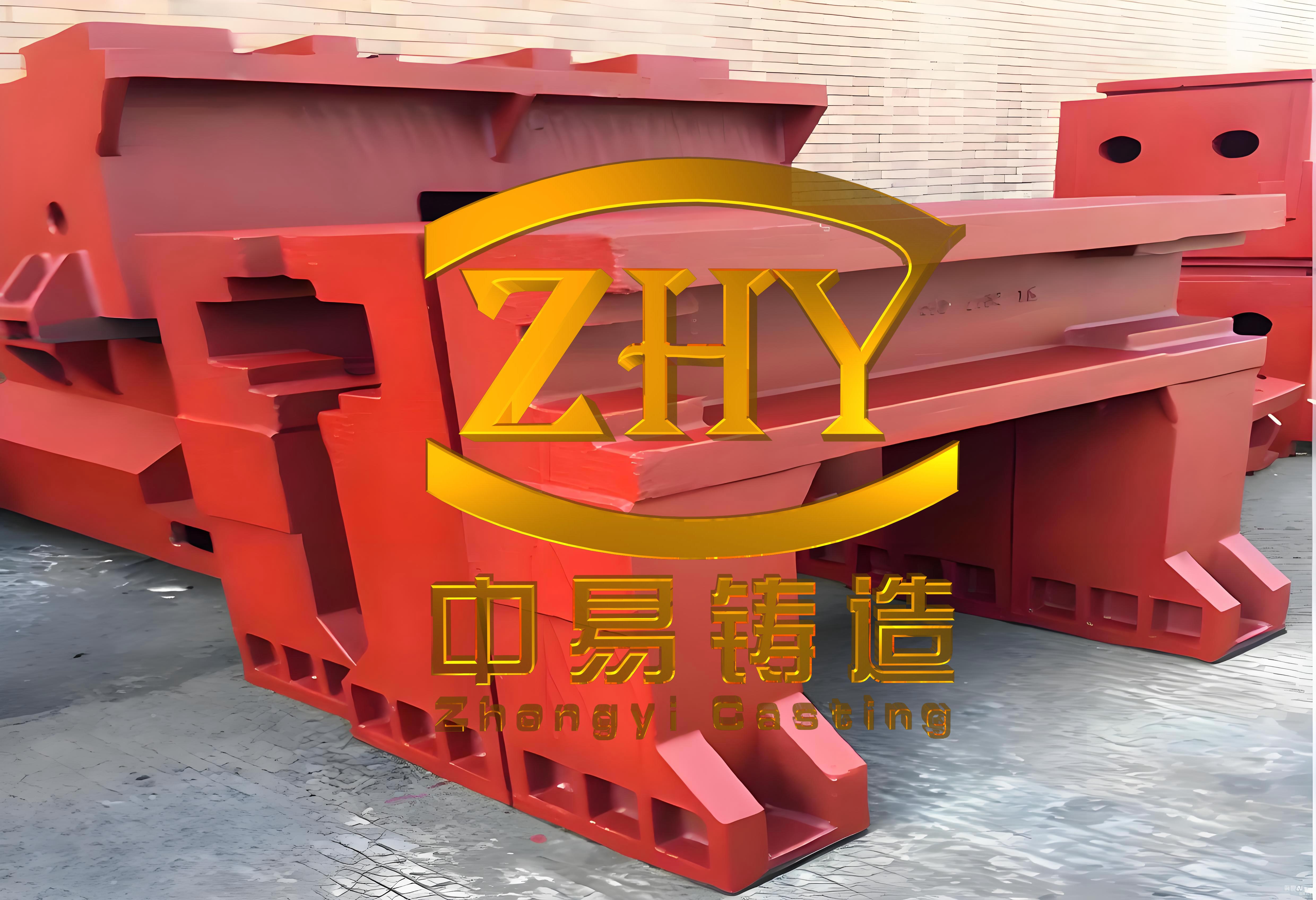
In the manufacturing of heavy-section machine tool castings, such as machine tool trays, surface slag hole defects are a common challenge that significantly impacts product quality. These machine tool castings play a critical role in numerical control machines, influencing machining accuracy and dimensional stability. Due to their thick sections, often exceeding 100 mm in wall thickness, the solidification process is slow, leading to increased susceptibility to slag inclusions and porosity on the surface, particularly in corners and recessed areas. This issue is closely tied to gating system design, mold sand quality, and coating performance. In this article, we analyze the root causes of slag hole defects in machine tool castings and present optimized strategies, including gating system modifications and coating enhancements, to mitigate these defects and improve overall casting quality.
The machine tool casting under consideration has an approximate outer dimension of 800 mm × 800 mm × 200 mm, with a weight of 700 kg and a material grade equivalent to HT300 gray iron. Key requirements include a defect-free machined surface, devoid of pores, sand inclusions, or slag holes. However, initial production runs consistently exhibited slag hole defects on the upper surfaces, compromising appearance and functionality. These defects often originate as small inclusions that aggregate during slow solidification, forming larger slag patches. Our investigation focuses on identifying the factors contributing to these issues in machine tool castings and implementing effective countermeasures.
| Parameter | Value |
|---|---|
| Outer Dimensions | 800 mm × 800 mm × 200 mm |
| Weight | 700 kg |
| Material | HT300 (Gray Iron) |
| Key Defects | Slag Holes, Inclusions on Upper Surface |
The initial gating system design employed a semi-closed configuration, typical for many machine tool castings, with a ceramic sprue of 60 mm diameter, a trapezoidal runner (upper width 40 mm, lower width 50 mm, height 50 mm), and six ingates each 60 mm wide and 7 mm thick. The cross-sectional area ratio was set as ΣSingate : ΣSrunner : ΣSsprue = 1 : 1.8 : 1.2, with two 100 mm × 100 mm × 22 mm 20 PPI filters placed vertically in the runner. This design aimed to facilitate metal flow but resulted in turbulent filling, as revealed by simulation analysis.
| Component | Dimensions | Cross-Sectional Area |
|---|---|---|
| Sprue | ϕ60 mm | Approx. 2827 mm² |
| Runner | Trapezoidal: 40/50 mm × 50 mm | Approx. 2250 mm² |
| Ingates (6 nos.) | 60 mm × 7 mm each | Total 2520 mm² |
| Area Ratio | ΣSingate : ΣSrunner : ΣSsprue | 1 : 1.8 : 1.2 |
Using AnyCasting simulation software, we analyzed the filling and solidification processes for the initial gating system. The results indicated significant turbulence and air entrainment during mold filling, leading to excessive oxidation and the formation of secondary slag inclusions. The velocity field and particle tracking simulations showed that molten metal entered the cavity at high speed, causing splashing and vortex formation. This turbulence promotes the generation of oxides, which accumulate as slag defects on the casting surface. The temperature field analysis further highlighted prolonged solidification times, exacerbating slag aggregation in thick sections of the machine tool casting.
The Reynolds number (Re) can be used to assess flow characteristics, where a high value indicates turbulence. For the original gating system, the Reynolds number is calculated as:
$$Re = \frac{\rho v D}{\mu}$$
where ρ is the density of molten iron (approximately 7000 kg/m³), v is the flow velocity, D is the hydraulic diameter, and μ is the dynamic viscosity (about 0.005 Pa·s for iron). In the initial design, the velocity v was high due to the semi-closed ratio, leading to Re values well above 4000, confirming turbulent flow. This turbulence increases the oxidation rate, forming slag compounds such as oxides and sulfides. The amount of slag formed can be approximated by:
$$m_{slag} = k \cdot A \cdot t \cdot [O]$$
where mslag is the mass of slag, k is a rate constant, A is the interfacial area, t is time, and [O] is the oxygen concentration. In thick-section machine tool castings, the extended solidification time t allows for more slag formation and aggregation.
To address these issues, we optimized the gating system from a semi-closed to an open design, reducing the inflow velocity and pressure to promote laminar flow. The sprue remained at 60 mm diameter, but the ingates were enlarged to 100 mm × 10 mm each, with the same number of six ingates. The cross-sectional area ratio was adjusted to ΣSingate : ΣSrunner : ΣSsprue = 1 : 0.75 : 0.47, and the runner was positioned in the drag to enhance slag trapping efficiency. This modification aimed to minimize turbulence and reduce secondary oxidation in the machine tool casting.
| Component | Dimensions | Cross-Sectional Area |
|---|---|---|
| Sprue | ϕ60 mm | Approx. 2827 mm² |
| Runner | Trapezoidal: 40/50 mm × 50 mm | Approx. 2250 mm² |
| Ingates (6 nos.) | 100 mm × 10 mm each | Total 6000 mm² |
| Area Ratio | ΣSingate : ΣSrunner : ΣSsprue | 1 : 0.75 : 0.47 |
Simulation of the optimized gating system showed a marked improvement, with smoother metal flow and reduced air entrainment. The Reynolds number decreased due to lower velocities, promoting laminar flow and minimizing oxide formation. Additionally, we addressed the composition of slag by reducing elements like barium (Ba) and calcium (Ca), which originate from inoculants such as silicon-calcium-barium, and sulfur (S) from mold materials. The sulfur content in reclaimed sand was measured at around 0.2%, which is relatively high. To mitigate this, we switched to a low-acidity catalyst with a controlled addition rate of 45% and replaced the silicon-calcium-barium inoculant with a silicon-based one. This reduces the formation of sulfide and oxide inclusions in the machine tool casting.
The effectiveness of these changes was evaluated using the following quality metrics. The defect density Dd can be expressed as:
$$D_d = \frac{N_d}{A_c}$$
where Nd is the number of slag defects and Ac is the casting surface area. Post-optimization, Dd decreased significantly. Furthermore, we applied an anti-oxidation and anti-sulfur shielding coating to the mold, which reduces sulfur penetration and oxidation at high temperatures. The coating’s performance can be modeled by a diffusion equation:
$$\frac{\partial C}{\partial t} = D \nabla^2 C – k C$$
where C is the concentration of sulfur or oxygen, D is the diffusion coefficient, and k is a reaction constant. This coating acts as a barrier, slowing down the diffusion of harmful elements into the molten metal during the extended solidification of thick-section machine tool castings.
| Parameter | Before Optimization | After Optimization |
|---|---|---|
| Slag Defect Frequency | High (Multiple defects per casting) | Low (Rare, minor defects) |
| Rejection Rate | Approx. 15-20% | Less than 5% |
| Surface Quality | Poor, with visible slag holes | Good, clean surface |
Validation through small-batch production confirmed that the optimized process consistently produced machine tool castings with minimal slag defects. The combination of an open gating system, controlled inoculant chemistry, and advanced coatings resulted in a stable process with high yield. This approach has been successfully implemented in mass production, ensuring reliable quality for heavy-section machine tool castings.
In conclusion, the prevention of slag hole defects in machine tool castings requires a holistic approach. First, the gating system design is crucial; an open system with appropriate area ratios promotes laminar flow and reduces turbulence. Second, numerical simulation tools like AnyCasting provide valuable insights into flow dynamics and solidification, enabling proactive optimization. Third, the selection of coatings and mold materials directly impacts defect formation, with anti-oxidation coatings playing a key role in shielding against sulfur and oxygen ingress. By integrating these strategies, manufacturers can enhance the quality and reliability of machine tool castings, meeting stringent industrial standards. Future work could explore real-time monitoring and adaptive control systems to further refine the casting process for complex machine tool components.