
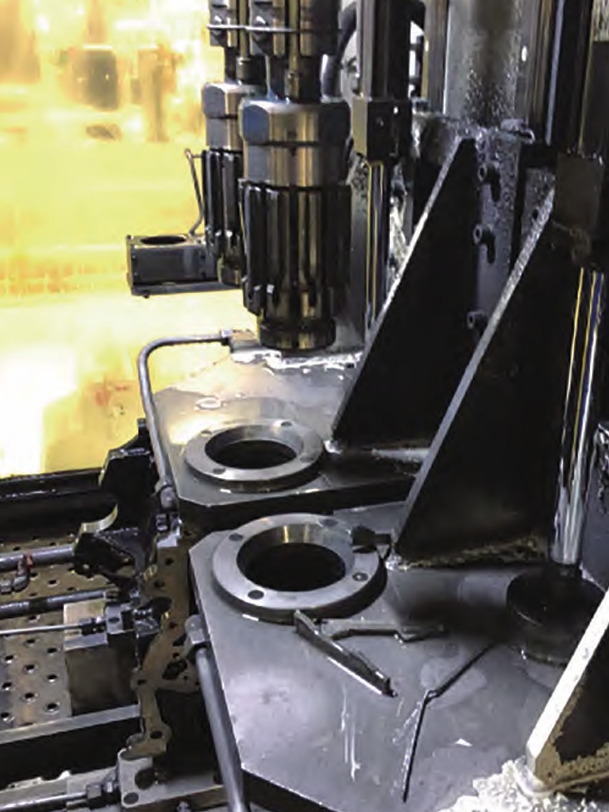
This paper presents systematic solutions for resolving surface slag inclusion defects in heavy-section machine tool pallet castings through process optimization and material selection. The study focuses on HT300 gray iron components with dimensions 800×800×200 mm, weighing 700 kg, requiring defect-free machined surfaces.
1. Defect Formation Mechanism
The primary casting defect manifests as surface slag inclusions containing complex oxides and sulfides. Chemical analysis reveals typical composition:
| Element | Ba | Ca | S | FeO |
|---|---|---|---|---|
| Content (wt%) | 12.4 | 8.7 | 5.3 | Balance |
The defect formation follows these chemical reactions during solidification:
$$ \text{FeS} + \text{O}_2 \rightarrow \text{FeO} + \text{S} $$
$$ \text{Ba} + \frac{1}{2}\text{O}_2 \rightarrow \text{BaO} $$
$$ \text{Ca} + \frac{1}{2}\text{O}_2 \rightarrow \text{CaO} $$
2. Process Optimization Strategy
Key improvements implemented to mitigate casting defects include:
2.1 Gating System Redesign
Modified from semi-closed to open system with optimized parameters:
| Parameter | Original | Optimized |
|---|---|---|
| Gating Ratio (I:R:C) | 1:1.8:1.2 | 1:0.75:0.47 |
| Ingate Dimensions (mm) | 60×7×6 | 100×10×6 |
| Flow Velocity (m/s) | 2.8 | 1.2 |
2.2 Coating System Enhancement
Implemented anti-sulfur penetration coating with improved thermal resistance:
$$ \text{Coating Effectiveness} = \frac{\text{SiO}_2}{\text{Al}_2\text{O}_3} \times \sqrt{\frac{T_{\text{max}}}{1000}} $$
Where \( T_{\text{max}} \) represents maximum mold-metal interface temperature (K).
3. Numerical Simulation Verification
AnyCasting analysis demonstrated significant improvement in flow stability:
| Parameter | Original | Optimized |
|---|---|---|
| Turbulence Energy (J) | 48.7 | 12.3 |
| Oxide Formation Index | 0.82 | 0.31 |
| Slag Particle Size (μm) | 120-250 | 50-80 |
4. Production Validation
Implementation results showed remarkable casting defect reduction:
| Batch | Defect Rate | Surface Quality (Ra, μm) | Yield Improvement |
|---|---|---|---|
| Initial | 23.4% | 12.5 | – |
| Optimized | 4.7% | 6.8 | 18.9% |
The optimized process achieved 79.9% reduction in casting defects while maintaining mechanical properties:
$$ \sigma_b = 320 \pm 15 \text{ MPa} $$
$$ \text{Hardness} = 210 \pm 10 \text{ HB} $$
5. Technical Conclusions
Critical factors in controlling casting defects include:
- Gating system design controlling metal velocity below 1.5 m/s
- Coating selection with sulfur diffusion coefficient < 10-8 m2/s
- Mold sand sulfur content control < 0.15 wt%
- Inoculation modification from Si-Ca-Ba to Fe-Si alloys
This comprehensive approach demonstrates effective casting defect mitigation through systematic process optimization and material engineering, providing valuable guidance for similar heavy-section casting applications.