
In pressure pipeline systems, valves serve as critical control devices, responsible for regulating or blocking the flow of various media, altering flow directions, adjusting pressure and flow rates, and ensuring the safety and normal operation of pipeline equipment. Valves are extensively used in fields such as engineering pipelines, petrochemicals, and power plants. In the petrochemical industry, valve operating conditions are particularly complex, with conveyed media often being corrosive, thereby imposing higher quality requirements on valve products compared to other applications. This complexity significantly increases the difficulty of casting process design. In this article, I will address the casting defects encountered during the actual production of a high-pound-class valve body, utilizing simulation software for in-depth analysis, proposing solutions, and validating these through practical production. The optimized process scheme can provide a reference for the process development of similar high-pound-class large-diameter valve bodies, with a particular focus on mitigating casting defects.
The valve body in question has a nominal diameter of 254 mm, with maximum overall dimensions of 1,292 mm × 867 mm × 814 mm. The net weight after machining is 2,430 kg. The material is WCC, a cast carbon steel, and its chemical composition and mechanical properties are summarized in the following tables.
| Element | C | Si | Mn | P | S | Cr | Ni | Mo | Cu | V |
|---|---|---|---|---|---|---|---|---|---|---|
| Content | ≤ 0.25 | ≤ 0.60 | 0.50-1.20 | ≤ 0.035 | ≤ 0.035 | ≤ 0.50 | ≤ 0.50 | ≤ 0.20 | ≤ 0.30 | ≤ 0.03 |
| Property | Yield Strength | Tensile Strength | Elongation | Reduction of Area |
|---|---|---|---|---|
| Requirement | > 275 MPa | > 485 MPa | > 22% | > 35% |
The pressure rating is ANSI 2500, corresponding to a design pressure of 42 MPa. Non-destructive testing requires 100% radiographic testing (RT) of the entire casting, adhering to ASME B16.34-2004 Class II standards. After machining, the valve undergoes a hydrostatic test at 42.5 MPa for 10 minutes; the test is considered passed if no visible leakage occurs or if the pressure holding equipment shows no significant drop.
During initial production trials, significant internal casting defects were detected via RT. These casting defects primarily manifested as slag inclusions, gas porosity, and shrinkage porosity at specific locations within the valve body. The original casting process employed horizontal molding with resin sand. Three flanges were present, each equipped with an open riser. Two separate risers were set in the central body section to facilitate directional solidification. The gating system was designed to introduce metal at the parting plane to establish a favorable temperature gradient from bottom to top. The pouring temperature was 1,580°C, with a pouring time of 60 seconds. Initial simulation using casting process software did not predict these issues, highlighting the complexity of casting defect formation.
A detailed analysis of the original process revealed the root causes of these casting defects. The shrinkage porosity, primarily located near the risers in the central section, was attributed to insufficient feeding capability. The original design used sand risers, which have low feeding efficiency. The feeding capacity of a riser can be evaluated using the Chvorinov’s rule and the feeding distance concepts. The solidification time for a section can be expressed as:
$$ t = k \left( \frac{V}{A} \right)^2 $$
where \( t \) is the solidification time, \( V \) is the volume, \( A \) is the surface area, and \( k \) is a mold constant. For the thick sections in question, the modulus \( \frac{V}{A} \) was high, requiring adequate feed metal supply. The original sand risers could not provide this, leading to shrinkage porosity, a critical type of casting defect.
The slag inclusions and gas porosity were traced to the gating system design. The original system featured a single 100 mm diameter sprue and two 60 mm diameter ingates. The pouring basin used a 70 mm diameter nozzle. During pouring, the sprue was never completely filled, leading to severe metal oxidation and the entrainment of oxide slag into the mold cavity. The ingate velocity was approximately 0.8 m/s, calculated using the basic fluid flow equation:
$$ v = \frac{Q}{A} $$
where \( v \) is velocity, \( Q \) is volumetric flow rate, and \( A \) is cross-sectional area. This high velocity caused turbulent flow and metal splashing, promoting slag formation and entrapment. Furthermore, the ingates were positioned on only two flanges, causing backflow when filling the third flange, which further incorporated oxides. The presence of such inclusions is a major category of casting defect that compromises pressure integrity.
| Process Parameter | Original Value | Associated Casting Defect | Mechanism |
|---|---|---|---|
| Riser Type | Sand Riser | Shrinkage Porosity | Low feeding efficiency, inadequate feed metal |
| Sprue Diameter | 100 mm | Sprue not filled, promoting oxidation | |
| Number of Ingates | Slag Inclusion & Turbulence | High ingate velocity, uneven filling | |
| Ingate Velocity | ~0.8 m/s | Slag Inclusion & Gas Porosity | Turbulent flow, air entrainment, splashing |
| Ingate Location | On two flanges only | Slag Inclusion | Backflow during filling, oxide entrapment |
To address these casting defects, a comprehensive process optimization was undertaken. The strategy focused on three key areas: improving solidification feeding, controlling filling velocity, and redesigning the gating system to minimize turbulence and slag entrainment. The first major change was replacing the two separate sand risers in the central body with a single elliptical exothermic riser. Exothermic risers provide superior feeding efficiency by maintaining a hotter thermal gradient, significantly reducing the risk of shrinkage porosity, a pervasive casting defect in heavy sections. The feeding efficiency \( \eta \) can be conceptually represented as:
$$ \eta = \frac{V_{\text{feed}}}{V_{\text{riser}}} \times 100\% $$
where \( V_{\text{feed}} \) is the volume of metal effectively fed to the casting and \( V_{\text{riser}} \) is the total riser volume. Exothermic risers exhibit a higher \( \eta \) compared to sand risers.
The gating system was completely redesigned. The sprue diameter was reduced from 100 mm to 80 mm to ensure it remains full throughout pouring, minimizing air aspiration and secondary oxidation. A slag trap or sprue well was incorporated at the base of the sprue to capture the initial, potentially dirty metal stream. The number of ingates was increased from two to four, each with a diameter of 60 mm. This modification, combined with a bifurcated (two-level) gating layout, ensured that each ingate delivered metal uniformly and at a controlled velocity. The target ingate velocity was reduced to below 0.5 m/s to promote laminar flow. The ingates were positioned to feed directly into all three flanges, ensuring simultaneous and balanced filling to eliminate backflow. The modified gating design principles aimed to eliminate the sources of slag inclusion, another critical casting defect.
| Process Parameter | Optimized Value | Purpose | Expected Impact on Casting Defect |
|---|---|---|---|
| Riser Type (Central Section) | Single Elliptical Exothermic Riser | Enhance feeding efficiency | Eliminate shrinkage porosity |
| Sprue Diameter | 80 mm | Ensure sprue full condition | Reduce oxidation and slag formation |
| Gating Feature | Added Sprue Well / Slag Trap | Capture initial oxide stream | Reduce slag inclusion |
| Number of Ingates | 4 | Distribute flow, reduce velocity | Reduce turbulence and slag inclusion |
| Ingate Velocity | < 0.5 m/s | Promote laminar filling | Reduce splashing, oxide entrainment, gas porosity |
| Ingate Location & Layout | All three flanges, Bifurcated design | Balanced, simultaneous filling | Eliminate backflow, reduce slag inclusion |
Before proceeding to production, the optimized process was rigorously analyzed using advanced casting simulation software. The simulation focused on key criteria for predicting casting defects. For shrinkage-related issues, the Niyama criterion is a widely used indicator for microporosity prediction. It is defined as:
$$ N_y = \frac{G}{\sqrt{\dot{T}}} $$
where \( G \) is the temperature gradient (°C/cm) and \( \dot{T} \) is the cooling rate (°C/s). Regions with a Niyama value below a critical threshold are prone to shrinkage porosity. Simulation of the new design showed Niyama values above the critical level in the previously problematic sections, indicating a low risk for this casting defect. The software’s porosity and microporosity modules confirmed the effectiveness of the exothermic riser.
For the filling-related casting defects, the simulation tracked inclusion formation and movement. The software uses particle tracking models to simulate the behavior of non-metallic inclusions (slags) based on fluid flow dynamics. The motion of an inclusion can be described by forces including drag and buoyancy:
$$ m_p \frac{d\mathbf{v}_p}{dt} = \mathbf{F}_D + \mathbf{F}_B + … $$
$$ \mathbf{F}_D = \frac{1}{2} C_D \rho_f A_p |\mathbf{v}_f – \mathbf{v}_p| (\mathbf{v}_f – \mathbf{v}_p) $$
where \( m_p \) is particle mass, \( \mathbf{v}_p \) is particle velocity, \( \mathbf{v}_f \) is fluid velocity, \( C_D \) is drag coefficient, \( \rho_f \) is fluid density, and \( A_p \) is particle cross-sectional area. The results showed a dramatic reduction in both the size and area fraction of inclusions within the casting cavity compared to the original process. The absolute velocity field during filling demonstrated a smooth, progressive front without jetting or severe turbulence, validating the gating design changes aimed at eliminating slag inclusion defects.
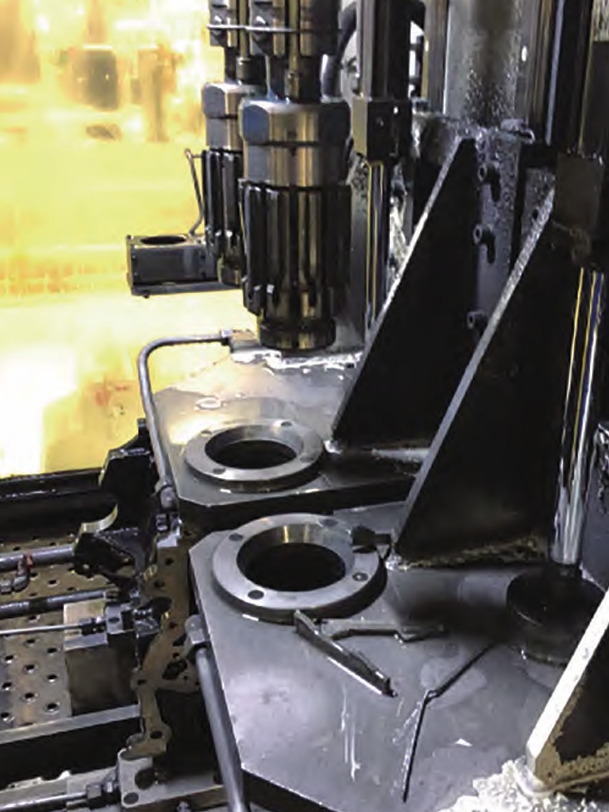
The image above illustrates a complex casting component, akin to the valve body in its geometric challenges, highlighting the importance of meticulous process design to avoid internal casting defects such as those analyzed here.
Following the positive simulation results, a production trial was conducted. The optimized process was implemented with additional shop-floor improvements to further safeguard against casting defects. In thick sections, chromite sand was used for mold facing to improve cooling and reduce shrinkage tendencies. The mold coating was changed to a zircon-based alcohol coating with a controlled thickness of 2 mm to enhance surface finish and prevent metal-mold reaction gas defects. Multiple vent channels were incorporated in the sand cores to ensure proper gas evacuation, mitigating another potential source of gas porosity, a common casting defect. The trial castings were produced under the same conditions (pouring temperature 1,580°C). Subsequent RT inspection revealed no internal defects exceeding the specified standards. All mechanical property tests and hydrostatic tests were successfully passed, confirming the effectiveness of the optimization in resolving the identified casting defects.
The successful resolution of these issues underscores several fundamental principles in avoiding casting defects in heavy-section steel castings. First, for isolated hot spots and heavy sections, the use of efficient feeding aids like exothermic risers is crucial to prevent shrinkage porosity, a classic casting defect. The feeding distance \( L_f \) for a plate can be estimated as:
$$ L_f = 4.5 \sqrt{T} $$
where \( T \) is the plate thickness, but this must be supported by adequate riser design. Second, for medium and large steel castings, the gating system should employ principles like bifurcation or multiple ingates to distribute flow evenly. The ingate velocity must be controlled, typically below 0.6 m/s, to ensure calm, non-turbulent filling and prevent slag formation and air entrainment, key contributors to inclusion and gas-related casting defects. Third, incorporating slag traps or runner extensions is essential to divert the initial, oxide-laden metal away from the casting cavity, directly addressing the root cause of slag inclusion defects. Finally, the indispensable role of casting simulation software in the design phase cannot be overstated. By utilizing criteria such as porosity indices, Niyama values, inclusion tracking, and temperature gradient analysis, potential casting defects can be predicted and corrected virtually, greatly enhancing the first-pass yield rate and reducing costly trial-and-error in production.
Casting defects remain a significant challenge in foundry operations, impacting productivity, cost, and product reliability. A deeper understanding of their taxonomy and formation mechanisms is essential. Casting defects can be broadly categorized into gas defects (blowholes, pinholes), shrinkage defects (macro-shrinkage, microporosity), inclusion defects (slag, sand), pouring metal defects (cold shuts, misruns), and mold material defects (scabs, penetration). Each type has distinct root causes related to process parameters. For instance, gas porosity often follows Henry’s Law, where gas solubility in liquid metal decreases upon solidification, leading to bubble formation if the gas cannot escape:
$$ C_s = k_H P_g $$
where \( C_s \) is solubility, \( k_H \) is Henry’s constant, and \( P_g \) is partial pressure of the gas. Proper degassing and mold venting are critical controls.
| Casting Defect Type | Typical Causes | Key Preventive Measures | Relevant Formula/Principle |
|---|---|---|---|
| Shrinkage Porosity | Inadequate feeding, improper riser design | Use of chills, efficient risers, directional solidification | Chvorinov’s Rule, Niyama Criterion \( N_y = G/\sqrt{\dot{T}} \) |
| Slag Inclusion | Turbulent filling, oxidation, poor gating design | Laminar flow gating, slag traps, controlled pouring | Reynolds Number \( Re = \frac{\rho v D}{\mu} \), target Re < 2000 for laminar flow |
| Gas Porosity | High moisture in mold, improper venting, metal gas content | Dry molds, effective vents, metal degassing | Gas Solubility \( S = S_0 \exp(-\Delta H/RT) \) |
| Cold Shut | Low fluidity, low pouring temp, slow filling | Adequate superheat, optimized gating for quick fill | Fluidity length related to viscosity and surface tension |
Process optimization often involves multi-objective trade-offs. For example, increasing pouring temperature improves fluidity but can worsen metal oxidation and mold erosion, potentially leading to different casting defects. The goal is to find a parameter window that minimizes the total defect risk. Statistical methods like Design of Experiments (DOE) combined with simulation can be powerful. A response surface for defect probability \( P_d \) as a function of key variables like pouring temperature \( T_p \), pouring time \( t_p \), and riser size \( V_r \) could be modeled:
$$ P_d = f(T_p, t_p, V_r, …) $$
Minimizing \( P_d \) requires understanding the complex interactions.
In conclusion, the case of the high-pound-class valve body demonstrates a systematic approach to diagnosing and eliminating severe casting defects. By combining thorough defect analysis, principled process redesign focused on feeding and fluid flow control, advanced simulation verification, and careful production implementation, it was possible to transform a casting with unacceptable internal quality into one that meets stringent pressure-containing component standards. The lessons learned, particularly the importance of controlled filling velocity, efficient feeding for thick sections, and the strategic use of simulation, are universally applicable in the quest to produce sound, reliable castings free from detrimental casting defects. Continuous improvement in understanding and controlling the myriad factors that lead to casting defects is the cornerstone of advanced foundry engineering.