
In my extensive experience within the foundry industry, addressing casting defects is a perennial challenge that directly impacts productivity, cost, and delivery schedules. One particularly persistent issue I recently confronted involved significant shrinkage depressions, or sink marks, on the upper surfaces of medium-speed engine flywheels. These defects, often exceeding 3mm in depth and sometimes reaching over 5mm, led to high scrap rates. This article details my first-hand investigation into the root causes of these defects in these specific grey iron castings and the systematic, multi-faceted approach we implemented to resolve them. The principles discussed, while centered on a flywheel, are widely applicable to improving the quality of various grey iron castings.
The component in question was a disc-shaped flywheel, a critical part of the engine assembly. Its key specifications are summarized in the table below:
| Parameter | Specification |
|---|---|
| Rough Casting Dimensions | Ø702 mm × 133 mm |
| Minimum Wall Thickness | 46 mm |
| Cast Weight | 245 kg |
| Material Grade | Grey Iron (HT250 analogue) |
| Hardness Requirement | 190 – 240 HBW |
| Microstructure | Predominantly Type A graphite (≥4级), Pearlite ≥98% |
| Post-Casting Treatment | Stress Relief Annealing |
The initial casting process for these grey iron castings was conducted on a high-production molding line. Two castings were produced per mold box using alkaline phenolic resin-bonded sand. The gating system was a traditional pressurized design, with the choke area located at the ingates. The key parameters of the standard process are outlined as follows:
| Aspect | Initial Process Parameters |
|---|---|
| Molding | Alkaline Phenolic Resin Sand, 2 castings/mold |
| Gating System Type | Pressurized (Choke at Ingates) |
| Gating Ratio (∑Asprue:∑Arunner:∑Agate) | 1.64 : 2.05 : 1 |
| Metal Composition | ~3.25% C, ~1.9% Si, ~0.95% Mn, ~0.4% Cu, ~0.28% Cr |
| Pouring Temperature | 1350 – 1360 °C |
| Mold Hardness / Compactness | Standard (15 seconds jolting time) |
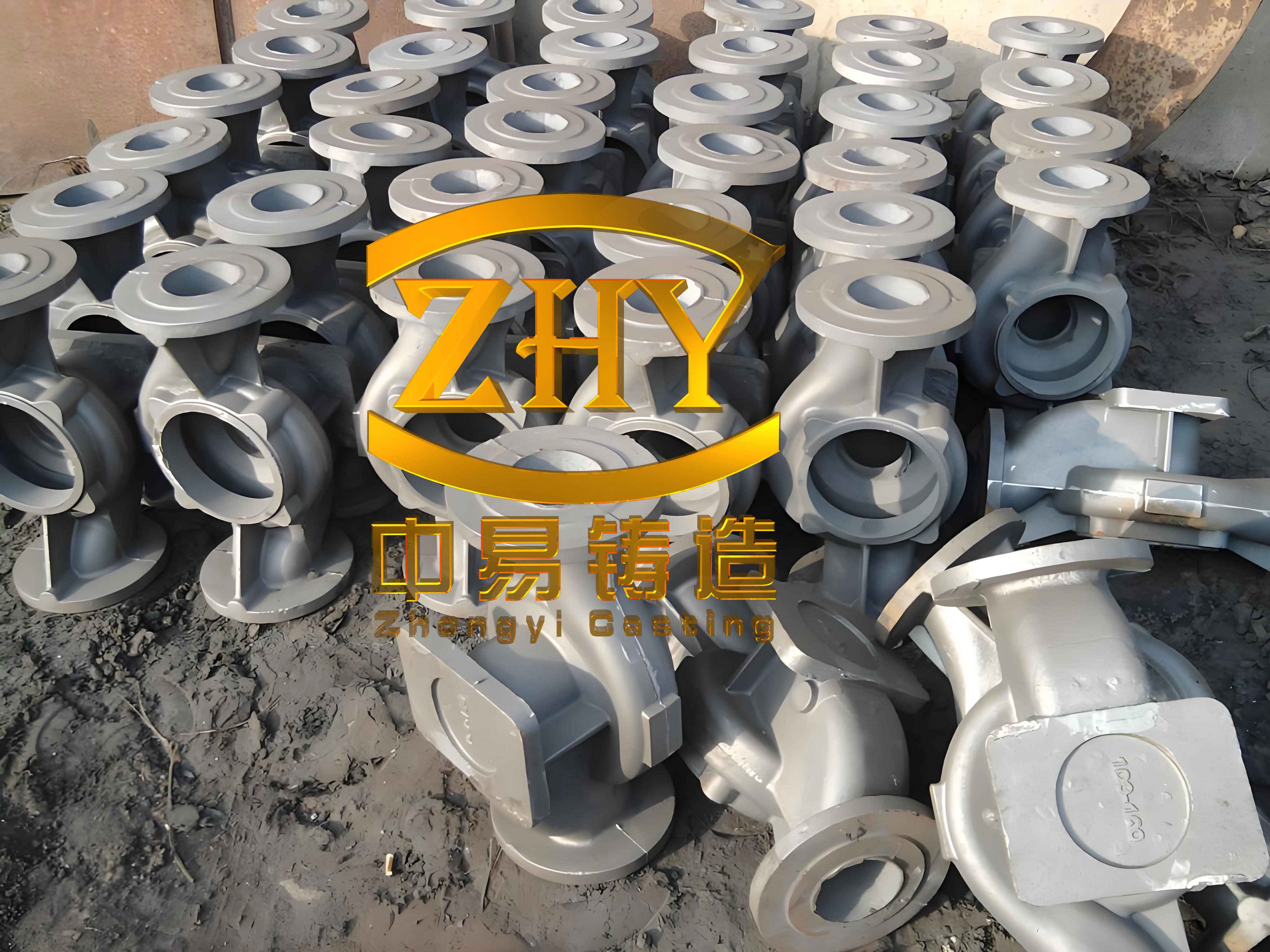
The defect manifested as a pronounced depression on the top coping surface of the casting. Upon closer examination, small “metal beads” were sometimes found within these depressions. Crucially, the depression areas retained the refractory coating after shakeout, while the beads did not. This observation was key to diagnosing the issue not as a gas defect or sand inclusion, but as a true shrinkage depression. The beads were interpreted as molten iron exuded during the final stages of solidification due to graphite expansion pressure, which explains the lack of coating on them. The defect formation in such grey iron castings can be fundamentally described by the total volume change during cooling and solidification:
$$ \Delta V_{total} = \Delta V_{liquid} + \Delta V_{solidification} + \Delta V_{solid} $$
Where $\Delta V_{liquid}$ is the contraction from pouring temperature to the liquidus, $\Delta V_{solidification}$ is the contraction (or expansion) during the phase change, and $\Delta V_{solid}$ is the thermal contraction of the solid metal. For grey irons, the graphite precipitation during eutectic solidification causes an expansion that can counteract the earlier shrinkage. A net shrinkage defect occurs when the liquid contraction and primary solidification shrinkage exceed the compensatory graphite expansion and the feeding capacity of the gating and risering system.
A thorough root-cause analysis was conducted, focusing on metallurgy, process dynamics, and mold integrity. The findings are summarized in the table below, linking each factor to its physical mechanism.
| Suspected Cause | Technical Analysis & Mechanism |
|---|---|
| Sub-optimal Carbon Equivalent (CE) | The initial chemistry placed the iron in a hypoeutectic region. A lower CE widens the solidification range, increasing the time and volume subject to shrinkage before graphite expansion begins. The Carbon Equivalent is calculated as: $$ CE = C\% + \frac{1}{3}(Si\% + P\%) $$ A low CE value increases the proportion of primary austenite, which contracts upon solidification. |
| Excessively High Pouring Temperature | A higher superheat increases the $\Delta V_{liquid}$ term in the total shrinkage equation. The liquid contraction volume can be approximated by: $$ \Delta V_{liquid} \approx \alpha_l \cdot V_0 \cdot (T_{pour} – T_{liquidus}) $$ where $\alpha_l$ is the coefficient of liquid thermal contraction. Higher $T_{pour}$ directly increases this contraction. |
| Inadequate Mold Stiffness | If the sand mold lacks sufficient rigidity (hardness), the internal metallostatic pressure and graphite expansion pressure can cause mold wall movement. This effectively increases the mold cavity volume during solidification, creating a void that appears as a shrinkage depression. The pressure, $P$, on the mold wall is related to metal density ($\rho$), height ($h$), and expansion force ($F_{exp}$): $$ P = \rho g h + \frac{F_{exp}}{A} $$ A soft mold yields to this pressure. |
| Non-optimized Gating System Design | 1. Turbulent Filling: The choke at the ingates resulted in very high metal velocity (>200 cm/s), causing turbulent flow and potential air entrainment. This disrupted a calm, thermal gradient conducive to directional solidification. 2. Poor Feeding: The small ingate cross-section (5mm height) solidified too quickly, isolating the casting from the liquid metal in the gating system before the critical shrinkage period ended, cutting off liquid feed. 3. Uncontrolled Filling: The system’s design led to a significant drop in the pouring basin level after stoppage, reducing the effective feeding pressure head. |
Based on this analysis, a comprehensive set of corrective actions was designed and implemented, targeting each identified cause. The strategy was holistic, recognizing that a single change might be insufficient for such a robust defect in heavy-section grey iron castings.
1. Metallurgical Adjustment – Increasing Carbon Equivalent:
The carbon content was deliberately increased from approximately 3.25% to 3.30%. This adjustment served a dual purpose: it reduced the liquidus temperature, thereby decreasing the $\Delta V_{liquid}$ term, and it moved the composition closer to the eutectic point, enhancing the volume of graphite expansion ($\Delta V_{graphite}$) to better compensate for shrinkage. The target CE was raised accordingly.
2. Process Control – Lowering and Stabilizing Pouring Temperature:
The target pouring temperature was reduced to 1350°C. To ensure strict adherence and minimize human factor variability, we installed temperature monitoring cameras at the pouring stations and implemented a dedicated pouring schedule for these flywheels. This prevented the iron from being used after waiting for other, lower-temperature jobs, avoiding unintended temperature spikes.
3. Mold Hardness Enhancement – Improving Mold Stiffness:
The jolting time during mold compaction was increased from 15 seconds to 25 seconds. This simple change significantly increased the mold hardness and overall rigidity, reducing its propensity to deform under the pressures of solidification. A stiffer mold better contains the graphite expansion, turning it into effective internal feeding rather than mold wall movement.
4. Gating System Redesign – Utilizing Simulation Software:
This was the most significant engineering change. We employed Magma softw are to simulate the original and proposed designs. The goals were to achieve laminar flow and extend the feeding time. The optimized design featured:
– A choke sprue or restrictor between the pouring cup and the runner, converting the system to a “pressurized-open” type. This drastically reduced ingate velocity to around 80 cm/s.
– A modified runner geometry (3/4 circle) with a slag trap at the end to further calm the metal flow.
– Taller ingates (increased from 5mm to 8mm) with a slightly reduced width to maintain area. This increased the ingate’s modulus, delaying its solidification and maintaining a liquid feeding path for a longer period into the casting’s solidification.
The simulation clearly showed a more favorable temperature gradient and predicted the elimination of the isolated hot spot corresponding to the shrinkage zone.
5. Operational Tweak – Increasing Pouring Overflow:
A slight intentional over-pouring was instituted to compensate for any residual metal-level drop after pouring cessation, ensuring the sprue remained full to maximize the feeding pressure head during the initial cooling stage.
The table below provides a consolidated comparison of the key changes made to the process for producing these grey iron castings.
| Process Parameter | Initial State | Optimized State | Intended Effect |
|---|---|---|---|
| Carbon Content (Typical) | ~3.25% | ~3.30% | Increase CE, enhance graphite expansion |
| Pouring Temperature | 1350-1360°C | ~1350°C (controlled) | Reduce liquid contraction volume |
| Mold Jolting Time | 15 sec | 25 sec | Increase mold hardness/rigidity |
| Gating System Type | Fully Pressurized | Pressurized-Open (Choked Sprue) | Calm filling, controlled flow |
| Ingate Height | 5 mm | 8 mm | Delay ingate solidification, extend feeding |
| Ingate Velocity (Simulated) | ~200 cm/s | ~80 cm/s | Reduce turbulence, promote thermal gradient |
The implementation of these combined measures yielded immediate and sustainable results. In a production batch of over one hundred flywheels cast after the changes, the severe shrinkage depressions were completely eliminated. The castings exhibited smooth, sound upper surfaces, meeting all dimensional and quality specifications. The scrap rate for this defect dropped to zero, resolving the cost and delivery issues.
This case underscores several critical, interdependent factors in producing sound, heavy-section grey iron castings:
1. Metallurgical Balance is Foundational: A properly adjusted carbon equivalent, tailored to the section size and casting geometry, is not just about meeting mechanical specifications but is crucial for controlling solidification behavior.
2. Process Control is Paramount: Consistent control of parameters like pouring temperature is often as important as their nominal values. Automation and procedural discipline are key.
3. Mold Rigidity is Frequently Underestimated: For grey iron castings that rely on graphite expansion for self-feeding, a hard, unyielding mold is essential to utilize that expansion effectively. It acts as an external pressure vessel.
4. Modern Simulation Tools are Invaluable: Software like Magma allows for proactive system design and optimization, visualizing flow and solidification to prevent defects before tooling is ever modified. The feeding efficiency of a gating system can be modeled by considering the pressure head and the solidification time of the feeding paths.
5. A Systems Approach is Necessary: Isolated corrections often fail. Success came from simultaneously addressing metal composition, thermal management, hydraulic design, and mold properties.
The principles demonstrated here—balancing contraction and expansion forces, ensuring adequate feeding through proper hydraulic and thermal design, and maintaining process control—are universally applicable to enhancing the quality and yield of a wide range of grey iron castings. Future work may involve further refining the gating design for yield improvement or exploring the effects of minor elements like tin or antimony on the pearlite stability and shrinkage characteristics in such castings. The continuous pursuit of perfection in the art and science of producing grey iron castings remains a cornerstone of efficient and competitive foundry operations.