
In the manufacturing of high-performance internal combustion engines, crankshafts serve as critical components, subjected to severe operational conditions including prolonged bending and torsional loads. To meet the demands for rigidity, fatigue strength, and wear resistance, high-grade nodular cast iron, specifically QT800-2, is widely adopted due to its excellent mechanical properties and cost-effectiveness. However, during the production of these crankshafts, a recurring issue has been the occurrence of inclusion defects on the machined surfaces, particularly at stress-concentration areas such as oil hole edges and fillet radii. These defects, if present in critical sections, can lead to catastrophic failures and necessitate scrapping of the parts. This article, from a first-person perspective as part of a production and quality control team, delves into a comprehensive analysis of the inclusion problem in high-grade nodular cast iron crankshafts, outlining the manufacturing process, root causes, and implemented solutions to enhance product quality.
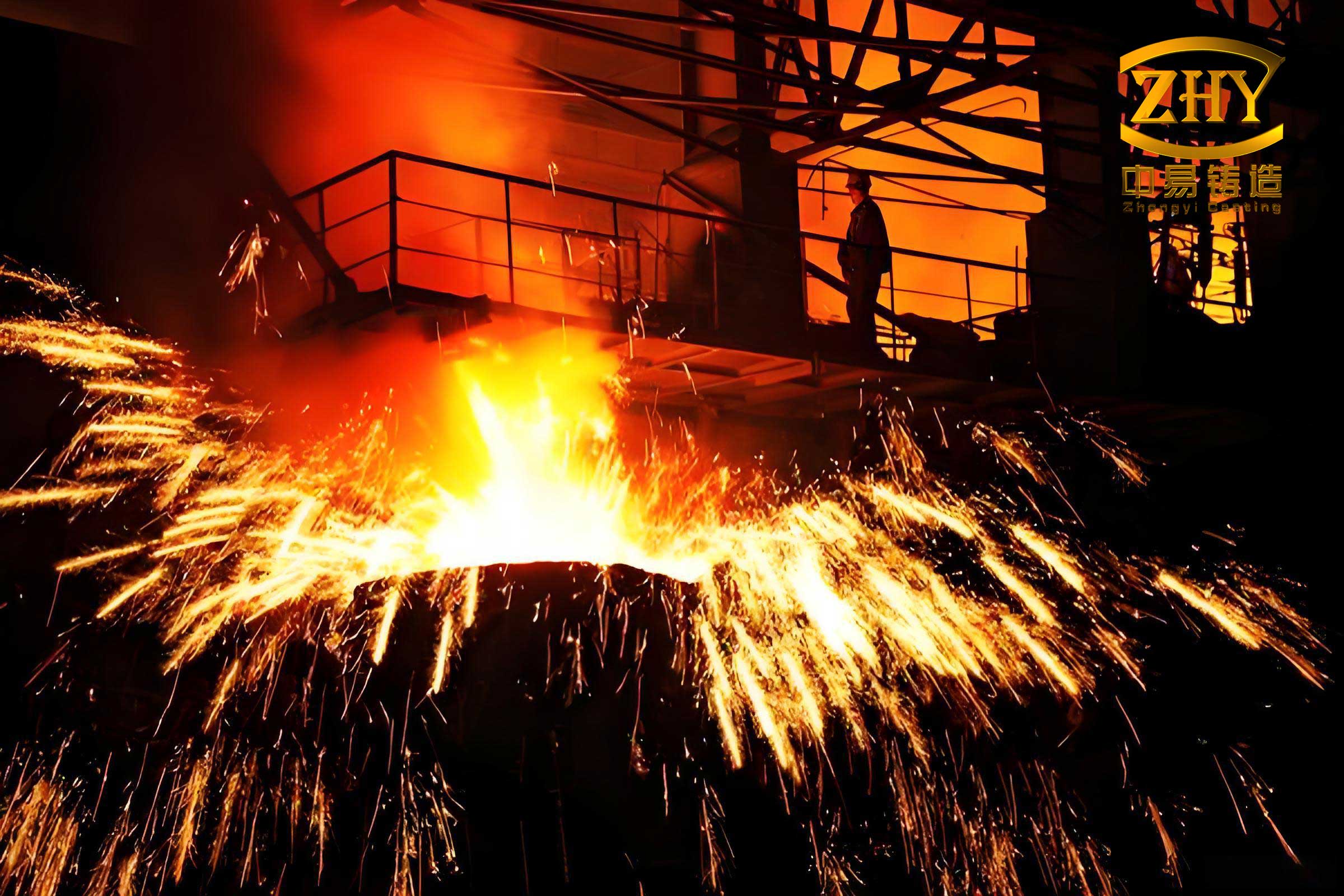
The production of high-grade nodular cast iron crankshafts involves a series of intricate steps, each crucial for ensuring the final product’s integrity. The process begins with molding, where alkaline phenolic resin self-hardening sand is used due to its simplicity and efficiency for crankshaft shapes. The mold is typically split into upper and lower sections, with complex geometries formed using chill sand cores. The entire process, except for mold closing, is automated via a production line, ensuring consistency and repeatability.
Melting is conducted in medium-frequency induction furnaces, where raw materials including pig iron, steel scrap, returned crankshaft/nodular cast iron scrap, and ferroalloys such as ferrosilicon and ferromanganese are charged. Controlling the base iron composition is paramount to achieving high-quality nodular cast iron, with strict limits on detrimental elements. The target chemical composition of the base iron is summarized in Table 1.
| Element | Target Range |
|---|---|
| Carbon (C) | 3.6 – 3.8 |
| Silicon (Si) | 1.2 – 1.5 |
| Manganese (Mn) | ≤ 0.6 |
| Sulfur (S) | ≤ 0.022 |
| Phosphorus (P) | ≤ 0.06 |
After melting, the iron is tapped into a treatment ladle where ferrosilicon and other alloys are added to adjust composition. Nodularization is achieved using a wire-feeding process, employing magnesium-bearing nodularizing wire (with approximately 20% Mg content) and inoculating wire to promote the formation of spherical graphite. Additional alloys are introduced to enhance pearlite formation. The final chemical composition of the nodular cast iron crankshaft is controlled within the ranges shown in Table 2.
| Element | Target Range |
|---|---|
| Silicon (Si) | 2.0 – 2.4 |
| Copper (Cu) | 0.5 – 0.6 |
| Antimony (Sb) | 0.01 – 0.02 |
| Magnesium (Mg) | 0.030 – 0.045 |
| Rare Earth (RE) | 0.005 – 0.020 |
Pouring is conducted using an automatic pouring machine with a teapot-style ladle to minimize slag entry. The pouring temperature is maintained between 1380°C and 1400°C. To counteract inoculation fade and refine graphite morphology, a secondary inoculation is applied using a silicon-zirconium stream inoculant, added at a mass fraction of 0.08% to 0.12%. The casting is oriented horizontally during pouring and immediately rotated to a vertical position after filling (within approximately 100 seconds) to facilitate directional solidification and feeding through the risers.
Post-casting, the molds are broken after a minimum of 24 hours to allow for complete cooling. The castings are then cleaned of residual sand, and the gating systems are removed. To optimize the mechanical properties, a heat treatment process is essential. The crankshafts are heated to about 900°C, transforming the ferrite and pearlite matrix into austenite, with partial dissolution of spherical graphite into the austenite. After holding at this temperature, the castings are air-cooled, resulting in a fine pearlitic structure that enhances overall strength and toughness. This process is critical for high-grade nodular cast iron components like crankshafts.
The inclusion defects observed on machined surfaces of nodular cast iron crankshafts were characterized using scanning electron microscopy (SEM) combined with energy-dispersive X-ray spectroscopy (EDS). The analysis revealed that the defect sites were primarily composed of slag inclusions, with elevated levels of oxygen (O), silicon (Si), magnesium (Mg), and aluminum (Al). This indicates the presence of oxide and possibly sulfide compounds. Inclusions in nodular cast iron can be categorized into primary and secondary slags. Primary slags originate from inadequate slag removal during the melting or pouring stages, such as residues from nodularization reactions. These are relatively straightforward to address through better process control. However, the defects in question were identified as secondary slags, which form during mold filling due to oxidation of the iron or reactions between the molten metal and mold/core materials. The common constituents of secondary slags in nodular cast iron include oxides like MgO, SiO₂, and Al₂O₃, and sulfides such as MgS. The formation of these inclusions can be described by chemical reactions. For instance, the oxidation of magnesium can be represented as:
$$2Mg + O_2 \rightarrow 2MgO$$
Similarly, the reaction between magnesium and sulfur to form magnesium sulfide is:
$$Mg + S \rightarrow MgS$$
These reactions are influenced by process parameters, particularly the residual magnesium and sulfur contents in the nodular cast iron. The thermodynamic driving force for such reactions can be expressed using the Gibbs free energy equation:
$$\Delta G = \Delta H – T\Delta S$$
where $\Delta G$ is the change in Gibbs free energy, $\Delta H$ is the enthalpy change, $T$ is the temperature, and $\Delta S$ is the entropy change. Negative $\Delta G$ values indicate spontaneous reaction, which is favorable for inclusion formation under certain conditions in nodular cast iron processing.
To mitigate the inclusion defects, a multi-faceted approach was undertaken, focusing on controlling residual magnesium and sulfur levels, enhancing raw material management, and addressing crankshaft bending issues. The residual magnesium content in the nodular cast iron was initially maintained between 0.03% and 0.045%, often targeting the upper limit to ensure satisfactory nodularization. However, excessive magnesium increases the risk of magnesium compound formation. By analyzing historical data, it was determined that the residual magnesium could be reduced while still achieving acceptable graphite nodularity. The control limits were adjusted, and the addition of nodularizing wire was optimized to minimize slag generation and temperature drop during treatment. The distribution of residual magnesium before and after the adjustment is illustrated in Table 3, showing a shift towards the lower end of the specification.
| Range (Mass %) | Frequency Before Adjustment (%) | Frequency After Adjustment (%) |
|---|---|---|
| 0.030 – 0.035 | 20 | 45 |
| 0.035 – 0.040 | 50 | 40 |
| 0.040 – 0.045 | 30 | 15 |
Metallographic examination confirmed that the nodular cast iron maintained a graphite nodularity grade of 3 or higher (according to relevant standards) and a graphite size of 5 to 7, both within acceptable limits, even with the reduced magnesium content. This demonstrates that the quality of nodular cast iron was not compromised. The relationship between residual magnesium and inclusion propensity can be modeled empirically. For instance, the probability of inclusion formation $P_i$ might be correlated with residual magnesium content $[Mg]$ and sulfur content $[S]$ through an equation such as:
$$P_i = k \cdot [Mg]^a \cdot [S]^b$$
where $k$, $a$, and $b$ are constants derived from process data for nodular cast iron. Minimizing $P_i$ involves controlling both $[Mg]$ and $[S]$.
Raw material purity plays a pivotal role in minimizing inclusions in nodular cast iron. To reduce impurity elements and trace contaminants, high-purity pig iron and low-phosphorus, low-titanium pig iron were substituted for standard grades. Additionally, strict batch management was enforced for pig iron and steel scrap to ensure consistent chemical composition without significant fluctuations. Returned scrap, consisting of gating systems and risers from nodular cast iron crankshafts, was meticulously cleaned through shot blasting to remove any adhered sand, and cross-contamination with other alloy scraps was prohibited. This rigorous control at the raw material stage directly reduces the influx of elements that contribute to slag formation in nodular cast iron.
Crankshaft bending during heat treatment and subsequent cooling was identified as another indirect contributor to surface inclusion defects. If a crankshaft warps excessively, the machining allowance becomes uneven. After setting the machining datum, the side with greater bending requires more material removal, while the opposite side has less. Insufficient machining on the latter side may fail to eliminate subsurface inclusions, leading to their appearance as defects after final polishing. To quantify this, a simple geometric model can be used. If the crankshaft bends with a maximum deflection $\delta$, the effective machining depth $d_{eff}$ on the convex side is reduced compared to the nominal depth $d_n$:
$$d_{eff} = d_n – \delta \cdot \sin(\theta)$$
where $\theta$ is the angular position along the crankshaft. For small deflections, this reduction can leave inclusions near the surface. To address this, the riser removal operation was shifted from after heat treatment to before heat treatment. This reduced the unbalanced weight during heating, minimizing bending caused by gravitational effects. Furthermore, specialized gauges were developed to measure crankshaft straightness, and any crankshaft exceeding tolerance limits was subjected to straightening processes. These measures significantly reduced the incidence of inclusions linked to insufficient machining due to bending in nodular cast iron crankshafts.
The effectiveness of the implemented solutions was evaluated through statistical analysis of defect rates. The inclusion defect frequency decreased by approximately 60% compared to the baseline, demonstrating a substantial improvement in the quality of nodular cast iron crankshafts. A summary of key process parameters and their optimized ranges is provided in Table 4, highlighting the holistic approach taken.
| Parameter | Original Range/ Practice | Optimized Range/ Practice |
|---|---|---|
| Residual Mg Content (%) | 0.030 – 0.045 (upper bias) | 0.030 – 0.040 (lower bias) |
| Sulfur Content in Base Iron (%) | ≤ 0.022 | ≤ 0.018 (stricter control) |
| Pig Iron Type | Standard Q10 | High-Purity, Low-P/Ti |
| Riser Removal Timing | After Heat Treatment | Before Heat Treatment |
| Straightness Control | Visual Inspection | Gauge Measurement & Straightening |
| Secondary Inoculation (%) | 0.08 – 0.12 | 0.10 – 0.12 (optimized) |
In conclusion, the problem of surface inclusions in high-grade nodular cast iron crankshafts was successfully mitigated through a systematic analysis and targeted interventions. Key takeaways include the critical importance of controlling residual magnesium and sulfur contents within optimal ranges to minimize the formation of secondary slags. The chemical kinetics of inclusion formation in nodular cast iron can be influenced by adjusting these elements. Moreover, stringent raw material management, including the use of high-purity charges and controlled return scrap, is fundamental to reducing impurity-driven defects. Finally, addressing geometric factors such as crankshaft bending ensured adequate machining allowance for defect removal. The collective implementation of these measures not only reduced the inclusion defect rate but also underscored the value of an integrated process control strategy in producing high-integrity nodular cast iron components. Future work may involve further refining the mathematical models for inclusion prediction and exploring advanced real-time monitoring techniques during melting and pouring for nodular cast iron applications.
The production of nodular cast iron crankshafts requires continuous attention to detail across all stages. By understanding the metallurgical principles behind inclusion formation and applying practical controls, manufacturers can consistently achieve the high performance demanded by modern engines. The experience gained from this case study reinforces that quality in nodular cast iron is not solely dependent on a single factor but on the harmonious control of multiple variables throughout the manufacturing chain.