
In the production of gray iron castings, a specific defect known as fissure-type nitrogen blowhole often arises, which can lead to significant economic losses due to scrapped components. This defect manifests as crack-like cavities, typically located in areas prone to shrinkage porosity, such as hot spots or thick sections of gray iron castings. It is frequently misdiagnosed as shrinkage defects, but its root cause lies in excessive nitrogen content in the molten iron. From my professional experience in foundry metallurgy, understanding this defect is crucial for improving yield and quality in gray iron castings. This article delves into the mechanisms, characteristics, and practical solutions, emphasizing the importance of controlling nitrogen levels to prevent such issues in gray iron castings.
The fissure-type nitrogen blowhole is an endogenous gas defect that occurs during the solidification of gray iron castings. It results from the precipitation of nitrogen gas when the nitrogen concentration in the molten iron exceeds its solubility limit upon cooling. Nitrogen, as a trace element, can enhance the strength and hardness of gray iron castings; however, when present in excess, it leads to detrimental porosity. The challenge lies in balancing the beneficial effects of nitrogen with the risk of defect formation, especially in high-grade gray iron castings where carbon equivalent is lower and nitrogen solubility is higher. Through this discussion, I aim to provide a comprehensive guide for foundries to mitigate this defect in gray iron castings.
Let me begin by explaining the formation mechanism. In molten iron, nitrogen dissolves interstitially, similar to carbon. During solidification, the solubility of nitrogen decreases with temperature. If the nitrogen content is below the solubility limit at the start of solidification, it remains dissolved and contributes to strengthening. However, if the nitrogen concentration surpasses the solubility, nitrogen gas bubbles nucleate and grow. For gray iron castings, which are hypoeutectic, austenite dendrites form first upon cooling. The nitrogen gas tends to accumulate in the interdendritic regions of these austenite crystals. As the surrounding metal solidifies, the gas bubbles become trapped, creating the characteristic fissure-shaped cavities. This process can be described by the solubility relationship for nitrogen in iron, which depends on temperature and composition. A simplified formula for nitrogen solubility in molten iron is often expressed as: $$ [N]_{sat} = A \cdot e^{-B/T} $$ where [N]_{sat} is the saturated nitrogen concentration in parts per million (ppm), T is the temperature in Kelvin, and A and B are constants influenced by alloy composition. In gray iron castings, elements like carbon and silicon reduce nitrogen solubility, making them more susceptible to blowholes when nitrogen levels are high.
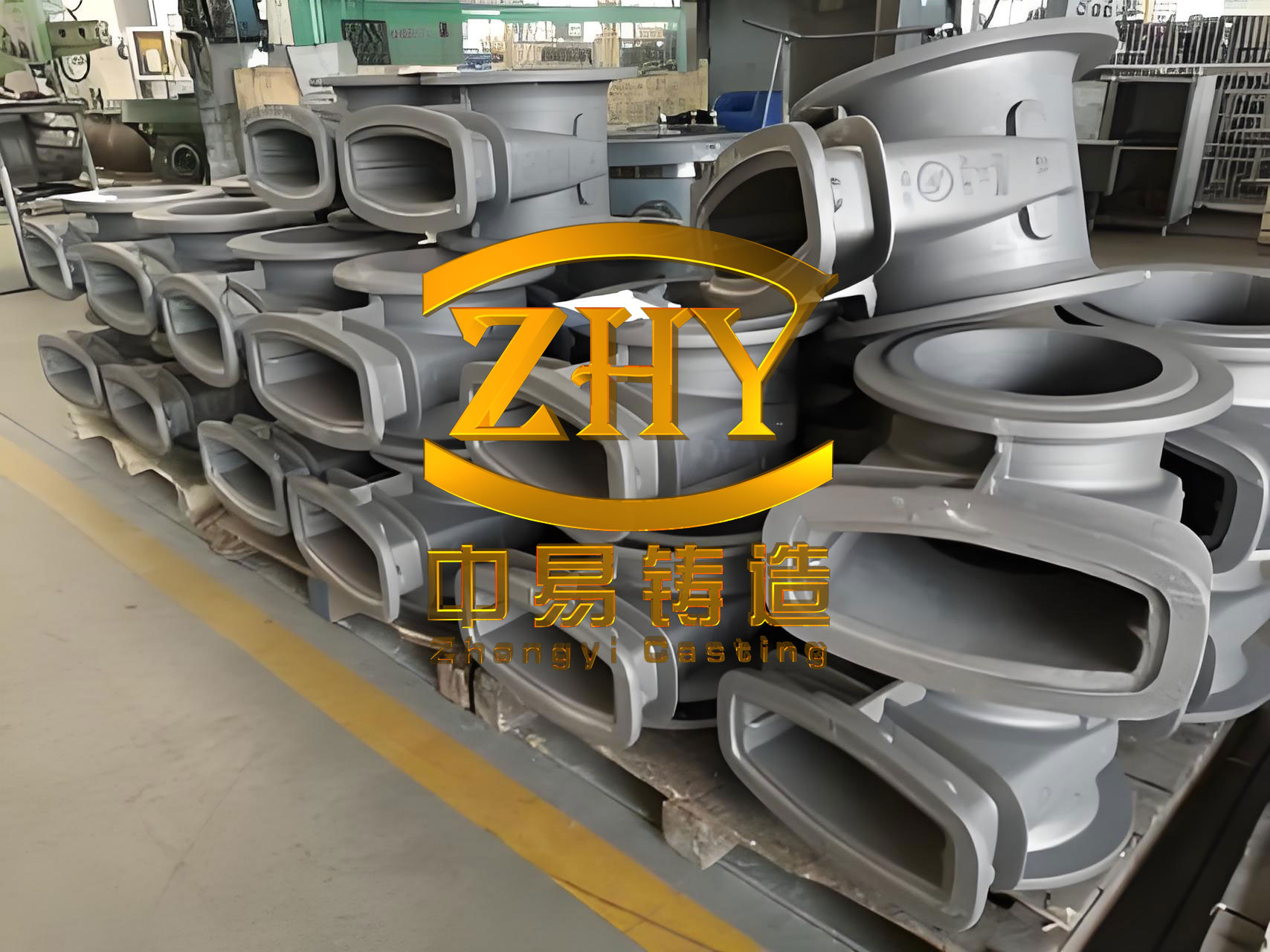
The characteristics of fissure-type nitrogen blowholes are distinct. Firstly, they are endogenous precipitation defects, meaning they originate from within the molten metal rather than from external reactions. This contrasts with exogenous gas defects, which appear on the surface of gray iron castings. Secondly, these blowholes are typically located in the upper sections or hot spots of gray iron castings, such as near risers or in thick regions, where solidification occurs last. This distribution aligns with the segregation of nitrogen during cooling, as nitrogen-rich liquid moves toward these areas. Thirdly, the shape is fissure-like, reflecting the austenite dendrite morphology. Under high magnification, the cavity walls show smooth surfaces with imprints of dendrites, distinguishing them from shrinkage pores. To summarize, here is a table comparing fissure-type nitrogen blowholes with shrinkage defects in gray iron castings:
| Feature | Fissure-Type Nitrogen Blowhole | Shrinkage Porosity |
|---|---|---|
| Origin | Internal nitrogen precipitation | Volume contraction during solidification |
| Location | Upper sections, hot spots | Hot spots, isolated cavities |
| Shape | Crack-like, interdendritic | Irregular, spongy |
| Surface | Smooth with dendrite marks | Rough, crystalline |
| Prevention | Control nitrogen content | Optimize feeding and cooling |
The nitrogen in molten iron for gray iron castings primarily comes from charge materials. Common sources include pig iron, returns, scrap steel, and carburizers. Pig iron usually has low nitrogen (10-30 ppm), while scrap steel can vary widely (50-140 ppm). Returns, especially from gray iron castings produced with nitrogen-containing binders, may have higher nitrogen due to contamination. Carburizers are a significant contributor; their nitrogen content depends on the type. Based on industry data, here is a table detailing various carburizers used in gray iron castings production:
| Carburizer Type | Fixed Carbon (%) | Nitrogen Content (ppm) | Sulfur Content (%) |
|---|---|---|---|
| Graphite Crucible Scrap | ≥ 99.70 | ≤ 100 | ≤ 0.02 |
| High-Temperature Graphitized | ≥ 99.00 | ≤ 300 | ≤ 0.05 |
| Medium-Temperature Graphitized | ≥ 98.00 | 500–800 | 0.30–0.50 |
| Graphite Electrode Scrap | ≥ 90.00 | ≤ 800 | ≤ 0.05 |
| Calcined Petroleum Coke | ≥ 98.00 | ≤ 8,000 | ≤ 0.30 |
| Calcined Coal-Based | ≥ 90.00 | ≤ 5,000 | ≤ 0.30 |
Additionally, in mold-making processes like furan resin or phenol urethane self-setting sand, nitrogen from the binder can dissolve into the molten iron during pouring, further increasing nitrogen levels in gray iron castings. The extent of this absorption depends on factors such as binder nitrogen content, casting thickness, and sand permeability.
To address fissure-type nitrogen blowholes in gray iron castings, a multifaceted approach is necessary. The fundamental strategy is to reduce the free nitrogen content in the molten iron. This can be achieved through charge control, selection of low-nitrogen materials, and process modifications. Let me outline key solutions based on my observations in foundry operations.
First, charge optimization is critical. When melting gray iron castings in induction furnaces, which tend to increase nitrogen pickup compared to cupolas, the proportion of scrap steel should be limited. Increasing pig iron content can lower overall nitrogen, as pig iron has inherently low nitrogen. For synthetic gray iron castings made from scrap and carburizers, choosing high-temperature graphitized carburizers with low nitrogen (e.g., ≤300 ppm) is essential to avoid excessive nitrogen introduction. Returns from gray iron castings should be cleaned via shot blasting to remove residual sand, especially when nitrogen-containing binders are used, to prevent nitrogen recycling.
Second, process controls during melting can help. Adding carburizers early in the melt and allowing sufficient holding time at high temperatures promotes nitrogen degassing. The relationship between holding time and nitrogen removal can be approximated by: $$ [N]_t = [N]_0 \cdot e^{-kt} $$ where [N]_t is the nitrogen concentration at time t, [N]_0 is the initial concentration, and k is a rate constant dependent on temperature and stirring. Maintaining dry charge materials minimizes hydrogen content, as hydrogen synergistically exacerbates nitrogen blowholes in gray iron castings. Moreover, controlling sand-to-metal ratio and using low-nitrogen binders in molding processes can reduce nitrogen absorption from molds.
Third, metallurgical treatments offer an alternative. By adding elements like titanium or zirconium, free nitrogen can be converted to stable nitrides, thus preventing gas precipitation. For instance, titanium addition follows the reaction: $$ Ti + [N] \rightarrow TiN $$ where TiN forms as inclusions. The amount of titanium required can be estimated based on nitrogen content. A common practice is to use ferrotitanium or zirconium-containing inoculants during treatment of gray iron castings. The effectiveness depends on the stoichiometry; for example, to bind 10 ppm of nitrogen, approximately 30 ppm of titanium might be needed, considering atomic weights. This approach not only mitigates blowholes but can also refine the microstructure of gray iron castings.
To quantify the impact of nitrogen on gray iron castings, studies show that nitrogen enhances mechanical properties up to a threshold. The increase in tensile strength (σ) with nitrogen content can be modeled as: $$ \Delta \sigma = \alpha \cdot \Delta [N] $$ where Δσ is the strength increase in MPa, Δ[N] is the nitrogen increment in ppm, and α is a coefficient ranging from 0.5 to 0.7 MPa/ppm for typical gray iron castings. For example, a 10 ppm rise in nitrogen may boost strength by 5–7 MPa and hardness by 3–4 HBW. However, exceeding critical levels—often around 90–100 ppm for thick-section gray iron castings—triggers blowhole formation. Therefore, monitoring nitrogen is vital; foundries should implement regular testing, either in-house or through external labs, to optimize nitrogen within safe limits for gray iron castings.
In conclusion, fissure-type nitrogen blowholes are a prevalent issue in gray iron castings, stemming from high nitrogen content in molten iron. They form during late solidification in interdendritic spaces, creating crack-like cavities that mimic shrinkage. Prevention hinges on comprehensive nitrogen management across charge materials, melting practices, and metallurgical treatments. From my perspective, foundries producing gray iron castings must prioritize low-nitrogen carburizers, balanced charges, and the use of nitride-forming elements when necessary. Regular nitrogen analysis is recommended to harness the strengthening benefits of nitrogen while avoiding defects. By adopting these measures, manufacturers of gray iron castings can enhance product quality, reduce scrap rates, and improve overall efficiency in casting operations.
To further elaborate, let me discuss some additional considerations for gray iron castings. The solubility of nitrogen is influenced by alloy composition. In gray iron castings, carbon and silicon are key elements; higher carbon equivalent (CE) reduces nitrogen solubility, increasing blowhole risk. The carbon equivalent is calculated as: $$ CE = C + \frac{Si + P}{3} $$ where C, Si, and P are percentages. For gray iron castings with lower CE (e.g., high-strength grades), nitrogen solubility is higher, so they can tolerate more nitrogen but are also more prone to blowholes if nitrogen exceeds limits. This interplay necessitates careful chemistry control for each batch of gray iron castings.
Another aspect is the effect of cooling rate. In thick gray iron castings, slow cooling allows more time for nitrogen segregation and bubble growth, exacerbating blowholes. Simulation tools can predict solidification patterns to identify risk areas in gray iron castings. Additionally, gating and riser design should facilitate degassing; for instance, tapered risers can help nitrogen escape before mold solidification. In my work, I’ve found that combining simulation with empirical data improves defect prediction for gray iron castings.
Regarding mold materials, the use of nitrogen-free or low-nitrogen binders, such as phenolic resins with minimal nitrogen, can reduce nitrogen pickup during pouring of gray iron castings. Sand regeneration systems should be maintained to control nitrogen buildup in reclaimed sand. Furthermore, coatings with good barrier properties can minimize metal-mold interactions, protecting gray iron castings from nitrogen absorption.
Finally, let me emphasize the economic impact. Scrap due to fissure-type nitrogen blowholes can be costly, especially for large or complex gray iron castings. Implementing preventive measures often involves upfront costs but leads to long-term savings. For example, switching to high-quality carburizers may increase material expenses, but it reduces defect rates and improves the consistency of gray iron castings. Foundries should view nitrogen control as an investment in quality assurance for gray iron castings.
In summary, the production of high-integrity gray iron castings requires a holistic approach to nitrogen management. By understanding the mechanisms, monitoring sources, and applying targeted solutions, foundries can effectively prevent fissure-type nitrogen blowholes. This not only enhances the performance of gray iron castings but also supports sustainable manufacturing practices. As the industry evolves, continuous research and adaptation will be key to optimizing processes for gray iron castings worldwide.