
In the field of textile machinery, wear-resistant components are critical for ensuring operational efficiency and longevity. Among these, needle rings fabricated from high-chromium white cast iron are widely employed due to their exceptional hardness and abrasion resistance. However, during product testing, we observed premature and rapid wear on needle rings, specifically at contact regions with needle pieces, leading to fabric distortion and failure to meet design life expectations. This investigation aims to dissect the root causes of this abnormal wear through a comprehensive analytical approach, emphasizing the role of microstructure in wear performance of white cast iron. The study involves comparative analysis between a severely worn needle ring and a well-performing unworn counterpart, utilizing macro-observation, compositional analysis, hardness testing, metallography, scanning electron microscopy (SEM), and energy-dispersive spectroscopy (EDS).
White cast iron, particularly high-chromium variants, is renowned for its high carbon and chromium content, which facilitates the formation of hard carbides within a martensitic matrix, conferring superior wear resistance. In textile applications, needle rings endure cyclic sliding contact with needle pieces, generating complex stress states. The premature wear observed here suggests deviations in material properties or microstructure that compromise durability. We delve into the wear mechanisms, focusing on abrasive wear phenomena influenced by carbide morphology and distribution. Throughout this analysis, we repeatedly reference white cast iron to underscore its significance in耐磨 applications.
The experimental procedure began with macroscopic examination of both worn and unworn needle rings. The worn sample exhibited smooth surfaces with elongated grooves aligned with the sliding direction of needle pieces, indicative of abrasive wear patterns. No foreign material adhesion or significant surface irregularities were noted, suggesting intrinsic material issues. The unworn sample displayed a pristine surface without such grooves. Chemical composition analysis was performed using optical emission spectroscopy and carbon-sulfur determinators. Results are summarized in Table 1, comparing elements against standard specifications for wear-resistant white cast iron.
| Element | Worn Sample | Unworn Sample | Standard Requirement (BTMCr12-DT) |
|---|---|---|---|
| C | 1.95 | 2.05 | 1.10–2.00 |
| Si | 0.24 | 0.28 | ≤1.50 |
| Mn | 0.31 | 0.31 | ≤2.00 |
| P | 0.02 | 0.03 | ≤0.06 |
| S | 0.02 | 0.01 | ≤0.06 |
| Cr | 11.86 | 11.50 | 11.00–14.00 |
| Ni | 0.07 | 0.33 | ≤2.50 |
| Mo | 0.05 | 0.29 | ≤3.00 |
| Cu | 0.12 | 0.11 | ≤1.20 |
| V | 0.24 | 0.18 | – |
The worn sample marginally exceeds the carbon limit, but more notably, it lacks significant nickel and molybdenum compared to the unworn sample. Nickel enhances toughness and matrix strengthening, while molybdenum refines grains and carbides, crucial for wear resistance in white cast iron. Hardness measurements were taken on surfaces and cross-sections using Rockwell and Vickers scales, respectively. Results are consolidated in Table 2, showing comparable surface hardness but highlighting differences in alloying effects.
| Sample | Surface Hardness (HRC) | Cross-section Hardness (HV) / Converted HRC |
|---|---|---|
| Worn Needle Ring | 63.1 | 543 HV / 52.0 HRC |
| Unworn Needle Ring | 63.8 | 549 HV / 52.5 HRC |
| Corresponding Needle Pieces (T10 Steel) | – | ~545 HV / 52.0–52.5 HRC |
Hardness conversion was approximated using the relation: $$ HRC \approx 0.095 \times HV – 24.5 $$ for values around 500–600 HV. Both needle rings meet the minimum hardness requirement of HRC 62, suggesting that hardness alone does not dictate wear performance. Metallographic examination revealed stark contrasts in microstructure. Samples were sectioned radially, polished, and etched to observe carbide distribution and matrix morphology. The unworn white cast iron exhibited a tempered martensitic matrix with uniformly dispersed secondary carbides and small, blocky eutectic carbides, rated at level 4 for carbide inhomogeneity per GB/T 14979-1994. In contrast, the worn white cast iron showed large, networked, and elongated eutectic carbides with sharp angles, forming closed networks rated at level 6, alongside fewer secondary carbides in the matrix. This microstructure is pivotal, as carbides in white cast iron directly influence abrasion resistance.
To quantify carbide effects, we consider the volume fraction of carbides, $V_c$, which impacts wear resistance. For white cast iron, $V_c$ can be estimated from composition using empirical formulas: $$ V_c \approx 0.12 \times (\%C) + 0.05 \times (\%Cr) – 0.8 $$ for high-chromium types. Applying this, both samples have similar $V_c$, but distribution differs. The mean free path between carbides, $\lambda$, affects stress concentration: $$ \lambda = \frac{1 – V_c}{N_A \cdot d} $$ where $N_A$ is number of carbides per unit area and $d$ is average carbide size. Larger $\lambda$ in the worn sample due to coarse carbides reduces matrix support, promoting carbide pull-out.
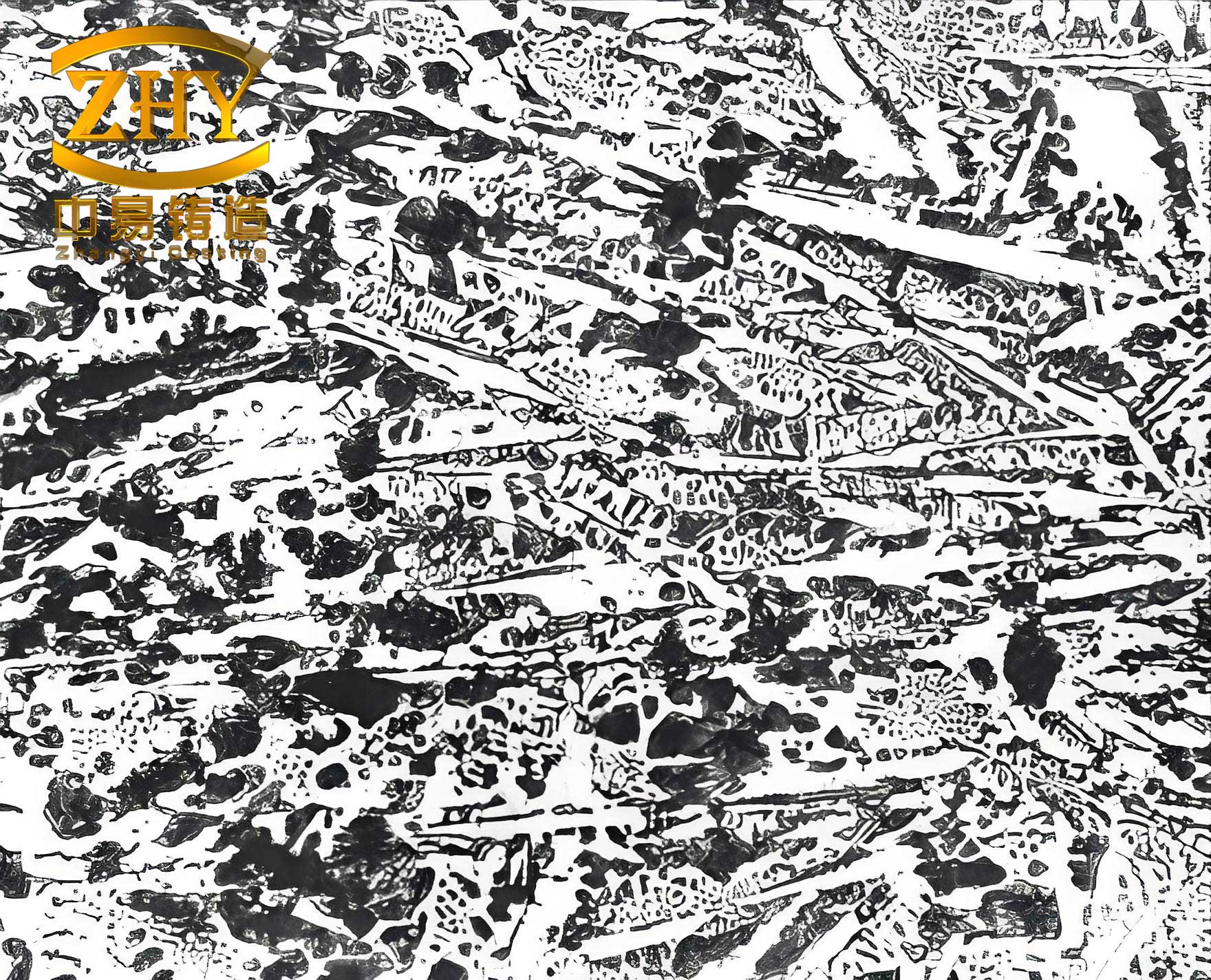
SEM surface morphology analysis further elucidated wear mechanisms. The worn white cast iron displayed numerous grooves ~2–5 µm wide, aligning with sliding direction, and voids matching carbide dimensions. EDS on these voids and extracted wear debris from lubricant confirmed high chromium and carbon content, signifying carbide origins. Table 3 presents EDS results, reinforcing that abrasive particles are primarily carbides from the white cast iron itself.
| Sample/Location | C | V | Cr | Fe | Si |
|---|---|---|---|---|---|
| Wear Debris from Lubricant | 27.72 | 0.75 | 30.82 | 39.06 | 0.35 |
| Surface Carbide on Worn Sample | 5.84 | 1.26 | 48.97 | 42.90 | – |
| Surface Carbide on Unworn Sample | 11.23 | 0.75 | 43.27 | 44.75 | – |
The wear mechanism is identified as abrasive wear, where hard particles plow through surfaces. The wear rate, $W$, can be modeled by Archard’s equation modified for abrasion: $$ W = k_a \cdot \frac{P \cdot v}{H^{3/2}} $$ where $k_a$ is an abrasive wear coefficient, $P$ is contact pressure, $v$ is sliding velocity, and $H$ is hardness. For white cast iron, $k_a$ depends on carbide morphology; coarse carbides increase $k_a$ due to easy detachment. In our case, detached carbides act as abrasives, accelerating wear—a self-propagating process. The contact pressure at needle ring uphill regions, where wear is severe, can be approximated: $$ P = \frac{F_n}{A_c} $$ with $F_n$ as normal force and $A_c$ as real contact area. Repeated sliding induces cyclic stresses, leading to fatigue-driven carbide removal.
Discussion centers on why the white cast iron in the worn sample succumbed to premature wear. Key factors include carbide network formation and insufficient matrix support. In white cast iron, eutectic carbides form during solidification; their size and shape are influenced by cooling rates and alloying. Molybdenum addition in the unworn sample likely refined carbides, as Mo forms stable carbides that nucleate finer structures. Nickel enhances austenite stability, aiding in martensite transformation and secondary carbide precipitation during tempering. Secondary carbides, precipitated from martensite, strengthen the matrix and anchor eutectic carbides. Their scarcity in the worn white cast iron reduces anchoring, making eutectic carbides prone to spalling.
We derive a carbide-matrix adhesion energy, $E_a$, to illustrate this: $$ E_a = \gamma_{cm} \cdot A_{interface} $$ where $\gamma_{cm}$ is interfacial energy and $A_{interface}$ is carbide-matrix contact area. For angular carbides, $A_{interface}$ is lower, reducing $E_a$. Additionally, stress concentration at carbide tips, $\sigma_{tip}$, follows: $$ \sigma_{tip} = \sigma_{applied} \cdot \left(1 + 2\sqrt{\frac{a}{\rho}}\right) $$ where $a$ is carbide size and $\rho$ is tip radius. Smaller $\rho$ in angular carbides raises $\sigma_{tip}$, promoting crack initiation. Combined with low $E_a$, this explains carbide pull-out in the worn white cast iron.
Comparative analysis of needle pieces (T10 steel) showed consistent composition and hardness, ruling out counterpart material as a contributor. Thus, the root cause lies in the white cast iron microstructure. The worn sample’s chemical composition, lacking Ni and Mo, led to coarse carbide networks during casting and heat treatment. The heat treatment process—quenching at 950°C and tempering at 400°C—may have been suboptimal for this composition, failing to fully destabilize austenite and precipitate secondary carbides. In white cast iron, proper “destabilization” heat treatment is essential to transform retained austenite and precipitate fine secondary carbides, enhancing matrix support.
To generalize, the wear resistance of white cast iron correlates with carbide morphology parameters. We propose a wear resistance index, $R_w$, for such materials: $$ R_w = \frac{H_m \cdot V_c^{1/2}}{\lambda \cdot S_c} $$ where $H_m$ is matrix hardness, $V_c$ is carbide volume fraction, $\lambda$ is mean free path, and $S_c$ is carbide shape factor (higher for angular shapes). For the unworn white cast iron, $R_w$ is higher due to finer $\lambda$ and lower $S_c$. Experimental validation through pin-on-disk tests could quantify $k_a$ for different white cast iron microstructures.
Further implications for textile machinery involve optimizing white cast iron grades. High-chromium white cast iron with balanced Ni, Mo, and V additions can yield superior performance. Vanadium, present in both samples, forms hard VC carbides that may enhance wear resistance if finely dispersed. However, in the worn sample, vanadium carbides might have coarsened due to inadequate processing. We recommend adjusting composition toward ASTM A532 Class III Type A specifications, which specify Ni and Mo for improved toughness and carbide refinement. Additionally, post-casting heat treatments like subcritical annealing or multiple tempering cycles can improve carbide distribution in white cast iron.
In conclusion, the abnormal wear of needle rings stems from abrasive wear initiated by carbide spalling. The white cast iron in the worn sample exhibits coarse, networked eutectic carbides with angular morphology and insufficient secondary carbides in the martensitic matrix, reducing adhesion and promoting particle generation. This study underscores the criticality of microstructure control in white cast iron for耐磨 applications. Recommendations include compositional adjustments to include Ni and Mo, optimized heat treatment to foster fine secondary carbides, and regular microstructure inspections to ensure carbide homogeneity. Future work could explore advanced manufacturing techniques like centrifugal casting or additive manufacturing to achieve finer carbide structures in white cast iron components, ultimately extending service life in textile and other industrial machinery.