
In recent years, the application of aluminum alloy thin-walled shell castings in aerospace and automotive industries has expanded significantly, driving advancements in casting technology while presenting new challenges. Traditional gating system design heavily relies on empirical knowledge, often requiring iterative testing for validation, which hinders technological progress. For aluminum alloy thin-walled shell castings, issues such as complex geometries and varying wall thicknesses demand precise control over the solidification process to minimize defects like shrinkage porosity. To address this, we integrate computational simulations with conventional methods, enabling detailed analysis of solidification phenomena. This study focuses on the low-pressure casting process for a hydraulic pump shell made from a novel Al-Si based alloy, employing numerical simulations and experimental validation to optimize the casting quality of shell castings.
We developed a new Al-Si based alloy by modifying ZL101A with trace additions of Ni and an Al-10Sr modifier to refine grain structure and enhance mechanical properties. The chemical composition of this material is summarized in Table 1.
| Element | Si | Mg | Fe | Ni | V | Al |
|---|---|---|---|---|---|---|
| Content | 6.9 | 0.35 | 0.09 | 0.06 | 0.007 | Balance |
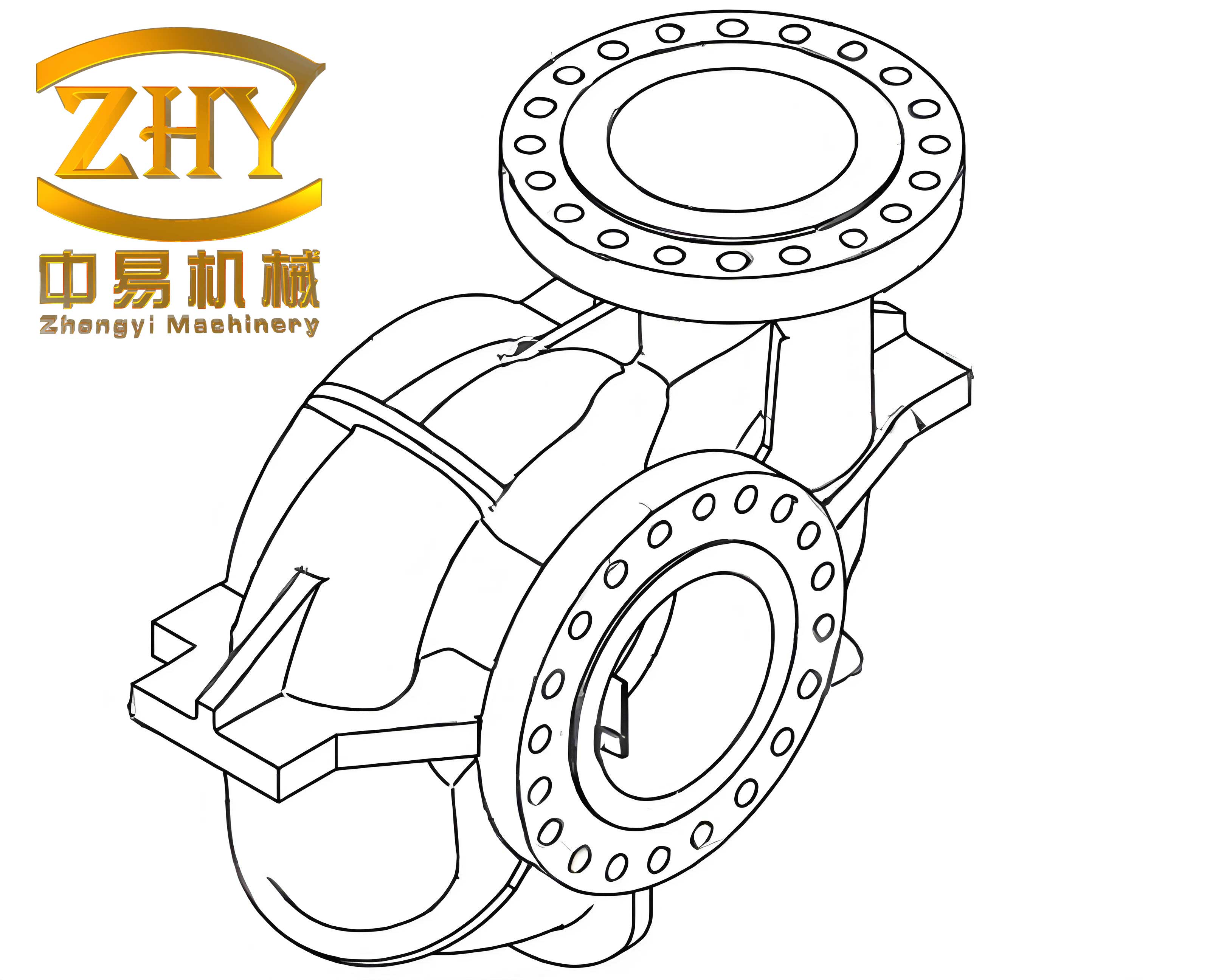
The hydraulic pump shell casting has overall dimensions of 167 mm in width, 248 mm in length, and 114 mm in height, with wall thicknesses ranging from 5 mm to 20 mm. It features rib structures on both sides to improve strength without increasing weight. We designed a low-pressure casting process with vertical placement along the symmetric plane, using twin cylindrical sprue channels (100 mm long, 10 mm diameter) to direct molten metal into the cavity. Venting slots (0.15 mm depth, 20 mm width) were incorporated to expel gases and reduce porosity defects in shell castings.
Key process parameters, such as filling velocity and pressure, were calculated to ensure optimal solidification. The minimum allowable average filling velocity $$ V_{min} $$ is derived from:
$$ V_{min} = 0.22 \times \frac{h}{\delta} \times \ln\left(\frac{T_{pour}}{380}\right) $$
where $$ h $$ is the casting height (mm), $$ \delta $$ is the wall thickness (mm), and $$ T_{pour} $$ is the pouring temperature (°C). For this shell casting, with $$ h = 114 $$ mm, $$ \delta = 5 $$ mm, and $$ T_{pour} = 630 $$°C, we obtained $$ V_{min} \approx 44 $$ mm/s. The filling pressure $$ P $$ is calculated using Pascal’s principle:
$$ P = H \gamma \mu $$
where $$ H $$ is the distance from the mold top to the molten metal surface (mm), $$ \gamma $$ is the metal density (N/mm³), and $$ \mu $$ is a resistance coefficient (1.2–1.5). Including atmospheric pressure, the total pressure was set to 0.1047 MPa. These parameters are summarized in Table 2 for shell castings.
| Parameter | Value | Unit |
|---|---|---|
| Pouring Temperature | 630 | °C |
| Filling Velocity | 44 | mm/s |
| Filling Pressure | 0.1047 | MPa |
| Mold Temperature | 20 | °C |
| Heat Transfer Coefficient (Mold-Air) | 25 | W/(m²·K) |
| Heat Transfer Coefficient (Casting-Mold) | 1500 | W/(m²·K) |
We performed numerical simulations using ProCAST software to analyze the filling and solidification processes. The finite element model of the shell casting was meshed with 389,526 tetrahedral elements and 107,900 nodes. Material properties, including thermal conductivity and latent heat, were computed via the CompuTherm module based on the alloy composition. The simulation accounted for coupled thermal-flow fields, predicting temperature distributions and solidification sequences.
The solidification process revealed distinct phases: initial filling (17.9 s), mushy state (27.8 s), solidus formation (182.5 s), and complete solidification (1552.3 s). The time to solidus across different regions of the shell casting varied, with thicker sections solidifying slower due to higher thermal mass. This uneven solidification can lead to shrinkage defects in shell castings, as isolated liquid pockets form during late-stage solidification. The solid fraction evolution is described by:
$$ f_s = 1 – \exp\left(-k (t – t_0)^n\right) $$
where $$ f_s $$ is the solid fraction, $$ k $$ and $$ n $$ are material constants, $$ t $$ is time, and $$ t_0 $$ is the start of solidification. This model helps predict shrinkage porosity in shell castings.
We manufactured actual aluminum alloy shell castings based on the simulated process. After removing the gating system and cleaning the surface, specimens were extracted for high-temperature compression tests to study the material’s behavior during solidification. Cylindrical samples (φ3 mm × 8 mm) were compressed at temperatures of 100°C, 300°C, and 550°C under strain rates ranging from 0.01 s⁻¹ to 20 s⁻¹. The microstructural evolution was analyzed to understand deformation mechanisms relevant to shell castings.
Table 3 summarizes the compression test conditions and observed microstructural characteristics for shell castings.
| Temperature (°C) | Strain Rate (s⁻¹) | Microstructural Characteristics |
|---|---|---|
| 550 | 0.01 | Large grain agglomeration due to slow deformation |
| 0.1 | Moderate grain growth | |
| 1 | Uniform fine structure, optimal for shell castings | |
| 5 | Increased particle clustering | |
| 20 | Rapid solidification leading to coarse grains | |
| 300 | 0.01–20 | Pronounced grain coarsening across all rates |
| 0.1 | Similar to 0.01 s⁻¹ but with slight refinement | |
| 1 | Partial uniformity, but defects emerge | |
| 5 | Internal cracking initiation | |
| 20 | Severe cracking and inhomogeneity | |
| 100 | 0.01–0.1 | Extensive cracking and poor integrity |
| 1 | Acceptable deformation with minor cracks | |
| 5 | Increased defect formation | |
| 20 | Catastrophic failure in shell castings |
The compression data indicate that at 550°C and a strain rate of 1 s⁻¹, the material exhibits homogeneous deformation with fine microstructures, ideal for minimizing defects in shell castings. This aligns with the solidification behavior where controlled cooling rates promote uniformity. The relationship between stress $$ \sigma $$, strain rate $$ \dot{\epsilon} $$, and temperature $$ T $$ can be expressed using the Arrhenius-type equation:
$$ \dot{\epsilon} = A \sigma^n \exp\left(-\frac{Q}{RT}\right) $$
where $$ A $$ is a constant, $$ n $$ is the stress exponent, $$ Q $$ is the activation energy, and $$ R $$ is the gas constant. This model helps optimize processing conditions for shell castings.
Shrinkage porosity in shell castings was predicted via simulation and correlated with experimental findings. The simulated results showed that initial pouring temperatures (630°C to 680°C) had minimal impact on reducing shrinkage, but heat treatment significantly improved outcomes. We applied a solution treatment at 550°C for 6 hours, followed by controlled cooling, to homogenize the microstructure. The shrinkage volume $$ V_{shrink} $$ can be estimated from the solidification contraction:
$$ V_{shrink} = \beta V_0 (1 – f_s) $$
where $$ \beta $$ is the volumetric shrinkage coefficient, $$ V_0 $$ is the initial volume, and $$ f_s $$ is the solid fraction. Post-treatment simulations demonstrated a marked reduction in porosity, confirming the efficacy of thermal management for shell castings.
Further analysis involved evaluating the effect of process variables on the quality of shell castings. We derived a comprehensive model linking pouring temperature, cooling rate, and defect formation. The defect probability $$ P_{defect} $$ is given by:
$$ P_{defect} = \alpha \cdot \exp\left(-\frac{T_{pour} – T_{opt}}{\Delta T}\right) + \gamma \cdot \left(\frac{\dot{T}_{cool}}{\dot{T}_{ref}}\right)^{-m} $$
where $$ \alpha $$, $$ \gamma $$, $$ \Delta T $$, $$ \dot{T}_{ref} $$, and $$ m $$ are empirical constants, $$ T_{opt} $$ is the optimal pouring temperature, and $$ \dot{T}_{cool} $$ is the cooling rate. This model underscores the importance of balanced parameters in producing high-integrity shell castings.
In summary, our study demonstrates that the novel Al-Si based alloy, enhanced with Ni and Sr, improves grain refinement in shell castings. Numerical simulations using ProCAST provided insights into solidification dynamics, while high-temperature compression tests revealed optimal deformation conditions. Through iterative process design, we established that a pouring temperature of 630°C combined with a solution treatment at 550°C for 6 hours effectively controls shrinkage porosity in shell castings. The integration of simulation and experiment offers a robust framework for optimizing the casting of complex thin-walled shell castings, ensuring enhanced mechanical properties and reduced defects. Future work will focus on scaling this approach for industrial applications, with continued emphasis on refining solidification models for shell castings.