
In modern manufacturing, the advancement of casting technology has significantly improved material properties, and heat treatment plays a crucial role in enhancing the quality of cast iron components. As a researcher in materials engineering, I have extensively studied the heat treatment processes for nodular cast iron, also known as ductile iron, which is widely used for mechanical parts due to its excellent combination of strength, ductility, and wear resistance. This article delves into the principles, classifications, and methodologies of heat treating nodular cast iron, aiming to provide a comprehensive guide for optimizing its performance. I will emphasize the importance of nodular cast iron in industrial applications and explore various thermal techniques through detailed explanations, tables, and formulas to summarize key aspects. The focus will be on both conventional and surface heat treatment methods, ensuring a thorough understanding of how to tailor nodular cast iron properties for specific needs.
To begin, it is essential to understand the broader context of cast iron types and their underlying principles. Cast iron is primarily classified based on the form and distribution of carbon within its microstructure. The main categories include white cast iron, gray cast iron, nodular cast iron, and compacted graphite iron. In white cast iron, carbon exists as cementite (Fe3C), leading to high hardness but brittleness, while gray cast iron contains flake graphite, which provides good machinability but limited strength. Nodular cast iron, however, is distinguished by its spheroidal graphite nodules, achieved through the addition of magnesium or rare earth elements during solidification. This unique structure gives nodular cast iron mechanical properties similar to steel, such as high tensile strength and toughness, making it highly amenable to heat treatment. The formation of graphite nodules can be described by nucleation and growth kinetics, often modeled using equations like the Johnson-Mehl-Avrami-Kolmogorov (JMAK) equation for phase transformations: $$ X(t) = 1 – \exp(-k t^n) $$ where \( X(t) \) is the transformed fraction, \( k \) is a rate constant, \( t \) is time, and \( n \) is the Avrami exponent. This foundational knowledge sets the stage for exploring heat treatment techniques that further enhance nodular cast iron.
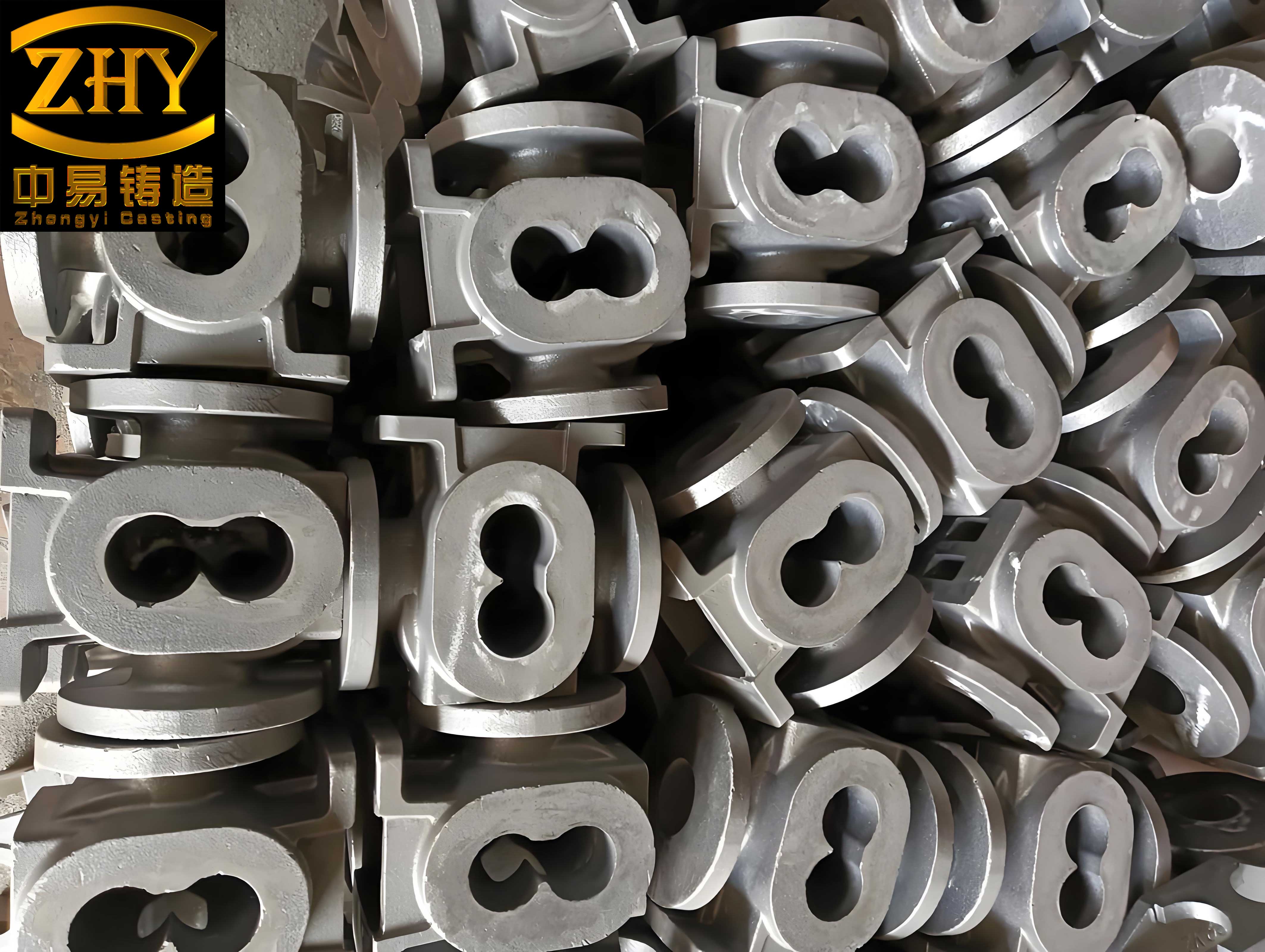
Heat treatment of nodular cast iron can be broadly categorized into two groups: processes that alter the microstructure and those that do not. Non-altering treatments, such as stress relieving, aim to reduce internal stresses without significant changes in properties, which is vital for dimensional stability in precision components. In contrast, microstructure-altering treatments are more commonly employed to modify mechanical characteristics like hardness, strength, and wear resistance. These include annealing, normalizing, quenching, surface hardening, and precipitation hardening. Each method targets specific phases within the nodular cast iron, such as ferrite, pearlite, austenite, or martensite, and their effectiveness depends on parameters like temperature, time, and cooling rate. For instance, the equilibrium phase diagram of iron-carbon alloys guides the selection of heat treatment temperatures, with critical points like the eutectoid temperature (approximately 727°C) playing a key role. Understanding these categories helps in selecting the appropriate heat treatment for nodular cast iron based on application requirements.
Conventional heat treatment methods for nodular cast iron involve bulk processing to achieve desired properties throughout the material. Below, I detail each method with tables and formulas to summarize key parameters and outcomes.
First, annealing is performed to decompose carbides and improve machinability by softening the nodular cast iron. The process typically involves heating to temperatures above 900°C, holding to allow carbon diffusion, and slow cooling. The decomposition of cementite can be expressed using the Arrhenius equation for reaction rates: $$ r = A \exp\left(-\frac{E_a}{RT}\right) $$ where \( r \) is the rate, \( A \) is the pre-exponential factor, \( E_a \) is the activation energy, \( R \) is the gas constant, and \( T \) is the temperature. A common annealing cycle for nodular cast iron includes heating to 920-950°C for 1-4 hours, followed by furnace cooling to 600°C and air cooling. This transforms the matrix into ferrite with spheroidal graphite, enhancing ductility. Table 1 summarizes typical annealing parameters and their effects on nodular cast iron.
| Temperature Range (°C) | Holding Time (hours) | Cooling Method | Resulting Microstructure | Hardness (HB) | Key Benefits |
|---|---|---|---|---|---|
| 900-950 | 2-4 | Furnace cool to 600°C, then air cool | Ferrite + graphite nodules | 150-200 | Improved machinability, reduced stress |
| 700-750 | 3-6 | Slow cool in furnace | Ferrite-pearlite mix | 180-230 | Balanced strength and ductility |
Second, normalizing aims to increase strength by producing a fine pearlitic matrix. The nodular cast iron is heated to 850-900°C, austenitized, and then air-cooled. This process dissolves carbon into austenite, which upon cooling transforms to pearlite. The hardness after normalizing can be correlated with pearlite content using a linear model: $$ H = H_f + \alpha P $$ where \( H \) is the hardness, \( H_f \) is the ferrite hardness, \( \alpha \) is a constant, and \( P \) is the pearlite volume fraction. Normalizing parameters are outlined in Table 2, highlighting how variations impact nodular cast iron properties.
| Austenitizing Temperature (°C) | Holding Time (minutes) | Cooling Rate (°C/s) | Resulting Microstructure | Tensile Strength (MPa) | Hardness (HB) |
|---|---|---|---|---|---|
| 850-870 | 60-90 | 10-20 (air) | Fine pearlite + graphite | 600-800 | 230-280 |
| 870-900 | 90-120 | 15-25 (air) | Coarse pearlite + graphite | 550-750 | 210-260 |
Third, quenching is used to achieve high surface hardness and wear resistance in nodular cast iron. The material is heated to 900-950°C for full austenitization, then rapidly cooled in oil or salt baths to form martensite. The quenching process follows the heat transfer equation: $$ \frac{dT}{dt} = -h (T – T_{\text{medium}}) $$ where \( \frac{dT}{dt} \) is the cooling rate, \( h \) is the heat transfer coefficient, and \( T_{\text{medium}} \) is the quenching medium temperature. After quenching, tempering at 300-500°C is performed to relieve stresses and improve toughness by converting martensite to tempered martensite. The tempered hardness can be estimated using the Hollomon-Jaffe equation: $$ H = H_0 \exp(-k T t^m) $$ where \( H_0 \) is the initial hardness, \( k \) and \( m \) are constants, \( T \) is tempering temperature, and \( t \) is time. Table 3 provides a summary of quenching and tempering parameters for nodular cast iron.
| Quenching Temperature (°C) | Quenching Medium | Tempering Temperature (°C) | Tempering Time (hours) | Resulting Hardness (HRC) | Impact Toughness (J) |
|---|---|---|---|---|---|
| 900-920 | Oil | 300-350 | 1-2 | 45-50 | 20-30 |
| 920-950 | Salt bath | 400-500 | 2-3 | 35-40 | 30-40 |
Fourth, tempering or tempering after quenching, often referred to as tempering treatment, is crucial for optimizing the balance between strength and toughness in nodular cast iron. This involves heating quenched material to 500-600°C to form tempered sorbitte, which offers good fatigue resistance. The tempering kinetics can be described using the Larson-Miller parameter: $$ P = T (\log t + C) $$ where \( P \) is the parameter, \( T \) is temperature in Kelvin, \( t \) is time in hours, and \( C \) is a constant. This helps predict the effect of tempering on nodular cast iron properties.
Fifth, austempering, or isothermal quenching, produces a bainitic matrix in nodular cast iron for exceptional strength and toughness. The process involves austenitizing at 830-870°C, then quenching to a salt bath at 280-350°C for isothermal transformation. The bainite formation time can be modeled with the Koistinen-Marburger equation for phase fractions: $$ f_B = 1 – \exp(-\beta (t – t_0)) $$ where \( f_B \) is the bainite fraction, \( \beta \) is a rate constant, \( t \) is time, and \( t_0 \) is an incubation time. Austempered nodular cast iron can achieve tensile strengths over 1100 MPa and impact toughness above 32 J, as summarized in Table 4.
| Austenitizing Temperature (°C) | Austempering Temperature (°C) | Holding Time (minutes) | Resulting Microstructure | Tensile Strength (MPa) | Hardness (HB) |
|---|---|---|---|---|---|
| 830-850 | 280-300 | 60-90 | Lower bainite + graphite | 1000-1200 | 350-400 |
| 850-870 | 320-350 | 90-120 | Upper bainite + graphite | 900-1100 | 300-350 |
Moving on to surface heat treatment methods, these are designed to enhance surface properties of nodular cast iron while maintaining a tough core. They are critical for applications like gears and bearings where wear resistance is paramount.
Surface hardening via induction or flame heating involves rapidly heating the surface to 900-950°C, followed by quenching. This creates a hardened layer of martensite, with depth controlled by heating time and power. The case depth \( d \) can be approximated using the heat conduction equation: $$ d = \sqrt{\alpha t} $$ where \( \alpha \) is thermal diffusivity and \( t \) is heating time. After quenching, tempering at 200-300°C is often applied to reduce brittleness. Table 5 compares different surface hardening techniques for nodular cast iron.
| Method | Heating Source | Surface Temperature (°C) | Quenching Medium | Case Depth (mm) | Surface Hardness (HRC) |
|---|---|---|---|---|---|
| Induction Hardening | High-frequency current | 900-950 | Water or polymer | 1-3 | 50-55 |
| Flame Hardening | Oxy-fuel torch | 900-950 | Oil or air | 2-4 | 48-52 |
| Laser Hardening | Laser beam | 950-1000 | Self-quenching | 0.5-2 | 55-60 |
Laser heat treatment utilizes focused laser beams to rapidly heat the surface of nodular cast iron, causing phase transformation hardening without the need for external quenching. The process is governed by the laser power density and scan speed, with hardness improvements due to refined microstructures. The temperature rise can be estimated using the one-dimensional heat flow model: $$ T(z,t) = T_0 + \frac{2I}{k} \sqrt{\frac{\alpha t}{\pi}} \exp\left(-\frac{z^2}{4\alpha t}\right) $$ where \( T(z,t) \) is temperature at depth \( z \) and time \( t \), \( T_0 \) is initial temperature, \( I \) is laser intensity, \( k \) is thermal conductivity, and \( \alpha \) is thermal diffusivity. This method is efficient for localized hardening of nodular cast iron components.
Surface chemical treatments, such as nitriding or carburizing, involve diffusing elements like nitrogen or carbon into the surface of nodular cast iron to form hard compounds. Nitriding, for example, is performed in ammonia atmospheres at 500-570°C for several hours, creating a nitride layer (e.g., iron nitrides) that boosts wear and corrosion resistance. The diffusion depth follows Fick’s second law: $$ \frac{\partial C}{\partial t} = D \frac{\partial^2 C}{\partial x^2} $$ where \( C \) is concentration, \( D \) is diffusion coefficient, and \( x \) is depth. For low-temperature gas nitrocarburizing, temperatures around 570°C are used with ammonia and carbon-containing gases to form a compound layer on nodular cast iron. Table 6 outlines common chemical treatments for nodular cast iron.
| Treatment Type | Process Temperature (°C) | Duration (hours) | Atmosphere | Case Depth (µm) | Surface Hardness (HV) |
|---|---|---|---|---|---|
| Gas Nitriding | 500-550 | 10-50 | Ammonia (NH3) | 100-300 | 800-1000 |
| Plasma Nitriding | 400-500 | 5-20 | Nitrogen-hydrogen mix | 50-200 | 900-1200 |
| Nitrocarburizing | 570-590 | 2-6 | NH3 + CO2 | 10-30 (compound layer) | 500-700 |
In conclusion, the heat treatment of nodular cast iron is a versatile and essential process for tailoring material properties to meet diverse industrial demands. Through conventional methods like annealing, normalizing, quenching, and austempering, the microstructure of nodular cast iron can be optimized for strength, hardness, and toughness. Surface treatments, including hardening and chemical diffusion, further enhance wear resistance while preserving core ductility. The selection of appropriate heat treatment for nodular cast iron depends on factors such as component design, service conditions, and performance requirements. By leveraging advanced modeling and empirical data, manufacturers can innovate and improve heat treatment techniques for nodular cast iron, ensuring its continued relevance in high-performance applications. Future research may focus on integrating digital twins and AI for predictive heat treatment of nodular cast iron, pushing the boundaries of material science.