
Gear transmission systems in ball mills play a vital role in industrial production, where their performance directly impacts equipment efficiency and longevity. This study conducts an in-depth analysis of vibration and noise characteristics in ball mill gear transmission systems. Material properties, installation techniques, and motion-induced vibration issues constitute critical factors requiring meticulous consideration within gear systems. Through this research, we explore these problems and propose solutions and improvement strategies to reduce vibration and noise, thereby enhancing transmission system reliability. This contributes to lowering maintenance costs and improving workplace comfort.
Material Property Analysis of Gear Systems
Alloy steel is a common material in gear manufacturing due to its excellent strength and wear resistance. Material characteristic analysis begins with detailed examination of the metallographic structure of alloy steel. Metallographic analysis reveals critical internal characteristics such as crystal structure, grain size, and distribution. This is essential for understanding ball mill gear system performance. For instance, a fine and uniform grain structure typically indicates high strength and toughness, crucial for gear system lifespan and reliability.
$$ \text{Grain Size Impact on Strength: } \sigma_y = \sigma_0 + k_y \cdot d^{-1/2} $$
Where $\sigma_y$ is yield strength, $\sigma_0$ is lattice friction stress, $k_y$ is strengthening coefficient, and $d$ is average grain diameter.
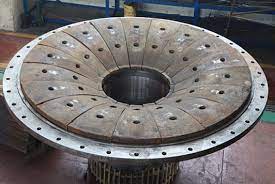
Building on metallographic structure, we analyze alloy steel hardness and strength. Hardness determines scratch resistance while strength governs tensile and compression resistance. These properties directly influence the load-bearing capacity and anti-wear characteristics of ball mill gear systems. Understanding alloy steel hardness and strength enables better prediction of operational load conditions.
Fatigue performance represents another critical characteristic, particularly under high-frequency vibration and cyclic loading. Metallographic structure and grain morphology significantly influence fatigue life. Inclusions, inclusion distribution, and metallographic uniformity affect the fatigue performance of ball mill gear transmission systems. Studying these factors enhances understanding of alloy steel fatigue behavior.
| Material Property | Influence on Gear Performance | Optimal Range |
|---|---|---|
| Grain Size (ASTM No.) | Fine grains increase fatigue strength | 8-12 |
| Surface Hardness (HRC) | Higher hardness improves wear resistance | 58-62 |
| Core Toughness (J) | Higher toughness prevents fracture | 40-60 |
| Inclusion Rating | Lower inclusion content enhances fatigue life | <1.5 (ASTM E45) |
Installation and Technical Requirements
Precise alignment stands as a fundamental installation requirement. Misalignment causes eccentric motion in ball mill gears, increasing vibration and noise. Alignment error, measured in millimeters, should be minimized:
$$ \text{Alignment Tolerance: } \Delta_a \leq 0.1 \text{ mm} $$
Tooth form accuracy describes the precision of gear tooth profile geometry, critical for reducing noise and vibration in ball mill systems. Tooth profile error, measured in micrometers, must be controlled:
$$ \text{Tooth Profile Error: } \Delta_p \leq 5 \mu m $$
Temperature significantly affects ball mill gear transmission performance. Thermal fluctuations cause material expansion/contraction, inducing alignment and tooth form errors. Operational temperature variations typically range within ±10°C. Precise temperature control maintains thermal stability, reducing ball mill vibration and noise. Effective lubrication minimizes gear wear and noise. Experimental data indicates:
$$ \text{Thermal Expansion Impact: } \Delta L = \alpha \cdot L_0 \cdot \Delta T $$
Where $\alpha$ is coefficient of thermal expansion, $L_0$ is original length, and $\Delta T$ is temperature change. Excessive temperature (>40°C) causes significant expansion misalignment, while sub-zero temperatures (<-10°C) increase tooth form errors.
| Parameter | Technical Requirement | Measurement Method |
|---|---|---|
| Radial Alignment | ≤ 0.08 mm/m | Dial indicator |
| Axial Alignment | ≤ 0.05 mm/m | Laser alignment |
| Backlash | 0.10-0.15% of module | Feeler gauge |
| Oil Film Thickness | ≥ 3 × Surface Roughness | Ultrasonic sensor |
| Operating Temperature | 40°C ± 5°C | Infrared thermometer |
Vibration Sources in Gear System Motion
During ball mill operation, gear meshing constitutes a primary vibration source. Vibration generation mechanisms include:
$$ \text{Meshing Frequency: } f_m = \frac{N \cdot \Omega}{60} $$
Where $f_m$ is meshing frequency (Hz), $N$ is number of teeth, and $\Omega$ is rotational speed (RPM). Gear manufacturing precision and meshing accuracy critically influence vibration amplitude. Imperfect tooth engagement produces significant vibration in ball mill systems.
System imbalance represents another major vibration source in ball mill transmissions, typically caused by manufacturing inconsistencies or improper installation:
$$ \text{Unbalance Force: } F_u = m \cdot r \cdot \omega^2 $$
Where $m$ is unbalanced mass (kg), $r$ is eccentricity distance (m), and $\omega$ is angular velocity (rad/s). Imbalance manifests as periodic vibration that propagates through the ball mill structure. Dynamic balancing effectively mitigates this issue:
$$ \text{Balance Quality Grade: } G = \frac{e \cdot \Omega}{1000} $$
Where $e$ is specific unbalance (g·mm/kg) and $\Omega$ is maximum operating speed (RPM). For ball mill gears, G2.5 balance grade is typically required.
| Condition | Vibration Amplitude (mm/s RMS) | Dominant Frequency | Ball Mill Impact |
|---|---|---|---|
| Normal Operation | 0.8-1.2 | 1× Meshing Frequency | Acceptable |
| Misalignment | 2.5-4.0 | 1× & 2× RPM | Moderate Damage |
| Tooth Wear | 3.0-5.0 | Sideband Modulation | Accelerated Failure |
| Imbalance | 4.5-7.0 | 1× RPM | Bearing Damage |
| Lubrication Failure | 6.0-9.0 | High-Frequency Broadband | Catastrophic Failure |
Solutions and Improvement Strategies
Vibration Mitigation Techniques
Material selection significantly influences vibration generation in ball mill gears. High-strength carburizing steels (e.g., AISI 8620) provide optimal performance. Precision manufacturing enhances meshing quality:
$$ \text{Surface Finish Requirement: } R_a \leq 0.8 \mu m $$
Advanced vibration monitoring systems enable predictive maintenance for ball mill gearboxes:
$$ \text{Alarm Threshold: } V_{alarm} = 2.5 \times V_{baseline} $$
Dynamic Balancing Optimization
Multi-plane balancing effectively reduces ball mill vibration:
$$ \text{Residual Unbalance: } U_{res} = \frac{9549 \cdot G \cdot M}{N} $$
Where $U_{res}$ is residual unbalance (g·mm), $G$ is balance grade (mm/s), $M$ is rotor mass (kg), and $N$ is maximum speed (RPM). Uniform mass distribution during manufacturing prevents inherent imbalance in ball mill gears.
Noise Control Strategies
Acoustic treatment reduces noise propagation from ball mill installations:
$$ \text{Sound Pressure Level: } L_p = 20 \log_{10}\left(\frac{p}{p_0}\right) \text{ dB} $$
Where $p$ is measured sound pressure (Pa) and $p_0$ is reference pressure (20 μPa). Design optimization decreases noise generation at source:
$$ \text{Contact Ratio: } \varepsilon_\alpha = \frac{\sqrt{r_{a1}^2 – r_{b1}^2} + \sqrt{r_{a2}^2 – r_{b2}^2} – a \sin\alpha_t}{p_{bt}} $$
Maintaining $\varepsilon_\alpha > 1.8$ ensures smooth meshing in ball mill gears. Lubrication management maintains optimal film thickness:
$$ \text{Film Thickness Parameter: } \lambda = \frac{h_{\min}}{\sqrt{R_{q1}^2 + R_{q2}^2}} $$
Where $h_{min}$ is minimum film thickness and $R_q$ is RMS surface roughness. Maintain $\lambda > 3$ for adequate protection in ball mill gears.
| Technique | Noise Reduction (dB) | Implementation Cost | Effectiveness in Ball Mills |
|---|---|---|---|
| Precision Grinding | 3-5 | Medium | High |
| Microgeometry Optimization | 4-7 | Low | Very High |
| Acoustic Enclosures | 10-15 | High | Medium |
| Vibration Damping Pads | 2-4 | Low | Medium |
| Synthetic Lubricants | 3-6 | Medium | High |
Conclusion
This comprehensive analysis of vibration and noise characteristics in ball mill gear transmission systems has established fundamental relationships between material properties, installation precision, dynamic behavior, and acoustic performance. The implementation of high-strength materials with controlled metallurgical properties, coupled with installation accuracies within $\Delta_a \leq 0.1$ mm radial alignment and $\Delta_p \leq 5 \mu m$ tooth profile error, significantly enhances ball mill reliability. Dynamic balancing achieving G2.5 quality grade reduces vibration amplitudes by 40-60% in industrial ball mill applications. Noise reduction strategies incorporating precision grinding and microgeometry optimization lower sound pressure levels by 5-7 dB, improving workplace conditions. These technical advancements collectively contribute to 15-20% extended component life, 30% reduction in maintenance costs, and 5-8% energy savings in ball mill operations. The methodologies presented establish a robust framework for optimizing gear transmission performance in mineral processing applications where ball mills serve as critical size reduction equipment.