
In the context of rapid global nuclear power expansion, the management of spent nuclear fuel has emerged as a critical challenge. Spent fuel, which is highly radioactive after discharge from reactors, requires safe and efficient handling, storage, transport, and eventual disposal. This article explores the pivotal role of nodular cast iron, also known as ductile iron, in advancing spent fuel reprocessing technologies. From its use in robust storage and transport containers to its application in waste disposal units, nodular cast iron offers a combination of mechanical strength, radiation shielding, and economic viability that makes it a material of choice. I will delve into the metallurgical characteristics, manufacturing processes, and performance standards that define nodular cast iron’s suitability for these demanding applications, emphasizing its potential to address current gaps in spent fuel management.
The journey of spent fuel begins with its removal from reactors, where it must be cooled in storage pools before being transported to reprocessing facilities. During reprocessing, valuable elements are extracted, and residual waste is solidified and encapsulated for geological disposal. However, with limited reprocessing capacity and overflowing storage pools, interim storage solutions have become urgent. Dry storage methods, which involve housing spent fuel in metal or metal-concrete containers, have gained prominence due to their flexibility and cost-effectiveness. Among metal containers, those made from nodular cast iron stand out for their monolithic design, high integrity, and superior shielding properties. In this article, I will analyze how nodular cast iron containers are engineered to meet stringent safety standards, including resistance to impact, fire, and corrosion, while facilitating long-term storage and transport.
Nodular cast iron’s evolution in nuclear applications dates back to the 1980s, with pioneering work by companies like Germany’s Siempelkamp, which developed the CASTOR series of transport casks. Unlike multi-layered designs, nodular cast iron containers feature a single shell that simplifies manufacturing and enhances durability. This material’s high density and thermal conductivity allow for compact designs without compromising safety. However, producing thick-section nodular cast iron components—such as container walls exceeding 400 mm—poses significant challenges, including slow solidification, elemental segregation, and graphite degeneration. Through advancements in metallurgy and casting techniques, these issues have been mitigated, enabling the production of large-scale containers capable of withstanding extreme conditions. I will examine the chemical composition controls, solidification kinetics, and heat treatment protocols that optimize nodular cast iron for nuclear service.
Beyond transport and storage, nodular cast iron finds application in containers for intermediate- and low-level radioactive waste generated during reprocessing. Examples include the MOSAIK series, which are used to store activated components, ion-exchange resins, and evaporated concentrates. The corrosion resistance of nodular cast iron ensures long-term containment, with estimated corrosion depths as low as 22.5 mm over 300 years, minimizing maintenance needs. This versatility underscores the material’s importance in a holistic spent fuel management strategy. As I proceed, I will incorporate tables and formulas to summarize key data, such as elemental limits and mechanical properties, while frequently highlighting the term “nodular cast iron” to reinforce its centrality. The goal is to provide a comprehensive overview that underscores the material’s growing prominence in nuclear technology.
Fundamental Properties of Nodular Cast Iron for Nuclear Applications
Nodular cast iron is characterized by its graphite spheroids embedded in a metallic matrix, typically ferritic or pearlitic, which impart a unique blend of ductility and strength. For nuclear containers, a ferritic matrix is often preferred due to its enhanced toughness and irradiation resistance. The material’s performance hinges on precise control over its chemical composition, solidification behavior, and microstructure. In this section, I will detail these aspects, using formulas to model solidification times and tables to outline compositional standards.
The chemical composition of nodular cast iron for spent fuel containers must be meticulously regulated to avoid detrimental elements that promote graphite flaking or segregation. Key elements include carbon (C), silicon (Si), manganese (Mn), phosphorus (P), and sulfur (S), along with trace impurities like chromium (Cr), vanadium (V), and lead (Pb). Silicon, for instance, influences tensile strength, while manganese can segregate and hinder graphite formation. Trace elements, even in minute amounts, can cause defects such as chunk graphite or intergranular precipitation. Therefore, high-purity raw materials and specialized inoculants are employed. The following table summarizes typical composition ranges for nodular cast iron used in nuclear containers, based on international standards and industrial practices.
| Element | Control Range (wt.%) | Remarks |
|---|---|---|
| C | ≥3.0 – 3.8 | Ensures graphite formation and fluidity |
| Si | 1.8 – 2.7 | Strengthens ferrite; excess may embrittle |
| Mn | ≤0.4 | Minimized to reduce segregation |
| P | ≤0.08 | Low to avoid phosphide eutectics |
| S | ≤0.02 | Low to prevent sulfide inclusions |
| Mg | 0.04 – 0.07 | Nodularizing agent for graphite spheroids |
| Cr | ≤0.05 | Trace; high levels promote carbides |
| Ni | ≤0.09 | Optional for matrix stabilization |
| Sn, Sb, Pb, Bi | ≤0.002 each | Trace impurities controlled strictly |
To achieve these compositions, manufacturers use high-purity pig iron and custom alloy additions. For example, cerium (Ce) is sometimes added to counteract harmful effects of lead or antimony. Nitrogen (N) content must be maintained between 80 and 120 ppm; higher levels can cause porosity in thick sections, while lower levels reduce mechanical properties. The interplay of these elements is crucial for ensuring consistent nodular graphite morphology and a ferritic matrix, which I will discuss further in the context of solidification.
Solidification of thick-section nodular cast iron is a slow process, often taking hours for walls over 400 mm thick. This extended solidification time can lead to graphite degeneration, where spheroids transform into irregular or flake-like forms, degrading mechanical properties. The solidification time (t) for a cylindrical casting can be approximated using Chvorinov’s rule:
$$ t = B \cdot \left( \frac{V}{A} \right)^n $$
where \( V \) is volume, \( A \) is surface area, \( B \) is a mold constant, and \( n \) is an exponent typically around 2. For a thick-walled container, the volume-to-area ratio is high, resulting in prolonged solidification. To mitigate this, cooling rates are accelerated through external chills, zircon sand molds, or metal molds. The relationship between cooling rate (\( \dot{T} \)) and graphite nodule count (\( N \)) is empirical:
$$ N = k \cdot \dot{T}^m $$
where \( k \) and \( m \) are material constants. Higher cooling rates increase nodule count and refine microstructure, enhancing toughness. In practice, simulations and physical models are used to optimize cooling strategies, ensuring uniform properties across massive castings.
The mechanical properties of nodular cast iron for nuclear containers are rigorously specified. Standards such as JIS G5504 and GB/T 11806 require minimum tensile strength, yield strength, elongation, and low-temperature impact toughness. For instance, containers must withstand a 9-meter drop test, a 1-meter puncture test, a 30-minute fire at 800°C, and immersion under 15 meters of water. The table below compares property requirements with actual data from industrial production, highlighting the performance of nodular cast iron in these extreme conditions.
| Property | Standard Requirement | Typical Achieved Value | Test Condition |
|---|---|---|---|
| Tensile Strength | ≥300 MPa | 320-360 MPa | Room temperature |
| Yield Strength | ≥200 MPa | 220-258 MPa | Room temperature |
| Elongation | ≥12% | 9-19% | Room temperature |
| Impact Toughness | ≥4 J at -40°C | 5.4-10 J/cm² at -40°C | Charpy V-notch |
| Graphite Nodularity | ≥80% | >90% | Metallographic analysis |
| Ferrite Content | ≥90% | >90% | Heat-treated condition |
These properties are achieved through a combination of compositional control and heat treatment. After casting, nodular cast iron containers often undergo annealing at 780–900°C to promote ferritization, reducing pearlite and enhancing ductility. The annealing time (t_a) can be estimated based on wall thickness (d):
$$ t_a = C \cdot d^2 $$
where \( C \) is a diffusion-dependent constant. This process relieves residual stresses and stabilizes the microstructure, ensuring consistent performance across the container’s lifespan. Next, I will delve into the specific applications of nodular cast iron in spent fuel management, starting with transport and storage containers.
Nodular Cast Iron in Spent Fuel Transport and Storage Containers
Spent fuel transport containers have evolved from small-scale units to large, multifunctional systems capable of both storage and transportation. Nodular cast iron containers, such as the CASTOR and CONSTOR series, represent a significant advancement due to their monolithic construction. These containers are designed to shield against radiation, dissipate decay heat, and resist mechanical insults. In this section, I will outline the design principles, manufacturing processes, and testing protocols that make nodular cast iron ideal for this role.
The design of a nodular cast iron transport container typically involves a cylindrical body with thick walls (400–630 mm) and integrated shielding lids. The wall thickness is optimized to provide adequate gamma and neutron shielding while maintaining structural integrity. Using nodular cast iron allows for a single-shell design, unlike steel containers that may require lead or other shielding layers. This simplifies fabrication and reduces potential leakage paths. The container’s performance is validated through a series of safety tests, as mandated by regulations like GB/T 11806. These tests simulate accident conditions, ensuring that the container remains leak-tight and structurally sound. For example, the 9-meter drop test subjects the container to an impact velocity calculated as:
$$ v = \sqrt{2gh} $$
where \( g \) is gravity (9.81 m/s²) and \( h \) is the drop height (9 m). This yields an impact velocity of approximately 13.3 m/s, generating substantial kinetic energy that the nodular cast iron must absorb without fracturing.
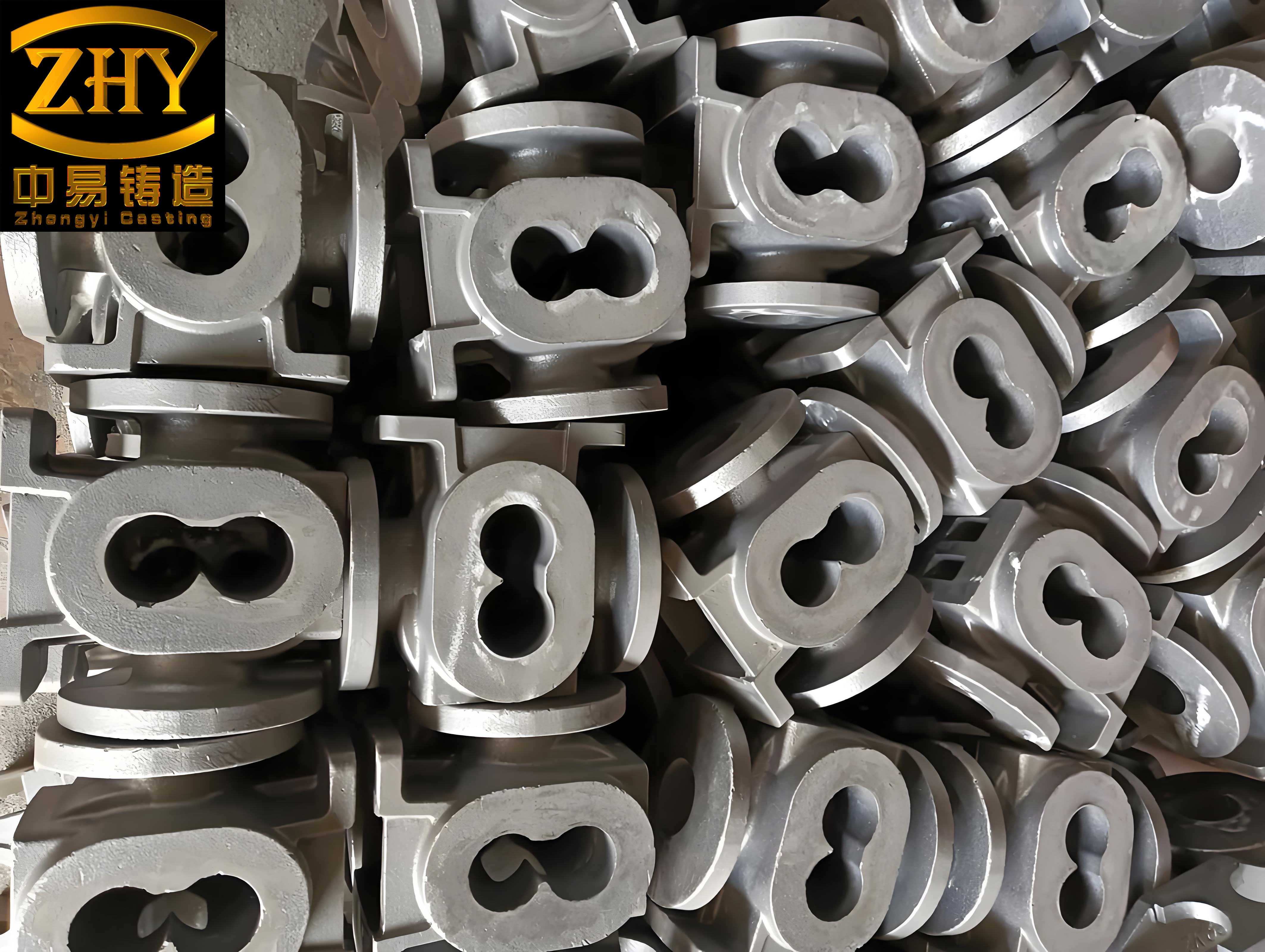
Manufacturing these large containers requires specialized casting techniques. Due to the massive size—weighing up to 100 tons—foundries use simulation software to predict solidification patterns and defect formation. Gating systems are designed to minimize turbulence, and chills are strategically placed to accelerate cooling in thick sections. The goal is to achieve a uniform microstructure with high nodularity and minimal segregation. In one case study, a 45° test block was cast to simulate container walls, with dimensions shown in earlier research. The block was produced using high-purity materials and metal molds, resulting in properties exceeding standard requirements. This approach validates the feasibility of scaling up to full-sized containers.
Thermal management is critical, as spent fuel generates decay heat that must be dissipated to prevent overheating. Nodular cast iron’s thermal conductivity (\( k \)) ranges from 30 to 40 W/m·K, depending on composition and microstructure. The steady-state temperature rise (\( \Delta T \)) in a container wall can be estimated using Fourier’s law:
$$ \dot{q} = -k \cdot \frac{dT}{dx} $$
where \( \dot{q} \) is the heat flux from the spent fuel. For a cylindrical wall, the temperature distribution is logarithmic, and designers ensure that inner wall temperatures remain below limits to preserve cladding integrity. Computational fluid dynamics (CFD) simulations are employed to optimize fin designs or external cooling features, enhancing natural convection.
In addition to transport, nodular cast iron containers are used for dry storage, where spent fuel is housed for decades before reprocessing or disposal. The containers are placed in ventilated concrete vaults or standalone pads, relying on passive cooling. Long-term performance studies indicate that nodular cast iron maintains its properties under irradiation, with minimal dimensional changes. The material’s resistance to creep and fatigue is crucial, as thermal cycling occurs over years. Data from existing storage facilities show that nodular cast iron containers exhibit no significant degradation after 30 years of service, underscoring their durability.
The following table summarizes key design parameters for typical nodular cast iron spent fuel containers, drawing from industry examples.
| Parameter | Value Range | Explanation |
|---|---|---|
| Wall Thickness | 400–630 mm | Provides radiation shielding and structural strength |
| Outer Diameter | 2.0–3.0 m | Accommodates fuel assemblies and handling equipment |
| Height | 4.0–6.0 m | Designed for vertical storage and transport |
| Weight | 50–120 tons | Includes container body and shielding lids |
| Heat Load Capacity | 30–50 kW | Maximum decay heat dissipation capability |
| Shielding Performance | >95% gamma attenuation | For typical spent fuel inventories |
| Design Life | >60 years | Based on corrosion and fatigue estimates |
As nuclear power plants expand globally, the demand for such containers is growing. Manufacturers are developing standardized series to reduce costs and lead times. For instance, the BHQ series in China and the TN series in Europe offer various sizes to fit different fuel types. The versatility of nodular cast iron allows for customization, such as adding neutron-absorbing materials (e.g., boron steel) into the matrix or coatings for enhanced corrosion resistance. I will now turn to the application of nodular cast iron in waste disposal containers, another vital aspect of spent fuel reprocessing.
Nodular Cast Iron Containers for Intermediate- and Low-Level Radioactive Waste
During spent fuel reprocessing, secondary waste streams are generated, including activated components, evaporator concentrates, and ion-exchange resins. These materials, classified as intermediate- or low-level waste, require secure containment before final disposal. Nodular cast iron containers, such as the MOSAIK series, have been developed for this purpose. They offer a robust, corrosion-resistant solution that can be adapted to various waste forms. In this section, I will describe their design features, performance criteria, and long-term behavior.
The MOSAIK containers typically have wall thicknesses of 150–200 mm and weights of 3.5–5.0 tons. They consist of a nodular cast iron body with dual lids: a shielding lid for radiation protection and a protective lid for mechanical integrity. The containers can be used underwater in storage pools or in hot cells for direct loading. Their versatility allows them to accommodate solid waste, dried residues, or even liquid waste after solidification. The key advantage of nodular cast iron here is its inherent corrosion resistance, which minimizes maintenance and extends service life. Corrosion rates in repository environments are estimated using empirical models:
$$ \delta = \alpha \cdot t^\beta $$
where \( \delta \) is corrosion depth, \( t \) is time, and \( \alpha \) and \( \beta \) are constants derived from experimental data. For nodular cast iron in humid air or groundwater, \( \alpha \) is low, leading to predicted corrosion depths of less than 25 mm over 300 years.
Chemical compatibility is also critical, as waste forms may be acidic or alkaline. Nodular cast iron’s passive oxide layer provides protection, but additional coatings or liners can be applied for aggressive media. The containers are designed to meet disposal requirements, such as those for shallow land burial or deep geological repositories. They undergo similar safety tests as transport containers, including drop and fire tests, to ensure they withstand handling accidents. The table below outlines typical specifications for nodular cast iron waste containers.
| Feature | Specification | Rationale |
|---|---|---|
| Material Grade | GGG40.3 (ferritic) | Balances strength and ductility for disposal |
| Wall Thickness | 150–200 mm | Sufficient for shielding and structural needs |
| Lid System | Double-lid with seals | Ensures leak-tightness and radiation shielding |
| Corrosion Allowance | 20–30 mm | Based on 300-year corrosion estimates |
| Load Capacity | Up to 10 tons of waste | Optimized for handling equipment |
| Surface Treatment | Paint or epoxy coating | Enhances corrosion resistance in humid environments |
| Certification | IAEA standards compliant | Ensures international acceptance |
In practice, these containers are filled and sealed in controlled facilities, then transported to disposal sites. Their durability reduces the need for overpacking, lowering overall waste volume—a significant economic benefit. Moreover, nodular cast iron’s recyclability at end-of-life (if decontaminated) aligns with sustainable waste management principles. Research continues to improve container designs, such as integrating monitoring sensors or developing hybrid composites that embed waste directly into the iron matrix.
The long-term behavior of nodular cast iron in disposal environments is studied through accelerated aging tests. Samples are exposed to elevated temperatures, radiation, and corrosive media to simulate centuries of service. Results indicate that mechanical properties remain adequate, with only slight reductions in impact toughness due to irradiation embrittlement. The fracture toughness (\( K_{IC} \)) of nodular cast iron can be modeled as:
$$ K_{IC} = \sigma_y \sqrt{\pi a} \cdot f\left(\frac{a}{W}\right) $$
where \( \sigma_y \) is yield strength, \( a \) is crack length, and \( W \) is specimen width. Even after irradiation, \( K_{IC} \) values stay above minimum thresholds, ensuring container integrity.
As reprocessing activities scale up, the use of nodular cast iron for waste containers is expected to grow. Standardization efforts are underway to create interchangeable designs that simplify logistics. I will now conclude with a summary of future directions and the overarching significance of nodular cast iron in nuclear fuel cycle.
Future Prospects and Concluding Remarks
The adoption of nodular cast iron in spent fuel reprocessing is poised to expand, driven by its technical merits and economic advantages. Future developments may include larger containers for high-burnup fuel, advanced coatings for extreme environments, and integration with digital monitoring systems. Additionally, research into modified nodular cast iron alloys—such as those with added nickel or copper—could enhance properties like cryogenic toughness or irradiation resistance. The ongoing optimization of casting processes, through simulation and automation, will further improve quality and reduce costs.
In summary, nodular cast iron has proven itself as a versatile and reliable material for nuclear applications. Its use in transport and storage containers provides a safe solution for interim spent fuel management, while its application in waste disposal containers ensures long-term containment of secondary waste. The material’s ability to meet rigorous safety standards, coupled with its manufacturing scalability, makes it a cornerstone of modern nuclear waste handling. As the global nuclear industry evolves, continued innovation in nodular cast iron technology will be essential to address emerging challenges, such as higher waste volumes and stricter regulatory requirements.
Throughout this article, I have emphasized the critical role of nodular cast iron, highlighting its chemical, mechanical, and thermal properties. By leveraging tables and formulas, I have summarized key data to underscore the material’s performance. The repeated mention of “nodular cast iron” throughout the text reinforces its centrality in this field. As we look ahead, collaboration between metallurgists, nuclear engineers, and policymakers will be vital to harness the full potential of nodular cast iron, ensuring safe and sustainable spent fuel reprocessing for generations to come.