
In recent years, the rapid advancement of 3D printing technology has revolutionized various industrial sectors, particularly in the field of precision casting. As a researcher and practitioner in this domain, I have observed how 3D printing, when integrated with investment casting processes, enables the direct fabrication of complex, high-precision metal components. This synergy not only reduces development costs and production cycles but also overcomes limitations inherent in traditional methods. Investment casting, also known as precision casting or lost-wax casting, is a near-net-shape metal forming process that produces parts with high dimensional accuracy and surface finish. However, conventional investment casting relies on wax patterns, which involve lengthy mold-making cycles, high costs, and specific material requirements. In contrast, 3D printing employs additive manufacturing principles to build objects layer by layer, allowing for the creation of intricate geometries that are challenging to achieve with traditional techniques. This article explores the integration of 3D printing into rapid investment casting, highlighting its implementation, advantages, and future prospects through detailed analyses, tables, and mathematical models.
The fusion of 3D printing and investment casting begins with understanding the fundamental processes. Investment casting typically uses wax patterns coated with refractory materials like silica sand or ceramic slurry. After dewaxing and firing at high temperatures, the wax melts away, leaving a cavity for molten metal. This method is renowned for producing components with complex structures, uneven wall thicknesses, and high precision, making it ideal for aerospace, automotive, and electronics industries. However, the dependency on wax patterns introduces constraints. For instance, wax-based materials have specific melting points and properties, as summarized in Table 1, which influence the casting quality. Common wax patterns include wax-based, resin-based, and high-temperature variants, each with distinct compositions and melting ranges.
| Material Type | Main Components | Melting Point Range (°C) |
|---|---|---|
| Wax-based pattern | Paraffin wax, stearic acid, etc. | 60–70 |
| Resin-based pattern | Natural resins | 70–120 |
| High-temperature pattern | Rosin, ceresin, polystyrene, etc. | >120 |
| Medium-temperature pattern (rosin-based) | Rosin, wax materials, etc. | 90–110 |
| Medium-temperature pattern (wax-based) | Paraffin wax, other additives | 80–100 |
3D printing, or additive manufacturing, emerged in the mid-1990s and diverges from subtractive methods by building parts directly from digital models. This process involves creating a 3D model via computer-aided design (CAD) or 3D scanning, optimizing parameters, and printing layer by layer. It enhances material utilization, shortens development cycles, and reduces costs, offering unprecedented flexibility in manufacturing. Common 3D printing materials, such as ABS, PLA, PETG, TPU, photopolymer resins, and nylon, have melting points that must align with investment casting requirements, as shown in Table 2. For example, photopolymer resins with low melting points (e.g., 60–90°C) are suitable substitutes for wax patterns in investment casting, enabling efficient dewaxing.
| Material | Melting Point Range (°C) |
|---|---|
| ABS (Acrylonitrile Butadiene Styrene) | 210–240 |
| PLA (Polylactic Acid) | 170–220 |
| PETG (Polyethylene Terephthalate Glycol) | 220–250 |
| TPU (Thermoplastic Polyurethane) | 190–230 |
| Photopolymer Resin | 60–90 |
| Nylon | 235–270 |
The integration of 3D printing into investment casting primarily replaces two aspects: mold fabrication and pattern making. A typical workflow, as illustrated in the process diagram, involves digital modeling, 3D printing of patterns, shell building, dewaxing, firing, and casting. This combination enhances visualization, control, and intuitiveness, addressing issues like long production cycles and high模具 costs in traditional investment casting. For instance, in precision casting applications, 3D printing allows for rapid iteration and customization, which is crucial for high-quality components. The relationship between material properties and casting efficiency can be expressed mathematically. For example, the thermal energy required to melt a pattern material during dewaxing can be modeled using the formula: $$Q = m \cdot c \cdot \Delta T + m \cdot L_f$$ where \(Q\) is the total heat energy, \(m\) is the mass of the pattern, \(c\) is the specific heat capacity, \(\Delta T\) is the temperature change, and \(L_f\) is the latent heat of fusion. This equation helps optimize dewaxing parameters for 3D-printed patterns in investment casting.
To demonstrate the practical implementation, I conducted a case study on manufacturing a small impeller with a base diameter of 100 mm, top diameter of 26 mm, and side width of 45 mm using stereolithography (SLA) 3D printing combined with investment casting. The process began with digital modeling, where a 3D model was designed using CAD software or generated via reverse engineering and 3D scanning. The model was converted to an STL file, sliced into layers, and processed into G-code for printing. This step emphasizes the importance of precision in digital design to ensure compatibility with investment casting requirements. For the printing phase, I selected a photopolymer resin with a melting point of approximately 70°C, which aligns well with investment casting dewaxing temperatures. The SLA process involved spreading resin uniformly on a build platform, followed by UV-induced curing to solidify each layer. Post-processing, such as sanding and polishing, was applied to achieve the desired surface quality. The printed pattern was then used in shell building, where it was coated with multiple layers of refractory slurry and sand—typically 5–6 cycles—to form a robust mold. Each layer was dried under controlled temperature and humidity to ensure strength and thermal stability.
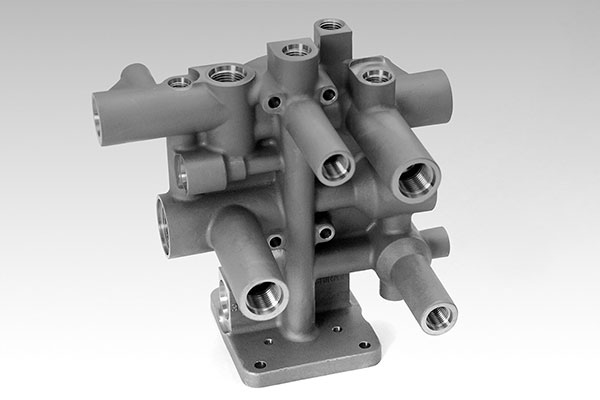
Dewaxing was performed by immersing the shell in hot water at 85–95°C, causing the photopolymer resin pattern to melt and flow out, leaving a cavity for casting. The shell was subsequently fired at around 900°C for 1–2 hours to remove moisture and residues. To prevent deformation during pouring, the fired shell was embedded in dry sand before introducing molten metal. The resulting impeller casting was measured for dimensional accuracy, as summarized in Table 3. The close alignment between theoretical and actual dimensions—with minimal errors in base diameter, top diameter, and side width—validates the effectiveness of combining 3D printing with investment casting for precision applications.
| Theoretical Dimension (mm) | Actual Dimension (mm) |
|---|---|
| Base Diameter: 100 | Base Diameter: 99.80 |
| Top Diameter: 26 | Top Diameter: 26.12 |
| Side Width: 45 | Side Width: 45.23 |
The advantages of integrating 3D printing into investment casting are multifaceted. Firstly, it significantly reduces development and prototyping costs by eliminating the need for expensive molds and manual labor. In traditional investment casting, pattern fabrication can take up to five days, whereas 3D printing accomplishes this in 1–2 days, accelerating time-to-market. Secondly, the process simplifies complex workflows, enabling the production of components that were previously unfeasible. As 3D printing technology advances and becomes more industrialized, its efficiency improves, and costs decrease, making mass production viable. Thirdly, it enhances production flexibility and efficiency, as evidenced by comparative metrics in Table 4. For example, 3D printing achieves higher material utilization (over 80% compared to 50% in traditional methods) and superior customization capabilities, meeting over 90% of个性化 design needs. The precision of 3D-printed patterns often reaches 0.5 mm or better, ensuring high-quality outcomes in investment casting.
| Advantage | Impact |
|---|---|
| Rapid成型 Speed | Traditional wax patterns average 5 days; 3D printing completes in 1–2 days |
| High Precision | Accuracy up to 0.5 mm or higher |
| Strong Customization Capability | Meets over 90% of personalized design requirements |
| High Material Utilization | Material usage reaches over 80%, compared to ~50% in traditional methods |
From a technical perspective, the integration can be further analyzed through mathematical models. For instance, the stress distribution during shell building and casting can be described using elasticity theory: $$\sigma = E \cdot \epsilon$$ where \(\sigma\) is stress, \(E\) is Young’s modulus, and \(\epsilon\) is strain. This helps in optimizing shell thickness and material selection for investment casting with 3D-printed patterns. Additionally, the thermal expansion coefficient of 3D printing materials relative to refractory shells can be modeled to prevent cracking during firing, a common issue in precision casting. The formula for linear thermal expansion is: $$\Delta L = L_0 \cdot \alpha \cdot \Delta T$$ where \(\Delta L\) is the change in length, \(L_0\) is the original length, \(\alpha\) is the coefficient of thermal expansion, and \(\Delta T\) is the temperature change. Such calculations ensure compatibility between 3D-printed patterns and investment casting processes.
In conclusion, the application of 3D printing, particularly SLA with photopolymer resins, in rapid investment casting demonstrates a seamless integration that produces high-precision castings with excellent surface quality. This approach addresses key challenges in traditional investment casting, such as long lead times and high costs, while enabling complex geometries. However, challenges remain, including the high initial cost of 3D printing equipment, the need for specialized operator skills, material limitations for certain applications, and scalability issues in mass production. Future efforts should focus on developing more affordable and versatile 3D printing technologies, expanding material options, and optimizing processes for large-scale investment casting. As these advancements unfold, the synergy between 3D printing and investment casting will continue to drive innovation in precision manufacturing, fostering high-quality development across industries like aerospace, automotive, and beyond. Through continuous research and practical applications, I am confident that this combination will redefine the standards of precision casting and investment casting, making them more accessible and efficient for global manufacturing.