
In our foundry, we specialize in the production of high-quality machine tool castings, which are essential components for various industrial applications. These machine tool castings often feature complex geometries, such as those found in spindle boxes, sliding seats, columns, and worktables, and they demand exceptional dimensional accuracy and mechanical properties. Over the years, we have faced significant challenges in maintaining low defect rates, particularly with issues like shrinkage porosity, gas holes, and slag inclusions. Through extensive research and application of equilibrium solidification technology, combined with the large orifice outflow theory for gating system design, we have achieved remarkable improvements in the quality and reliability of our machine tool castings. This approach has enabled us to reduce scrap rates substantially while optimizing material usage and production efficiency.
The core principle behind equilibrium solidification technology lies in managing the sequential solidification and expansion phases in cast iron, which exhibits unique behavior due to graphite precipitation. Unlike traditional methods that rely on prolonged feeding from large risers, equilibrium solidification emphasizes the self-compensating effect of the casting itself. This is particularly relevant for machine tool castings, where varying wall thicknesses and complex structures can lead to localized thermal nodes. By carefully controlling the solidification process, we ensure that shrinkage is offset by expansion at the right moments, minimizing the need for extensive riser systems. The mathematical foundation for this can be expressed using formulas that describe the solidification dynamics. For instance, the solidification time for a casting section can be estimated using Chvorinov’s rule: $$ t = k \cdot V^2 / A^2 $$ where \( t \) is the solidification time, \( V \) is the volume, \( A \) is the surface area, and \( k \) is a constant dependent on the mold material and casting conditions. In equilibrium solidification, we focus on the balance between contraction and expansion, which can be modeled as: $$ \Delta V_{\text{shrinkage}} = \Delta V_{\text{expansion}} \cdot f(G) $$ where \( \Delta V_{\text{shrinkage}} \) is the volume change due to shrinkage, \( \Delta V_{\text{expansion}} \) is the expansion from graphite formation, and \( f(G) \) is a function of graphite content and distribution. This balance is critical for achieving sound machine tool castings without defects.
To complement equilibrium solidification, we employ the large orifice outflow theory for designing gating systems. This theory addresses the limitations of traditional small orifice calculations, which often underestimate the actual flow rates and lead to prolonged pouring times. In large orifice outflow, the effective pressure head at the ingate is considered, and the gating ratio is incorporated into the calculations to achieve more accurate and efficient metal flow. The basic equation for the flow rate through an orifice is derived from Bernoulli’s principle: $$ Q = C_d \cdot A \cdot \sqrt{2gh} $$ where \( Q \) is the flow rate, \( C_d \) is the discharge coefficient, \( A \) is the cross-sectional area, \( g \) is gravity, and \( h \) is the effective head. For gating systems in machine tool castings, we modify this to account for the gating ratio \( R_g \), defined as \( R_g = A_{\text{sprue}} : A_{\text{runner}} : A_{\text{ingate}} \). The pouring time \( t_p \) can then be calculated as: $$ t_p = \frac{W}{\rho \cdot C_d \cdot A_{\text{ingate}} \cdot \sqrt{2g h_{\text{eff}}}} $$ where \( W \) is the total weight of metal, \( \rho \) is density, and \( h_{\text{eff}} \) is the effective head considering the gating geometry. This approach ensures rapid and uniform filling, reducing the risk of cold shuts and inclusions in critical areas of machine tool castings.
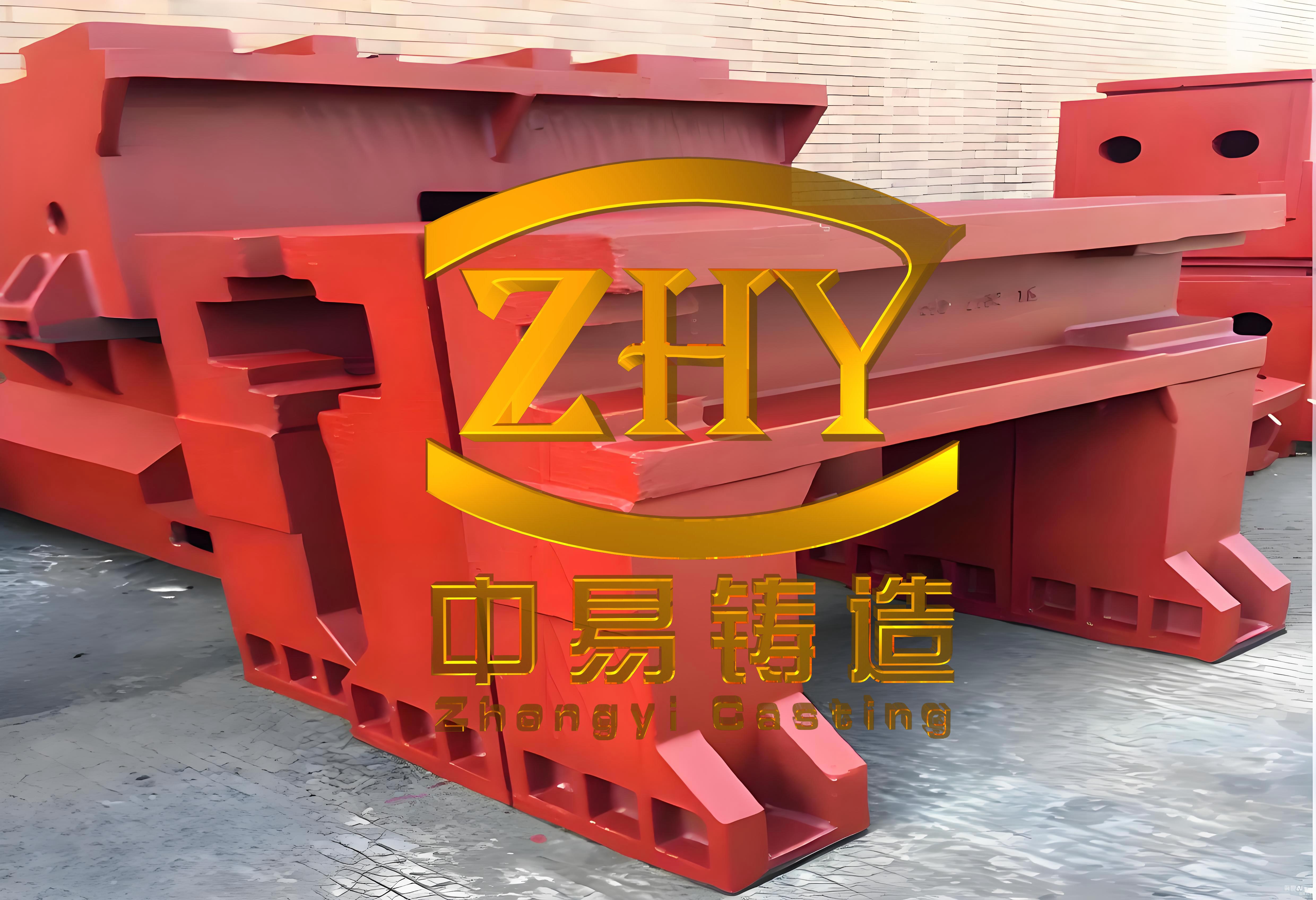
In our practice, we categorize machine tool castings into several types based on their structural characteristics, each requiring tailored工艺 approaches. For spindle box castings, which combine box-like sections with vertical guides, the key challenge is to prevent defects in the guideways while ensuring the integrity of the bore holes. We typically use high pouring temperatures ranging from 1360°C to 1420°C and employ risers such as duck-bill or ear types to provide initial feeding without creating thermal nodes. The riser dimensions are determined based on the guide thickness \( T \), with the riser diameter \( D \) given by \( D = k \cdot T \), where \( k \) ranges from 1.5 to 2.0. The riser neck is designed to be short, thin, and wide to facilitate early feeding and prevent back-feeding during the expansion phase. Our gating systems are designed as multi-level step gates to ensure smooth metal distribution, with ingates positioned to avoid direct impingement on bore areas. This has resulted in scrap rates below 5% for spindle box machine tool castings, compared to previous rates exceeding 10%.
For sliding seat and lower worktable castings, which feature intersecting guideways on different planes, we often orient the longer guides vertically to simplify molding and utilize risers effectively. The pouring temperature is maintained between 1380°C and 1420°C to enhance fluidity and reduce gas entrapment. The pouring time is optimized using the formula \( t_p = k \cdot \sqrt{W} \), where \( W \) is the casting weight in kg, and \( k \) is a factor dependent on the casting complexity, as summarized in Table 1. The gating system follows a “gate” shape runner with uniformly distributed ingates along the guide length. The ingate thickness \( t_i \) is typically 0.6 to 0.8 times the guide thickness, and the gating ratio is set to 1.5 : 1.2 : 1 for sprue, runner, and ingate areas, respectively. This design promotes directional solidification and minimizes slag inclusion, leading to scrap rates under 3% for these machine tool castings.
| Casting Weight Range (kg) | Factor \( k \) |
|---|---|
| 50 – 100 | 1.2 – 1.5 |
| 100 – 500 | 1.0 – 1.2 |
| 500 – 1000 | 0.8 – 1.0 |
| 1000 – 2000 | 0.6 – 0.8 |
Vertical guide castings, such as columns and lifting bodies, present additional difficulties due to their tall sections and intersecting guides. In these machine tool castings, defects like shrinkage and gas holes are common in the vertical faces. We address this by using ear risers positioned at the highest points to act as overflow channels for slag and gas. The riser size is calculated as \( D = 1.8 \cdot T \) to 2.2 \cdot T, with the riser neck thickness \( t_n \) being 0.4 to 0.6 times the guide thickness. The gating system is designed with elevated sprues to tilt the casting slightly, ensuring that the vertical guides face downward during pouring. This orientation reduces the adhesion of slag and sand to the guide surfaces. By implementing these measures, we have reduced scrap rates to below 4% for such machine tool castings.
Worktable and surface plate castings involve thick tables with thinner guides, leading to significant differences in solidification rates. Here, we often position the table surface upward to leverage self-feeding through the expansion phase. Pouring temperatures are controlled between 1350°C and 1400°C, and chills are strategically placed to balance the cooling rates. The self-compensating effect is maximized by ensuring that the thicker sections solidify later, allowing the graphite expansion to compensate for shrinkage in the guides. The solidification modulus \( M \), defined as \( M = V/A \), is used to determine the placement of chills and risers. For instance, if the modulus of the guide is \( M_g \) and that of the table is \( M_t \), we aim for \( M_t / M_g > 2 \) to promote directional solidification. This approach has enabled us to produce sound worktable machine tool castings with minimal riser usage, achieving a yield of over 90%.
To summarize the key parameters and results across different types of machine tool castings, we have compiled Table 2, which outlines the typical design considerations and outcomes. This table highlights the effectiveness of equilibrium solidification and large orifice outflow theory in improving the quality of machine tool castings.
| Casting Type | Typical Weight (kg) | Pouring Temperature (°C) | Gating Ratio (Sprue:Runner:Ingate) | Riser Type | Scrap Rate Reduction |
|---|---|---|---|---|---|
| Spindle Box | 100 – 300 | 1360 – 1420 | 1.2 : 1.0 : 1 | Duck-bill/Ear | >50% |
| Sliding Seat | 200 – 600 | 1380 – 1420 | 1.5 : 1.2 : 1 | Side Riser | >60% |
| Column | 300 – 800 | 1370 – 1410 | 1.4 : 1.1 : 1 | Ear Riser | >55% |
| Worktable | 500 – 1500 | 1350 – 1400 | 1.3 : 1.0 : 1 | None/Chill | >70% |
In addition to the process optimizations, we have integrated advanced simulation tools to validate the equilibrium solidification behavior in machine tool castings. Using finite element analysis, we model the temperature distribution and solidification sequences to predict potential defect sites. The governing heat transfer equation during solidification is: $$ \frac{\partial T}{\partial t} = \alpha \nabla^2 T + \frac{L}{c_p} \frac{\partial f_s}{\partial t} $$ where \( T \) is temperature, \( t \) is time, \( \alpha \) is thermal diffusivity, \( L \) is latent heat, \( c_p \) is specific heat, and \( f_s \) is the solid fraction. By coupling this with the expansion-contraction balance, we can optimize the riser and gating designs virtually before production, further enhancing the reliability of our machine tool castings.
Another critical aspect is the control of metallurgical quality in the iron used for machine tool castings. We maintain a consistent carbon equivalent (CE) value, calculated as \( \text{CE} = \%C + 0.3(\%Si + \%P) \), within the range of 3.8 to 4.2 to ensure adequate fluidity and graphite formation. The inoculation practice is tailored to promote fine graphite flakes or nodules, depending on whether we are producing gray or ductile iron machine tool castings. For instance, in gray iron, we aim for Type A graphite distribution to maximize the self-feeding effect during solidification.
Throughout our implementation, we have conducted numerous trials to refine the equilibrium solidification parameters. For example, in a typical spindle box machine tool casting weighing 150 kg, we adjusted the riser size based on real-time solidification monitoring. The optimal riser diameter was found to follow the relation \( D = 1.75 \cdot T + 10 \) mm, where \( T \) is the guide thickness in mm. Similarly, the pouring time was calibrated as \( t_p = 0.9 \cdot \sqrt{W} \) seconds for most machine tool castings under 500 kg. These empirical relationships have been instrumental in standardizing our processes across different product lines.
The economic benefits of adopting equilibrium solidification for machine tool castings are substantial. By reducing the riser sizes and minimizing scrap, we have achieved significant savings in material and energy consumption. For instance, in the production of large worktable castings, the elimination of massive risers has cut down the total metal usage by up to 15%, while improving the overall yield to above 85%. This aligns with our sustainability goals and enhances the competitiveness of our machine tool castings in the global market.
In conclusion, the application of equilibrium solidification technology and large orifice outflow theory has revolutionized our approach to producing high-integrity machine tool castings. By focusing on the dynamic balance between shrinkage and expansion, and optimizing the gating systems for efficient metal flow, we have consistently achieved low defect rates and high mechanical properties. Our experience demonstrates that these principles are universally applicable to a wide range of machine tool castings, from small spindle boxes to large worktables. As we continue to refine these methods, we are confident that the quality and efficiency of our machine tool castings will set new benchmarks in the industry.