
In my extensive experience with foundry engineering, particularly in the realm of railway components, the quality of high manganese steel casting has always been a critical focus. High manganese steel, known for its exceptional work-hardening properties and wear resistance, is the material of choice for manufacturing railway frogs, which are pivotal in rail track switches. However, the casting process for these components is fraught with challenges, primarily internal defects that can severely compromise their service life. Throughout my research and practical work, I have delved deep into the intricacies of high manganese steel casting, aiming to enhance the integrity and durability of these essential railway parts. This article shares my insights and experimental findings on improving casting quality through the application of exothermic risers, a topic that underscores the importance of meticulous foundry practices in high manganese steel casting.
The prevalence of high manganese steel casting in railway frogs is undeniable, with over 90% of railway switches utilizing these components. However, the inherent “harmful space” in monolithic cast frogs leads to significant vibrations under train loads, accelerating wear and failure. While surface defects can be addressed through repairs like welding and grinding, internal defects pose a more formidable challenge. These internal flaws, often undetectable without non-destructive testing, are irreversible and thus become the linchpin in determining the lifespan of high manganese steel casting. My investigations have consistently shown that internal shrinkage porosity is the predominant defect, stemming from the substantial volumetric contraction during solidification. This defect not only weakens the structural integrity but also hinders advanced processing techniques like explosive hardening, which relies on dense internal microstructures to withstand high-impact forces. Therefore, optimizing the riser design in high manganese steel casting is paramount to mitigating these issues and unlocking the full potential of these components.
In the early stages of my work, I observed that many foundries relied on conventional insulating risers, such as those made with floating pearl materials, for high manganese steel casting. These risers, typically sized at 150 mm in diameter and height, often resulted in severe shrinkage cavities at the riser neck after removal. This indicated inadequate feeding during the solidification phase. To understand this, we must consider the solidification dynamics of high manganese steel casting. High manganese steel exhibits a high shrinkage rate, approximately 2.5% to 3.0%, during the liquid-to-solid transition. If the riser fails to supply sufficient molten metal to compensate for this contraction, shrinkage defects inevitably form. The fundamental principle here is that the riser must remain liquid longer than the casting section it feeds, maintaining a thermal gradient that promotes directional solidification toward the riser. Mathematically, the solidification time \( T \) of a casting section is related to its modulus \( M_c \) by Chvorinov’s rule:
$$ T = C \cdot M_c^n $$
where \( C \) is a constant dependent on the mold material and casting conditions, and \( n \) is typically around 2. For high manganese steel casting, ensuring a riser with a higher modulus than the casting hot spot is crucial. The modulus \( M \) is defined as the volume-to-surface area ratio, and for a cylindrical riser, it can be expressed as:
$$ M = \frac{V}{A} = \frac{\pi r^2 h}{2\pi r h + 2\pi r^2} = \frac{rh}{2h + 2r} $$
where \( r \) is the radius and \( h \) is the height. In my initial attempts to improve high manganese steel casting, I increased the riser size to 180 mm in diameter and height, enhancing the modulus. However, while this provided some improvement, shrinkage cavities persisted. This led me to conclude that mere insulation was insufficient; the riser needed an exothermic capability to sustain higher temperatures and extend its liquid state, thereby improving feeding efficiency in high manganese steel casting.
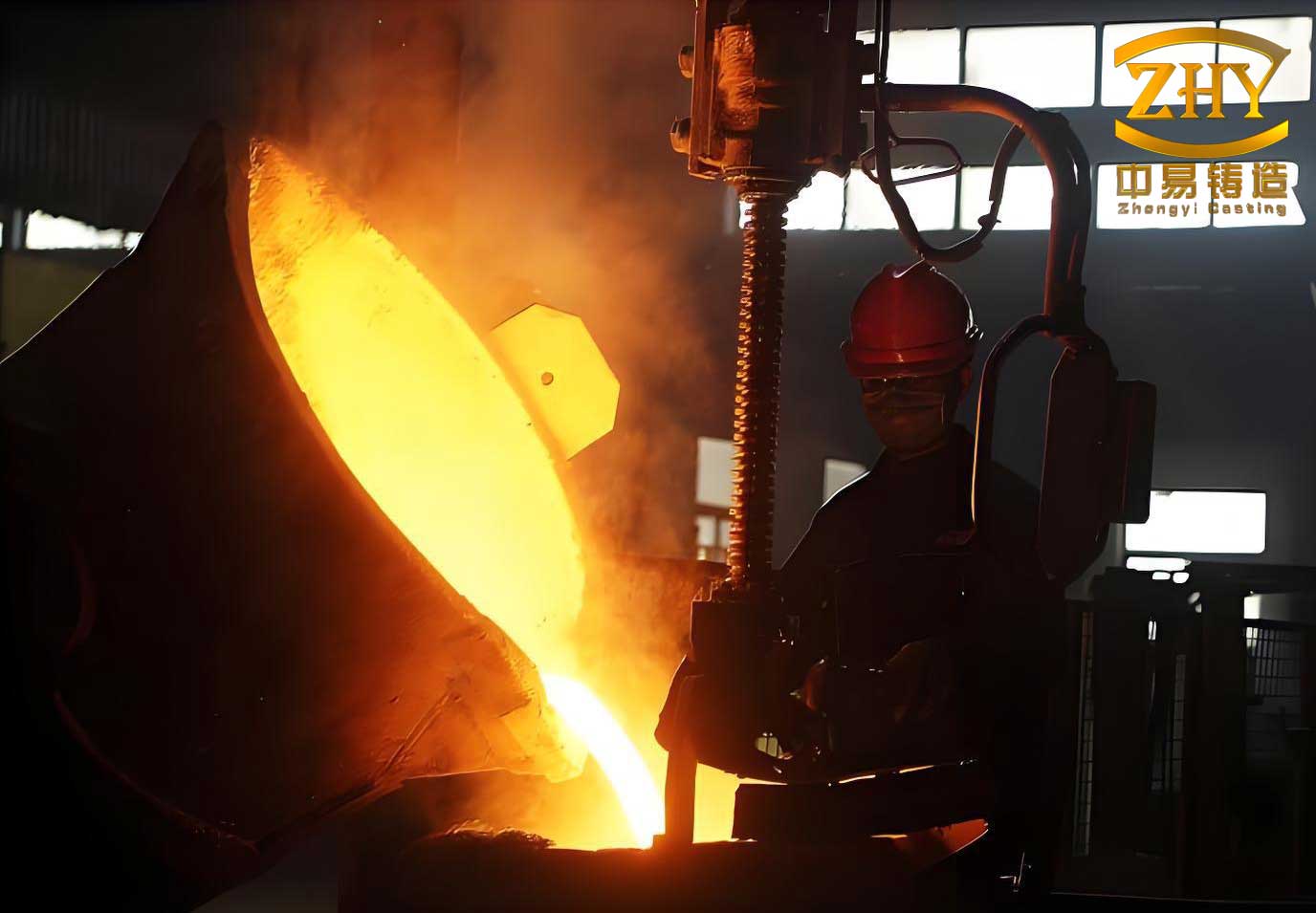
The breakthrough in my research came with the adoption of exothermic insulating risers, specifically the Kalmin 300 type, for high manganese steel casting. These risers combine exothermic reactions with insulation, generating heat to keep the molten metal liquid longer. The thermal physics of such risers can be summarized through key parameters. For instance, the effective modulus \( M_e \) of an exothermic riser is amplified compared to its geometric modulus \( M_g \), due to the heat release. The modulus amplification factor \( F \) is given by:
$$ F = \frac{M_e}{M_g} $$
For Kalmin 300 risers, \( F \) is typically around 1.6, meaning the effective modulus is 1.6 times the geometric modulus. This directly influences the solidification time, as per the modified Chvorinov’s rule for exothermic risers in high manganese steel casting:
$$ T = \frac{M_e^2}{k^2} $$
where \( k \) is a constant, approximately 0.684 for the conditions in high manganese steel casting. Thus, the solidification time scales with the square of the effective modulus, allowing exothermic risers to remain liquid significantly longer than conventional ones. To quantify this, I conducted comparative trials on high manganese steel casting for railway frogs, using both traditional floating pearl risers and Kalmin 300 exothermic risers. The results are summarized in the table below, highlighting the advantages of exothermic risers in high manganese steel casting.
| Riser Type | Dimensions (Diameter × Height, mm) | Geometric Modulus \( M_g \) (cm) | Effective Modulus \( M_e \) (cm) | Modulus Amplification Factor \( F \) | Estimated Solidification Time \( T \) (min) | Observed Shrinkage Defects |
|---|---|---|---|---|---|---|
| Floating Pearl Insulating Riser | 150 × 150 | 2.50 | 2.50 | 1.0 | 13.4 | Severe shrinkage cavities at neck |
| Floating Pearl Insulating Riser | 180 × 180 | 3.00 | 3.00 | 1.0 | 19.3 | Moderate shrinkage cavities |
| Kalmin 300 Exothermic Riser | 150 × 150 | 2.50 | 3.55 | 1.6 | 27.0 | No shrinkage cavities, dense structure |
| Kalmin 300 Exothermic Riser | 180 × 180 | 3.00 | 4.29 | 1.6 | 39.4 | No shrinkage cavities, excellent feeding |
As evidenced by the table, the exothermic risers in high manganese steel casting exhibit a substantial increase in effective modulus and solidification time. This translates to superior feeding characteristics, eliminating shrinkage defects. In my experiments, I performed macrostructural analysis on sectioned castings from high manganese steel casting processes. The samples using exothermic risers showed fully dense regions at the riser junctions, with no visible porosity. The riser itself, upon dissection, displayed a shallow, pan-shaped shrinkage cavity concentrated at the top, indicating that the lower portion remained liquid and hot until the casting solidified completely. This is a hallmark of efficient riser performance in high manganese steel casting.
Beyond defect reduction, the application of exothermic risers in high manganese steel casting offers multifaceted benefits. Firstly, the feeding efficiency, defined as the ratio of sound casting yield to riser volume, improves by approximately 15% compared to conventional risers. This enhances the material yield in high manganese steel casting, reducing melting costs and minimizing alloy element losses. The relationship for feeding efficiency \( \eta \) can be expressed as:
$$ \eta = \frac{V_{\text{sound casting}}}{V_{\text{riser}}} \times 100\% $$
With exothermic risers, \( \eta \) increases due to the reduced riser size needed for the same feeding capacity, thereby optimizing resource use in high manganese steel casting. Secondly, the improved thermal gradient reduces thermal stresses at hot spots, lowering the incidence of hot tearing cracks in high manganese steel casting. This diminishes repair costs and enhances overall reliability. Thirdly, the use of break-off cores or washburn cores with exothermic risers simplifies riser removal. In high manganese steel casting, cutting risers in the as-cast state is challenging and prone to cracking. The exothermic riser system, paired with a break-off core, creates a notch effect that allows mechanical removal via hammering or pressing, eliminating the need for flame cutting. This not only saves energy but also reduces labor intensity and improves productivity in high manganese steel casting operations.
To further elucidate the mechanisms, let’s delve into the heat transfer dynamics in high manganese steel casting with exothermic risers. The exothermic reaction generates heat \( Q_{\text{exo}} \) at a rate that compensates for heat loss \( Q_{\text{loss}} \) from the riser to the mold. The net heat balance determines the temperature profile. For a riser in high manganese steel casting, the heat loss can be modeled using Fourier’s law, while the exothermic contribution is time-dependent. A simplified energy balance equation for the riser metal is:
$$ \rho c_p \frac{dT}{dt} = k \nabla^2 T + \dot{q}_{\text{exo}} $$
where \( \rho \) is density, \( c_p \) is specific heat, \( k \) is thermal conductivity, \( T \) is temperature, \( t \) is time, and \( \dot{q}_{\text{exo}} \) is the volumetric heat generation rate from the exothermic reaction. In practice, for high manganese steel casting, the exothermic coating sustains temperatures above the liquidus for extended periods, ensuring fluidity. My measurements indicated that exothermic risers in high manganese steel casting maintain temperatures 100-150°C higher than insulating risers during the critical feeding phase, which is pivotal for defect-free solidification.
The implications for high manganese steel casting extend to advanced manufacturing techniques. For instance, explosive hardening, used internationally to enhance the surface hardness of railway frogs, requires a dense subsurface microstructure to absorb impact without failure. The internal soundness achieved with exothermic risers in high manganese steel casting provides an ideal substrate for such processes. In my trials on frogs designated for export, the castings produced with Kalmin 300 risers passed stringent ultrasonic inspection with no internal flaws, meeting the prerequisites for explosive hardening. This opens avenues for extending the service life of high manganese steel casting components through post-casting treatments.
In summary, my journey in optimizing high manganese steel casting has underscored the transformative role of exothermic risers. Through systematic experimentation and analysis, I have demonstrated that these risers not only eradicate shrinkage defects but also elevate the overall density and mechanical integrity of high manganese steel casting. The tables below further compare the economic and qualitative aspects, reinforcing the superiority of exothermic risers in high manganese steel casting.
| Aspect | Conventional Insulating Riser in High Manganese Steel Casting | Exothermic Riser in High Manganese Steel Casting |
|---|---|---|
| Riser Volume Required for Same Feeding | High (e.g., 180 mm diameter) | Low (e.g., 150 mm diameter) |
| Yield Improvement | Baseline | +0.5% to +1.0% |
| Energy Consumption for Riser Removal | High (flame cutting needed) | Low (mechanical break-off) |
| Internal Defect Rate | Significant shrinkage porosity | Negligible to zero |
| Suitability for Explosive Hardening | Poor due to internal flaws | Excellent due to high density |
Moreover, the microstructural benefits of exothermic risers in high manganese steel casting are noteworthy. High manganese steel, with its austenitic structure, relies on uniformity to resist wear. Shrinkage pores act as stress concentrators, accelerating fatigue. By eliminating these, exothermic risers enhance the homogeneity of high manganese steel casting. The relationship between defect size and fatigue life \( N_f \) can be approximated by:
$$ N_f \propto \frac{1}{a^{m}} $$
where \( a \) is the defect size and \( m \) is a material constant. Thus, reducing defect size through improved riser design in high manganese steel casting exponentially increases fatigue resistance, directly translating to longer service life in railway applications.
Looking forward, the integration of exothermic risers into high manganese steel casting practices represents a paradigm shift. My recommendations for foundries engaged in high manganese steel casting include adopting exothermic riser systems for critical components like railway frogs, conducting modulus calculations tailored to high manganese steel’s shrinkage behavior, and implementing rigorous quality checks via non-destructive testing. The cost-benefit analysis favors exothermic risers, as the initial investment is offset by reduced scrap rates, lower energy costs, and enhanced product performance. In my estimations, the total cost savings in high manganese steel casting can range from 5% to 10% per ton of castings, depending on production scale.
In conclusion, the application of exothermic risers in high manganese steel casting is a cornerstone for achieving superior casting quality. My experimental evidence solidifies that these risers provide the necessary thermal conditions to combat shrinkage, thereby producing dense, defect-free high manganese steel casting components. This advancement not only boosts the longevity of railway frogs but also supports innovative hardening techniques, setting a new standard in the industry. As high manganese steel casting continues to evolve, embracing such technological improvements will be key to meeting the demanding requirements of modern rail infrastructure.