
In my perspective, the evolution of energy equipment toward larger scales has opened vast opportunities for thick-section spheroidal graphite iron castings. As a material, spheroidal graphite iron offers a unique combination of mechanical properties, cost-effectiveness, and manufacturability, making it indispensable in modern energy infrastructure. This article delves into the applications of thick-section spheroidal graphite iron across thermal power, hydropower, wind power, and nuclear power sectors, highlighting technical challenges, innovations, and future directions. Through detailed analysis, tables, and mathematical formulations, I aim to underscore the critical role of spheroidal graphite iron in advancing energy technologies.
Spheroidal graphite iron, commonly known as ductile iron, is characterized by its graphite spheroids embedded in a metallic matrix, which confer high strength, ductility, and fatigue resistance. Thick-section castings, typically defined by wall thicknesses exceeding 100 mm, present unique solidification and microstructural challenges. However, with optimized processing, spheroidal graphite iron can outperform steels and other materials in specific energy applications. The inherent advantages of spheroidal graphite iron include excellent castability, reduced weight, and lower production costs, which are pivotal for large-scale energy components.
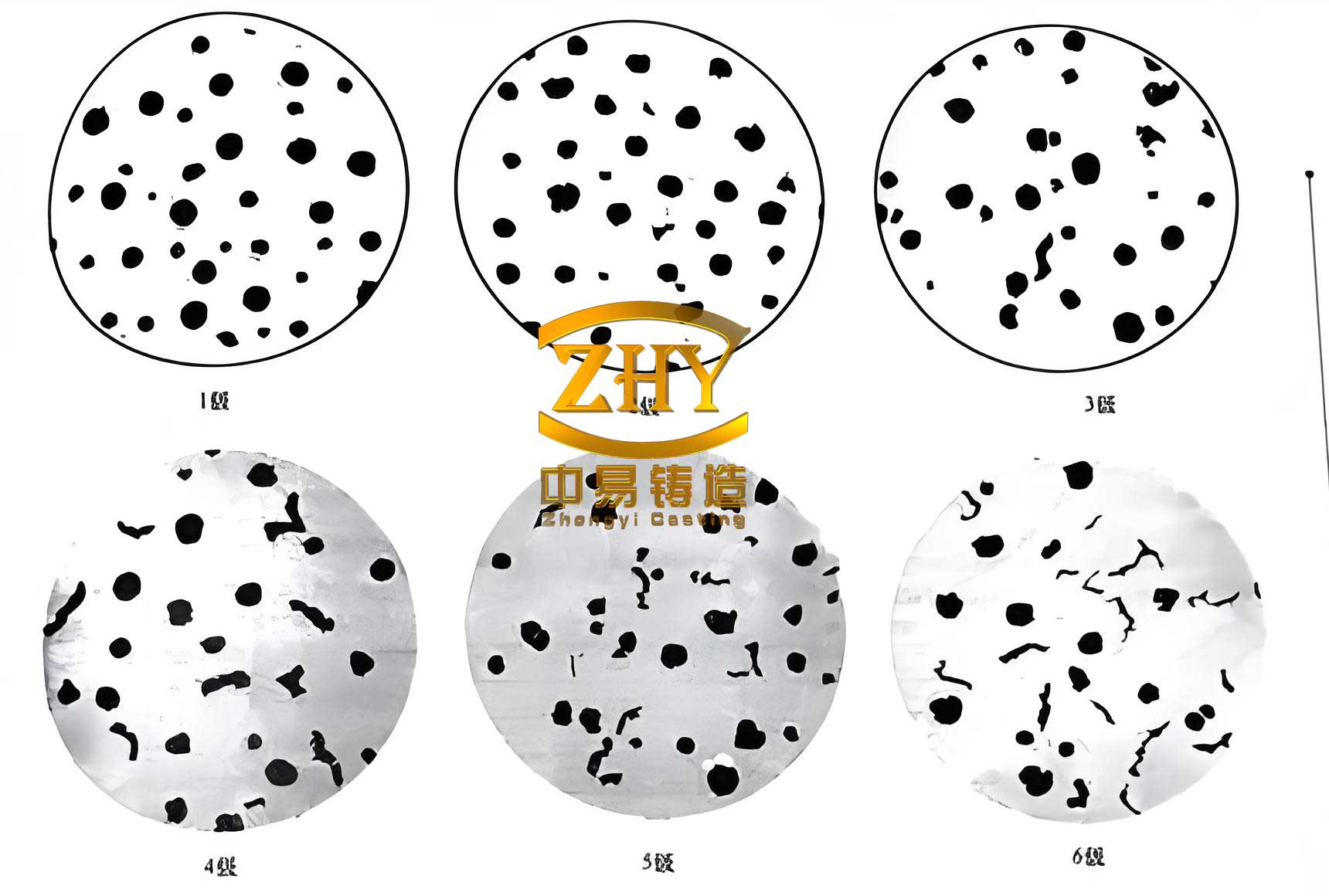
In thermal power generation, the shift toward higher efficiency and lower emissions drives the development of advanced steam turbines. Thick-section spheroidal graphite iron is employed in critical components like medium-pressure outer casings for 1000 MW secondary reheat turbines. These castings weigh up to 84 tonnes, with wall thicknesses ranging from 60 mm to 320 mm, and require stringent quality standards. The mechanical properties demanded include a spheroidal graphite grade better than 3, graphite size between 5 to 8, and pearlite content below 10%. Non-destructive testing, such as ultrasonic and magnetic particle inspection, is mandatory, with ultrasonic sound velocities exceeding 5500 m/s in key areas. The manufacturing process involves careful control of chemistry, gating design, and inoculation. For instance, molybdenum addition of 0.55% to 0.65% enhances hardenability, while low-rare-earth magnesium treatment at 1450–1465°C ensures proper nodularization. The use of prolonged and graphite-nucleating inoculants totaling 0.8% optimizes graphite formation. This results in spheroidal graphite iron castings that withstand high pressures and temperatures, contributing to turbine efficiency and reliability.
To summarize thermal power applications, consider the following table outlining key components and specifications:
| Component | Material Grade | Max Weight (tonnes) | Wall Thickness (mm) | Key Requirements |
|---|---|---|---|---|
| Medium-Pressure Outer Casing | QT400-18 (近似) | 84 | 60–320 | Graphite grade ≤3, sound velocity >5500 m/s |
| Bearing Housing | QT400-18 | 18.5 | Up to 490 | Dimensional stability, non-destructive testing |
The performance of spheroidal graphite iron in thermal power can be related to its microstructure through equations. For example, the yield strength $\sigma_y$ can be estimated from the matrix composition and graphite morphology. A simplified model is:
$$\sigma_y = \sigma_0 + k \cdot f_{pearlite} + m \cdot d^{-1/2}$$
where $\sigma_0$ is the base strength, $k$ is a coefficient for pearlite volume fraction $f_{pearlite}$, $m$ is a constant, and $d$ is the graphite spheroid diameter. This highlights how controlling microstructure is crucial for thick-section spheroidal graphite iron.
In hydropower, spheroidal graphite iron is used for large valve bodies and butterfly plates in dam systems. These components, such as butterfly plates weighing up to 24 tonnes with a maximum diameter of 4062 mm and wall thickness of 160 mm, operate under high hydraulic pressures. The material grade is typically QT450-10, requiring good ductility and impact resistance. Ultrasonic testing per EN 12680-3 and magnetic particle testing per EN 1369 are conducted, with acceptance levels of 2–3. The casting process employs bottom gating and open systems to minimize turbulence, and chemistry is tailored using high-purity pig iron and steel scrap. Wire-feeding treatment at 1360–1390°C with composite inoculation ensures dense microstructure. Post-casting, pressure tests verify leak-tightness, underscoring the reliability of spheroidal graphite iron in hydropower.
A table for hydropower applications is provided below:
| Component | Material Grade | Max Weight (tonnes) | Dimensions (mm) | Testing Standards |
|---|---|---|---|---|
| Butterfly Plate | QT450-10 | 24 | Φ4062 × 860 | EN 12680-3, EN 1369 |
| Valve Body | QT450-10 | 23.2 | Φ5482 × 1225 | EN 12680-3, EN 1369 |
The fracture toughness of spheroidal graphite iron in hydropower components can be expressed as:
$$K_{IC} = C \cdot \sqrt{\pi a} \cdot \sigma_f$$
where $K_{IC}$ is the fracture toughness, $C$ is a geometry factor, $a$ is crack length, and $\sigma_f$ is the fracture stress. This emphasizes the need for high-integrity spheroidal graphite iron castings to prevent catastrophic failures.
Wind energy represents a rapidly growing sector where spheroidal graphite iron is essential for heavy-duty components like hubs, bedplates, and main shafts. These castings, often made of low-temperature grades such as QT400-18AL (EN-GJS-400-18U-LT), must withstand harsh environmental conditions and cyclic loads. For instance, a 6 MW wind turbine rotor weighing 47.4 tonnes with walls up to 200 mm thick requires ferritic matrix to achieve optimal impact properties at sub-zero temperatures. Production involves using low-impurity pig iron, antimony additions, and multi-stage inoculation with barium-containing inoculants. The gating design prioritizes bottom filling and exothermic risers, while ventilation ratios are set at 1.5 to minimize defects. The resulting spheroidal graphite iron exhibits excellent ultrasonic soundness and mechanical performance.
For wind power, the following table summarizes typical castings:
| Component | Material Grade | Max Weight (tonnes) | Wall Thickness (mm) | Low-Temperature Impact (J/cm²) |
|---|---|---|---|---|
| Rotor | QT400-18AL | 47.4 | 60–200 | >12 at -40°C |
| Main Shaft | QT400-18AL | 16 | >200 | >12 at -40°C |
| Gearbox Housing | QT350-22AL | 90 | Up to 500 | >20 at -40°C |
The impact energy $E_{impact}$ of spheroidal graphite iron at low temperatures can be modeled as:
$$E_{impact} = E_0 \cdot \exp\left(-\frac{Q}{RT}\right) \cdot (1 – f_{carbide})$$
where $E_0$ is a reference energy, $Q$ is activation energy, $R$ is the gas constant, $T$ is temperature, and $f_{carbide}$ is carbide volume fraction. This underscores the importance of minimizing carbides in thick-section spheroidal graphite iron for wind applications.
Nuclear power poses the most demanding requirements for spheroidal graphite iron, particularly in spent fuel storage and transport containers. These containers, weighing up to 183 tonnes with wall thicknesses exceeding 400 mm, must provide radiation shielding, mechanical strength, and fracture toughness at -40°C. Compared to forged steel or lead-stainless steel alternatives, spheroidal graphite iron offers higher yield-to-tensile ratios (0.6–0.7), better impact fatigue resistance, and cost savings of 50–60%. German producers, for example, use grade GGG40.3 spheroidal graphite iron with controlled nitrogen levels (80–120 ppm) and cerium additions to counteract trace elements. Cooling systems and zircon sand molds ensure rapid solidification, enhancing elongation from 7% to 15% in 500 mm sections. Japanese research has optimized carbon equivalents (CE ≈ 4.3%) and silicon content (1.8–2.3%) for shrinkage minimization, enabling riserless casting of 100-tonne containers.
The table below outlines nuclear applications:
| Container Type | Material Grade | Max Weight (tonnes) | Wall Thickness (mm) | Key Properties |
|---|---|---|---|---|
| TN1300 (German) | GGG40.3 | 115 | >400 | UTS >300 MPa, impact >12 J/cm² at -40°C |
| CASTOR (German) | GGG40.3 | 183 | 400–500 | Fracture toughness >30 MPa√m |
| BQH-20 (Chinese) | QT400-18 | 16 | 280 | Pressure resistance, leak-tightness |
The radiation shielding effectiveness of spheroidal graphite iron can be approximated by:
$$I = I_0 \cdot e^{-\mu x}$$
where $I$ is transmitted intensity, $I_0$ is initial intensity, $\mu$ is linear attenuation coefficient, and $x$ is wall thickness. For spheroidal graphite iron, $\mu$ depends on density and composition, making thick sections advantageous for nuclear containment.
Throughout these sectors, the production of thick-section spheroidal graphite iron involves meticulous control of parameters. The carbon equivalent (CE) is a critical factor, defined as:
$$CE = C + \frac{Si + P}{3}$$
For thick sections, CE is typically maintained between 4.0% and 4.5% to balance fluidity and shrinkage. Inoculation efficiency, measured by graphite nodule count $N$, can be expressed as:
$$N = N_0 \cdot \left(1 + \alpha \cdot I_{eff}\right)$$
where $N_0$ is base nodule count, $\alpha$ is a constant, and $I_{eff}$ is effective inoculant addition. This relationship highlights how advanced inoculation techniques boost the performance of spheroidal graphite iron.
Looking ahead, the demand for thick-section spheroidal graphite iron is poised to grow with energy infrastructure expansion. Research should focus on enhancing solidification modeling, optimizing alloy designs for extreme environments, and developing non-destructive evaluation methods. For instance, computational simulations can predict cooling rates and microstructure evolution in spheroidal graphite iron castings. Equations like the Fourier heat conduction law:
$$\frac{\partial T}{\partial t} = \alpha \nabla^2 T$$
where $T$ is temperature, $t$ is time, and $\alpha$ is thermal diffusivity, can be adapted for spheroidal graphite iron solidification. Additionally, fatigue life prediction models for spheroidal graphite iron under cyclic loading are vital for wind and nuclear components.
In conclusion, thick-section spheroidal graphite iron is a cornerstone material in energy systems, offering unparalleled benefits in thermal, hydro, wind, and nuclear power. Its versatility stems from tailored microstructures achieved through sophisticated metallurgy and casting practices. As energy equipment scales up, continued innovation in spheroidal graphite iron technology will be essential for sustainable and efficient power generation. I believe that by deepening fundamental research and embracing digital tools, the spheroidal graphite iron industry can further propel the energy transition, solidifying its role in a cleaner future.
To further illustrate the compositional ranges for thick-section spheroidal graphite iron, here is a summary table:
| Element | Typical Range (wt%) | Influence on Thick Sections |
|---|---|---|
| Carbon (C) | 3.4–3.8 | Enhances graphitization, reduces shrinkage |
| Silicon (Si) | 1.8–2.5 | Promotes ferrite, adjusts CE |
| Manganese (Mn) | 0.1–0.4 | Minimized to prevent segregation |
| Magnesium (Mg) | 0.03–0.06 | Essential for nodularization |
| Nickel (Ni) | 0.5–1.0 | Improves low-temperature toughness |
| Molybdenum (Mo) | 0.2–0.7 | Increases hardenability and strength |
| Copper (Cu) | 0–0.5 | Enhances pearlite formation |
The mechanical properties of spheroidal graphite iron can be correlated with microstructure via empirical equations. For example, the tensile strength $\sigma_t$ might be:
$$\sigma_t = A + B \cdot HV + C \cdot \rho_{graphite}$$
where $HV$ is Vickers hardness, $\rho_{graphite}$ is graphite nodule density, and $A$, $B$, $C$ are constants. Such models aid in designing spheroidal graphite iron for specific energy applications.
Ultimately, the success of thick-section spheroidal graphite iron hinges on interdisciplinary collaboration among metallurgists, engineers, and designers. By leveraging advanced characterization techniques and real-time process monitoring, we can ensure that spheroidal graphite iron components meet the ever-rising standards of the energy sector. As I reflect on these advancements, it is clear that spheroidal graphite iron will remain a key enabler of large-scale, reliable energy infrastructure worldwide.