
As a researcher and practitioner in the field of advanced casting materials, I have witnessed the growing significance of thick-section spheroidal graphite cast iron in the energy industry. The drive toward larger, more efficient energy equipment has created a substantial demand for components that combine high performance with cost-effectiveness. Spheroidal graphite cast iron, often referred to as ductile iron, offers a unique set of properties—including excellent castability, good mechanical strength, and superior damping capacity—that make it ideal for heavy-duty applications. In particular, thick-section spheroidal graphite cast iron, defined by wall thicknesses often exceeding 100 mm, is increasingly replacing steel castings and forgings in critical energy infrastructure. This article explores the applications of thick-section spheroidal graphite cast iron across thermal power, hydropower, wind power, and nuclear power sectors, highlighting technical challenges, production methodologies, and future prospects from my firsthand experience and industry observations.
The fundamental advantage of spheroidal graphite cast iron lies in its microstructure, where graphite exists as spheroids within a metallic matrix, typically ferrite or pearlite. This structure imparts a combination of ductility and strength, akin to steel, but with better vibration absorption and lower production costs. For thick sections, however, the solidification process becomes complex, often leading to issues like graphite flotation, shrinkage porosity, and carbide formation. Overcoming these challenges requires precise control over chemistry, cooling rates, and inoculation practices. Over the years, my work has involved developing and optimizing these parameters to ensure that thick-section spheroidal graphite cast iron meets the stringent requirements of modern energy systems.
In thermal power generation, the shift toward higher efficiency and lower emissions has led to the development of advanced steam turbines operating at elevated temperatures and pressures. Thick-section spheroidal graphite cast iron is employed in components such as medium-pressure outer casings, bearing housings, and valve bodies. For instance, a medium-pressure outer casing for a 1000 MW secondary reheat steam turbine can weigh up to 84 tonnes, with wall thicknesses ranging from 60 mm to 320 mm. Such castings demand high integrity, with specifications requiring spheroidal graphite grades better than Class 3, graphite size between 5 to 8, and pearlite content below 10%. Non-destructive testing, including 100% magnetic particle and ultrasonic inspection, is mandatory, with ultrasonic wave speeds exceeding 5500 m/s in critical zones to ensure soundness.
To achieve these properties, a tailored approach is essential. The chemical composition must be optimized; for example, adding 0.55–0.65% molybdenum enhances high-temperature strength, while controlled levels of rare earth magnesium inoculants promote graphite spheroidization. The gating system typically employs bottom pouring with open risers to facilitate feeding and minimize turbulence. The pouring temperature is maintained between 1340–1360°C to ensure fluidity while reducing thermal stresses. A key aspect is the use of multiple inoculation stages: primary inoculation with long-lasting inoculants and secondary inoculation with agents that increase graphite nodule count. This practice refines the microstructure, improving both mechanical properties and castability. The success of such castings underscores the viability of thick-section spheroidal graphite cast iron in replacing steel for large, complex geometries in thermal power plants.
The table below summarizes typical applications and requirements for spheroidal graphite cast iron in thermal power equipment:
| Component | Material Grade | Max Weight (tonnes) | Wall Thickness Range (mm) | Key Requirements |
|---|---|---|---|---|
| Medium-Pressure Outer Casing | QT400-18 or equivalent | 84 | 60–320 | Ultrasonic wave speed >5500 m/s, no leakage under pressure |
| Bearing Housing | QT400-18 | 18.5 | Up to 490 | Dimensional stability, good machinability |
| Valve Bodies | QT450-10 | 23.2 | Up to 120 | Pressure tightness, impact resistance |
The mechanical behavior of spheroidal graphite cast iron can be modeled using relationships that account for microstructure. For example, the tensile strength (σ) often correlates with the volume fraction of ferrite (V_f) and the graphite nodule count (N). A simplified empirical formula is:
$$
\sigma = \sigma_0 + k_1 V_f + k_2 \ln(N)
$$
where $\sigma_0$, $k_1$, and $k_2$ are material constants. For thick sections, ensuring a high nodule count is critical to prevent degenerate graphite forms, which can degrade properties. This is achieved through effective inoculation, as mentioned earlier.
In hydropower, thick-section spheroidal graphite cast iron is used for large valves, butterfly plates, and turbine components. These parts operate under high hydraulic pressures and require excellent fatigue resistance and leak-proof performance. A butterfly valve plate, for instance, can have a diameter over 4 meters and a weight of 24 tonnes, with wall thicknesses up to 160 mm. The material grade is typically QT450-10, with strict non-destructive testing per standards like EN 12680-3 for ultrasonics and EN 1369 for magnetic particle inspection. Acceptance criteria often mandate Grade 2–3 quality, indicating minimal defects.
The production of such castings involves careful melting and treatment. High-purity pig iron and steel scrap are used to control trace elements, while alloying elements like nickel (0.5–1.0%) are added to enhance toughness. The spheroidization process is carried out via wire feeding at 1350–1380°C, followed by composite inoculation with barium-containing inoculants for extended effectiveness. The gating system is designed as bottom-poured and open to reduce slag inclusion and promote directional solidification. Pouring temperatures of 1320–1360°C are maintained to achieve a dense microstructure. After casting, heat treatment may be applied to ensure a fully ferritic matrix, which improves impact resistance—a key property for components subjected to water hammer and cyclic loads.
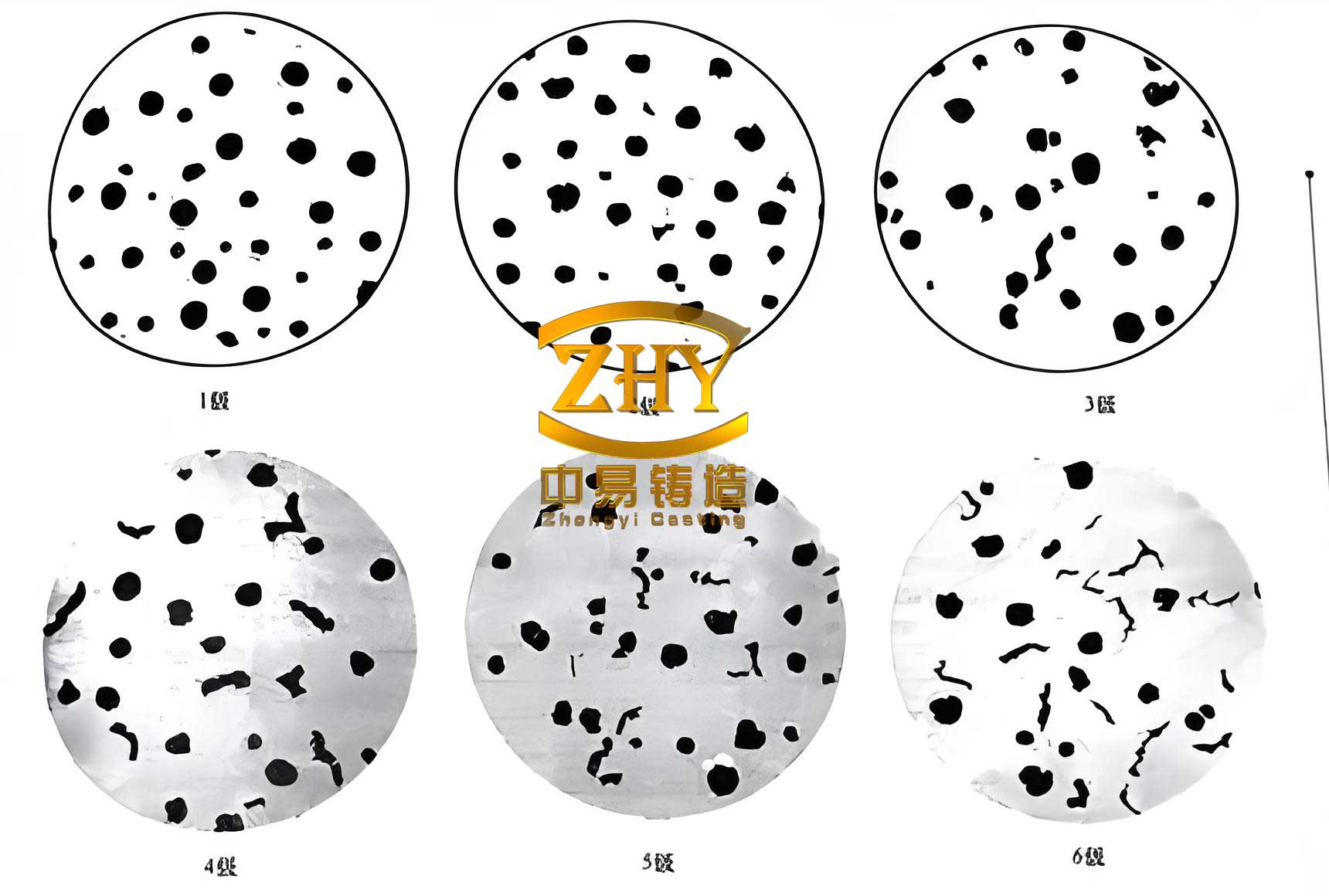
The image above illustrates the typical microstructure of spheroidal graphite cast iron, showing well-formed graphite spheroids in a ferritic matrix. Such a structure is essential for the performance of thick-section castings in energy applications, as it balances strength and ductility while providing good fatigue resistance.
Wind energy represents another growing domain for thick-section spheroidal graphite cast iron, particularly in hubs, bedplates, main shafts, and gearbox housings for multi-megawatt turbines. These components face harsh environmental conditions, including low temperatures and high dynamic loads, necessitating materials with superior low-temperature toughness. Grades like QT400-18AL (equivalent to EN-GJS-400-18U-LT) are common, requiring Charpy impact values above 12 J at -40°C. A wind turbine rotor, weighing 47.4 tonnes with walls up to 200 mm thick, exemplifies the scale involved. The casting process must inhibit carbide formation and ensure a predominantly ferritic matrix to meet low-temperature specifications.
Key measures include using low-impurity charge materials, with total trace elements below 0.06%, and adding antimony to suppress pearlite. Inoculation is multi-stage: primary treatment with low-rare earth magnesium alloys and secondary treatment with nodule-enhancing inoculants. The mold design incorporates exothermic risers and ample venting, with a vent-to-ingate area ratio of 1.5 to avoid gas defects. Cooling is controlled, with shakeout at 300°C to prevent residual stresses. The resulting spheroidal graphite cast iron exhibits excellent ultrasonic test results, with soundness meeting all standards. The table below outlines typical wind power components and their requirements:
| Component | Material Grade | Max Weight (tonnes) | Low-Temperature Impact Requirement | Key Challenges |
|---|---|---|---|---|
| Rotor Hub | QT400-18AL | 90 | >12 J at -40°C | Achieving uniform ferrite in thick sections |
| Main Shaft | QT400-18AL | 16 | >12 J at -40°C | Preventing shrinkage in heavy walls |
| Gearbox Housing | QT350-22AL | 25 | >15 J at -40°C | Ensuring pressure tightness and stiffness |
The low-temperature toughness of spheroidal graphite cast iron can be described by a modified impact energy model:
$$
KE(T) = KE_0 \exp\left(-\frac{\Delta H}{R(T – T_0)}\right)
$$
where $KE(T)$ is the impact energy at temperature $T$, $KE_0$ is a reference value, $\Delta H$ is an activation energy term, $R$ is the gas constant, and $T_0$ is a transition temperature. For ferritic spheroidal graphite cast iron, $T_0$ is typically low, enabling good performance in cold climates. Achieving this requires careful control of silicon content (usually 2.0–2.5%) and minimal pearlite, as pearlite reduces toughness.
Nuclear power poses the most demanding challenges for thick-section spheroidal graphite cast iron, especially in spent fuel storage and transport containers. These containers must provide shielding, structural integrity, and resistance to impact under accident conditions. Spheroidal graphite cast iron offers advantages over steel: higher yield-to-tensile ratio (0.6–0.7 vs. 0.5–0.6 for steel), better impact fatigue resistance, lighter weight (up to 10% reduction), and lower cost (40–50% of steel). However, producing containers with wall thicknesses over 400 mm and weights exceeding 100 tonnes requires advanced foundry techniques.
For example, a nuclear spent fuel container might weigh 115 tonnes, with a diameter of 2.5 meters and wall thickness of 500 mm. The material grade is often GGG40.3 (similar to QT400-18), with stringent requirements for fracture toughness and low-temperature impact strength (>12 J/cm² at -40°C). Production involves riserless casting designs, zircon sand molds with strengths above 3 MPa, and forced cooling systems to accelerate solidification in thick sections. Chemistry control is critical: cerium is added to neutralize trace elements like lead and antimony that promote coarse graphite, and nitrogen is kept within 80–120 ppm to avoid defects while maintaining mechanical properties. Simulation software is used to predict solidification patterns and optimize feeding.
The following table compares spheroidal graphite cast iron containers across different nuclear programs:
| Container Type | Country/Producer | Weight (tonnes) | Max Wall Thickness (mm) | Key Material Properties |
|---|---|---|---|---|
| TN1300 | Germany | 115 | 500 | Tensile strength >300 MPa, impact >12 J/cm² at -40°C |
| CASTOR | Germany | 183 | 450 | High fracture toughness, pressure resistance |
| BQH-20 | International Collaboration | 16 | 280 | Good shielding, leak-tightness |
The solidification time for thick-section spheroidal graphite cast iron can be estimated using Chvorinov’s rule, modified for graphite expansion:
$$
t_s = B \left(\frac{V}{A}\right)^n
$$
where $t_s$ is solidification time, $V$ is volume, $A$ is surface area, $B$ is a mold constant, and $n$ is an exponent typically near 2. For riserless designs, the carbon equivalent (CE) is crucial; it is defined as:
$$
CE = C + \frac{Si + P}{3}
$$
For thick sections, CE is often controlled around 4.3–4.5% to utilize graphite expansion for self-feeding, reducing shrinkage defects. Silicon content is kept between 1.8–2.3% to balance fluidity and ferrite formation.
In my experience, the future of thick-section spheroidal graphite cast iron in energy applications hinges on ongoing research into microstructure control and process innovation. Areas such as computational modeling of solidification, advanced inoculation techniques, and alloy design for enhanced high-temperature performance are vital. For instance, the addition of micro-alloys like niobium or vanadium can refine the matrix and improve creep resistance, beneficial for thermal power components. Similarly, developing spheroidal graphite cast iron with higher nickel content (3–5%) could extend its use to more corrosive environments in offshore wind or nuclear cooling systems.
Moreover, sustainability considerations are driving interest in recycling and low-carbon production methods. Spheroidal graphite cast iron, with its high scrap utilization potential, aligns well with circular economy goals. Lifecycle assessments show that spheroidal graphite cast iron components often have a lower environmental footprint compared to steel, due to reduced energy consumption during melting and casting.
In conclusion, thick-section spheroidal graphite cast iron has proven indispensable in the energy sector, offering a blend of performance, economy, and manufacturability that is hard to match. From massive turbine casings in thermal plants to resilient wind turbine hubs and robust nuclear containers, this material enables the trend toward larger and more efficient energy equipment. As a practitioner, I believe that continued collaboration between foundries, researchers, and energy companies will unlock further potential, paving the way for even more innovative applications. By deepening our understanding of the fundamentals—such as graphite nucleation, matrix transformation, and defect formation—we can ensure that spheroidal graphite cast iron remains a cornerstone of energy infrastructure for decades to come.