
In my extensive experience within the investment casting industry, I have consistently encountered the challenge of slag inclusion defects, which severely compromise the sealing performance of critical components such as valves and flanges. These defects, often manifesting as non-metallic inclusions like wax residues, shell material spalls, and oxidation slags, not only lead to leakage under pressure but also degrade mechanical properties such as impact toughness and yield strength. Through rigorous process optimization and controlled production practices, I have developed a comprehensive approach to minimize or eliminate these imperfections. This article delves into the root causes of slag inclusion defects and outlines effective strategies, supported by empirical data, tables, and metallurgical formulas, to enhance casting integrity and sealing reliability.
The formation of slag inclusion defects is multifaceted, originating from various stages of the investment casting process. Based on my observations, the primary sources can be categorized as follows: Firstly, residual wax impurities from incomplete wax reclamation can become entrapped during shell building. Secondly, foreign materials, such as broken shell fragments, may fall into the mold cavity after dewaxing if the pouring cup is not properly protected. Thirdly, inadequate melting practices—including the use of damp or rusted charge materials, insufficient shell firing, and improper deoxidation—contribute to oxide formation. Fourthly, low pouring temperatures hinder the flotation of slags to the casting surface. Lastly, both primary and secondary oxidation of molten steel during melting and pouring are significant contributors. Understanding these origins is crucial for implementing targeted countermeasures.
One of the most effective ways to mitigate slag inclusion defects is through thoughtful process design, particularly in wax pattern assembly or “treeing.” I always prioritize avoiding the placement of critical sealing surfaces upward, as this orientation tends to accumulate floating slags. Instead, I employ a side-gating approach whenever possible. For instance, when casting valve bodies or covers, I orient the sealing surface sideways to prevent it from becoming a slag collection area. However, when design constraints necessitate an upward-facing sealing surface, I implement compensatory measures. These include increasing machining allowances on that surface to provide a sacrificial layer for slag accumulation, which is later removed during finishing. Alternatively, I add specialized slag traps or risers at the top of the casting to capture and concentrate inclusions away from functional areas. These design adjustments have proven instrumental in reducing the incidence of slag inclusion defects.
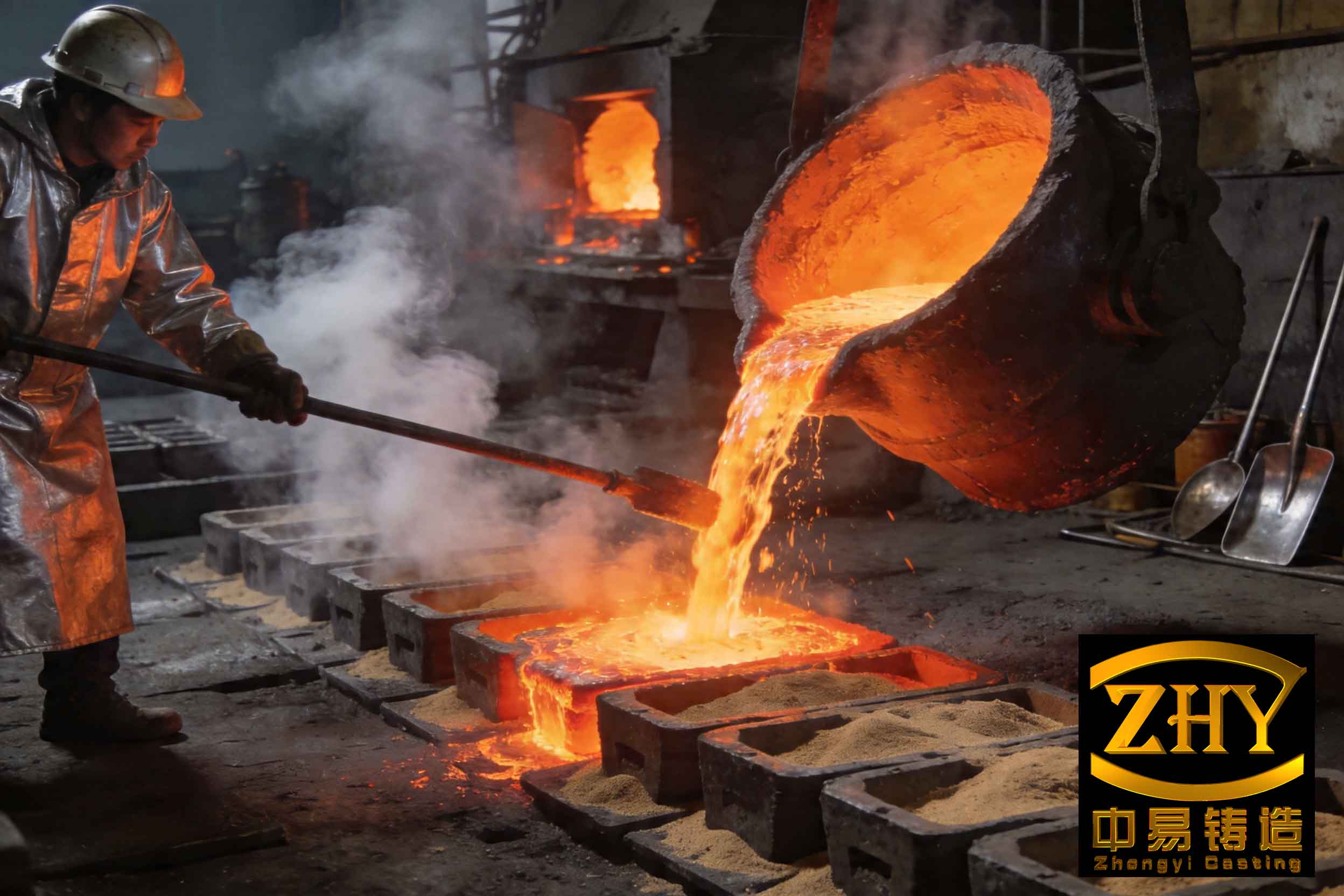
Beyond design, meticulous control during production is paramount. The wax reclamation process must be optimized to minimize impurities. I oversee a sequence involving dewaxing, wax evaporation, agitation, homogenization, and skimming to ensure recycled wax purity. To prevent contaminants from entering the shell cavity post-dewaxing, I enforce strict protocols: maintaining intact and clean pouring cups, storing shells with cups facing downward, or sealing cups with disposable covers when inversion is impractical. For shells requiring additional operations like back-coating or slurry pouring, I use plastic wraps to isolate the cup, thereby safeguarding the cavity.
The selection of charge materials significantly influences slag formation. I conducted comparative trials using bundled scrap (packing material) versus plate stock for melting. The parameters and outcomes are summarized in the table below, which clearly demonstrates the superiority of plate stock in reducing slag inclusion defects. This is attributed to the lower surface-area-to-volume ratio of plate stock, which minimizes oxidation during heating compared to the densely packed, oxidized scraps in bundled materials.
| Material Type | Melting Time (min) | Pouring Temperature (°C) | Observation on Casting (Flange Area) |
|---|---|---|---|
| Bundled Scrap (304 Stainless Steel) | 46 | 1541 | Severe slag inclusion defects present |
| Plate Stock (304 Stainless Steel) | 48 | 1545 | No visible slag inclusion defects |
Deoxidation practices are central to achieving clean molten metal. I tailor the deoxidation process based on steel composition, employing a combination of weak and strong deoxidizers in a specific sequence to facilitate slag removal. The fundamental reactions involved are:
Manganese deoxidation: $$ [Mn] + [O] = MnO $$
Silicon deoxidation: $$ [Si] + 2[O] = SiO_2 $$
When manganese deoxidation precedes silicon addition, the products combine to form low-melting-point manganese silicate: $$ MnO + SiO_2 = MnO \cdot SiO_2 $$ with a melting point of approximately 1291°C, which readily floats to the surface. I further employ complex deoxidizers like silicon-calcium-manganese alloys for diffusion deoxidation and aluminum for final killing. The detailed deoxidation schedules for different steel grades are outlined in the following table.
| Steel Type | Deoxidation Elements & Addition Rates | Deoxidation Procedure |
|---|---|---|
| Carbon & Alloy Steels (C: 0.20–0.40%) | FeMn (upper limit of spec), Si-Ca-Mn alloy (0.13%), Al wire (0.08%) | 1. Add FeMn for pre-deoxidation at >80% melt, then slag off. 2. At full melt (1500–1550°C), reduce power, add Si-Ca-Mn for diffusion deoxidation under covering flux for 2–3 min, slag off. 3. Raise temperature, insert Al wire for final deoxidation. |
| Carbon & Alloy Steels (C < 0.20%) | FeMn (upper limit), Si-Ca-Mn alloy (0.15%), Al wire (0.10%) | Same as above, with adjusted addition rates for higher deoxidation demand. |
| Stainless Steels (e.g., 304, 316) | Electrolytic Mn (upper limit), Si-Ca-Mn alloy (0.3%) | 1. Add electrolytic Mn for pre-deoxidation at >80% melt, slag off. 2. At full melt (1550–1580°C), perform two-stage diffusion deoxidation with Si-Ca-Mn under flux, slagging after each stage. |
Pouring temperature is another critical lever. Higher temperatures promote slag flotation due to reduced metal viscosity and enhanced buoyancy. I have observed a direct correlation: castings poured at lower temperatures (e.g., 1564°C) exhibit severe slag inclusion defects, while those poured at elevated temperatures (e.g., 1643°C) show virtually none. The relationship can be conceptualized through the Stokes’ law for slag particle rise velocity: $$ v = \frac{2g(\rho_m – \rho_s)r^2}{9\eta} $$ where \( v \) is the rise velocity, \( g \) is gravity, \( \rho_m \) and \( \rho_s \) are densities of metal and slag, \( r \) is slag particle radius, and \( \eta \) is metal viscosity. Increasing temperature decreases \( \eta \), thereby increasing \( v \) and improving slag removal.
The choice of shell facecoat material is often overlooked but vital, especially for low-alloy steels prone to interfacial reactions. I compared zirconia-based facecoats (zircon flour/sand) with high-purity alumina-based ones (white alumina flour/sand). Chemical compositions of typical materials are shown below.
| Material | ZrO₂ + HfO₂ (%) | SiO₂ (%) | Al₂O₃ (%) | Other Oxides (%) |
|---|---|---|---|---|
| Zircon Sand | ≥66.0 | ≤33.5 | ≤0.3 | Fe₂O₃, TiO₂, etc. |
| White Alumina | – | ≤0.1 | ≥99.5 | Traces |
For martensitic steels (e.g., grade 1.4008), zirconia facecoats often react with molten steel, releasing free SiO₂ that forms silicates like fayalite (Fe₂SiO₄) or manganese silicates, leading to pitting defects. The reaction can be simplified as: $$ 2[FeO] + SiO_2 = 2FeO \cdot SiO_2 $$ Alumina facecoats, being inert, prevent such reactions. In trials, castings produced with alumina facecoats had significantly fewer surface defects, thereby enhancing sealing performance by avoiding subsurface slag inclusion defects.
Implementing a standardized, process-controlled workflow is essential for consistent results. I have established protocols encompassing all stages—from wax tree design and shell making to melting and pouring. Each step includes checkpoints to monitor potential sources of slag inclusion defects. For example, regular audits of wax reclamation systems, controlled storage of shells, and strict adherence to deoxidation schedules based on real-time melt analysis. Statistical process control (SPC) charts are maintained to track defect rates, with corrective actions triggered for any deviations.
In conclusion, the battle against slag inclusion defects in precision casting is won through a holistic strategy integrating design foresight, material selection, and process rigor. Key takeaways from my practice are: First, always design the wax tree to orient critical surfaces away from slag accumulation zones, or employ compensations like extra machining allowance or slag traps. Second, purify wax and shield mold cavities relentlessly. Third, select charge materials with low oxidation propensity, such as plate stock over bundled scrap. Fourth, execute tailored deoxidation sequences using appropriate agents to generate removable slags. Fifth, optimize pouring temperature to maximize slag flotation, guided by principles of fluid dynamics. Sixth, choose chemically inert facecoat materials like alumina for reactive steel grades. By embedding these measures into a quality management system, foundries can achieve dramatic reductions in slag inclusion defects, resulting in castings with superior sealing integrity and reliability. Continuous improvement through data analysis and technological adoption remains the cornerstone for excellence in investment casting.