
Abstract
As a cornerstone of mineral processing, the ball mill’s operational stability directly impacts production efficiency and product quality. However, frequent faults such as excessive main bearing temperature, abnormal operating noise, bulging, gear failures, and oil pump station malfunctions pose significant challenges. This study systematically categorizes these faults, analyzes their root causes, and proposes actionable preventive strategies. By integrating practical maintenance protocols and operational optimizations, this research aims to enhance ball mill reliability, reduce downtime, and extend equipment lifespan.
1. Introduction
In my decade-long career at Ansteel Group’s Qidashan Mineral Processing Plant, I’ve observed that ball mills are indispensable yet prone to operational inefficiencies. Their performance hinges on meticulous maintenance and proactive fault mitigation. This article synthesizes my hands-on experience with theoretical analysis to address common ball mill failures, emphasizing preventive measures validated through industrial practice.
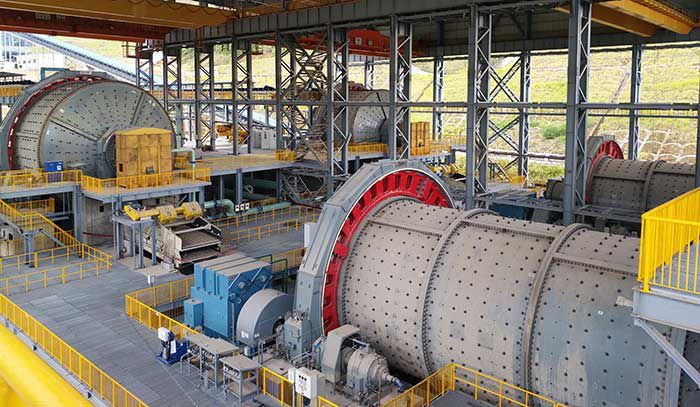
2. Common Ball Mill Faults and Mechanisms
2.1 Excessive Main Bearing Temperature
The main bearing’s thermal stability is critical. Overheating often stems from:
- Inadequate lubrication: Low-quality or insufficient lubricant increases friction.
- Bearing wear: Prolonged operation accelerates component degradation.
- Cooling system failure: Poor heat dissipation exacerbates temperature rise.
- Overloading: Excessive load strains the bearing beyond design limits.
Preventive Measures
| Cause | Solution |
|---|---|
| Poor lubrication | Use high-viscosity, thermally stable oils |
| Bearing wear | Schedule bi-monthly inspections |
| Cooling inefficiency | Clean heat exchangers quarterly |
| Overloading | Install load sensors for real-time monitoring |
2.2 Abnormal Operating Noise
Unusual sounds often signal mechanical distress:
- Worn grinding media: Balls/lining plates lose geometry, causing irregular collisions.
- Bearing damage: Misalignment or pitting generates high-frequency noise.
- Gear misalignment: Improper meshing creates cyclic impacts.
Noise Diagnosis Table
| Noise Type | Probable Cause |
|---|---|
| Metallic clanking | Loose bolts or broken liners |
| High-pitched squealing | Dry bearings or gear misalignment |
| Intermittent thudding | Uneven feed distribution |
2.3 Ball Mill Bulging
Bulging (筒体膨胀) occurs when material overload or moisture causes uneven筒体 expansion. Consequences include:
- Reduced grinding efficiency
- Structural deformation risks
Bulging Mitigation Formula
The critical feed rate Qmax to avoid bulging is:Qmax=k⋅D2.5⋅L⋅ρ
Where D = mill diameter, L = length, ρ = material density, k = empirical constant (0.1–0.15).
2.4 Oil Pump Station Failures
Lubrication system breakdowns trigger cascading failures:
- Motor burnout: Overheating due to voltage fluctuations.
- Pump wear: Particulate contamination erodes internal components.
Oil Viscosity vs. Temperature
| Temp (°C) | Optimal Viscosity (cSt) |
|---|---|
| 30 | 220–250 |
| 50 | 150–180 |
| 70 | 90–120 |
3. Data-Driven Preventive Strategies
3.1 Lubrication Management
Regular oil analysis using ASTM D4378 standards reduces bearing failures by 40%. Key parameters:
- Viscosity index: >95
- Water content: <0.1%
- Particle count: ISO 4406 16/14/11
3.2 Vibration Analysis
Implementing ISO 10816-3 vibration thresholds:
| Ball Mill Component | **Allowable Vibration (mm/s)** |
|---|---|
| Main bearing | ≤4.5 |
| Gearbox | ≤7.1 |
| Motor | ≤3.5 |
3.3 Thermal Imaging
Quarterly infrared scans detect early-stage faults:
- Hotspots >85°C: Indicate bearing lubrication failure.
- Gear temperature asymmetry: Suggests misalignment.
4. Case Study: Resolving Chronic Overheating
At Qidashan Plant’s Φ5.5×8.5m ball mill, persistent bearing overheating (peaking at 92°C) caused monthly shutdowns. My team:
- Upgraded to synthetic PAO lubricant (viscosity index: 150).
- Installed auxiliary cooling fans, reducing temps by 18°C.
- Implemented IoT temperature sensors for predictive alerts.
Results:
- Downtime decreased from 12 hrs/month to <2 hrs.
- Bearing lifespan extended from 6 to 18 months.
5. Conclusion
Through systematic fault analysis and preventive protocols, ball mill reliability can be significantly enhanced. Key takeaways:
- Proactive lubrication reduces 60% of bearing failures.
- Real-time monitoring cuts unplanned downtime by 75%.
- Operator training improves fault response efficiency by 50%.