
In the production of high-nickel-chromium indefinite chilled ductile iron centrifugal composite rolls, the application of a carbon-adding process has proven critical for achieving optimal material properties. As a practitioner in the field of metal casting, I have observed that these rolls are essential in steel rolling due to their combination of high wear resistance in the barrel and high toughness in the core, significantly extending service life and improving rolling efficiency. The shift toward synthetic ductile iron castings, utilizing large proportions of scrap steel (≥40%), reduces costs and enhances tensile strength beyond 500 MPa, but exacerbates carbon equivalent imbalance (CE < 3.6). This necessitates precise carbon control through carbon-adding techniques to maintain carbon content within the target range of 3.2% to 4.1%. In this article, I will delve into the principles, practices, and outcomes of carbon-adding in such ductile iron castings, emphasizing its role in refining microstructure and performance.
The carbon-adding process involves introducing carbon into molten iron to achieve desired carbon levels, driven by concentration gradients between the solid carbon additive and the liquid iron. Carbon exists in molten iron primarily as interstitial solid solution atoms (dissolved carbon) and as free carbon in the form of submicroscopic graphite particles. The dissolution mechanism is governed by diffusion, where carbon atoms migrate from the additive surface into the iron matrix. According to Fick’s first law of diffusion, the flux \( J \) (mol·m\(^{-2}\)·s\(^{-1}\)) is proportional to the concentration gradient \( \frac{dc}{dx} \) (mol·m\(^{-4}\)) and the diffusion coefficient \( D \) (m\(^{2}\)·s\(^{-1}\)):
$$ J = -D \frac{dc}{dx} $$
Here, \( D \) increases with temperature, accelerating carbon dissolution. In ductile iron castings, other elements like silicon can impede carbon diffusion, reducing solubility, while manganese may enhance it. The process also involves chemical reactions, such as oxidation of carbon with oxygen in the melt:
$$ \text{C} + \text{O}_2 \rightarrow \text{CO}_2 $$
$$ \text{C} + \frac{1}{2}\text{O}_2 \rightarrow \text{CO} $$
$$ \text{C} + \text{CO}_2 \rightarrow 2\text{CO} $$
These reactions lead to carbon loss, highlighting the need for controlled oxygen levels. For instance, manganese reacts with oxygen to form MnO, mitigating carbon oxidation. Understanding these dynamics is key to optimizing carbon-adding for ductile iron castings.
The efficiency of carbon-adding hinges on several technical factors, which I have categorized into key aspects. First, the selection of carbon additives is paramount. Graphitized carbon additives, with high fixed carbon (≥98%), low sulfur (<0.05%), and low nitrogen, are preferred for ductile iron castings due to their rapid dissolution and ability to provide nucleation sites for graphite spheroids. Particle size matters: too fine, and oxidation losses increase; too coarse, and dissolution slows. A size range of 1–5 mm is typical for medium-frequency induction furnaces. Second, timing and method of addition influence outcomes. Adding carbon when 70–80% of charge is melted ensures sufficient liquid phase and temperature for dissolution. It can be introduced into the furnace or ladle; ladle addition with direct iron stream impingement improves mixing. Third, initial melt composition affects carbon uptake. Lower initial carbon content boosts diffusion drive, achieving absorption rates above 85%, while higher levels near saturation reduce efficiency. Elements like silicon decrease absorption by 3–4% per 0.1% Si increase, whereas manganese increases it by 2–3% per 0.1% Mn increase. Sulfur has a minor negative impact. Fourth, temperature control is crucial: maintaining 1450–1550°C promotes dissolution without excessive oxidation. Fifth, stirring enhances uniformity; induction furnaces provide natural agitation, but mechanical or gas stirring (e.g., argon) can further improve carbon distribution. The relationship between these factors is summarized in Table 1, which outlines their effects on carbon-adding efficiency in ductile iron castings.
| Factor | Optimal Condition | Effect on Absorption Rate | Notes for Ductile Iron Castings |
|---|---|---|---|
| Carbon Additive Type | Graphitized, fixed C ≥98%, S <0.05% | High (>90%) | Enhances graphite nucleation and spheroidization. |
| Particle Size | 1–5 mm | Moderate to High | Balances dissolution speed and oxidation loss. |
| Addition Timing | 70–80% charge melted | High | Ensures adequate temperature and liquid phase. |
| Initial Carbon Content | Low (e.g., <3.0%) | Inversely proportional | Higher gradient drives faster dissolution. |
| Silicon Content | Low (e.g., 1.0–1.5%) | Negative impact | Reduces carbon solubility; monitor in ductile iron castings. |
| Temperature | 1450–1550°C | Positive correlation | Increases diffusion coefficient and solubility. |
| Stirring Intensity | Moderate to vigorous | Positive correlation | Promotes uniform distribution in ductile iron castings. |
In practice, the melting process for high-nickel-chromium ductile iron castings involves a structured approach. The charge composition typically includes scrap roll returns (30–40%), scrap steel (35–50%), minimal pig iron (0–10%), and trace alloys, with carbon additives added to adjust carbon. For a 2-ton medium-frequency furnace, I follow a stepwise procedure: Initially, 20% returns and 35% scrap steel are melted, heated to 1350–1400°C, and a first batch of graphitized carbon additive is added, covered with iron chips to promote immersion. After melting the cover, remaining scrap steel is added, reheated to 1350–1400°C, and a second carbon batch is introduced, followed by the rest of returns. Post full melting, a 5–10 minute hold at 1400°C ensures carbon homogenization. The melt is then heated to target temperature, slag removed, and composition analyzed; if carbon is low, additional carbon is added, or if high, scrap steel dilutes it. This precise control is vital for producing consistent ductile iron castings. The target chemical composition for the working layer is detailed in Table 2, reflecting the alloying elements that define these high-performance ductile iron castings.
| Element | C | Si | Mn | Cr | Ni | Mo | S | P |
|---|---|---|---|---|---|---|---|---|
| Content (wt%) | 3.43 | 1.3 | 0.85 | 1.80 | 4.33 | 0.35 | 0.015 | 0.06 |
Following carbon adjustment, spheroidization and inoculation are critical for developing the graphite morphology in ductile iron castings. I employ a three-stage composite inoculation process: primary inoculation with 75% ferrosilicon covering the spheroidizer (1.4–1.5% of melt weight), stream inoculation during tapping (0.4–0.6% fine ferrosilicon), and instantaneous inoculation before casting (0.1–0.15% ultrafine ferrosilicon). This enhances graphite nucleation, yielding high nodularity. The treated melt is then centrifugally cast into rotating molds, covered with “O”-type glass slag, and cooled to form the indefinite chilled layer. Throughout, monitoring ensures proper solidification for ductile iron castings.
The as-cast microstructure of these ductile iron castings reveals significant improvements from carbon-adding. Graphite morphology and distribution are key indicators. With carbon-adding, graphite nodularity exceeds 90%, with spherical graphite particles uniformly dispersed and sizes below 0.015 mm. This contrasts with non-carbon-added versions, where graphite may be sparse or irregular. The carbon additives provide abundant nucleation sites, fostering fine, round graphite spheroids essential for mechanical properties in ductile iron castings. The base matrix, composed of bainite, minor martensite, retained austenite, and carbides, also benefits. Carbon-adding stabilizes austenite, promoting a more homogeneous bainitic matrix with reduced martensite and increased retained austenite, enhancing toughness. The solidification process, influenced by high cooling rates and alloy elements like chromium and nickel, follows dendritic growth models. The temperature gradient \( G \) and growth rate \( R \) interact to define microstructure, often described by the Kurz-Fisher model for dendritic solidification in ductile iron castings:
$$ \lambda = a G^{-b} R^{-c} $$
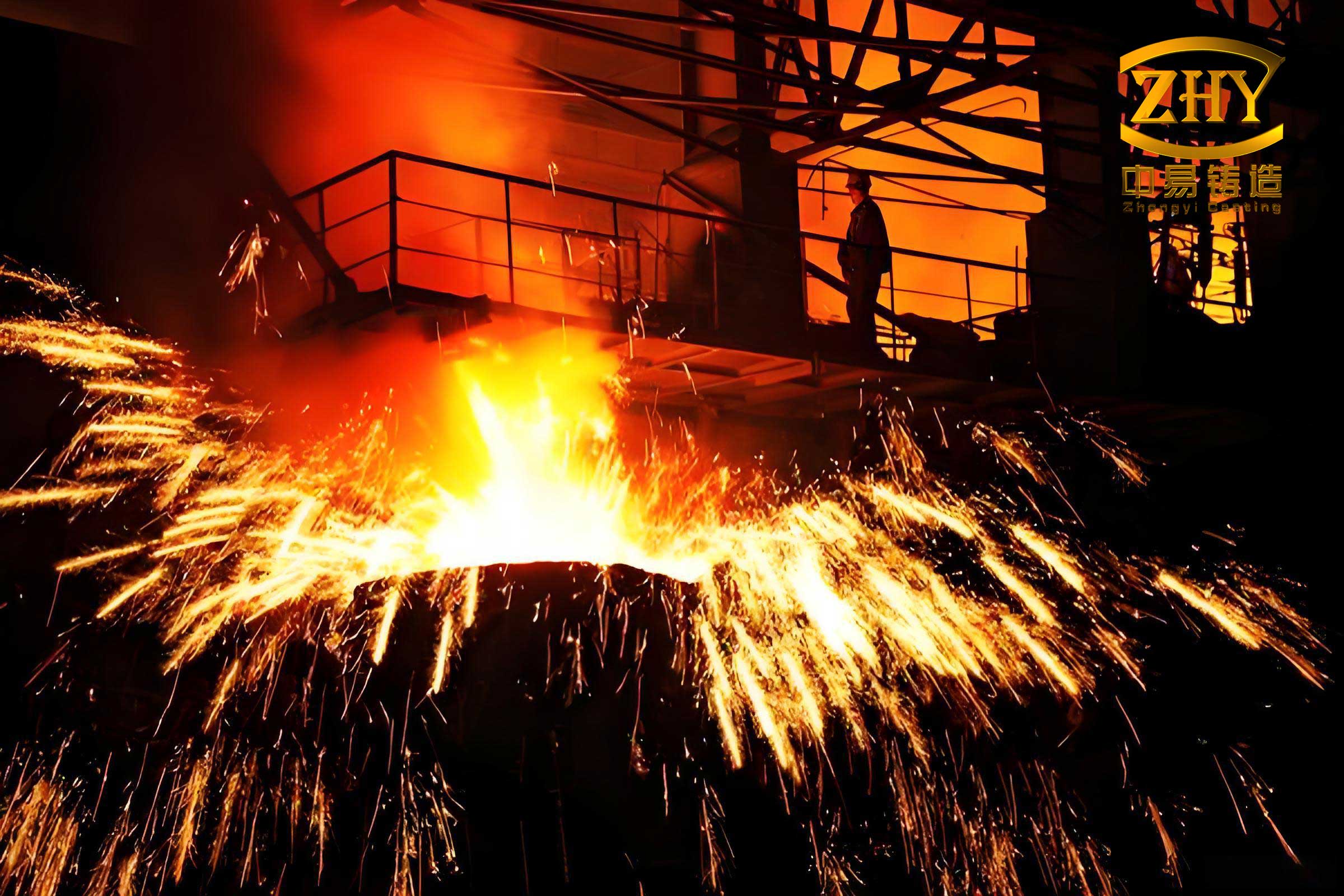
where \( \lambda \) is dendritic arm spacing, and \( a \), \( b \), \( c \) are constants. This results in a columnar-to-equiaxed transition, optimizing properties. To illustrate the microstructural outcomes, consider the following visual representation of ductile iron castings, which highlights the refined graphite and matrix achieved through carbon-adding.
Quantitative analysis of ductile iron castings shows that carbon-adding increases graphite area fraction by 10–20% compared to traditional methods. The nodularity level, a critical metric, is calculated as the percentage of graphite particles with aspect ratios near 1. For carbon-added ductile iron castings, this often exceeds 90%, whereas without carbon-adding, it may drop below 80%. The distribution of graphite can be modeled using statistical methods, where the number density \( N_v \) (particles per unit volume) relates to processing parameters. In ductile iron castings, higher carbon availability from additives boosts \( N_v \), improving uniformity. Similarly, the matrix hardness and toughness correlate with carbon content; I have observed that carbon-added ductile iron castings exhibit more consistent hardness profiles across sections, reducing susceptibility to cracking during service.
To further elaborate on the benefits, let’s examine the thermodynamic aspects. The solubility of carbon in iron melts, \( C_{\text{sat}} \), varies with temperature and composition. For ductile iron castings, an empirical equation can approximate this:
$$ C_{\text{sat}} = 1.3 + 2.57 \times 10^{-3} T – \sum k_i [\% i] $$
where \( T \) is temperature in °C, and \( k_i \) are interaction coefficients for elements like silicon and nickel. Carbon-adding helps maintain carbon near \( C_{\text{sat}} \), ensuring sufficient carbon for graphite formation without excessive carbides. In practice, the carbon absorption efficiency \( \eta \) is defined as:
$$ \eta = \frac{C_{\text{final}} – C_{\text{initial}}}{C_{\text{added}}} \times 100\% $$
For ductile iron castings, \( \eta \) typically ranges from 80% to 95% with optimal practices. Factors affecting \( \eta \) include additive quality, melt conditions, and stirring, as summarized in Table 3, which provides a comparative analysis for ductile iron castings production.
| Condition | Carbon Additive Type | Melt Temperature (°C) | Stirring Method | Absorption Efficiency (%) | Impact on Ductile Iron Castings Quality |
|---|---|---|---|---|---|
| Optimal | Graphitized, 98% C | 1500 | Induction + Mechanical | 90–95 | High nodularity, uniform matrix |
| Suboptimal | Non-graphitized, 90% C | 1450 | Induction only | 70–80 | Lower nodularity, inconsistent properties |
| High Sulfur | Graphitized, but high S | 1520 | Gas stirring | 75–85 | Increased carbides, reduced toughness |
| Low Temperature | Graphitized, 98% C | 1420 | Mechanical | 60–70 | Poor dissolution, graphite defects |
In terms of kinetic modeling, the carbon dissolution rate \( \frac{dC}{dt} \) in ductile iron castings can be expressed as a function of interfacial area \( A \), concentration difference \( \Delta C \), and mass transfer coefficient \( k \):
$$ \frac{dC}{dt} = k A \Delta C $$
This highlights the importance of particle size (affecting \( A \)) and stirring (affecting \( k \)). For ductile iron castings, fine-tuning these parameters ensures rapid and uniform carbon uptake. Additionally, the role of inoculation synergizes with carbon-adding; the nucleation potential \( I \) of graphite can be enhanced by carbon additives acting as substrates, described by:
$$ I = I_0 \exp\left(-\frac{\Delta G^*}{kT}\right) $$
where \( \Delta G^* \) is activation energy for nucleation, reduced by carbon additives. This leads to finer graphite in ductile iron castings, improving mechanical properties like tensile strength and fatigue resistance.
From an industrial perspective, the carbon-adding process offers economic and quality advantages for ductile iron castings. By replacing costly pig iron with scrap steel and carbon additives, material costs can be reduced by 28–35%, while maintaining or enhancing performance. The improved carbon control minimizes rejects and rework, boosting productivity. In my experience, ductile iron castings produced with carbon-adding show longer roll life in steel mills, attributable to better wear resistance and crack propagation resistance. The microstructure, characterized by fine graphite and homogeneous bainite, withstands the harsh conditions of rolling operations. Moreover, the process supports sustainability by maximizing scrap utilization, aligning with green manufacturing trends for ductile iron castings.
To summarize, the carbon-adding process is indispensable in modern ductile iron castings production, particularly for high-nickel-chromium indefinite chilled rolls. Its success relies on understanding dissolution principles, optimizing additive selection and addition techniques, and controlling melt parameters. The resulting microstructural refinements—high graphite nodularity, uniform distribution, and stabilized matrix—directly translate to enhanced durability and efficiency. As ductile iron castings continue to evolve, carbon-adding will remain a cornerstone technology, driving innovation in metal casting industries worldwide. Future research could explore advanced additives or real-time monitoring systems to further perfect this process for ductile iron castings.