
In the realm of modern automotive engineering, the turbocharger stands as a critical component for enhancing engine performance, efficiency, and meeting stringent emission standards. By harnessing exhaust gases to pre-compress intake air, it allows for greater fuel combustion and increased power output. As gasoline engines evolve, exhaust gas temperatures entering the turbocharger have soared from approximately 950°C to over 1,050°C, demanding housing materials that exhibit exceptional high-temperature strength, creep resistance, oxidation and corrosion resistance, and dimensional stability over the vehicle’s lifespan. Cast steel turbocharger housings, particularly those produced via shell casting processes, have emerged as superior alternatives to traditional ferritic or high-silicon molybdenum ductile irons. In this comprehensive discussion, I will delve into the intricate casting process for these shell castings, covering structural analysis, material specifications, process design, simulation-aided optimization, and production validation.
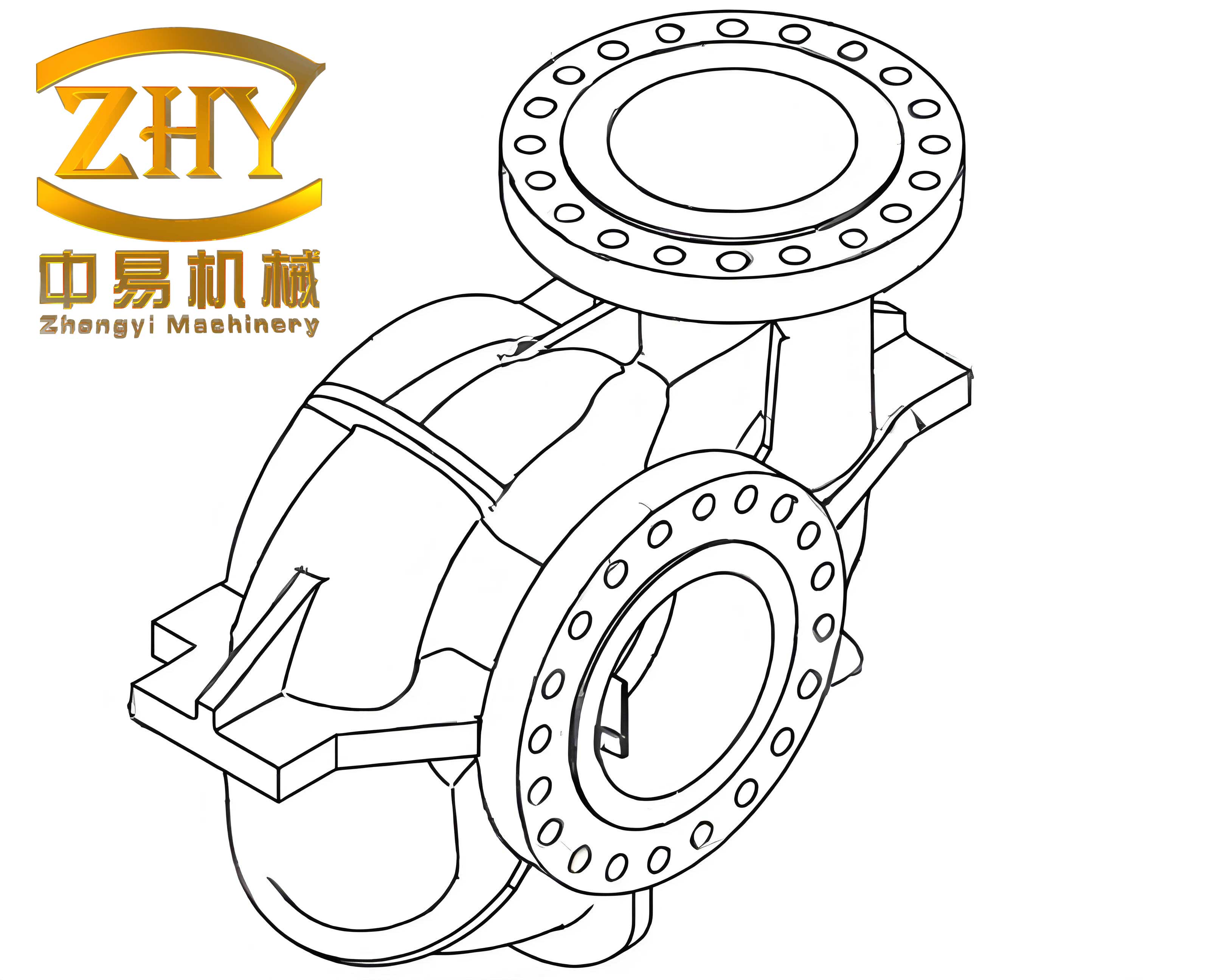
The turbocharger housing, often referred to as the “volute” or “turbine housing,” is a complex thin-walled component with intricate internal flow passages. The specific housing under consideration here is designed for cast steel construction. Its weight is approximately 2.9 kg, with overall envelope dimensions of 190 mm × 140 mm × 130 mm. A significant challenge in producing such shell castings is the presence of minimal wall sections, some as thin as 4 mm, alongside thicker sections where volute channels converge. These thicker junctions become natural hot spots and potential sites for shrinkage defects. Furthermore, critical internal flow passage dimensions must be held to tight tolerances, often verified through core print or impression checks.
The material specified is a heat-resistant cast steel conforming to the grade GX40CrNiSi25-20, as per the EN 10295 standard for heat-resistant steel castings. This austenitic steel derives its properties from a balanced composition of chromium and nickel, providing the necessary high-temperature performance. Key material requirements are summarized in the table below.
| Parameter | Standard Requirement | Typical Target/Note |
|---|---|---|
| Chemical Composition (%) | ||
| Carbon (C) | 0.3 – 0.5 | |
| Silicon (Si) | 1.0 – 2.5 | |
| Manganese (Mn) | ≤ 2.0 | |
| Phosphorus (P) | ≤ 0.04 | |
| Sulfur (S) | ≤ 0.03 | |
| Nickel (Ni) | 11.0 – 14.0 | |
| Chromium (Cr) | 24.0 – 27.0 | |
| Niobium (Nb) | 1.5 – 2.0 | |
| Molybdenum (Mo) | ≤ 0.5 | |
| Mechanical Properties | ||
| Tensile Strength (σb) | ≥ 450 MPa | |
| Yield Strength (σs) | ≥ 220 MPa | |
| Elongation (δ) | ≥ 6% | |
| Hardness (HB) | 150 – 220 | |
| Microstructure | Austenite + Chromium Carbides | |
| Defect Standard | ES492-00131 (G) | Defines max size, count, and location for porosity, shrinkage, etc. |
The defect standard is particularly stringent, governing both surface and internal imperfections. For instance, in machined areas, the maximum allowable pore diameter is 1.0 mm, with strict limits on depth, count, and spacing. Internal shrinkage cavities must be isolated and below specific size thresholds. Meeting these specifications in complex shell castings requires a meticulously designed and controlled process.
The chosen production method is shell molding, a precision casting process ideal for high-volume, dimensionally accurate components like turbocharger housings. In this process, a pre-coated resin sand (precoated sand) is used to form thin, rigid shells around a heated pattern. These shells are then assembled to create the mold cavity. For the housing, we employ a horizontal parting line and a layout yielding two castings per mold (two impressions). This approach maximizes productivity while maintaining the dimensional stability characteristic of shell castings. The mold and core material is furan sand, known for its good collapsibility and surface finish.
The cornerstone of a sound casting process is a robust gating and feeding system. Given the relatively small size of these shell castings and the use of a bottom-pour ladle (typical for steel), a semi-closed (or enlarged) gating system with a vertical choke was designed. The goal is to achieve a smooth, non-turbulent fill while establishing favorable temperature gradients for directional solidification. The key design parameters are pouring time and gating ratios.
The total poured weight per mold is calculated considering the casting weight and an expected yield (productivity) of approximately 35%. For two castings at 2.9 kg each, the total casting weight is 5.8 kg. With a 35% yield, the total poured weight \( G \) is estimated as:
$$ G = \frac{5.8}{0.35} \approx 16.6 \, \text{kg} $$
The pouring time \( t \) was calculated using two empirical formulas and averaging the results. The first formula is a statistical mean equation:
$$ t_1 = \sqrt{G} + \sqrt[3]{G} $$
Substituting \( G = 16.6 \):
$$ t_1 = \sqrt{16.6} + \sqrt[3]{16.6} \approx 4.07 + 2.55 \approx 6.62 \, \text{s} $$
The second formula uses a pouring coefficient \( S \), typically between 2.2 and 3.0 for small steel castings. Taking \( S = 2.75 \):
$$ t_2 = S \times \sqrt{G} = 2.75 \times \sqrt{16.6} \approx 2.75 \times 4.07 \approx 11.19 \, \text{s} $$
Averaging these gives a practical pouring time:
$$ t = \frac{t_1 + t_2}{2} = \frac{6.62 + 11.19}{2} \approx 8.9 \, \text{s} $$
For the gating system, the cross-sectional area ratios were set as: Sprue : Choke : Runner : Ingate = 1.2 : 0.6 : 0.9 : 1. This semi-closed system helps slow the metal stream at the choke before distributing it through the runner and ingates. The total ingate area \( \sum A_{\text{ingate}} \) is calculated using the formula:
$$ \sum A_{\text{ingate}} = \frac{G}{t \cdot K \cdot S’} $$
Where \( K \) is the pouring rate constant (\( \text{kg/(cm}^2 \cdot \text{s)} \)), typically \( K = 0.022 \sqrt{H_p} \), with \( H_p \) being the mean metallostatic pressure head. \( S’ \) is a fluidity factor, taken as 1.0. Based on the mold geometry and ladle height, \( H_p \) was determined, leading to the calculation of individual gate areas. The finalized areas were: Sprue \( A_{\text{sprue}} = 1200 \, \text{mm}^2 \), Choke \( A_{\text{choke}} = 600 \, \text{mm}^2 \), Runner \( A_{\text{runner}} = 900 \, \text{mm}^2 \), and total Ingate \( \sum A_{\text{ingate}} = 1000 \, \text{mm}^2 \). This design aims for a calm fill essential for high-quality shell castings.
Feeding design is paramount to prevent shrinkage porosity in the heavy sections. Before physical tooling, we utilized MAGMASoft simulation software to predict solidification behavior and identify critical regions. The 3D CAD model (in .STL format) was imported, and a mesh of approximately 2 million elements was generated. Material properties for X40CrNiSi25-20 were selected from the database, with a solidus of 1,335°C, liquidus of 1,407°C, latent heat of 298 kJ/kg, and a pouring temperature of 1,600°C. The shell mold and cores were modeled with furan sand properties.
The initial simulation, without feeders, clearly highlighted the isolated liquid regions and hot spots at the volute confluence, as predicted by modulus calculations. The modulus \( M \) of a section, defined as its volume divided by its cooling surface area (\( M = V/A \)), is a key indicator of solidification time. The hot spot modulus \( M_{\text{hotspot}} \) was calculated. To ensure soundness, feeder necks must be placed accordingly. The feeder design follows standard principles:
Modulus Criterion: \( M_{\text{feeder}} = K_M \times M_{\text{hotspot}} \), where \( K_M \) ranges from 0.8 to 1.1.
Volume Criterion: \( V_{\text{feeder}} \geq f \times V_{\text{hotspot}} \), where \( f \) is the alloy shrinkage factor (approximately 0.4 for this steel).
Pressure Criterion: The feeder must maintain metallostatic pressure above the feeding path.
Based on these, a combination of side feeders (for smaller hot spots) and a top feeder (for the main volute junction) was designed. The top feeder was designed with a height-to-diameter ratio \( h/d = 1.2 \) for efficient feeding. Additionally, chill plates were strategically placed near the thick sections to accelerate local solidification and promote directional solidification towards the feeders, a common technique in steel shell castings to reduce hot tearing tendency.
The complete system, including gating and feeders, was simulated. The filling sequence showed a smooth, progressive rise of metal with minimal turbulence. The temperature field during filling confirmed that the feeder regions remained the hottest, establishing a favorable thermal gradient. The solidification simulation, visualized through fraction solid plots, demonstrated that the thin walls solidified first, followed by the heavier sections, with the top feeder solidifying last—a classic directional solidification pattern crucial for sound shell castings.
However, the initial simulation also revealed a potential issue. During the final stages of solidification, a small isolated liquid zone appeared in the heavy section near the feeder neck, indicating a risk of micro-shrinkage. This was due to the limited feeding distance caused by the geometry of the internal flow channel, which acted as a thermal barrier.
To validate the simulation, initial prototype castings were produced using the designed shell molding process. Radiographic inspection and sectioning of these prototype shell castings confirmed the simulation’s prediction: a shrinkage zone measuring approximately 21.7 mm in length and 4.7 mm in width was found in the volute confluence area. This exceeded the allowable limits of the defect standard for continuous shrinkage.
The root cause analysis, corroborated by the simulation, pointed to an insufficient feeding distance. The thermal center of the heavy section was effectively isolated from the feeder by the intervening wall of the flow passage, creating a “hot spot” that could not be adequately fed despite the feeder’s presence.
The solution involved modifying the pattern to include a wash or pad (a localized thickening) on the casting at the junction of the feeder neck and the heavy section. This pad effectively increases the thermal connection or feeding path between the feeder and the hot spot, shortening the effective feeding distance. The modified design was re-simulated. The new results showed a complete elimination of the isolated liquid zone in the critical area; the solidification sequence now showed a clear thermal gradient from the casting to the feeder through the pad.
Production trials with the modified pattern were conducted. The resulting shell castings were fully inspected. Sectioning and non-destructive testing showed no shrinkage defects in the previously problematic area. The chemical composition and mechanical properties of the trial castings were verified and met all specifications, as shown in the table below.
| Property | Standard Requirement | Measured Value (Sample 1) | Measured Value (Sample 2) |
|---|---|---|---|
| C (%) | 0.3 – 0.5 | 0.41 | 0.42 |
| Si (%) | 1.0 – 2.5 | 1.25 | 1.22 |
| Cr (%) | 24.0 – 27.0 | 26.4 | 26.3 |
| Ni (%) | 11.0 – 14.0 | 13.4 | 13.2 |
| Nb (%) | 1.5 – 2.0 | 1.80 | 1.83 |
| σb (MPa) | ≥ 450 | 540 | 528 |
| σs (MPa) | ≥ 220 | 312 | 308 |
| δ (%) | ≥ 6 | 13 | 11 |
| Hardness (HB) | 150 – 220 | 198 | 202 |
Metallographic examination revealed the required austenitic matrix with finely distributed chromium carbides, confirming the desired microstructure for high-temperature service. The successful production run validated the optimized process design.
In conclusion, the development of a reliable casting process for high-performance cast steel turbocharger housings is a multi-faceted engineering challenge. The shell casting process, with its inherent dimensional accuracy and surface finish, is exceptionally well-suited for such components. However, the complexity of the geometry and the stringent quality requirements necessitate a methodical approach. Key to this success was the integration of fundamental foundry engineering principles with advanced numerical simulation. The use of MAGMASoft software allowed for accurate prediction of filling patterns and, more importantly, solidification defects like shrinkage porosity in these precision shell castings. The initial simulation correctly identified a feeding problem that manifested in physical prototypes. The subsequent iterative optimization—adding a strategic feed pad—was first validated virtually and then confirmed in production, eliminating the defect. This case underscores the critical importance of simulation in modern foundry practice, not just for problem-solving but for proactive process design. It significantly reduces the trial-and-error cycle, shortens lead times for new components like turbocharger housings, and ensures robust manufacturability. Furthermore, the combination of well-designed gating, judicious use of chills, and properly sized feeders based on modulus calculations is essential for achieving sound, high-integrity shell castings in heat-resistant steels. The final process delivers castings that meet all mechanical, metallurgical, and stringent defect standards, ensuring reliable performance in the demanding high-temperature environment of modern turbocharged engines. The entire journey from design to validated production highlights the synergy between traditional foundry art and digital simulation technology in advancing the state-of-the-art for critical shell castings.