
As an engineer specializing in casting process optimization, I have extensively utilized Casting Computer-Aided Engineering (CAE) to address persistent casting defects in automotive components. The integration of simulation tools has revolutionized how we predict, analyze, and mitigate defects such as shrinkage porosity, gas entrapment, and hot tears, which are critical in ensuring the durability and safety of automotive parts. In this article, I will elaborate on the application of Casting CAE, focusing on strategies to eliminate casting defects, supported by tables, formulas, and a detailed example. The keyword ‘casting defect’ will be emphasized throughout to highlight its centrality in quality assurance.
Casting defects are inherent challenges in metal casting processes, particularly in high-pressure die casting used for automotive parts. These defects can lead to component failure under operational stresses, as seen in fatigue testing. Through Casting CAE, we simulate the entire process—from mold filling and solidification to thermal stresses—enabling proactive defect identification. The core advantage lies in reducing trial-and-error iterations, saving time and costs. For instance, in a recent project involving an aluminum alloy wiper arm, casting defects like shrinkage holes and gas pores were identified as root causes of fracture during fatigue tests. By employing CAE software, we optimized mold design iteratively, ultimately eliminating the casting defect and enhancing product reliability.
To systematically address casting defects, it is essential to classify them based on their origin. Common casting defects in automotive applications include shrinkage porosity, gas porosity, cold shuts, and misruns. The table below summarizes these defects, their causes, and typical CAE prediction modules.
| Casting Defect Type | Primary Causes | CAE Simulation Module | Impact on Automotive Components |
|---|---|---|---|
| Shrinkage Porosity | Inadequate feeding, thermal gradients | Solidification Analysis | Reduces mechanical strength, leads to fatigue failure |
| Gas Porosity | Air entrapment during filling, mold gases | Filling Flow Analysis | Causes stress concentration, affects durability |
| Cold Shut | Low metal temperature, poor flow front merging | Temperature Field Simulation | Creates weak seams, compromises integrity |
| Misrun | Insufficient fluidity, early solidification | Velocity and Pressure Analysis | Results in incomplete filling, part rejection |
The CAE simulation strategy for die casting, as I apply it, involves a multi-step approach. First, we define the geometry and material properties, such as the alloy’s thermal conductivity and latent heat. Then, we simulate the filling phase to assess flow patterns and gas entrapment risks. The governing equations for fluid flow include the Navier-Stokes equations, simplified for incompressible flow in casting:
$$ \rho \left( \frac{\partial \mathbf{v}}{\partial t} + \mathbf{v} \cdot \nabla \mathbf{v} \right) = -\nabla p + \mu \nabla^2 \mathbf{v} + \mathbf{f} $$
where $\rho$ is density, $\mathbf{v}$ is velocity, $p$ is pressure, $\mu$ is dynamic viscosity, and $\mathbf{f}$ represents body forces. For solidification, the heat transfer equation is critical:
$$ \frac{\partial T}{\partial t} = \alpha \nabla^2 T + \frac{L}{c_p} \frac{\partial f_s}{\partial t} $$
Here, $T$ is temperature, $t$ is time, $\alpha$ is thermal diffusivity, $L$ is latent heat, $c_p$ is specific heat, and $f_s$ is solid fraction. By solving these equations numerically, CAE software predicts potential casting defect locations, such as areas with high gas pressure or slow cooling rates.
In my experience, a structured simulation plan is vital. The table below outlines a typical CAE analysis workflow for die casting, emphasizing defect prediction and optimization.
| Simulation Phase | Key Parameters | Defect Focus | Output Metrics |
|---|---|---|---|
| Pre-processing | Mesh generation, boundary conditions | None | Model readiness |
| Filling Analysis | Injection velocity, gate design | Gas porosity, cold shuts | Flow front temperature, air pressure |
| Solidification Analysis | Cooling rate, feed paths | Shrinkage porosity | Temperature gradient, solidification time |
| Stress Analysis | Thermal contraction, mold constraints | Hot tearing, residual stresses | Stress distribution, deformation |
| Optimization Loop | Design modifications (e.g., risers, cooling) | All casting defects | Defect size reduction, quality index |
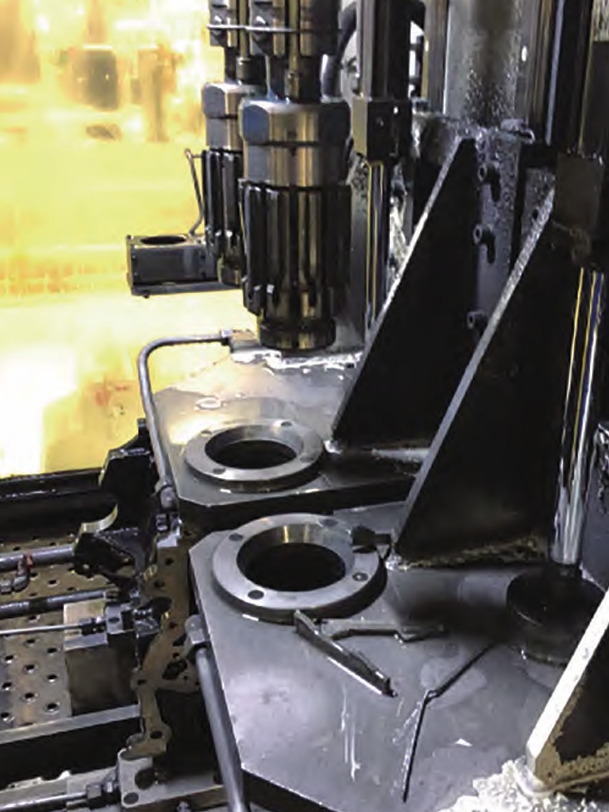
To illustrate, consider an automotive component like an engine cylinder block, which is prone to casting defects due to its complex geometry. During simulation, we often observe that certain regions, such as thick sections or junctions, act as hot spots, leading to shrinkage defects. By applying CAE, we can optimize the cooling system design to mitigate these issues. For visual reference, here is an example of such a component where casting defect analysis is crucial:
In a specific case involving a wiper arm—a safety-critical automotive part—initial fatigue tests revealed fractures traced back to casting defects. Metallurgical analysis confirmed the presence of shrinkage and gas pores at the crack site. Using CAE, I simulated the existing mold design to identify the root causes. The filling simulation showed gas entrapment in the rib area, while solidification analysis indicated shrinkage porosity due to inadequate cooling. This casting defect combination significantly weakened the component, leading to failure under cyclic loads.
The initial simulation results highlighted the severity of the casting defect. For instance, the shrinkage pore size was predicted to be approximately 3.2 mm × 2.2 mm, and gas pressure peaks indicated entrapment zones. To address this, I proposed design modifications, starting with enhanced cooling. The optimization process involved multiple iterations, each simulated to assess effectiveness. The first iteration added spot cooling channels near the rib, reducing the shrinkage defect size to 1.8 mm × 1.3 mm. However, gas entrapment persisted, necessitating further changes.
Subsequent optimizations focused on both filling and solidification. I extended the runner gate to promote earlier filling of the rib section, which reduced gas entrapment pressure by 13%. Additionally, I redesigned the cooling system to include pinpoint cooling directly above and below the hot spot, using higher water flow rates. The solidification analysis for this iteration showed a further reduction in shrinkage pore size to 1.0 mm × 0.5 mm. The table below summarizes the progression of casting defect mitigation across these iterations.
| Optimization Iteration | Modification Description | Shrinkage Pore Size (mm) | Gas Entrapment Level | Casting Defect Severity |
|---|---|---|---|---|
| Initial Design | Baseline mold | 3.2 × 2.2 | High | Critical |
| Iteration 1 | Added spot cooling, modified fillet radius | 1.8 × 1.3 | Moderate | High |
| Iteration 2 | Extended gate, improved cooling layout | 1.0 × 0.5 | Low | Medium |
| Iteration 3 | Implemented spray cooling, adjusted runner | 0.5 × 0.5 | Minimal | Low |
The final optimization combined the best elements: a revised gate design to minimize gas entrapment and an aggressive cooling strategy using spray channels. The simulation predicted a shrinkage defect size of 0.5 mm × 0.5 mm, effectively negligible for the application. After implementing these changes in production, X-ray inspection confirmed the absence of detectable casting defects, and fatigue tests exceeded 50 hours without failure, demonstrating the success of CAE-driven optimization.
Beyond this example, Casting CAE is applicable to various automotive components, such as transmission housings, brake calipers, and suspension parts. Each part presents unique challenges; for instance, thin-walled sections may be prone to misruns, while thick regions risk shrinkage. The general approach involves defining a quality index, $Q$, to quantify casting defect severity:
$$ Q = 1 – \frac{D_{\text{actual}}}{D_{\text{critical}}} $$
where $D_{\text{actual}}$ is the predicted defect size (e.g., pore diameter) and $D_{\text{critical}}$ is the maximum allowable defect size based on mechanical properties. By iterating designs to maximize $Q$, we ensure robustness. Additionally, statistical models can link process parameters to defect formation. For example, the probability of gas porosity, $P_g$, might be expressed as:
$$ P_g = k \cdot \exp\left(-\frac{\Delta P}{\rho v^2}\right) $$
where $k$ is a material constant, $\Delta P$ is pressure drop, and $v$ is flow velocity. Such formulas help in fine-tuning injection parameters to minimize casting defects.
In practice, I recommend a holistic CAE framework that integrates multiple physics. The table below outlines key simulation outputs and their relevance to casting defect prevention in automotive die casting.
| Simulation Output | Physical Meaning | Related Casting Defect | Optimization Action |
|---|---|---|---|
| Temperature Gradient | Rate of cooling variation | Shrinkage porosity | Adjust cooling channels, modify wall thickness |
| Flow Front Velocity | Speed of metal advance | Gas porosity, cold shuts | Optimize gate size, injection speed |
| Solidification Time | Time for complete freezing | Shrinkage, hot tears | Enhance feeding systems, use chills |
| Residual Stress | Internal stresses after cooling | Cracking, distortion | Modify mold stiffness, control cooling rate |
Looking forward, the role of Casting CAE in automotive manufacturing is expanding with advancements in machine learning and real-time monitoring. By training models on historical simulation data, we can predict casting defects more accurately and even suggest automatic corrections. However, the core principle remains: proactive simulation is indispensable for quality assurance. In my work, I have seen reductions in defect rates by over 50% through CAE adoption, leading to significant cost savings and improved product performance.
In conclusion, Casting CAE is a powerful tool for resolving casting defects in automotive components. By simulating filling, solidification, and stress phenomena, engineers can identify and mitigate defects early in the design phase, avoiding costly mold rework and ensuring component reliability. The iterative optimization process, supported by tables and formulas, enables precise control over parameters that influence defect formation. As automotive industry demands for lighter and stronger parts grow, the integration of CAE will continue to be critical in achieving zero-defect manufacturing. Through continuous innovation, we can further enhance our ability to predict and eliminate casting defects, driving forward the quality standards in automotive casting.