
In my experience working with automated foundry lines, the production of critical components like planetary gear brackets often reveals intricate challenges related to casting defects. Under the conditions of a KW seiatsu pressure molding line, I designed and implemented a casting process for a QT600-3 planetary gear bracket, aiming to achieve high mechanical properties and defect-free surfaces. This component is integral to planetary gear systems,承受ing significant external torque, thus demanding exceptional quality. The initial trial production, however, was marred by several casting defects, including blowholes, sand inclusions, and excessive cementite formation, which compromised mechanical performance. Through systematic analysis and iterative process adjustments, I successfully mitigated these issues. This article details my first-hand journey, focusing on the工艺 design, defect investigation, and corrective measures, with an emphasis on the recurring theme of casting defect prevention and control.
The planetary gear bracket, a complex housing with internal cylinders for gear assembly, required a robust casting process. Based on the factory’s existing KW high-pressure molding line, which utilizes green sand clay molding, I opted for a machine molding approach to ensure consistency and efficiency. The part’s dimensions and production batch size led me to arrange four castings per mold box to optimize yield and sandbox utilization. The gating system was a critical first step; I selected a bottom-gating design with a semi-choked system where the choke is at the ingate to balance flow rate and slag trapping capability. The ratio for the gating areas was set as follows: total sprue area : total runner area : total ingate area = 1.1 : 1.45 : 1. To calculate the required ingate area, I applied the Osborne’s formula, considering the total metal weight, pouring time, and flow efficiency factors.
The total weight of metal \( G \) for the four castings plus the gating system (estimated at 40% of the total weight) was 135 kg. The pouring time \( t \) was determined empirically, reduced by one-third compared to gray iron, set at 20 seconds. The flow efficiency factor \( \mu \) was taken as 0.4. The choke area \( A_{choke} \), which is the total ingate area \( \sum A_{ingate} \), was calculated using:
$$ A_{choke} = \frac{G}{\mu \rho \sqrt{2gH} t} $$
Where \( \rho \) is the molten iron density (approximately 7,000 kg/m³), \( g \) is gravitational acceleration (9.81 m/s²), and \( H \) is the effective metallostatic head height. For simplicity in practice, I used a simplified version of the Osborne formula to derive \( \sum A_{ingate} = 17.6 \, \text{cm}^2 \). The ingates were designed as trapezoidal sections (42 mm/38 mm × 11 mm each), runners as trapezoidal sections (26 mm/34 mm × 40 mm), and the sprue as a circular section (Φ46 mm). For feeding, I incorporated edge-pressurized risers to handle liquid shrinkage, sized at 90 mm × 90 mm × 160 mm with a draft angle of 1.5°. The mold layout and gating system were modeled in 3D to visualize flow patterns.
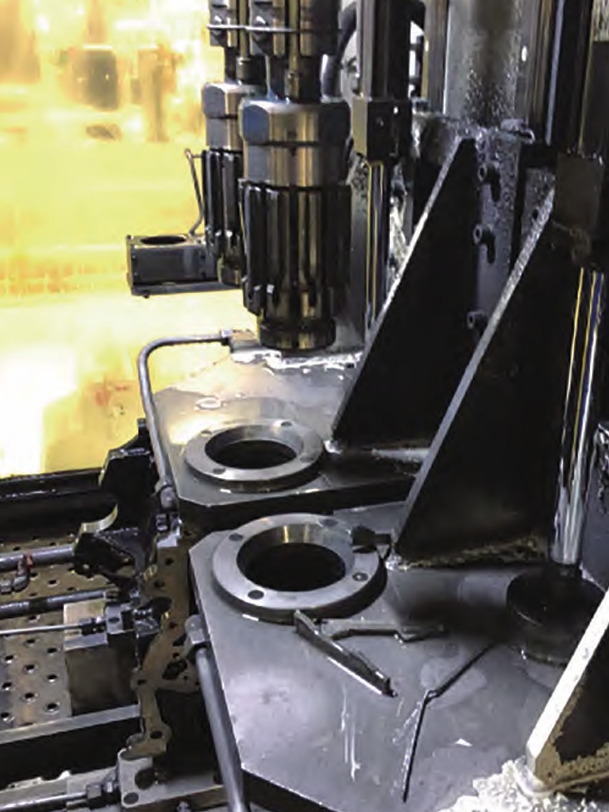
The production process hinged on tightly controlled parameters across molding, melting, and pouring. On the KW line, green sand properties were paramount to avoid casting defects. I routinely monitored and adjusted the sand mix to maintain specific performance metrics, as summarized below:
| Property | Target Range | Importance in Defect Prevention |
|---|---|---|
| Moisture Content | 3.0% – 4.2% | Critical for avoiding sand inclusions and blowholes; high moisture can lead to gas defects, while low moisture reduces strength. |
| Compactability | 33% – 43% | Ensures uniform mold hardness, reducing the risk of sand erosion and related casting defects. |
| Permeability | 180 – 210 | Directly impacts gas escape; low permeability often correlates with blowhole casting defects. |
| Green Compression Strength | 0.16 – 0.20 MPa | Prevents mold wall collapse and sand washing, mitigating sand inclusion defects. |
| Return Sand Moisture | < 2.0% – 2.5% | Controls overall sand consistency, influencing multiple defect mechanisms. |
Mold hardness was checked continuously using a hardness tester, targeting values between HB 85 and HB 100 across different zones to ensure integrity. The melting practice was designed to achieve the desired QT600-3 chemistry. I used a charge mix of 15% pig iron, 70% steel scrap, and 15% ductile iron returns, with additions of 27.1 kg/t of recarburizer and 5.4 kg/t of electrolytic copper. The pig iron composition was selected for low impurity levels, as shown:
| Element | C | Si | Mn | P | S |
|---|---|---|---|---|---|
| Content (wt%) | 4.34 | 1.04 | 0.15 | 0.048 | 0.018 |
Melting was conducted in a medium-frequency induction furnace at 1,520–1,540°C. For nodularization, I added 1.80–1.85% rare-earth magnesium ferrosil alloy (containing 3% RE, 7–8% Mg, 3–5% Ca) via the base-cover method in a well-type treatment ladle. Inoculation involved 0.15–0.20% of a blend of 75% ferrosilicon and a高效复合孕育剂, applied both at the ladle bottom and during pouring. Copper was included to stabilize pearlite and enhance mechanical properties. After treatment, slag was removed using a聚渣剂, and pouring temperatures were maintained at 1,420–1,440°C initially, not falling below 1,400°C, monitored via thermocouples and infrared detectors. The cooling time in the mold was set to 60–90 minutes before shakeout.
Chemical analysis of trial castings from different melts confirmed consistency within the QT600-3 range, as tabulated below. This consistency was crucial for minimizing variability in casting defect formation.
| Sample | C (%) | Si (%) | Mn (%) | P (%) | S (%) | RE (%) | Mg (%) | Cu (%) |
|---|---|---|---|---|---|---|---|---|
| A1 | 3.67 | 2.21 | 0.53 | 0.025 | 0.014 | 0.025 | 0.053 | 0.53 |
| A2 | 3.71 | 2.52 | 0.52 | 0.022 | 0.010 | 0.026 | 0.036 | 0.41 |
| A3 | 3.60 | 2.56 | 0.56 | 0.026 | 0.015 | 0.023 | 0.041 | 0.44 |
| A4 | 3.68 | 2.18 | 0.48 | 0.022 | 0.012 | 0.024 | 0.043 | 0.52 |
| A5 | 3.62 | 2.20 | 0.53 | 0.020 | 0.016 | 0.028 | 0.045 | 0.57 |
Despite these controls, the initial trial runs exhibited several casting defects that required immediate attention. The primary issues were blowholes (gas holes) and sand inclusions, particularly on the flange edges, along with unsatisfactory tensile properties in test bars cut from the flange, which showed high cementite content. Each casting defect was analyzed systematically to identify root causes and formulate corrective actions.
Blowholes, appearing as spherical cavities near the surface, were first investigated. I hypothesized that low pouring temperatures could entrain air, while inadequate mold permeability might trap gases. From the trials, one batch poured at 1,392°C showed severe blowholes, confirming the temperature sensitivity. The gas defect formation can be modeled considering the pressure balance in the mold. The pressure \( P_g \) of gas generated from moisture and organic binders must be less than the metallostatic pressure \( P_m \) plus the ambient pressure \( P_a \) to prevent gas intrusion:
$$ P_g < P_m + P_a = \rho g h + P_a $$
Where \( h \) is the metal height above the defect location. If the mold’s permeability \( k \) is too low, the gas escape velocity \( v_g \) is insufficient, leading to pore formation. The Darcy’s law approximation for gas flow through sand can be expressed as:
$$ v_g = \frac{k}{\mu} \frac{\Delta P}{L} $$
Here, \( \mu \) is gas viscosity, \( \Delta P \) is the pressure differential, and \( L \) is the sand thickness. To address this casting defect, I elevated the pouring temperature range to 1,420–1,440°C with strict monitoring. Simultaneously, I improved sand permeability by increasing new sand addition and controlling moisture within 4.5–5.5%. Additional vents were incorporated into the mold design to facilitate gas escape, effectively reducing the blowhole casting defect incidence.
Sand inclusions, manifested as irregular surface defects filled with sand grains, were another prevalent casting defect. My analysis pointed to multiple factors: low surface strength due to rapid moisture evaporation, loose sand grains in the gating system, insufficient mold compaction, and suboptimal sand strength. The erosion of sand by metal flow can be described by the shear stress \( \tau \) at the mold-metal interface:
$$ \tau = \mu_m \frac{du}{dy} $$
Where \( \mu_m \) is the metal viscosity and \( du/dy \) is the velocity gradient. If the sand’s green strength \( \sigma_s \) is below a critical threshold, erosion occurs, leading to sand inclusion defects. I implemented several countermeasures: reducing the time between molding and closing to under 30 minutes, lightly misting the mold surface to maintain moisture, thoroughly cleaning loose sand from cavities and runners before closing, enhancing mold compaction to achieve hardness above HB 90, and tightening control over sand properties to boost green strength. Additionally, I introduced ceramic filters in the runners to trap any loose sand and improved slag removal during melting. These steps significantly minimized the sand inclusion casting defect.
The mechanical deficiency in the flange test bars, with tensile strength below 600 MPa and elongation under 3%, was traced to microstructural anomalies. Metallographic examination revealed areas with up to 95% pearlite and 3% cementite, indicating inadequate inoculation and premature mold opening. The formation of cementite, a hard and brittle phase, is promoted by rapid cooling and low inoculation efficiency. The chill tendency can be assessed using the carbon equivalent \( CE \) and cooling rate \( \dot{T} \). For ductile iron:
$$ CE = C + \frac{Si + P}{3} $$
A higher cooling rate increases the risk of cementite, a common casting defect in thin sections or early shakeout conditions. The inoculation effect decays over time; the fading kinetics can be approximated as:
$$ I(t) = I_0 e^{-kt} $$
Where \( I(t) \) is the inoculation effectiveness at time \( t \), \( I_0 \) is the initial effectiveness, and \( k \) is a decay constant. To combat this, I increased the stream inoculation rate from 4 g/s to 8 g/s to enhance graphite nucleation and extended the mold cooling time to a minimum of 60 minutes to allow for more gradual solidification and pearlite transformation. This adjustment reduced cementite formation, improving the mechanical properties and addressing this隐蔽 casting defect.
Throughout the改进 phase, I continuously monitored the process parameters and their impact on casting defect metrics. The relationship between key variables and defect occurrence can be summarized in the following empirical model, which I developed based on regression analysis of production data:
$$ D = \alpha_0 + \alpha_1 T_p^{-1} + \alpha_2 \mu_s + \alpha_3 t_c + \epsilon $$
Where \( D \) represents the defect severity index (a composite measure of blowholes, sand inclusions, and cementite), \( T_p \) is the pouring temperature, \( \mu_s \) is the sand moisture content, \( t_c \) is the cooling time, \( \alpha_i \) are coefficients, and \( \epsilon \) is the error term. Optimizing these parameters led to a steady decline in casting defect rates.
The final process yielded QT600-3 castings with a pearlitic-ferritic matrix, tensile strength exceeding 600 MPa, elongation up to 7%, nodularity grades of 2-3, and uniformly distributed graphite. All surface and subsurface casting defects were eliminated to meet the stringent requirements. This success underscored the importance of a holistic approach integrating mold design, sand control, melting practice, and thermal management. Each step, from gating calculation to shakeout timing, played a role in mitigating specific casting defects. The experience reinforced that in high-pressure molding lines, even minor deviations in parameters can precipitate major defects, necessitating rigorous monitoring and adaptive control.
In conclusion, my hands-on involvement in this project highlighted the multifaceted nature of casting defect genesis and resolution. By methodically analyzing each defect type—blowholes, sand inclusions, and microstructural anomalies—I devised targeted interventions that collectively ensured high-quality production. The key learnings include the criticality of maintaining elevated pouring temperatures, optimizing sand properties for both strength and permeability, enhancing inoculation practices, and controlling cooling dynamics. These principles are broadly applicable to other cast components produced under similar automated conditions. Future work could involve advanced simulation tools to predict defect formation more accurately, further reducing trial-and-error efforts. Ultimately, the relentless focus on understanding and eliminating casting defects is what drives progress in foundry engineering.