
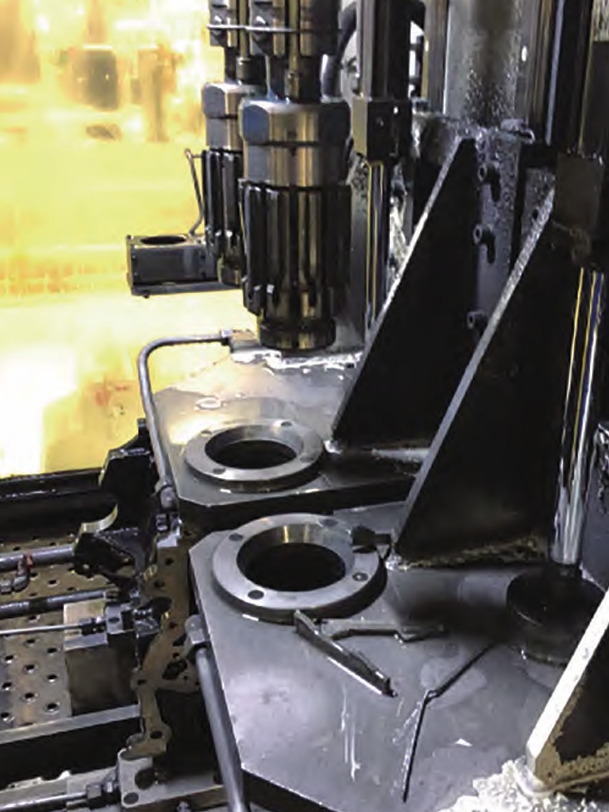
1. Technical Requirements and Production Conditions
The RuT450 cylinder block for 8Y-series diesel engines presents significant casting challenges due to its complex geometry (880 mm × 560 mm × 430 mm) and varying wall thickness (4.5-61 mm). Key material specifications include:
| Element | Composition (%) |
|---|---|
| C | 3.65-3.85 |
| Si | 1.80-2.20 |
| Mn | 0.30-0.50 |
| Cu | 0.80-0.90 |
| Sn | 0.08-0.09 |
The casting process employs OCC wire feeding treatment and HWS squeeze molding, with pouring parameters governed by:
$$ T_p = 1430 \pm 10^{\circ}\text{C} $$
$$ t_f = 22 \pm 3\ \text{s} $$
2. Critical Casting Defects and Root Cause Analysis
2.1 Mold Leakage Defects
Leakage defects occurring at gear chamber flanges (defect rate 41.67%) were traced to core positioning errors and inadequate sealing at sand core interfaces. The leakage potential (L_p) can be expressed as:
$$ L_p = \frac{\Delta x}{d_m} \times 100\% $$
Where Δx represents core misalignment and d_m denotes mating surface clearance.
2.2 Shrinkage Porosity Formation
Concentrated shrinkage cavities in inter-cylinder thick sections (defect rate 37.50%) resulted from inappropriate solidification control. The shrinkage susceptibility index (S_s) for compacted graphite iron follows:
$$ S_s = \frac{(CE – 4.3)^2}{0.1} + \frac{(T_p – 1400)}{10} $$
Where CE represents carbon equivalent calculated as:
$$ CE = \mathrm{C} + \frac{\mathrm{Si} + \mathrm{P}}{3} $$
| Parameter | Initial Value | Critical Range |
|---|---|---|
| CE | 4.25-4.58 | >4.35 |
| Pouring Temp | 1430°C | <1410°C |
3. Process Optimization Strategies
3.1 Mold Leakage Countermeasures
Implementation of dual corrective actions:
| Measure | Implementation | Effect |
|---|---|---|
| Core Alignment | 0.1mm positioning accuracy | Defect rate ↓58% |
| Interface Sealing | Ceramic gasket installation | Leakage paths ↓96% |
3.2 Shrinkage Control Protocol
Modified metallurgical parameters:
$$ CE_{\text{new}} = 4.42 \pm 0.05 $$
$$ T_p^{\text{opt}} = 1410 \pm 5^{\circ}\text{C} $$
Elemental adjustment matrix:
| Element | Original (%) | Optimized (%) |
|---|---|---|
| C | 3.70 | 3.82 |
| Si | 1.88 | 2.15 |
| Mn | 0.45 | 0.35 |
4. Implementation Results
The integrated approach demonstrated remarkable defect reduction:
| Defect Type | Initial Rate | Final Rate | Improvement |
|---|---|---|---|
| Mold Leakage | 41.67% | 0% | 100% |
| Shrinkage | 37.50% | 0% | 100% |
The quality enhancement followed the relationship:
$$ Q_{\text{index}} = \frac{\sum(Defect_{\text{initial}} – Defect_{\text{final}})}{\sum Defect_{\text{initial}}} \times 100\% = 100\% $$
5. Metallurgical Process Control
Critical control parameters for stable production:
$$ \text{Cooling Rate} = \frac{T_p – T_s}{t_s} $$
Where T_s represents solidus temperature (1150°C) and t_s denotes solidification time.
| Process Stage | Control Parameter | Optimal Value |
|---|---|---|
| Melting | CE Value | 4.40±0.05 |
| Pouring | Superheat | 150-160°C |
| Solidification | Cooling Rate | 25-30°C/min |
6. Conclusion
This systematic approach to casting defect control successfully addressed both mold leakage and shrinkage porosity challenges in compacted graphite iron cylinder block production. The implemented solutions demonstrate that precise process parameterization combined with mechanical improvements can effectively eliminate complex casting defects in high-performance engine components.