
In my experience with high-pressure molding lines for automotive components, producing defect-free thin-walled shell castings remains one of the most persistent challenges. The specific component under discussion is a clutch housing, a classic example of a complex shell casting with intricate internal geometries formed by multiple sand cores. The material specification is grade HT250 gray iron, with a maximum envelope of 363 mm x 384 mm x 220 mm, a weight of approximately 18 kg, and a minimum wall thickness of only 5 mm. The functional requirement for pressure tightness mandates a sound, dense microstructure completely free from internal defects, making the control of casting integrity paramount. This narrative details the systematic investigation and resolution of recurring defects in these shell castings.
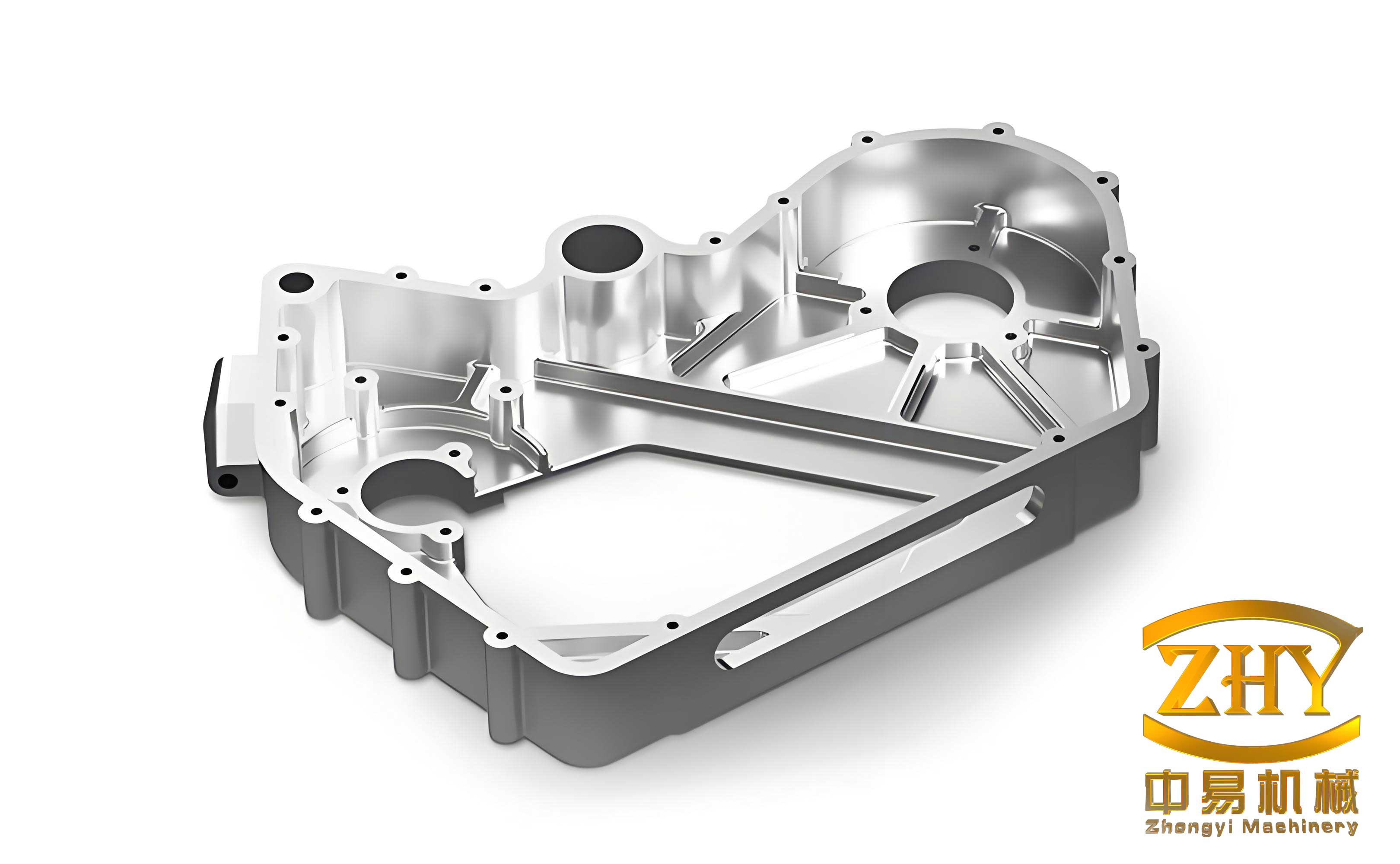
The initial production process was designed for efficiency on a horizontal parting flaskless molding line with a box size of 1200 mm x 800 mm, employing a pattern of four shell castings per mold. The gating system was a bottom-runner design with the ingates positioned along the parting line, a choice made to promote tranquil filling, minimize the buoyant force on the extensive core assembly, and enhance resistance to shrinkage and slag entrapment. Each casting was fed by three ingates. Given that all cores were made from resin-coated sand (shell cores), which inherently has a high gas evolution potential, the original process incorporated vent channels in the core prints and multiple venting aids. These included overflow risers with vent pins at the top flange, vent strips at the highest points of the lower casting face, and vent pins on all bosses on the cope side to maximize the venting area. Despite these precautions, systematic defects emerged during volume production, primarily manifesting as blowholes at the roots of the vent strips on the lower face, sand inclusions on the vertical walls of the top flange, and fractures at the connecting points between the two main core segments.
Root Cause Analysis of Defects in Shell Castings
The failure analysis focused on the specific, recurrent locations of the defects, which pointed directly to weaknesses in the process design for these particular shell castings.
1. Analysis of Blowhole Formation
The location of the blowholes at the highest points indicated classic侵入性气孔 (intrusive blowholes), caused by gases trapped within the mold cavity during pouring. The primary gas source in this scenario was the substantial volume of resin-coated sand used for the complex cores. The original venting scheme, where two large cores shared a single vent passage, proved inadequate. The total gas generation rate $G_{total}$ from the cores can be expressed as:
$$G_{total} = \sum_{i=1}^{n} (V_{core_i} \cdot \rho_s \cdot g_{resin} \cdot f(T))$$
where $V_{core}$ is core volume, $\rho_s$ is sand density, $g_{resin}$ is the specific gas yield of the resin, and $f(T)$ is a function of the temperature-dependent gas evolution rate. The vent’s capacity to evacuate this gas, $Q_{vent}$, is governed by the cross-sectional area $A_v$ and the pressure differential:
$$Q_{vent} \propto A_v \cdot \sqrt{\frac{\Delta P}{\rho_g}}$$
The initial design likely resulted in $G_{total} > Q_{vent}$, leading to a pressure buildup $P_{gas}$ inside the cavity that exceeded the metallostatic pressure $P_{metal} = \rho_{Fe} \cdot g \cdot h$ at the affected thin sections, forcing gas into the solidifying iron. Alternatives like reducing mold sand moisture or resin content were non-viable due to impacts on mold strength and core integrity, respectively.
2. Analysis of Sand Inclusion Defects
The concentration of sand washes on the vertical flange walls formed by the mold (not the core) was highly indicative. In high-pressure impulse molding, deep, narrow recesses in the pattern—like the space around a flange—are prone to “bridging,” resulting in areas of low compaction and poor surface hardness. Measurement confirmed the hardness in these areas was only 50-60, significantly below the required >70 standard. The erosive force of the flowing metal, related to its dynamic pressure $P_{dynamic} = \frac{1}{2} \rho_{Fe} v^2$, where $v$ is the local flow velocity, easily dislodged poorly compacted sand grains. Since altering the molding machine’s compaction parameters to harden these specific vertical faces was impractical, the solution had to involve removing them from the mold’s responsibility.
3. Analysis of Core Fracture
The fracture occurred at the small, protruding print connections that linked the two major core sections. These prints acted as cantilever beams supporting a significant core mass. The bending stress $\sigma$ at the root of the print can be estimated by:
$$\sigma \approx \frac{F \cdot L}{Z}$$
where $F$ is the buoyant force and core weight component, $L$ is the cantilever length, and $Z$ is the section modulus of the small print. The inherent strength of the shell sand material $\sigma_{core}$ was insufficient to withstand this stress. Using higher-strength resin would increase cost and gas evolution, while chaplets risked leakage points. Reinforcing the critical stress points internally was the logical path forward.
| Defect Type | Primary Cause | Key Contributing Factors | Non-Viable Solutions (Reason) |
|---|---|---|---|
| Blowholes | Insufficient core gas evacuation | Shared vent path; High core volume/gas yield | Lower mold moisture (weak mold); Less resin (weak core); Higher pour temp (dimensional issues) |
| Sand Inclusions | Low mold hardness on vertical faces | Bridging during impulse compaction; Deep pattern recess | Increasing mold hardness locally (machine limitation) |
| Core Fracture | Overstress in cantilever core prints | Small print section; Large core mass; Buoyancy forces | Higher-strength core sand (cost & gas); Chaplets (leak risk) |
Systematic Process Improvement for Shell Castings
The corrective actions were designed to directly attack the root causes without introducing new process complexities or significant cost increases for these shell castings.
1. Enhanced Venting Architecture for Cores
The most critical change was abandoning the shared vent system. Each major core was given its own dedicated, optimally routed vent channel that terminated at the highest possible point in the mold. This effectively doubled the available vent cross-sectional area $A_v$ for gas removal and prevented gas from one core from interfering with another. The principle is to ensure the venting capacity meets or exceeds the peak gas generation:
$$Q_{vent\_new} = A_{v1} + A_{v2} \geq \max(G_{total}(t))$$
where $G_{total}(t)$ is the time-dependent gas evolution rate. This direct, low-resistance path allowed gases to escape freely to the atmosphere rather than building pressure and invading the molten iron.
2. Redesign of Core-Mold Interface to Eliminate Sand Washes
To solve the sand inclusion problem, the core design was modified to extend its geometry to form the problematic vertical flange walls. This transformed a vulnerable mold surface into a hard, resin-bonded core surface with high erosion resistance. The modification is a prime example of defect prevention through design for manufacturability in shell castings. The core print size was increased, changing the parting line between mold and core. This ensured that all critical vertical surfaces subject to direct metal impingement were now generated by the core, whose surface strength $\sigma_{core\_surface}$ is inherently much higher than that of a green sand mold, satisfying the condition:
$$\tau_{metal\_flow} < \sigma_{core\_surface}$$
where $\tau_{metal\_flow}$ is the shear stress imposed by the flowing metal.
3. Structural Reinforcement of Critical Core Prints
To address the fracture issue, a reinforcing steel rod (core rod) was embedded within the slender connecting prints during the core shooting process. This is a standard but highly effective technique for enhancing the bending strength of long, thin core sections in complex shell castings. The composite strength of the print $\sigma_{composite}$ becomes a function of both the sand and the rod:
$$\sigma_{composite} \approx \frac{A_{sand} \cdot \sigma_{sand} + A_{steel} \cdot \sigma_{steel}}{A_{total}}$$
where $A$ represents cross-sectional area. The steel rod carries the majority of the tensile stress. Furthermore, the rod from one core segment was designed to protrude and embed itself with adhesive into a matching socket in the adjoining core segment during assembly. This created a positive mechanical link, transforming a weak sand-to-sand joint into a robust steel-reinforced, adhesively bonded connection, dramatically increasing the assembly’s resistance to bending and shear failure.
| Improvement Measure | Target Defect | Design Change | Mechanism / Governing Principle |
|---|---|---|---|
| Dedicated Core Vents | Blowholes | Individual vent per core; Optimal routing to highest point | Maximize gas evacuation flux $Q_{vent}$ to ensure $P_{gas} < P_{metal}$ at all times. |
| Core Extension for Flange Walls | Sand Inclusions | Increased core print size; Core forms critical vertical faces | Replace low-strength green sand surface ($\sigma_{mold}$) with high-strength core sand surface ($\sigma_{core}$) where $\tau_{flow}$ is high. |
| Steel Rod Reinforcement in Prints | Core Fracture | Embedded steel core rod in slender prints; Interlocking adhesive joint | Increase bending strength $\sigma_{composite}$ and create positive mechanical connection between core segments. |
Results and Quantitative Validation
The implementation of these three coordinated improvements yielded immediate and stable results in the production of these shell castings. The core fracture defect was completely eliminated, as the reinforced prints successfully withstood the buoyancy and handling stresses. The incidence of sand inclusions on the flange wall dropped to near zero, confirming that the erosion resistance of the core surface was fully adequate. The blowhole defect rate saw a dramatic reduction. While not entirely eradicated in every single casting—as is often the case in high-volume foundry production—the scrap rate due to blowholes fell well within acceptable commercial limits, proving the efficacy of the dedicated, high-capacity venting system.
A crucial part of the validation involved monitoring key process parameters before and after the change to ensure no negative interactions. The table below summarizes this comparison:
| Parameter / Metric | Original Process | Improved Process | Impact / Note |
|---|---|---|---|
| Pouring Temperature | 1380 – 1400 °C | 1380 – 1400 °C | Held constant to avoid shrinkage risk. |
| Mold Hardness (Vertical Face) | 50 – 60 | Not Applicable (Core Surface) | Core surface hardness > 90. |
| Core Gas Vent Cross-section | X (Shared) | ~2X (Dedicated) | Effective vent area doubled. |
| Scrap Rate: Core Fracture | >5% | 0% | Completely eliminated. |
| Scrap Rate: Sand Inclusion | ~3% | <0.5% | Negligible occurrence. |
| Scrap Rate: Blowhole | ~8% | ~1.5% | Significant reduction to acceptable level. |
| Total Relevant Scrap Rate | ~16% | ~2% | Overall process capability greatly enhanced. |
Generalized Principles for Quality Enhancement of Shell Castings
This case study underscores several fundamental principles applicable to the manufacturing of complex, cored shell castings across various industries:
1. Proactive Gas Management is Non-Negotiable: For shell castings utilizing substantial volumes of resin-bonded sand, venting cannot be an afterthought. The venting system must be designed with the same rigor as the gating system, providing low-resistance, direct paths from all core and mold cavities to the exterior. The design should be based on an estimated peak gas load, ensuring sufficient evacuation capacity.
2. Design the Core-Mold Partition for Robustness: The interface between the core and the mold should be strategically placed to avoid subjecting poorly compactable green sand areas to high-velocity metal flow. Whenever possible, critical internal and vertical surfaces should be assigned to the core, leveraging its superior and more consistent surface strength. This is a key strategy for preventing erosion-related defects in shell castings.
3. Reinforce Geometrically Unfavorable Core Features: Slender core prints, long cantilevers, and other delicate core features are high-risk points. Embedding steel reinforcements (core rods or wires) during core manufacturing is a highly effective and low-cost method to prevent breakage during handling, mold closing, and metal pouring. The small additional material cost is insignificant compared to the cost of a scrapped casting.
4. Holistic Process Analysis is Key: Defects like blowholes, sand inclusions, and core shift/breakage are often interlinked. A change to address one (e.g., increasing resin for core strength) can exacerbate another (e.g., blowholes). The successful approach involved simultaneous, complementary modifications that solved multiple problems without creating new ones.
The production of high-integrity shell castings, especially those requiring pressure tightness, demands a meticulous balance of design, material science, and process engineering. By rigorously applying fundamental foundry principles—optimizing venting for gas evacuation, strategically assigning surfaces to cores or mold based on their capabilities, and reinforcing vulnerable core geometries—chronic quality issues can be systematically resolved, leading to robust and economical manufacturing processes.