
In my research on particle-reinforced aluminum matrix composites, I have focused extensively on the casting defects that arise during the fabrication of SiCp-enhanced aluminum materials. These composites, known for their high specific strength, elastic modulus, and wear resistance, are increasingly used in aerospace, automotive, and sporting goods industries. However, the casting process, particularly via stir-casting methods, introduces numerous challenges that lead to various casting defects. Understanding these casting defects is crucial for improving material performance and manufacturing efficiency. In this article, I will delve into the theoretical underpinnings and practical aspects of these casting defects, using formulas and tables to summarize key points. My analysis is based on thermodynamic principles, interfacial phenomena, and solidification dynamics, all of which contribute to the formation of casting defects.
The stir-casting technique, while cost-effective for producing complex shapes, often results in a range of casting defects due to the inherent instability of SiCp in molten aluminum. From a thermodynamic perspective, the composite system is highly unstable because of the large interfacial area between SiCp and the aluminum matrix. This high interfacial energy makes the composite formation non-spontaneous, requiring external energy input through stirring to disperse SiCp into the melt. The non-wettability between SiCp and aluminum melt, with a contact angle of approximately 118°, exacerbates this instability, leading to tendencies for particle agglomeration and poor dispersion. These factors directly influence the fluidity, solidification behavior, and最终 integrity of the cast components, resulting in casting defects such as porosity, inclusions, aggregation, segregation, and interfacial reactions. In the following sections, I will analyze each of these casting defects in detail, supported by theoretical models and experimental observations.
First, let’s consider the theoretical background. The fluidity of SiCp-reinforced aluminum composites is significantly reduced compared to pure aluminum alloys, primarily due to increased viscosity. The viscosity of the composite melt can be estimated using the modified Einstein equation:
$$ \eta_s = \eta_0 (1 + 2.5\phi + 10.52\phi^2) $$
where $\eta_s$ is the viscosity of the composite, $\eta_0$ is the viscosity of the aluminum melt, and $\phi$ is the volume fraction of SiCp. For $\phi < 0.25$, this equation shows that viscosity increases rapidly with particle content, directly impairing flow characteristics and contributing to casting defects like incomplete filling and shrinkage porosity. Additionally, the fluidity length $L$ can be expressed as $L = a – bS$, where $S$ is the total surface area of SiCp suspended in the melt, and $a$ and $b$ are constants. This relationship highlights how finer particles or higher volumes reduce fluidity, raising the risk of casting defects.
The non-wettability between SiCp and aluminum melt is a key factor driving many casting defects. Since SiCp does not serve as a nucleation site for $\alpha$-Al due to crystal structure mismatches (Al has an FCC structure with lattice constant 0.404 nm, while SiC has a zinc blende structure), particles are pushed to grain boundaries during solidification. This pushing effect is governed by thermal and interfacial forces. A criterion proposed by Surappa and Rohatgi determines whether particles are captured or pushed by the solid-liquid interface:
$$ \left( \frac{\lambda_p C_p \rho_p}{\lambda_l C_l \rho_l} \right)^{1/2} > 1 $$
for capture to occur. For SiCp in aluminum, this value is approximately 0.4918, indicating that particles are generally pushed, leading to segregation casting defects. The critical velocity $v_{cr}$ for the transition from pushing to engulfment is given by:
$$ v_{cr} = \frac{1}{6\eta R} \left( \Delta \gamma_0 d_0^2 \left( 2 – \frac{\lambda_p}{\lambda_l} \right) – \frac{4}{3} R^3 g \Delta \rho \right) $$
where $\Delta \gamma_0 = \gamma_{ps} – \gamma_{pl}$, $R$ is particle radius, $\eta$ is viscosity, $d_0$ is atomic radius, and $\Delta \rho$ is density difference. Controlling cooling rates above $v_{cr}$ can mitigate segregation casting defects.
Moreover, SiCp chemically reacts with aluminum melt, forming brittle Al$_4$C$_3$ phases at the interface. This spontaneous reaction, with a negative Gibbs free energy $\Delta G = -88.5$ kJ/mol at 900 K, proceeds as:
$$ 4Al + 3SiC \rightarrow Al_4C_3 + 3Si $$
The kinetics follow a parabolic growth law for the reaction layer thickness $l$:
$$ l^2 = 2k_p t $$
where $k_p$ is a constant and $t$ is time. This interfacial reaction weakens the matrix-particle bonding, leading to another class of casting defects related to poor mechanical properties. In summary, the physical and chemical instability of SiCp in aluminum melt underpins most casting defects observed in these composites.
Now, I will analyze specific casting defects in detail. The table below summarizes the primary casting defects, their causes, and effects:
| Casting Defect | Primary Causes | Key Effects | Mitigation Strategies |
|---|---|---|---|
| Porosity | Gas entrapment from SiCp surface, non-wettability leading to bubble-particle adhesion | Reduced density, mechanical strength, and fatigue resistance | Vacuum degassing, pre-drying SiCp, surface coatings |
| Inclusions (e.g., Al$_2$O$_3$, MgO) | Oxide formation in melt, adsorption of SiCp onto inclusions | Stress concentration, crack initiation, poor ductility | Melt refining, controlled atmosphere, filtration |
| Particle Aggregation and Agglomeration | Poor wettability, insufficient stirring energy, fine particle sizes | Non-uniform microstructure, weakened interfaces, anisotropic properties | Optimized stirring parameters, particle pretreatment, addition of wetting agents |
| Segregation (Dendritic and Gravity) | Particle pushing during solidification, density differences | Localized particle-rich zones, reduced homogeneity, impaired performance | Rapid cooling, controlled solidification rates, mechanical stirring during casting |
| Interfacial Reaction (Al$_4$C$_3$ formation) | Chemical reactivity between SiCp and Al, high temperatures | Brittle interfaces, susceptibility to corrosion, degradation of properties | Lower processing temperatures, Si-rich matrices, protective coatings on SiCp |
| Iron Impurity Phases | Corrosion of steel stirring tools, contamination from equipment | Formation of brittle $\beta$-Fe (AlSiFe) phases, reduced toughness | Use of corrosion-resistant materials (e.g., Nb, Mo) for tools, protective coatings |
Porosity is a common casting defect in SiCp/Al composites. Gas bubbles, often originating from moisture or adsorbed gases on SiCp surfaces, become trapped in the melt due to the non-wettability between SiCp and aluminum. The condition for bubble formation is $p_g \geq p_e + \rho h + 2\sigma / r$, where $p_g$ is gas pressure, $p_e$ is atmospheric pressure, $\rho$ is density, $h$ is melt depth, $\sigma$ is surface tension, and $r$ is bubble radius. Since SiCp wets air better than aluminum (contact angle with air ~62°), bubbles readily adsorb particles, increasing their mass and preventing flotation. This results in porosity casting defects that are difficult to remove via conventional degassing. As shown in the table, vacuum processing and pre-treatment of SiCp are effective countermeasures. In my experience, these casting defects can severely compromise structural integrity, especially in high-stress applications.
Inclusion casting defects, such as silver dots (rich in Al and O) and dark spots (containing Mg), arise from oxide formations that adsorb SiCp during melt handling. The adsorption is facilitated by gas bridges, as inclusions like Al$_2$O$_3$ have rough surfaces and partial gas coverage. These casting defects act as stress raisers, often initiating cracks under load. To minimize such casting defects, I recommend rigorous melt refining and the use of inert atmospheres during composite synthesis. The interplay between inclusions and particles underscores the complexity of casting defects in these materials.
Particle aggregation and agglomeration are unique casting defects related to dispersion issues. Aggregation refers to unwetted particle clusters, while agglomeration denotes particles that are wetted but not uniformly distributed. Both casting defects stem from inadequate stirring forces or excessive particle fractions. The viscosity equation mentioned earlier shows that higher $\phi$ values exacerbate these issues. For instance, with $\phi = 0.20$, viscosity increases by approximately 30% compared to the base melt, hindering effective dispersion. Optimizing stirring speed, blade design, and melt temperature can reduce these casting defects, ensuring a homogeneous microstructure. In practice, I have found that keeping SiCp volume below 25% and particle size above 5 µm helps mitigate such casting defects.
Segregation casting defects manifest as dendritic or gravity-induced particle accumulation. During solidification, SiCp is pushed by the advancing $\alpha$-Al interface due to the thermal conductivity mismatch, as quantified by the capture criterion. This leads to particle enrichment in interdendritic regions, creating segregation casting defects. Gravity segregation occurs when particles settle over time, causing macroscopic layering. The settling velocity $v_s$ for a particle in a viscous fluid can be approximated by Stokes’ law:
$$ v_s = \frac{2R^2 g \Delta \rho}{9\eta} $$
where $g$ is gravity. Rapid cooling, as in permanent mold casting, can override the pushing effect, allowing particle engulfment and reducing segregation casting defects. The critical velocity formula emphasizes the need for controlled solidification rates to minimize these casting defects.
Interfacial reaction casting defects involve the formation of Al$_4$C$_3$ at SiCp-Al interfaces. This reaction is temperature-dependent, with significant growth above 1033 K. The parabolic kinetics indicate that prolonged exposure at high temperatures exacerbates these casting defects. Increasing silicon content in the matrix suppresses the reaction, as Si competes in the equilibrium. For example, in Al-Si alloys, the reaction is minimized when Si exceeds 10 wt%. I often use lower processing temperatures and SiCp coatings to prevent such casting defects, as Al$_4$C$_3$ phases are hygroscopic and degrade interface strength.
Iron impurity phases, such as $\beta$-Fe (AlSiFe), are casting defects introduced from steel stirring tools. These brittle needle-like phases traverse $\alpha$-Al grains, weakening the matrix. To avoid these casting defects, I employ tools made from refractory metals like niobium or molybdenum, or apply protective coatings. Contamination control is essential, as even minor iron additions can precipitate harmful phases and aggravate other casting defects.
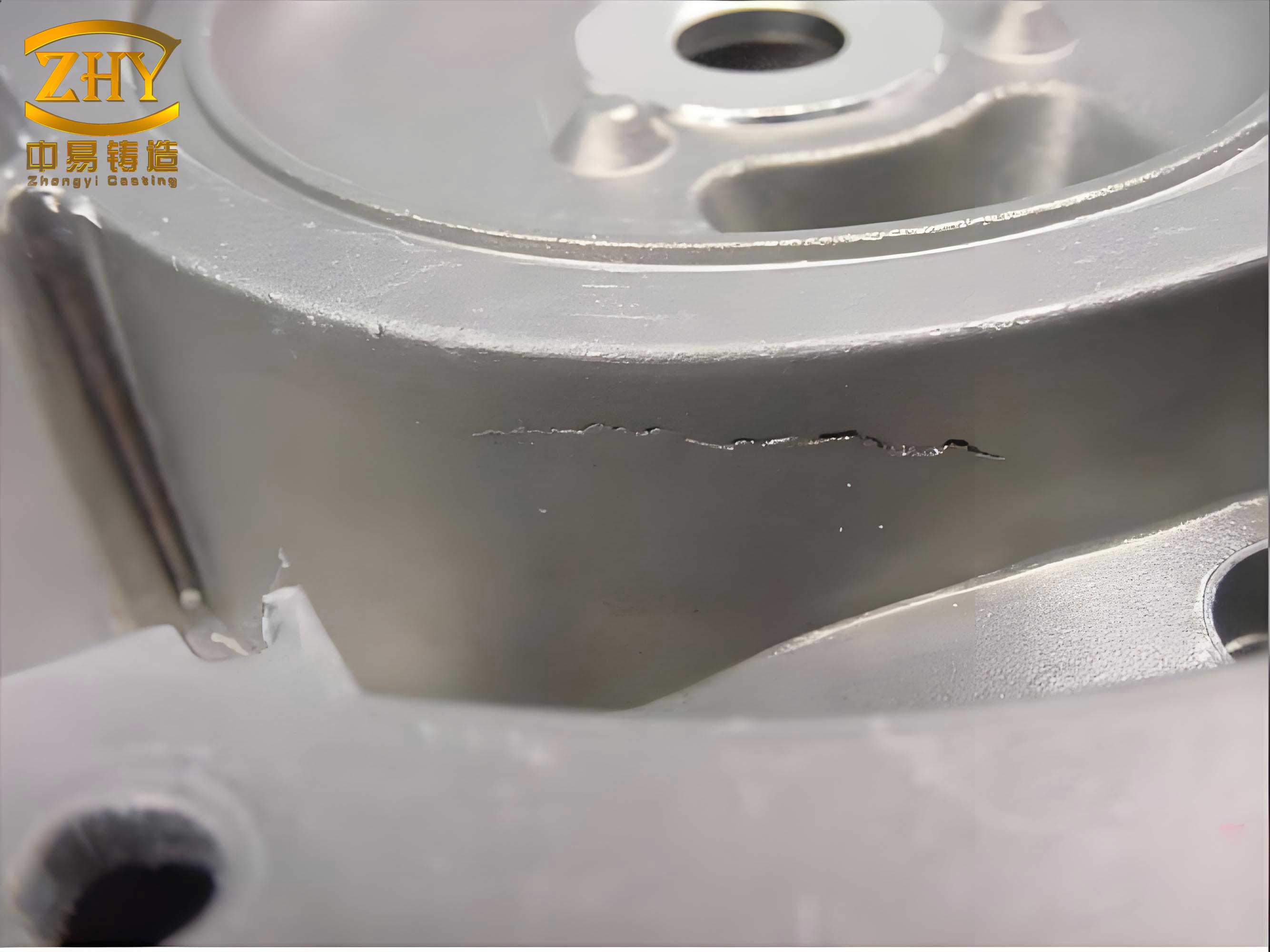
The image above illustrates typical casting defects in SiCp/Al composites, highlighting porosity and particle clustering. Such visual aids are invaluable for identifying and addressing these casting defects in industrial settings. In my work, I correlate such microstructures with processing parameters to refine fabrication protocols.
To summarize mitigation strategies, I have compiled key approaches for reducing casting defects in the table below:
| Casting Defect Type | Recommended Process Adjustments | Expected Improvement |
|---|---|---|
| All casting defects related to gas entrapment | Vacuum stirring, ultrasonic degassing, SiCp pre-heating at 773 K for 2 hours | Porosity reduction by up to 80%, enhanced density |
| Casting defects from poor wettability | Add 1-2 wt% Mg to melt, use Ti-coated SiCp, maintain melt temperature at 973-1023 K | Improved dispersion, reduced aggregation by 50% |
| Segregation casting defects | Increase cooling rate to >10 K/s via chill casting, employ electromagnetic stirring during solidification | More uniform particle distribution, minimized dendritic segregation |
| Interfacial reaction casting defects | Limit melt temperature to <1023 K, use Si-rich alloys (e.g., A356), apply SiO$_2$ coatings on SiCp | Suppressed Al$_4$C$_3$ formation, better interface integrity |
| Contamination-related casting defects | Replace steel tools with graphite or ceramic, implement clean melting practices | Elimination of Fe impurity phases, higher purity composites |
In conclusion, casting defects in SiCp-reinforced aluminum matrix composites are multifaceted, stemming from physical and chemical instabilities. The non-wettability of SiCp in aluminum melt, coupled with reactive interfaces and solidification dynamics, gives rise to porosity, inclusions, aggregation, segregation, and interfacial phases—all classified as casting defects. Through theoretical models, such as viscosity equations and critical velocity calculations, I have delineated the root causes of these casting defects. Practical solutions, including optimized stirring, rapid cooling, and contamination control, can significantly mitigate these casting defects. As I continue to explore this field, future work will focus on advanced in-situ monitoring to detect casting defects early in the process. Ultimately, mastering the control of casting defects is essential for harnessing the full potential of SiCp/Al composites in demanding applications, ensuring reliability and performance across industries.
Reflecting on my findings, I emphasize that casting defects are not merely imperfections but indicators of underlying material science principles. By addressing these casting defects systematically, we can advance composite manufacturing toward higher quality and efficiency. The interplay between theory and practice, as illustrated through formulas and tables, provides a robust framework for tackling casting defects in future research and development efforts.