
Abstract
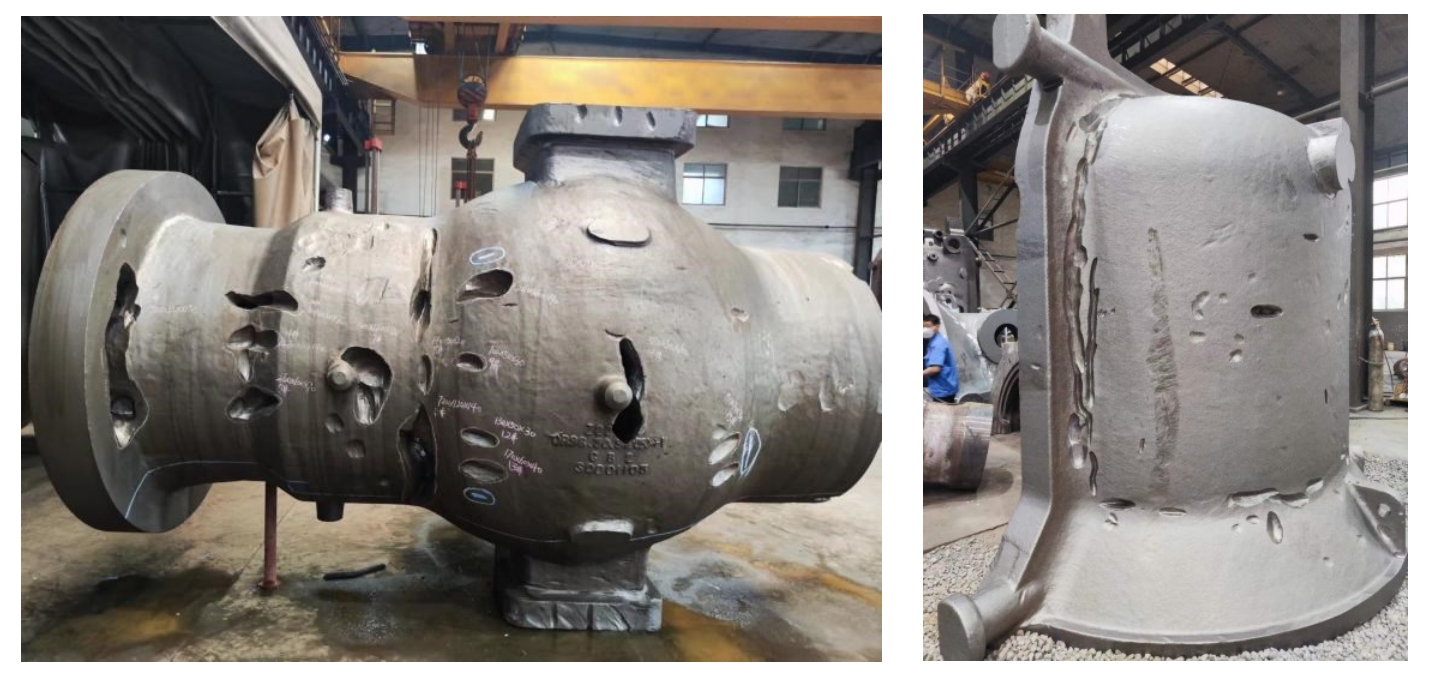
The heat-resistant steel casting of a newly introduced heavy-duty gas turbine compressor support ring in enterprises as the research object. Compared with ordinary castings, this type of casting has a larger size, a more complex structure, a larger amount of molten metal, and thick walls, making it prone to various casting defects. By leveraging the ProCAST simulation software, this study aims to optimize the casting process, reduce defects, and improve the quality of the compressor support ring steel casting.
1. Introduction
Large-scale steel castings, such as compressor support rings for gas turbines, are critical components in the manufacturing of heavy-duty gas turbines. These castings undergo extensive molten metal pouring, which can lead to the formation of casting defects like shrinkage cavities and porosity, reducing the finished product rate. This paper employs the ProCAST casting simulation software to optimize the casting process, predicting and preventing potential defects during the filling and solidification phases.
2. Literature Review
Global casting production has fluctuated around 100 million tons in recent years, with China accounting for a significant portion. The casting industry in China has shown growth, transitioning from high-speed to medium-low-speed growth since 2011. Advancements in casting simulation technology have enabled more precise predictions and preventions of casting defects.
3. Casting Numerical Simulation Theory Overview
3.1 Filling Process Numerical Theory
The filling process involves the pouring of molten metal into the mold. ProCAST simulates this process by solving the flow equations within the mold, considering factors like metal viscosity and fluid dynamics.
3.2 Solidification Process Numerical Theory
The solidification process simulates the cooling and crystallization of the alloy. It includes heat transfer and latent heat treatment, essential for predicting shrinkage defects.
3.3 Boundary Conditions Handling
Accurate simulation of interface heat transfer coefficients and mesh conditions at the casting-mold interface is crucial for predicting defect formation.
3.4 Defect Prediction in Numerical Simulation
Common casting defects include shrinkage cavities, porosity, and inclusions. ProCAST predicts these defects based on the filling and solidification simulations.
4. Case Study: Compressor Support Ring Steel Casting
4.1 Structure and Process Characteristics
The compressor support ring has a complex structure with thick walls and large size, making it susceptible to casting defects. The casting process used is sand-mold casting, requiring significant amounts of molten steel.
4.2 Original Casting Process Simulation
Using ProCAST, the original casting process was simulated. The results revealed that metal flow was turbulent in the pouring gates, causing temperature fluctuations and potential defects.
Table 1: Simulation Parameters for Original Casting Process
| Parameter | Value |
|---|---|
| Pouring Temperature | 1565-1585°C |
| Pouring Speed | 90-105 kg/s |
| Sand Mold Temperature | 20-30°C |
4.3 Optimization of Casting Process
Based on the simulation results, the casting process was optimized by:
- Adjusting the pouring gate design to improve metal flow.
- Introducing chillers and insulation sleeves to manage heat transfer.
- Optimizing the riser placement and size for better feeding.
4.4 New Casting Process Simulation
After optimization, the new casting process was simulated again using ProCAST. The results showed improved metal flow and reduced temperature fluctuations, predicting fewer defects.
Table 2: Simulation Results for Optimized Casting Process
| Simulation Stage | Observations |
|---|---|
| Filling Process | Improved metal flow, reduced turbulence |
| Solidification Process | Sequential solidification from thin to thick sections |
| Defect Prediction | No significant shrinkage or porosity predicted |
5. Orthogonal Test for Pouring Parameters
To determine the optimal pouring parameters, an orthogonal test was designed. Three factors (pouring temperature, pouring speed, and sand mold temperature) were tested at three levels each.
Table 3: Factors and Levels for Orthogonal Test
| Factor | Level 1 | Level 2 | Level 3 |
|---|---|---|---|
| Pouring Temperature | 1565°C | 1575°C | 1585°C |
| Pouring Speed | 90 kg/s | 100 kg/s | 105 kg/s |
| Sand Mold Temperature | 20°C | 25°C | 30°C |
The results showed that the pouring temperature had the most significant impact on defect formation, followed by pouring speed and sand mold temperature. The optimal parameter combination was identified as: pouring temperature of 1575°C, pouring speed of 100 kg/s, and sand mold temperature of 20°C.
6. Validation of Simulation Results
The optimized casting process was validated through actual production. Non-destructive testing confirmed that the castings produced using the optimized parameters were free of macroscopic defects, verifying the effectiveness of the optimization.
7. Conclusion and Future Work
This study employed ProCAST to simulate and optimize the casting process for compressor support ring steel castings. By analyzing the filling and solidification processes, defects were predicted and the casting process was optimized. The optimized process led to a significant reduction in casting defects, improving product quality.
However, there is still room for improvement. Casting simulation software cannot fully replicate actual production conditions, and several factors remain to be explored. Future work should focus on refining the casting process, further reducing defects, and improving production efficiency.