
In my extensive experience within the foundry industry, particularly in the production of safety-critical components, one of the most persistent and costly challenges has been the occurrence of casting holes, specifically sand-related defects. These defects, often referred to as sand holes or sand inclusions, manifest as cavities or holes on or within a casting, filled with loose or bonded sand particles. They are a subset of inclusion defects that severely compromise the structural integrity, pressure tightness, and machinability of cast components. For high-integrity parts like automotive brake calipers, which endure significant dynamic loads, the presence of such casting holes is unacceptable. This article details a systematic, first-hand approach to diagnosing the root causes of these defects and implementing effective, data-driven process improvements to mitigate them.
The fundamental mechanism behind the formation of sand holes involves the erosion of the mold or core surface by the flowing molten metal. When the hydrodynamic forces exerted by the metal stream exceed the binding strength of the molding sand, particles are dislodged, entrained into the flow, and subsequently trapped within the solidifying casting. This process can be described by considering the dynamic pressure of the liquid metal. The pressure (P) exerted by the stream on the mold wall is proportional to the kinetic energy of the flow:
$$P = \frac{\rho Q V}{g} = \frac{\rho S V^2}{g}$$
where $\rho$ is the metal density, $Q$ is the volumetric flow rate, $V$ is the flow velocity, $S$ is the cross-sectional area of the stream, and $g$ is the acceleration due to gravity. This equation clearly indicates that the erosive pressure scales with the square of the velocity. Therefore, controlling the metal velocity during mold filling is paramount in preventing the initiation of these casting holes.
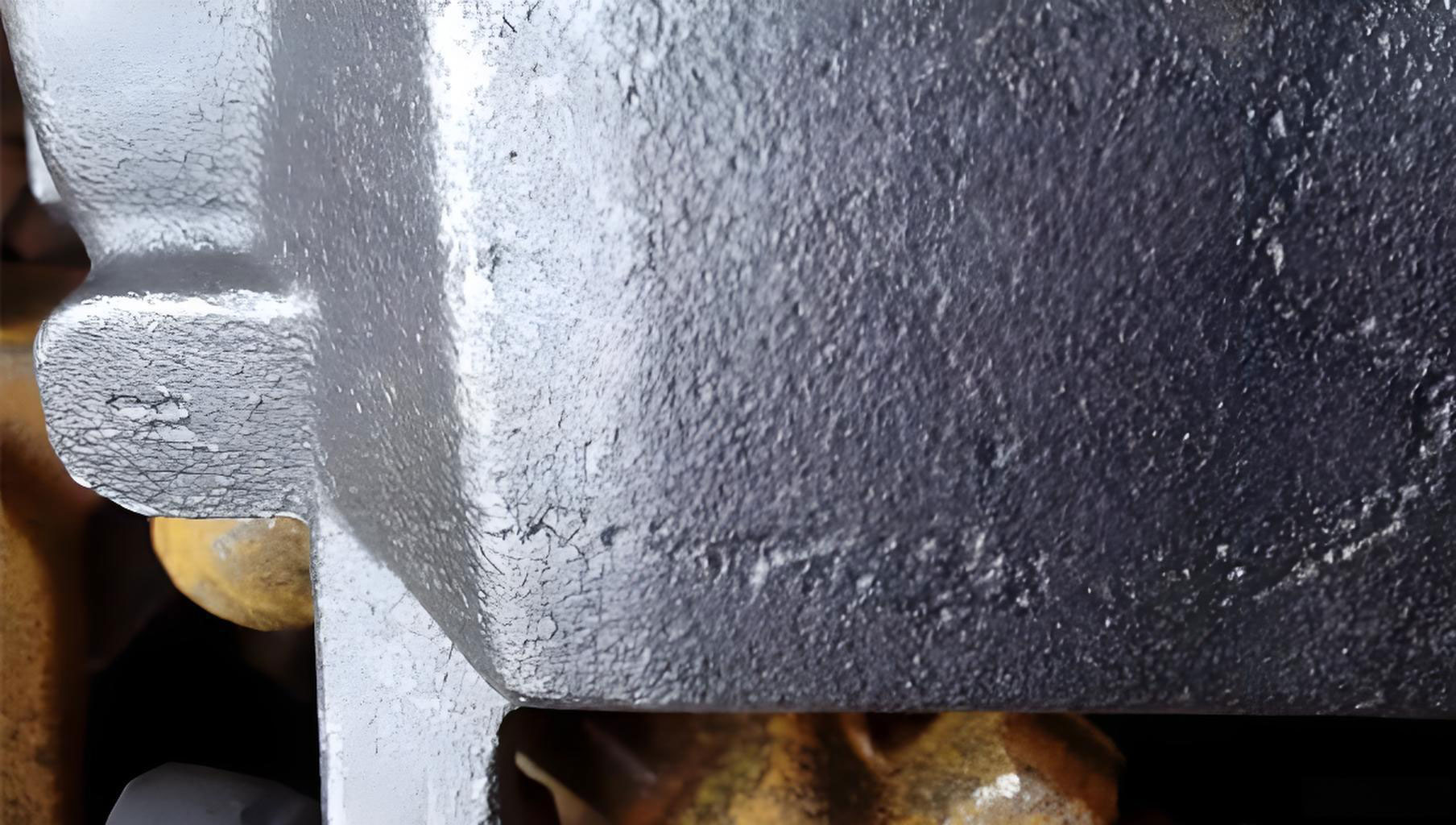
Furthermore, the flow regime plays a critical role. Turbulent flow, characterized by high Reynolds numbers ($Re = \frac{\rho V D}{\mu}$, where $D$ is a characteristic diameter and $\mu$ is the dynamic viscosity), creates chaotic eddies that aggressively scrub the mold surface, dramatically increasing the risk of sand erosion and the subsequent creation of casting holes. Laminar flow, in contrast, is significantly less damaging. The transition between these regimes is a key consideration in gating system design aimed at eliminating casting holes.
The Critical Role of Mold Sand Quality
Before attributing casting holes solely to pouring practice or design, a foundational assessment of the mold sand system is essential. A stable, consistent sand mix with adequate strength is the first line of defense against erosion. In the production under review, a green sand system was employed. The key parameters monitored and their target ranges are summarized below:
| Property | Measurement Method | Typical Value | Target Range |
|---|---|---|---|
| Compactability (%) | Jolt-Squeeze Tester | 35.8 | 30 – 40 |
| Moisture Content (%) | Moisture Teller | 3.36 | 3.0 – 4.0 |
| Permeability | Permeability Meter | 190 | 160 – 240 |
| Green Compression Strength (N/cm²) | Universal Strength Machine | 19.6 | 14 – 20 |
| Active Bentonite (%) | Derived (22.16*GCS / (132.11 – Compactability)) | 4.51 | – |
| Available Bentonite (%) | Derived (0.1527*GCS + 1.326*Moisture) | 7.45 | – |
| Muller Efficiency (%) | (Active Bentonite / Available Bentonite) * 100 | >60 | >55 |
The muller efficiency, a measure of how effectively the binder is coated on sand grains, was consistently above 60%, indicating good mixing practice. With all sand properties within specification, the recurring issue of casting holes pointed decisively towards other factors in the process chain, namely core-making/molding practices and the design of the casting process itself.
Systematic Analysis of Defect Origin
When visual inspection is inconclusive, advanced analytical techniques are indispensable for correctly diagnosing casting holes and distinguishing them from other defects like slag inclusions. Energy Dispersive X-ray Spectroscopy (EDS) analysis of material extracted from the defect site provides a chemical fingerprint. A primary composition of silicon (Si) and oxygen (O), indicating silica (SiO₂), is the definitive signature of a sand-related casting hole. This analysis confirmed that the voids in question were indeed caused by eroded mold or core sand, not by slag or other contaminants.
The location of these casting holes—predominantly on the upper surfaces of the castings—provided further clues. This pattern often suggests that the eroded sand particles are buoyant in the molten iron and float to the highest points of the mold cavity before being trapped by the advancing solidification front. This understanding directly informs the corrective strategy: not only must sand erosion be minimized, but the gating system must also be designed to trap any dislodged particles before they enter the main cavity.
Process Improvement Strategy 1: Core and Mold Design Optimization
A significant source of casting holes can be introduced during core setting and mold closing. Manual core setting, if not guided properly, can lead to misplacement or rubbing of the core against the mold wall (a phenomenon known as “crushing”), which generates loose sand grains directly inside the cavity. To address this, two key modifications were implemented in the core design:
- Increased Core Print Bearing Area: The contact area between the core print and the mold was expanded. This provides greater stability and guidance during placement, making it easier for operators to position the core correctly on the first attempt, drastically reducing the risk of crushing and the generation of sand that leads to casting holes.
- Implementation of Crush Reliefs (Pressure Rings): Small, intentional reliefs or steps (typically 0.3-0.5 mm in height) were added to the core or mold pattern at interfaces where tight fits could cause sand to be sheared off during mold closure. These reliefs create a slight clearance, preventing mechanical compaction of sand at the parting line and eliminating another potential source of loose sand.
The effectiveness of these changes was evaluated through controlled production trials. The results clearly demonstrate the impact of design-for-manufacturability on reducing casting holes.
| Improvement Scheme | Measures Implemented | Incidence of Casting Holes (%) | Batch Size (pcs) |
|---|---|---|---|
| 1 (Baseline) | None | ~30 (Historical Avg.) | – |
| 2 | Increased Core Print Area Only | 18 | 1,000 |
| 3 | Added Crush Reliefs Only | 11 | 1,000 |
| 4 | Combined: Increased Area + Crush Reliefs | 6 | 1,000 |
While the combined approach yielded a remarkable 80% reduction from the historical baseline, a 6% scrap rate due to casting holes remained economically significant. This confirmed that core/mold handling was only one part of the equation, directing further investigation towards the metal filling dynamics.
Process Improvement Strategy 2: Gating System Redesign
The design of the gating system governs the velocity, pressure, and flow regime of the metal as it enters the mold. An improperly designed system can generate sufficient force to directly scour sand from the runner walls, sprue base, or even the cavity itself. The primary goal is to achieve a non-erosive, laminar fill. For the brake caliper, a horizontally parted mold typically uses a pressurized gating system (sprue area < total runner area < total ingate area) to promote a rapid but controlled fill and good skimming action.
The most critical variable for controlling erosion is the ingate velocity. Based on the pressure equation $P \propto V^2$, even a small reduction in velocity yields a large decrease in erosive force. The strategy was to redesign the ingates to be “wide and thin.” This configuration maintains the necessary total cross-sectional area to achieve the desired fill time while minimizing the metal thickness, which in turn reduces the velocity for a given flow rate. The thinner section also acts as a better filter for any remaining sand particles. Several ingate geometries were tested, with the following results:
| Trial Scheme | Ingate Dimensions (Thickness x Width) mm | Calculated Ingate Velocity (cm/s)* | Incidence of Casting Holes (%) | Batch Size (pcs) |
|---|---|---|---|---|
| A | 4 x 50 | ~128 | < 1 | 1,000 |
| B | 3 x 65 | ~157 | >30 | 1,000 |
| C | 6 x 34 | ~120 | 6 | 1,000 |
*Velocity estimated based on Bernoulli’s theorem and system choke.
The results are striking. Scheme B, with the thinnest section (3mm) but highest velocity, performed the worst, producing severe casting holes. Scheme C, while having a lower velocity than B, used a thicker section (6mm) which was less effective at reducing velocity and particle trapping. Scheme A, with a moderate thickness (4mm) and the widest width, achieved the lowest velocity among the practical designs and nearly eliminated the defect. This validates the principle: an ingate thickness in the range of 3-5 mm, combined with sufficient width to control velocity, is optimal for preventing the formation of casting holes.
Furthermore, the orientation of the ingates was changed to promote a tangential, swirling flow within the cavity rather than a direct impingement on core surfaces. This swirling action reduces the localized velocity against any single wall, further mitigating erosion and helping to float any entrained particles towards a designed collection area, such as a riser or overflow.
Integrative Prevention Strategy for Casting Holes
The successful resolution of chronic casting holes requires a holistic, systems-based approach. Relying on a single fix is often insufficient. The following integrated strategy summarizes the key learnings:
- Establish and Maintain Foundational Sand Properties: Consistently produce mold sand with adequate green strength, moisture, and mulling efficiency. This is the essential baseline without which other improvements will falter.
- Design for Robust Manufacturing: Engineer cores and molds for error-proof assembly. Use generous core prints and strategic crush reliefs to eliminate manual handling as a source of sand contamination that leads to casting holes.
- Master Fluid Dynamics in Gating Design: Apply hydrodynamic principles to minimize metal velocity and pressure. Employ wide, thin ingates (3-5mm thick) to act as both flow controllers and particle traps. Design the fill pattern to avoid direct impingement and promote a smooth, progressive front.
- Implement Process Monitoring and Feedback: Use defect tracking to correlate the occurrence of casting holes with specific process parameters (sand properties, pour time, metal temperature). Employ non-destructive testing and periodic destructive analysis with EDS to confirm the nature of defects.
The journey from a 30% scrap rate down to less than 1% for casting holes was not the result of a single eureka moment, but of systematically investigating each element of the process—sand, tooling, and method—and understanding their interactions. By viewing the mold cavity not just as a geometry to be filled, but as a dynamic environment where fluid forces interact with a granular structure, we can design processes that are inherently resistant to the formation of these costly and dangerous casting holes. This systematic approach is universally applicable, offering a proven roadmap for diagnosing and eliminating sand-related defects in a wide variety of cast components.