
In the field of foundry engineering, the manufacturing of large thin-walled shell castings from aluminum alloys presents significant challenges, particularly in the selection of casting shrinkage rates and the management of deformation during casting and heat treatment processes. Based on my extensive experience, I will delve into the intricacies of process design for such shell castings, emphasizing the relationship between shrinkage behavior, structural factors, and deformation mechanisms. This discussion is grounded in practical trials and research on a specific large aluminum alloy oil pan, but the principles apply broadly to similar shell castings. The goal is to provide insights into optimizing shrinkage rate selection, predicting and mitigating deformation, and implementing effective gating systems for rapid and stable filling.
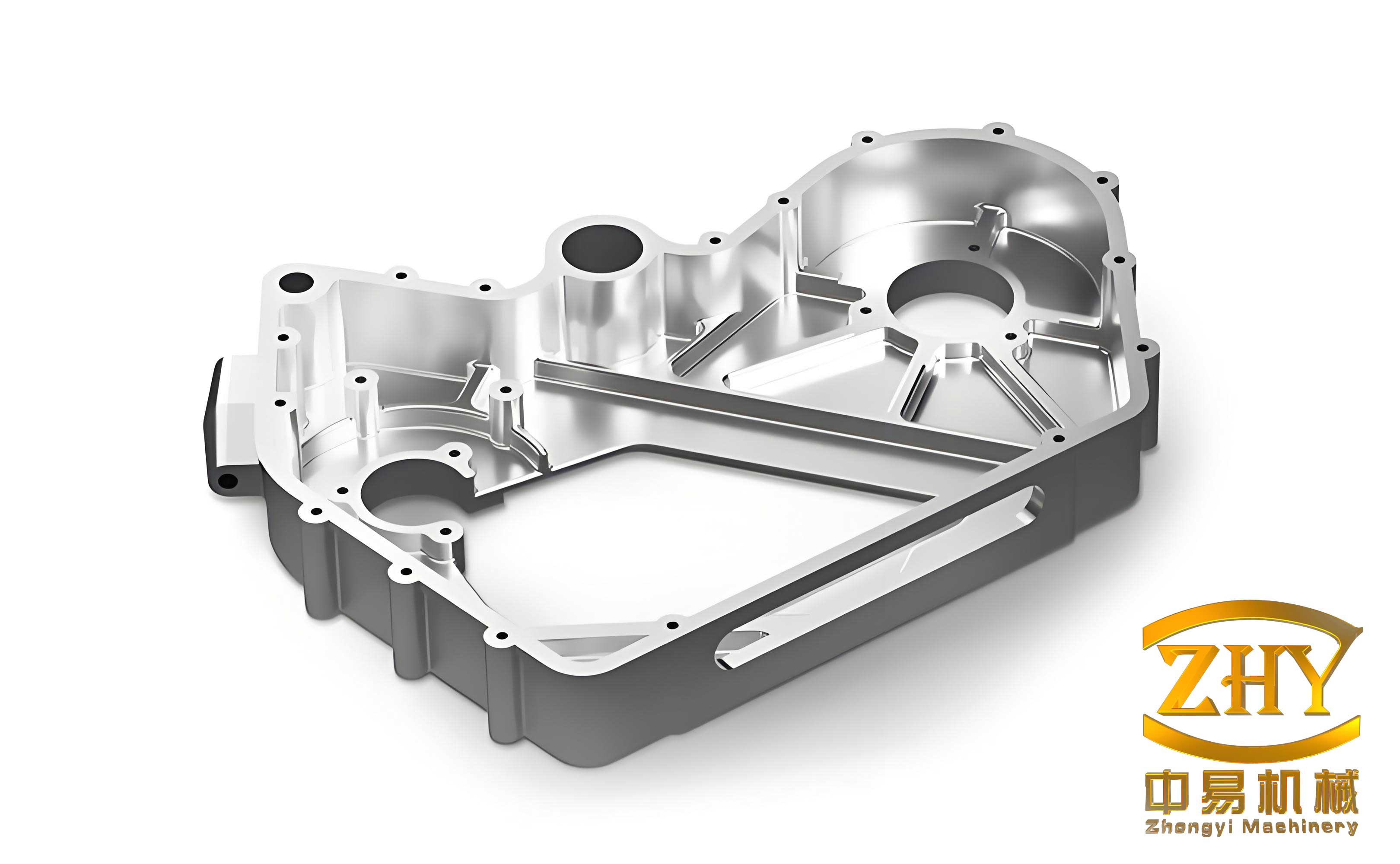
The design of casting processes for large shell castings requires a nuanced understanding of how geometric and thermal factors influence shrinkage and distortion. Shell castings, characterized by their extensive surface areas and relatively thin walls, are prone to dimensional inaccuracies and warping if not properly managed. In this article, I will explore the methodology for determining directional shrinkage rates, analyze deformation patterns, and introduce innovative gating techniques. The focus is on empirical findings that enhance the quality and reliability of these critical components in industries such as automotive and aerospace.
Analysis of Casting Structure and Selection of Casting Shrinkage Rate
The foundation of successful process design for shell castings lies in a thorough structural analysis. For instance, consider a large oil pan shell casting with dimensions 2042 mm in length, 480 mm in width, and 649 mm in height, featuring an average wall thickness of 12 mm and a thickness variation of up to 70 mm. The material is ZL104 aluminum alloy, with a casting weight of 202 kg and a molten metal requirement of 296 kg. The mold assembly comprises 17 cores, including base, sidewall, and end cores, fabricated using PEPSET self-curing resin sand for core-making and gravity pouring. This complex structure necessitates careful shrinkage rate selection to achieve dimensional precision.
Initially, wooden patterns and core boxes were used, with a uniform casting shrinkage rate of 1% applied in all directions—length, width, and height. However, post-casting inspection revealed significant discrepancies. The actual length was less than the theoretical value calculated as $$L_{\text{theoretical}} = L_{\text{design}} \times (1 + \text{shrinkage rate})$$, indicating greater shrinkage than anticipated. Conversely, the width exceeded theoretical values due to restrained contraction, while height dimensions aligned with expectations, suggesting free contraction. This highlights that shrinkage in shell castings is not isotropic but depends on directional constraints and thermal gradients.
To quantify this, the actual shrinkage rates can be derived from measured dimensions. Let \( L_a \), \( W_a \), and \( H_a \) be the actual dimensions, and \( L_d \), \( W_d \), \( H_d \) be the design dimensions. The actual shrinkage rate \( S \) in a given direction is: $$S = \frac{L_d – L_a}{L_d} \times 100\%$$ For the oil pan, length-direction shrinkage exceeded 1%, width-direction shrinkage was less than 1%, and height-direction shrinkage was approximately 1%. This non-uniformity stems from the mold’s restraint; for example, cores in the width direction impeded contraction, whereas the height direction was relatively unconstrained.
Based on these observations, I revised the shrinkage rate strategy for metal mold design. Instead of a single baseline, I adopted directional shrinkage rates, using the midpoint of the length as a reference for symmetric contraction. The adjusted rates are summarized in the table below, which effectively minimized dimensional errors to within 2 mm in length and 1 mm in width and height for subsequent shell castings productions.
| Direction | Initial Shrinkage Rate | Revised Shrinkage Rate | Contraction State | Key Influencing Factors |
|---|---|---|---|---|
| Length | 1% | 1.2% (symmetric from center) | Partially restrained | Thermal gradients, core interference |
| Width | 1% | 0.8% | Restrained | Core obstacles, flange geometry |
| Height | 1% | 1% | Free | Minimal mold resistance |
The relationship between shrinkage and wall thickness for shell castings can be approximated by: $$S = k \cdot \Delta T \cdot \alpha$$ where \( S \) is shrinkage, \( k \) is a constraint factor (ranging from 0 to 1), \( \Delta T \) is the temperature drop, and \( \alpha \) is the thermal expansion coefficient of aluminum alloy. For thin-walled sections, \( k \) tends toward 1 (free contraction), while for thick sections or areas near cores, \( k \) decreases due to restraint. This formula underscores the need to tailor shrinkage rates based on localized geometry in shell castings.
Gating System Design and Application of High-Pressure Head Pouring Cup
The gating system plays a pivotal role in ensuring the integrity of shell castings by controlling filling dynamics and minimizing defects. In initial trials with a single sprue at one end, the molten metal flow slowed considerably toward the opposite end, leading to prolonged pouring times, increased oxide inclusion, and cold shuts on upper surfaces. To address this, I redesigned the gating to incorporate two sprues positioned symmetrically along the sides, facilitating balanced and rapid filling. This modification reduced pouring time by approximately 30% and enhanced temperature uniformity across the shell castings cavity.
Further improvement involved replacing conventional straight sprues with serpentine sprues. The high vertical drop (nearly 800 mm including risers) in large shell castings caused excessive turbulence and splash, promoting dross formation. The serpentine design, with its sinuous “S” shape, dissipates kinetic energy and reduces splash, as described by the energy equation: $$\frac{v_1^2}{2g} + h_1 = \frac{v_2^2}{2g} + h_2 + h_f$$ where \( v \) is velocity, \( h \) is height, and \( h_f \) represents head losses due to friction and directional changes. By increasing \( h_f \) through curvature, the serpentine sprue lowers the impact velocity, thereby decreasing oxidation. Empirical data showed a 40% reduction in slag-related leaks in shell castings after this change.
However, the serpentine sprue also slightly reduced filling speed, particularly near the top of the mold, where cold shuts reemerged. Instead of raising the pouring cup height—which would exacerbate splash—I implemented a high-pressure head pouring cup. This device maintains a consistent metallostatic pressure head during pouring, enabling fast filling without additional metal volume. The pressure head \( P \) is given by: $$P = \rho g H$$ where \( \rho \) is molten aluminum density, \( g \) is gravity, and \( H \) is the effective head height. The high-pressure head cup optimizes \( H \) dynamically, ensuring that the Reynolds number remains within a laminar flow regime for shell castings, typically below 2000: $$Re = \frac{\rho v D}{\mu}$$ where \( D \) is hydraulic diameter and \( \mu \) is viscosity. The table below compares gating system performances for shell castings.
| Gating Configuration | Filling Time (s) | Oxide Inclusion Rate | Cold Shut Incidence | Remarks |
|---|---|---|---|---|
| Single straight sprue | 45 | High | Significant | Poor flow balance |
| Double straight sprues | 32 | Moderate | Reduced | Improved distribution |
| Double serpentine sprues | 35 | Low | Minor | Reduced splash |
| With high-pressure head cup | 30 | Very low | Negligible | Optimal pressure control |
These advancements underscore the importance of adaptive gating design for large shell castings, where filling stability directly impacts defect formation. The integration of serpentine sprues and high-pressure head cups has proven effective in achieving rapid, tranquil filling, essential for the complex geometries of shell castings.
Analysis and Prevention of Casting Deformation
Deformation in shell castings arises from both casting and heat treatment processes, manifesting as warping or twisting, particularly in thick sections. For the oil pan shell casting, initial trials without countermeasures resulted in distortions up to 7–8 mm at the ends, where thick masses (over 70 mm) and intersecting features like sealing bosses created thermal stresses. The deformation mechanism can be modeled using thermal strain theory: $$\epsilon_{\text{thermal}} = \alpha \Delta T + \sigma_{\text{residual}} / E$$ where \( \epsilon_{\text{thermal}} \) is strain, \( \sigma_{\text{residual}} \) is residual stress, and \( E \) is Young’s modulus. During solidification, uneven cooling generates residual stresses that warp thin-walled shell castings.
To mitigate casting-induced deformation, I employed a multi-pronged approach. First, simply increasing machining allowances—beyond the initial 8 mm—was ineffective, as added mass exacerbates shrinkage stresses. Instead, I incorporated pre-deformation (reverse distortion) into the metal mold design. By anticipating the deformation direction—typically outward bowing at the ends—the mold was crafted with an opposite curvature, quantified by: $$D_{\text{pre}} = k_d \cdot D_{\text{predicted}}$$ where \( D_{\text{pre}} \) is pre-deformation amount, \( D_{\text{predicted}} \) is estimated deformation from historical data, and \( k_d \) is a factor (usually 0.9–1.1) derived from simulation or trial. For these shell castings, a pre-deformation of 6–7 mm effectively neutralized distortion.
Second, I added process ribs (stiffeners) at critical locations, such as the ends of the shell castings. These ribs, with thickness matching the casting wall (≈12 mm), act as restraints during solidification. Their efficacy depends on solidification timing; ideally, ribs solidify slightly before the main casting to provide mechanical support. The rib design can be optimized using Fourier’s law for heat transfer: $$\frac{\partial T}{\partial t} = \kappa \nabla^2 T$$ where \( \kappa \) is thermal diffusivity. By matching rib and wall thermal masses, simultaneous solidification is approximated, reducing crack risks. Post-implementation, deformation in shell castings decreased to under 2 mm.
Heat treatment introduces additional distortion risks, as relief of residual stresses can cause further warping. For shell castings oriented with their mating surfaces upward, gravity and thermal expansion exacerbate downward sagging. To counteract this, I used support fixtures and bolt-tightening devices during heat treatment. The supports resist gravitational deflection, while bolts apply reverse bending moments, partially recovering prior distortion. The stress during heat treatment can be expressed as: $$\sigma_{\text{HT}} = E \alpha \Delta T_{\text{HT}} – \sigma_{\text{relief}}$$ where \( \Delta T_{\text{HT}} \) is the temperature change during treatment. Fixtures help maintain \( \sigma_{\text{HT}} \) within elastic limits, preventing plastic deformation in shell castings.
| Deformation Source | Prevention Method | Mechanism | Typical Reduction in Deformation | Applicability to Shell Castings |
|---|---|---|---|---|
| Casting (solidification) | Pre-deformation in mold | Counters predicted warpage | 70–80% | High, especially for large spans |
| Casting (residual stress) | Process ribs | Provides mechanical restraint | 50–60% | Moderate, depends on geometry |
| Heat treatment | Support fixtures and bolts | Resists sagging, applies reverse stress | 40–50% | Essential for thin-walled sections |
| Overall | Combined approach | Integrates multiple strategies | Up to 90% | Optimal for complex shell castings |
These strategies highlight the importance of proactive distortion management in the process design for shell castings. By understanding thermal-mechanical interactions, we can significantly enhance dimensional stability.
Conclusion
In summary, the casting process design for large thin-walled shell castings of aluminum alloy demands a comprehensive approach that accounts for directional shrinkage, deformation dynamics, and gating efficiency. Through empirical studies on shell castings like oil pans, I have demonstrated that shrinkage rates must be tailored based on structural constraints and wall thickness variations, rather than applied uniformly. The use of symmetric shrinkage from a central reference point, coupled with adjusted rates for restrained directions, minimizes dimensional errors in shell castings.
Moreover, gating system innovations—such as serpentine sprues and high-pressure head pouring cups—facilitate rapid and stable filling, reducing defects like oxide inclusions and cold shuts. These elements are critical for maintaining the integrity of shell castings during pouring. Simultaneously, deformation control through pre-deformation molds, process ribs, and heat treatment fixtures effectively mitigates warping, ensuring that shell castings meet stringent tolerances.
The insights presented here underscore the iterative nature of foundry engineering for shell castings. By leveraging formulas for shrinkage and stress analysis, along with tabular data for process optimization, designers can enhance the predictability and quality of these complex components. Future advancements may involve computational modeling to further refine shrinkage and distortion predictions for shell castings, but the empirical principles outlined remain foundational. Ultimately, a holistic view of process design—integrating material behavior, geometric factors, and thermal management—is key to success in manufacturing large shell castings.