
In my experience working with high manganese steel casting, I have encountered numerous challenges due to the unique properties of this material. High manganese steel is renowned for its work-hardening characteristics, making it an ideal choice for wear-resistant applications in industries such as mining, metallurgy, and construction. However, the casting process for thick-wall components, like idlers, is particularly demanding because of the high solidification shrinkage, low thermal conductivity, and susceptibility to defects like hot tearing and shrinkage porosity. This article delves into the detailed casting process I developed for a thick-wall high manganese steel idler, weighing 1.7 tons, emphasizing the use of simulation tools like ProCAST, practical production insights, and the integration of tables and formulas to optimize the process. Throughout this discussion, the term ‘high manganese steel casting’ will be frequently referenced to highlight its importance in achieving durable and reliable components.
The foundation of any successful high manganese steel casting project lies in understanding the material’s chemical composition and performance requirements. For the idler, the specified material was ASTM A128-E, which demands precise control over elements to ensure optimal properties. Table 1 summarizes the chemical composition requirements, which are critical for minimizing harmful elements like phosphorus and sulfur that can lead to embrittlement and defects.
| Element | Range |
|---|---|
| C | 0.7–1.3 |
| Si | ≤1.0 |
| Mn | 11.5–14.0 |
| Mo | 0.9–1.2 |
| S | ≤0.07 |
| P | ≤0.07 |
In high manganese steel casting, the performance criteria are stringent. For this idler, penetrant testing had to meet ASTM E433 Quality Level 2, and radiographic inspection adhered to ASTM E280 Level 3 standards. Additionally, the surface hardness was specified between 450 and 500 HBW, and no defect-related welding was permitted—only cosmetic repairs were allowed. These requirements underscore the need for a flawless casting process to avoid costly rework or rejection. The high manganese steel casting must achieve a dense, homogeneous microstructure to withstand operational stresses, which is why every step, from melting to heat treatment, requires meticulous attention.
When designing the casting process for the thick-wall idler, I focused on the riser and feeding system to address solidification issues. High manganese steel exhibits an intermediate solidification mode, where the riser’s feeding range is broader compared to carbon steel, but the end-effect zone is smaller. This characteristic, combined with the material’s poor thermal conductivity, necessitated a careful riser design to prevent defects. I developed two distinct riser schemes, as illustrated in the following discussion. Scheme 1 involved a large circular riser on the hub face, with a portion of the axial hole cast solid to act as a feed aid, allowing the top riser to feed the entire casting. In contrast, Scheme 2 used an elongated elliptical riser that extended down to the spoke surfaces, with the axial hole cast completely, enabling effective feeding of the major hot spots. The total molten metal weight was 3.77 tons for Scheme 1 and 3.15 tons for Scheme 2, highlighting the efficiency gains in Scheme 2.
To evaluate these schemes, I employed ProCAST software for numerical simulation of stress distribution. ProCAST uses finite element analysis to model the casting process, providing accurate predictions of thermal and mechanical behavior. The software automatically calculates material properties based on the alloy composition, which for high manganese steel casting, aligns closely with results from tools like JMatPro. The effective stress distribution was analyzed after a solidification time of t = 95,000 seconds. For Scheme 1, the stress was uneven, with higher concentrations at the riser neck and transition corners between the hub and spokes, increasing the risk of cracking. In Scheme 2, the stress was more uniform and gradually varying, with lower overall values, reducing the likelihood of defects. This analysis reinforced the importance of riser design in high manganese steel casting for minimizing internal stresses.
The stress analysis can be quantified using the von Mises effective stress formula, which is commonly applied in casting simulations: $$\sigma_e = \sqrt{\frac{(\sigma_1 – \sigma_2)^2 + (\sigma_2 – \sigma_3)^2 + (\sigma_3 – \sigma_1)^2}{2}}$$ where $\sigma_1$, $\sigma_2$, and $\sigma_3$ are the principal stresses. In high manganese steel casting, this formula helps identify areas prone to failure, and the simulations showed that Scheme 2 resulted in lower $\sigma_e$ values, confirming its superiority. Additionally, the solidification time for such thick-wall castings can be estimated using Chvorinov’s rule: $$t = k \cdot V^2 / A^2$$ where $t$ is the solidification time, $V$ is the volume, $A$ is the surface area, and $k$ is a constant dependent on the mold material. For high manganese steel casting, with its low thermal conductivity, $k$ tends to be higher, leading to prolonged solidification and increased risk of coarse grains and segregation. Thus, optimizing the riser design is crucial to control these factors.
Based on the simulation results and practical considerations, I selected Scheme 2 as the final process. Although Scheme 1 offered easier post-casting finishing with less grinding, the need to machine out the solid axial hole section in high manganese steel casting would have been time-consuming and costly due to the material’s work-hardening nature. Scheme 2, however, allowed for minimal machining of the axial hole and used gas cutting to remove the riser and feed aids, provided proper measures were taken to avoid cracking. This approach aligned with the goal of reducing internal stresses and improving overall quality in high manganese steel casting.
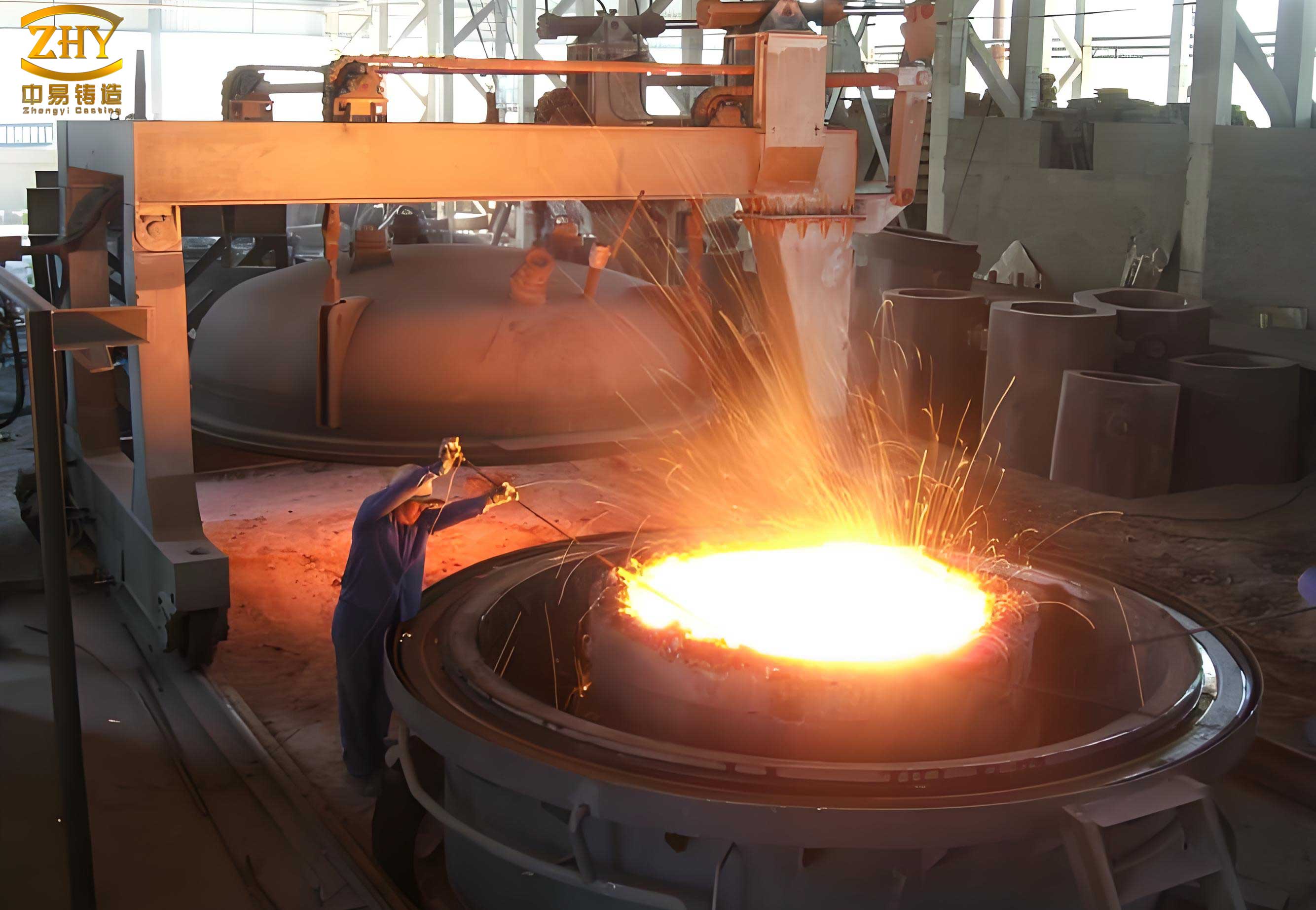
Moving to production, several technical aspects were critical for success. First, chemical composition control during melting was paramount. Phosphorus and sulfur are detrimental in high manganese steel casting; phosphorus, in particular, can form brittle phosphide eutectics at grain boundaries, reducing toughness. I ensured that phosphorus levels were kept below 0.04% through careful charge selection and refining practices. The melting process involved using basic slag to control sulfur, and the pouring temperature was maintained at 1420 ± 5°C to ensure fluidity while minimizing overheating. The gating system was designed as a bottom-pouring, open type to facilitate smooth metal flow and reduce temperature gradients, which is essential in high manganese steel casting to prevent thermal stresses.
The mold and coating materials also play a vital role in high manganese steel casting. I preferred alkaline sands like magnesite or olivine, or neutral sands such as chromite, for their high heat capacity, which accelerates cooling and reduces the risk of coarse microstructures. Chromite sand, in particular, offers excellent heat dissipation properties. For coatings, I used magnesia-based or chromite-based materials to prevent chemical reactions and improve surface finish. Table 2 summarizes the key process parameters I monitored during production to ensure consistency in high manganese steel casting.
| Parameter | Value or Range |
|---|---|
| Pouring Temperature | 1420 ± 5°C |
| Phosphorus Content | < 0.04% |
| Sulfur Content | ≤ 0.07% |
| Mold Sand Type | Chromite or Magnesite |
| Coating Type | Magnesia or Chromite-based |
| Heat Treatment Temperature | 1050°C (Homogenization) |
| Water Quench Temperature | ≥ 950°C |
Heat treatment is a decisive step in high manganese steel casting to achieve the desired austenitic microstructure and toughness. The idlers underwent homogenization at 1050°C, with strict control to avoid excessive temperature or time, which could cause decarburization and coarse grain growth. After homogenization, water quenching was performed at temperatures not below 950°C to transform the structure and enhance hardness. I ensured minimal delay between furnace extraction and immersion, and the castings were agitated in water to promote rapid cooling. This water toughening process is critical for high manganese steel casting to prevent the precipitation of carbides and ensure a uniform, fine-grained structure. The risers were cut underwater after quenching to minimize the risk of cracking, a common issue in high manganese steel casting due to residual stresses.
Throughout the production of six idlers, this optimized process yielded consistently qualified castings, with only minor cosmetic welding required. The integration of ProCAST simulations allowed me to preemptively address stress-related issues, reducing the need for rework. The success of this high manganese steel casting project underscores the importance of a holistic approach, combining advanced modeling with empirical knowledge. For instance, the solidification kinetics in high manganese steel casting can be described by the Fourier number for heat transfer: $$Fo = \frac{\alpha t}{L^2}$$ where $\alpha$ is the thermal diffusivity, $t$ is time, and $L$ is a characteristic length. Given the low $\alpha$ of high manganese steel, the Fourier number remains low, necessitating longer cooling times and careful riser design to avoid defects.
In conclusion, the casting process for thick-wall high manganese steel idlers demands a comprehensive strategy that addresses material properties, design optimization, and production controls. By leveraging simulation tools like ProCAST and adhering to strict metallurgical practices, I achieved a robust process that minimized internal stresses and defects. The repeated emphasis on ‘high manganese steel casting’ in this discussion highlights its centrality to industries requiring durable wear-resistant components. Future work could explore further refinements in riser design or alternative heat treatment methods to enhance performance. Ultimately, this experience demonstrates that with careful planning and execution, high manganese steel casting can produce high-quality, reliable parts even for challenging applications.