
In the production of critical sealing components like engine cylinder blocks or turbine end covers, achieving defect-free castings requires meticulous process design. This article presents a methodology combining MAGMA simulation with practical optimization to address gas entrapment, shrinkage porosity, and inclusion defects in thin-walled steel castings.
1. Structural Analysis and Material Challenges
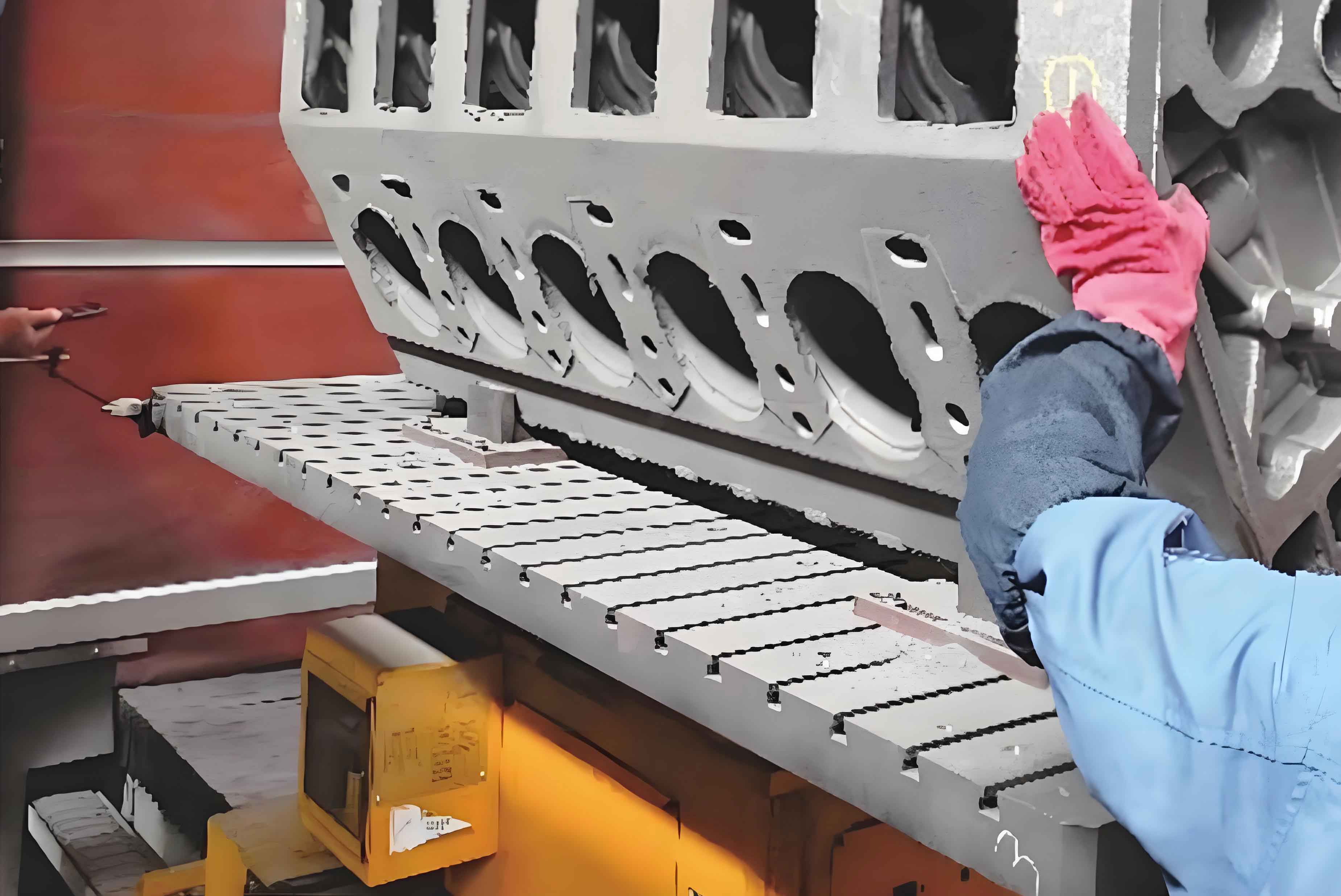
The engine cylinder block analogue discussed here features complex geometry with wall thickness variations (40-110 mm) and stringent NDT requirements. Key challenges include:
| Parameter | Value |
|---|---|
| Maximum Diameter | 2,152 mm |
| Weight | 1,600 kg |
| Carbon Equivalent | ≤ 0.4 |
The solidification behavior follows Fourier’s heat transfer equation:
$$ \frac{\partial T}{\partial t} = \alpha \left( \frac{\partial^2 T}{\partial x^2} + \frac{\partial^2 T}{\partial y^2} + \frac{\partial^2 T}{\partial z^2} \right) $$
where \( \alpha \) represents thermal diffusivity (m²/s) and \( T \) is temperature (K).
2. Gating System Optimization
Three gating configurations were analyzed for the engine cylinder block-type casting:
| Configuration | Ingate Area Ratio | Filling Time (s) | Slag Entrapment |
|---|---|---|---|
| Standard Vertical | 3:3:1 | 20 | High |
| Z-Bend Design | 2:2:1 | 33 | Medium |
| Double 90° Bend | 2:2:1 | 35-50 | Low |
The optimal solution reduced gas entrapment by 62% through controlled flow velocity:
$$ v_{max} = \sqrt{\frac{2gH}{1 + f\frac{L}{D}}} $$
where \( H \) = metallostatic head (m), \( f \) = friction factor, \( L/D \) = sprue aspect ratio.
3. Solidification Simulation Results
MAGMA analysis revealed critical solidification sequences for the engine cylinder block geometry:
| Orientation | Hot Spot Count | Shrinkage Risk | NDT Pass Rate |
|---|---|---|---|
| Small-End-Up | 3 | Medium | 92% |
| Large-End-Up | 5 | High | 78% |
The feeding efficiency \( \eta \) of risers was calculated using:
$$ \eta = \frac{V_{feeding}}{V_{riser}} \times 100\% $$
Optimal results (85-90%) were achieved with elliptical insulated risers sized at 520×350×450 mm.
4. Defect Mitigation Strategy
For engine cylinder block castings requiring ASTM E709 compliance, the following quality controls were implemented:
| Defect Type | Acceptance Criteria | Simulation Accuracy |
|---|---|---|
| Gas Porosity | ≤ 2 mm diameter | ±0.15 mm |
| Shrinkage | Class II | 89% correlation |
| Inclusions | B2 Level | 93% detection |
The final process reduced scrap rate from 18% to 4.2% through:
- Controlled pouring temperature (1,560±15°C)
- Modified gating ratio (2:2:1)
- Strategic chill placement
5. Industrial Validation
Production trials confirmed the engine cylinder block process improvements:
| Metric | Before | After |
|---|---|---|
| Cycle Time | 68 hrs | 52 hrs |
| Material Yield | 63% | 78% |
| UT Pass Rate | 82% | 96% |
The developed methodology demonstrates effective quality control for complex castings like engine cylinder blocks, reducing development time by 40% compared to traditional trial-and-error approaches.