
The hydraulic turbine runner plays a critical role in converting the pressure and potential energy of water into rotational mechanical energy, which is transmitted via the turbine shaft to the generator shaft. With increasing demands for precision in hydropower stations, the use of integral casting for turbine runners has become more prevalent. The runner structure primarily consists of an upper crown, blades, and a lower ring, and it can be classified into integral cast runners and welded assemblies. Integral cast runners are formed by pouring the upper crown, blades, and lower ring as a single casting. The application of 3D printing technology enables the fabrication of runner flow channel sand cores, followed by integral pouring to produce the runner casting. This foundry technology, utilizing 3D printed sand molds, offers advantages such as low cost, short manufacturing cycles, and high dimensional accuracy of the castings, significantly reducing the time and expenses associated with post-casting welding. During operation, the runner withstands substantial alternating loads, high-pressure water heads, and erosion from sediment, making the blades susceptible to cavitation. Consequently, stringent quality requirements are imposed on the castings. This study focuses on producing integral cast runners via 3D printed sand cores to achieve castings free from shrinkage porosity and cavities, with internal quality meeting the required standards.
The runner discussed here has an outline dimension of ø2242 mm × 1205 mm, a mass of 5701 kg, a maximum wall thickness of 170 mm, and a minimum wall thickness of 40 mm, made from material GX4CrNi13-4. Its structural complexity, characterized by numerous thermal junctions and limited operational space, poses challenges in molding and dimensional control. Additionally, the runner is prone to issues such as turbulent flow during casting and difficulty in slag flotation due to its intricate geometry. To address these challenges, an advanced foundry technology incorporating 3D printing has been developed, optimizing the casting process through simulation and precise molding.
Product Overview
The runner’s design necessitates high stress control and fatigue resistance to meet hydraulic performance criteria. As a Francis turbine runner, it requires stringent dimensional accuracy on the flow surfaces, with surfaces free from defects like gas holes, sand inclusions, shrinkage, and cracks. The inherent structural features, including elongated curved flow channels, complicate the casting process, necessitating innovative foundry technology solutions.
| Parameter | Value |
|---|---|
| Outline Dimension | ø2242 mm × 1205 mm |
| Mass | 5701 kg |
| Maximum Wall Thickness | 170 mm |
| Minimum Wall Thickness | 40 mm |
| Material | GX4CrNi13-4 |
Casting Process Design
Determination of Casting Scheme
Based on the structural characteristics of the runner, a casting orientation with the upper crown facing upward was selected. This scheme facilitates the design of risers and ensures proper filling. The casting layout is optimized to manage thermal distribution and solidification patterns, which are critical in foundry technology for minimizing defects.
Simulation Analysis of Thermal Junctions
Using MAGMA simulation software, the thermal junctions and shrinkage porosity distribution were analyzed. The results indicate that thermal junctions are concentrated at the intersections of the lower ring and blades, the upper crown and blades, and the upper crown shaft. These junctions exhibit a spiral band-like morphology due to the elongated curved flow channels, making direct feeding challenging. Traditional methods involve multiple small risers, but this approach reduces yield and increases post-casting finishing work. The simulation aids in optimizing the riser design to address these issues effectively.
The solidification process can be modeled using the Chvorinov’s rule, where the solidification time \( t \) is proportional to the square of the volume-to-surface area ratio:
$$ t = k \left( \frac{V}{A} \right)^2 $$
where \( V \) is the volume, \( A \) is the surface area, and \( k \) is a constant dependent on the material and mold properties. For the runner, the modulus method is applied to calculate riser dimensions, ensuring adequate feeding.
| Location | Thermal Junction Type | Challenge |
|---|---|---|
| Lower Ring and Blades | Spiral Band-like | Long distance, difficult feeding |
| Upper Crown and Blades | Spiral Band-like | Complex geometry |
| Upper Crown Shaft | Concentrated | High modulus area |
Riser Design
Risers are designed using the modulus method, where the modulus \( M \) is defined as the ratio of volume to cooling surface area. The riser modulus \( M_r \) is calculated as:
$$ M_r = (1.2 \text{ to } 1.4) M_c $$
where \( M_c \) is the modulus of the casting section, with 1.2 for open risers and 1.4 for blind risers. For the upper crown, a single riser is placed at the shaft end face, supplemented by a tapered padding that thickens from the riser downward to create a solidification gradient. This padding extends radially from the shaft root to the outer circumference, with a thickness gradient of 8% to 12%, ensuring directional solidification toward the riser.
For the lower ring and blade intersections, longitudinal riser necks and padding are implemented. Each blade corresponds to one padding and riser, with a solidification gradient of 10% to 15% to facilitate feeding. The padding design ensures that shrinkage defects are redirected to the risers, achieving sound castings. MAGMA simulations confirm the absence of超标 defects with this design.
| Component | Riser Type | Modulus Ratio | Gradient |
|---|---|---|---|
| Upper Crown | Single Riser | 1.2 \( M_c \) | 8%-12% |
| Lower Ring and Blades | Longitudinal Riser Neck | 1.4 \( M_c \) | 10%-15% |
Gating System Design
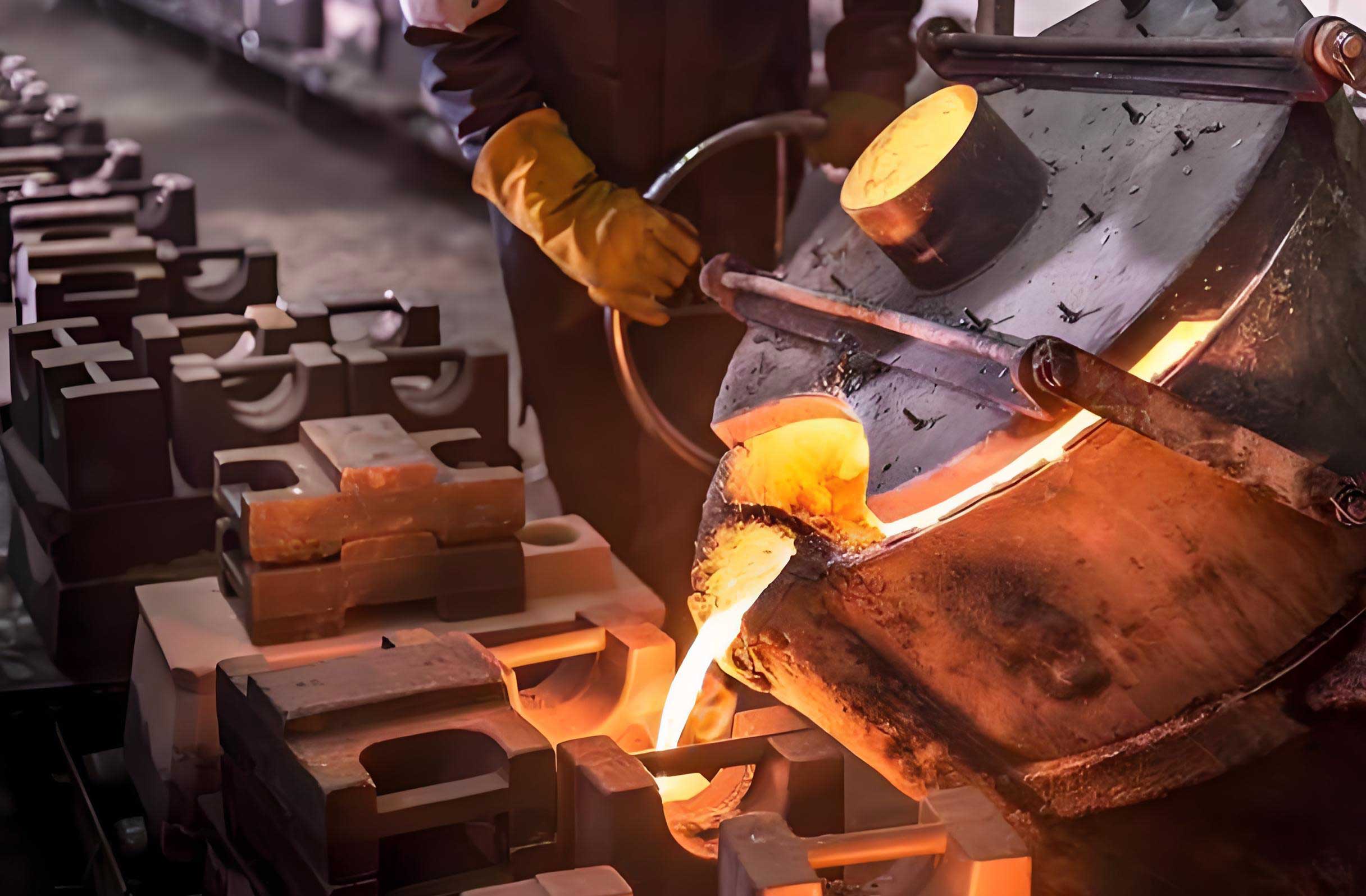
The gating system is designed to ensure smooth, rapid, and continuous filling of the mold cavity, while facilitating slag flotation and venting. A single-pour open gating system is employed, where molten metal enters through a sprue, flows into primary runners, and is distributed via multiple gates positioned below each padding. Filters are installed at each gate inlet to trap inclusions and reduce flow velocity, minimizing erosion and oxidation. This design aligns with advanced foundry technology principles to enhance casting quality.
The flow rate \( Q \) in the gating system can be expressed as:
$$ Q = A \cdot v $$
where \( A \) is the cross-sectional area and \( v \) is the flow velocity. The system is calibrated to maintain laminar flow, with Reynolds number \( Re \) kept below 2000 to avoid turbulence:
$$ Re = \frac{\rho v D}{\mu} $$
where \( \rho \) is density, \( D \) is hydraulic diameter, and \( \mu \) is dynamic viscosity.
| Component | Function | Design Feature |
|---|---|---|
| Sprue | Initial Entry | Directs flow to runners |
| Runners | Distribution | Multi-stage分流 |
| Gates | Cavity Entry | Filter-equipped, below padding |
Molding Scheme Design
The molding strategy combines 3D printing and traditional pattern making. The outer mold, being a simple rotational body, is produced using CNC-machined wooden patterns for dimensional accuracy and batch production. The inner cores, including the flow channel cores and shaft core, are fabricated via 3D printing, achieving a precision of ±1 mm. This hybrid approach leverages the strengths of both methods: the outer mold ensures stability and efficiency, while 3D printing enables complex internal geometries with high accuracy. The cores are assembled into the mold, and after pouring and cooling, the runner is subjected to heat treatment to achieve the desired mechanical properties. This integrated foundry technology significantly improves dimensional control and reduces lead times.
Production Validation
Practical verification of the cast runner was conducted through dimensional inspection and non-destructive testing. The results show that all flow channel dimensions fall within tolerance, with no surface defects such as sand adhesion or shrinkage. Internal quality assessments confirm the absence of超标 defects, validating the effectiveness of the riser design and gating system. The use of 3D printing for core manufacturing ensured precise molding, contributing to the overall success of the foundry technology applied.
| Aspect | Result | Standard |
|---|---|---|
| Dimensional Accuracy | Within Tolerance | ±1 mm |
| Surface Quality | No Defects | No sand inclusion, gas holes |
| Internal Quality | No Shrinkage | Non-destructive testing passed |
Conclusion
This study addresses the challenges in casting hydraulic turbine runners through the integration of 3D printing and simulation-based optimization. The developed foundry technology, featuring tailored riser designs and a controlled gating system, effectively mitigates shrinkage and slag inclusion issues. The hybrid molding approach, combining 3D printed cores with traditional patterns, ensures high dimensional accuracy. Production validations demonstrate that the cast runners meet all quality requirements, underscoring the viability of this advanced foundry technology for manufacturing integral cast turbine runners. Future work could focus on further refining the simulation models and expanding the application of 3D printing in foundry technology for other complex components.