
In the field of internal combustion engine components, piston rings play a critical role in sealing, heat transfer, and support functions. Among various materials, ductile cast iron has emerged as a superior choice due to its excellent wear resistance, elasticity, and thermal stability. The development and application of ductile cast iron piston rings represent a significant leap in manufacturing history. However, producing high-quality ductile cast iron piston rings stably remains a formidable challenge, primarily due to complexities in raw material composition and process control. In this article, I will share insights from my experience in mastering the casting technology for monolithic two-piece ductile cast iron piston rings, focusing on overcoming limitations in local raw materials through precise metallurgical control and advanced工艺设计.
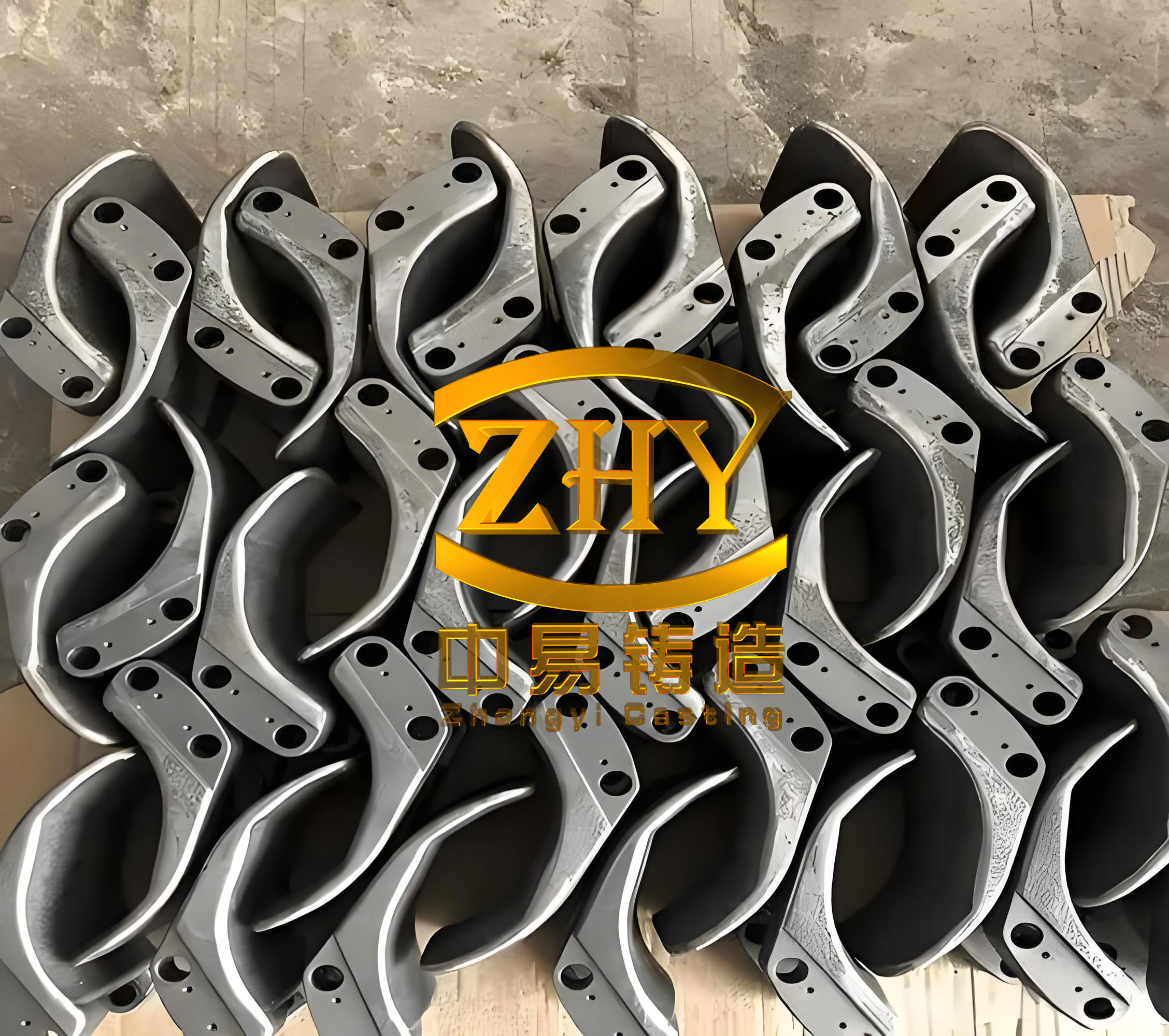
The monolithic two-piece casting approach, as illustrated below, involves machining away the central shrinkage porosity and surface defects from the cast blank, thereby yielding superior ductile cast iron rings. This method has been widely adopted internationally, but domestic production often struggles with consistency. Key issues include the use of生铁 with elevated levels of manganese, phosphorus, and sulfur, which adversely affect graphitization and nodularization. Through systematic experimentation, I have developed a robust process that ensures high nodularity, adequate graphite nodule count, and desirable mechanical properties, even with suboptimal raw materials. This article delves into the technical nuances, incorporating tables and formulas to summarize critical parameters.
My journey began with a thorough工艺可行性分析. International standards often specify high-purity or synthetic生铁 with strict composition limits: 3.8% to 4.3% carbon (C), 0.2% to 0.4% silicon (Si), 0.04% to 0.15% manganese (Mn), phosphorus (P) below 0.045%, and sulfur (S) below 0.01%, with other elements under 0.03%. However, locally available生铁 typically contains higher Si (0.8%–1.3%), Mn (0.2%–0.5%), P (<0.07%), and S (<0.03%). These deviations pose significant challenges for ductile cast iron production. Elevated Mn promotes carbide formation, affecting as-cast microstructure; high P can lead to phosphide eutectics, reducing toughness; and excessive S consumes球化剂, impairing nodularization and increasing defects like slag inclusions and subsurface porosity. After evaluation, I selected生铁 with: 4.0%–4.2% C, 0.80%–0.9% Si, 0.20%–0.4% Mn, 0.04%–0.06% P, and S <0.026%. While not ideal, this composition is workable with careful process adjustments. The key lies in controlling原铁液 composition, employing specialized球化剂 and孕育剂, and optimizing casting parameters to mitigate raw material shortcomings.
To validate the工艺, I conducted extensive工艺性试验及分析 using a 150 kg medium-frequency induction furnace. The charge consisted of 40%–100% of the selected生铁 and up to 60% returns. Melting operations were strictly controlled to achieve a球化 temperature of 1500–1550°C, with the total time from tapping to pouring completion limited to 10 minutes to preserve球化效果. The focus was on two core aspects:球化处理 and孕育处理.
For球化处理, a custom球化剂 was utilized with composition: 38%–48% Si, 5.0%–6.5% magnesium (Mg), rare earth (RE) ≤1.0%, and aluminum (Al) ≤1.0%, in granular form (5–40 mm). This球化剂 offers a balanced Mg content, ensuring moderate reaction kinetics and controlled Mg absorption. The low RE content minimizes carbide formation while enhancing nucleation during孕育. The球化剂 addition rate is critical and depends on the piston ring’s V/O ratio (cross-sectional area to perimeter ratio) and原铁液 S content. The required Mg can be estimated using the formula:
$$Mg_{total} = Mg_{loss} + Mg_{desulfurization} + Mg_{residual}$$
where $Mg_{loss}$ accounts for烧损 during handling (assumed constant under standardized conditions), $Mg_{desulfurization}$ is the Mg consumed to remove S, and $Mg_{residual}$ is the remaining Mg needed for nodularization. The desulfurization reaction follows:
$$Mg + S \rightarrow MgS$$
with stoichiometric consumption of approximately 0.76 parts Mg per part S. Given原铁液 S levels of 0.02%–0.03%, the $Mg_{desulfurization}$ ranges from 0.0152% to 0.0228%. Using a carbon-sulfur analyzer, I monitored S in real-time to adjust球化剂 additions. The球化 effect was evaluated based on nodularity合格率 and graphite nodule count合格率. Table 1 summarizes the relationship between球化剂 addition and outcomes for a typical piston ring with V/O ≈ 2.0.
| 球化剂 Addition (%) | Nodularity合格率 (%) | Nodule Count合格率 (%) | Remarks |
|---|---|---|---|
| 1.2 | 0 | — | Insufficient residual Mg; vermicular graphite observed. |
| 1.4 | 80 | 80 | Marginal nodularity; some carbides present. |
| 1.6 | 100 | 100 | Optimal: full nodularity, high nodule count. |
| 1.8 | 100 | 95 | Excessive Mg; carbides formed, reducing nodule count. |
From this, I determined that a球化剂 addition of 1.6% yields the best results for ductile cast iron rings. Residual Mg should be maintained at 0.04%–0.06% to ensure spheroidal graphite without promoting carbides.
孕育处理 is equally vital for refining graphite nodules and preventing chill. I employed a custom混合孕育剂 comprising S孕育剂 (73%–78% Si, 0.7%–1.0% Sr, 0.6%–1.0% Ca, Al ≤1.0%) and M孕育剂 (43%–47% Si, 1.0%–1.5% Mg, 0.6%–0.9% Ca, Al ≤1.0%) in a specific ratio. This blend not only enhances graphitization but also supplements Mg, Sr, and Ca at lower temperatures, boosting nodule count and sphericity. The孕育剂 addition was varied to assess its impact, as shown in Table 2. Note that nodule count合格率 is measured after successful球化.
| 孕育剂 Addition (%) | Nodule Count合格率 (%) | Graphite Morphology |
|---|---|---|
| 0.2 | 54 | Coarse nodules, some carbides. |
| 0.3 | 82 | Improved nodule refinement. |
| 0.4 | 100 | Optimal: fine, spherical nodules. |
| 0.5 | 100 | Slightly larger nodules, occasional开花. |
| 0.6 | 100 | Excessive开花, risk of graphite flotation. |
Thus, a 0.4%孕育剂 addition is ideal for ductile cast iron piston rings. Instantaneous孕育 during pouring further improves microstructure by increasing nucleation sites. The effectiveness can be modeled using the nucleation potential公式:
$$N = N_0 \cdot e^{-k \cdot \Delta T}$$
where $N$ is the nodule count, $N_0$ is a constant related to孕育剂 potency, $k$ is a cooling rate factor, and $\Delta T$ is undercooling. The混合孕育剂 raises $N_0$, leading to higher $N$ values.
Beyond球化 and孕育, precise control of原铁液 carbon and silicon is paramount for ductile cast iron quality. Carbon content influences graphite morphology and casting integrity. Higher carbon (up to the eutectic point) promotes more graphite nuclei, refining nodules and enhancing density through graphitization expansion. However, excessive carbon (>3.9% for typical rings) can cause graphite flotation and deteriorated morphology. I recommend a carbon range of 3.65%–3.8%, adjusted for V/O ratio. The carbon equivalent (CE) can be calculated as:
$$CE = \%C + \frac{\%Si + \%P}{3}$$
For ductile cast iron piston rings, CE should be near 4.3–4.5 to approximate eutectic composition, ensuring good fluidity and minimal shrinkage.
Silicon is a potent graphitizer, but its source matters: silicon from孕育剂 has stronger effects than base silicon. Total silicon content must balance graphitization and avoid开花 graphite. Based on V/O ratios, I established the following guidelines for原铁液 silicon (prior to球化和孕育), as summarized in Table 3.
| V/O Ratio Range | 原铁液 Si Content (%) |
|---|---|
| ≤1.80 | 1.9 |
| 1.81–2.50 | 1.7 |
| 2.51–4.50 | 1.6 |
| >4.50 | 1.1 |
After球化和孕育, the final silicon content typically reaches 2.4%–2.8%. This level suppresses carbide formation while maintaining adequate ductility in the ductile cast iron matrix. The relationship between silicon and graphite nodule count can be expressed as:
$$N_{nodules} \propto \sqrt{[Si]_{inoculated}}$$
where $[Si]_{inoculated}$ is the silicon contributed by孕育剂.
Implementing these protocols, I have successfully produced monolithic two-piece ductile cast iron piston rings for various engines, such as those in Santana sedans. The production involves melting in medium-frequency or electric arc furnaces, followed by controlled球化,孕育, and pouring into designed molds. Key process parameters include: pouring temperature of 1450–1480°C,浇注速度 within 6–8 minutes post-球化, and mold designs that facilitate rapid filling and slag trapping. The resulting ductile cast iron rings exhibit exceptional microstructural and mechanical properties, as detailed in Table 4.
| Property/Microstructure | GOETZE KV1 Specification (Ring Diameter ≤200 mm) | Our Produced Ductile Cast Iron Rings |
|---|---|---|
| Graphite Morphology | Approximately spherical | Spherical with minimal团聚 |
| Nodularity (%) | ≥80 | ≥85 |
| Nodule Count (nodules/cm²) | >30,000 | >40,000 |
| Hardness (HRB) | 104–112 | 104–112 |
| Bending Strength (MPa) | ≥1300 | ≥1600 |
| Elastic Modulus (MPa) | ≥150,000 | ≥155,000 |
The high nodule count (>40,000 nodules/cm²) ensures a predominantly ferritic matrix in the as-cast state, with carbides below 5%. To optimize machinability, a subsequent annealing heat treatment is applied, but that is beyond the scope of this casting discussion. Over years of production, the defect rate has remained low, demonstrating the reliability of this ductile cast iron technology.
In conclusion, producing high-quality ductile cast iron piston rings hinges on several factors: selecting the least impure生铁 feasible, employing tailored球化剂 and孕育剂 with精确 addition rates, and maintaining stringent control over原铁液 carbon and silicon. The process formulas and tables provided here serve as a guide for optimizing nodularity and microstructure. For instance, the球化剂 addition can be fine-tuned using:
$$A_{球化剂} = \frac{[S]_{initial} \cdot k_S + [Mg]_{target}}{[Mg]_{球化剂}}$$
where $A_{球化剂}$ is the球化剂 addition percentage, $[S]_{initial}$ is the initial sulfur content, $k_S$ is the Mg consumption factor for desulfurization (∼0.76), $[Mg]_{target}$ is the desired residual Mg (0.04%–0.06%), and $[Mg]_{球化剂}$ is the Mg content in the球化剂. Similarly,孕育剂 addition $A_{孕育剂}$ can be derived from:
$$A_{孕育剂} = \frac{N_{target} – N_{base}}{k_N}$$
where $N_{target}$ is the target nodule count, $N_{base}$ is the base count without孕育, and $k_N$ is a potency constant for the混合孕育剂.
Furthermore, the V/O ratio critically affects solidification behavior. For ductile cast iron rings, a higher V/O ratio necessitates lower silicon to prevent carbides, as per Table 3. The cooling rate $v_c$ can be approximated as:
$$v_c = \frac{T_{pour} – T_{solidus}}{t_{solidification}}$$
where $T_{pour}$ is the pouring temperature, $T_{solidus}$ is the solidus temperature (∼1150°C for ductile cast iron), and $t_{solidification}$ is the solidification time, estimated from Chvorinov’s rule:
$$t_{solidification} = k_m \cdot \left(\frac{V}{A}\right)^2$$
with $k_m$ as the mold constant and $V/A$ as the volume-to-surface area ratio (related to V/O). Faster cooling (higher $v_c$) requires more potent孕育 to achieve high nodule counts.
My experience confirms that with disciplined process execution, ductile cast iron piston rings can meet international standards even with local raw material constraints. The key is to integrate real-time monitoring (e.g., carbon-sulfur analysis) with adaptive球化和孕育 strategies. This approach not only enhances the performance of ductile cast iron components but also reduces reliance on imported materials, fostering sustainable manufacturing. As the demand for高效 engines grows, mastering such ductile cast iron technologies will remain pivotal for advancing automotive industries worldwide.