
In my extensive experience working in a manganese steel casting foundry, I have come to appreciate the unique challenges and intricacies involved in producing high-quality castings from this remarkable material. Manganese steel, often referred to as Hadfield steel or austenitic manganese steel, is renowned for its exceptional wear resistance and toughness under impact loading. These properties make it indispensable in demanding applications such as mining equipment, crusher parts, and earth-moving machinery. However, the very characteristics that lend manganese steel its superior performance—like rapid work-hardening upon machining—also dictate that castings are typically used in the as-cast state or with minimal machining allowance. This places a premium on precision in the foundry process itself. The entire approach to pattern making, molding, gating, and feeding must be meticulously tailored to accommodate the material’s high linear shrinkage, poor thermal conductivity, and excellent fluidity in the molten state. Mastering the manganese steel casting foundry process is therefore a specialized art, demanding a deep understanding of its distinct工艺特点.
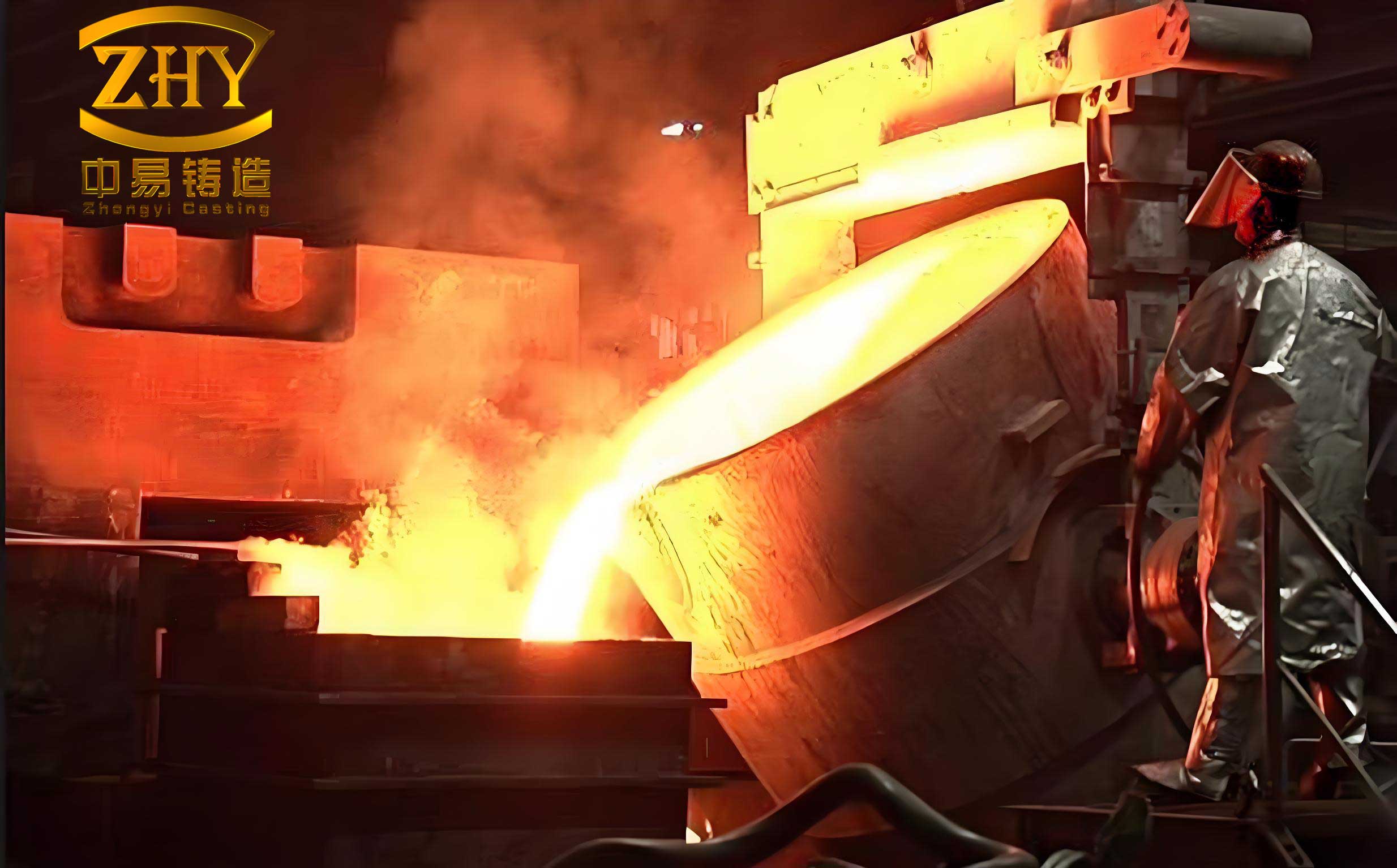
The journey of a manganese steel casting begins with the pattern. Since the final component often goes directly into service with little to no machining, the accuracy of the pattern is paramount. Any deviation can lead to assembly issues or outright rejection of the casting. In a manganese steel casting foundry, we adhere to several core principles in pattern technology.
First is the shrinkage allowance. Manganese steel exhibits significant solidification contraction. The linear shrinkage is typically between 2.0% and 2.5%. This can be expressed by the fundamental shrinkage formula:
$$ \delta = \alpha \cdot L_0 $$
where $\delta$ is the total shrinkage, $\alpha$ is the linear shrinkage coefficient, and $L_0$ is the pattern dimension. For standard manganese steel castings, we use a patternmaker’s shrink rule of 2.0% to 2.5%. However, for open-shaped or flanged castings that are restrained by the mold, this allowance may be reduced or even omitted to achieve the final desired dimensions. The selection is based on empirical data accumulated within the manganese steel casting foundry.
| Parameter | Typical Value/Rule | Technical Rationale |
|---|---|---|
| Shrinkage Allowance | 2.0% – 2.5% | Compensates for high austenitic transformation and thermal contraction. Reduced for restrained, open-shape castings. |
| Parting Line Negative | 0.5 – 3.0 mm, increasing with mold box size | Accounts for mold wall movement and parting line lift in dry sand molds. Often zero for small green sand molds. |
| Dimensional Tolerance Principle | Contour dimensions: negative tolerance; Mounting holes: positive tolerance | Ensures guaranteed fit and ease of assembly for the end-user without machining. |
| Core Positioning | Mandatory use of locator prints, asymmetrical core prints, and climb cores | Prevents core shift and misplacement, which is critical for non-machined cast features. |
The parting line negative is another critical factor. It compensates for the inevitable slight mismatch and mold wall movement during pouring and solidification. While small green sand castings might not need it, for larger dry sand molds, the negative must be increased, particularly for extensive horizontal parting surfaces. The principle can be related to mold rigidity: $$ N = k \cdot \sqrt{A} $$ where $N$ is the parting negative, $A$ is the mold box area, and $k$ is an empirical factor higher for dry sand molds in a manganese steel casting foundry.
Dimensional tolerances are not arbitrarily chosen. For components like liner plates, external轮廓 dimensions are assigned negative tolerances to ensure they never exceed the designated space. Conversely, holes used for bolting or fixing are given positive tolerances to guarantee the fastener will fit. For mating parts, the “enclose-and-enclosed” principle applies: the enclosing feature (e.g., a hub) gets a positive tolerance, and the enclosed feature (e.g., a shaft) gets a negative tolerance. This systematic approach is vital for the smooth operation of any manganese steel casting foundry.
Core design and location demand meticulous attention. For square or elliptical holes, proper locator prints are essential. To prevent loose core prints from shifting, we frequently employ climb cores. In complex castings where the parting line is ambiguous, the core print can be placed on the core itself. For inclined cores, suspending them from the cope is an effective strategy. Whenever possible, using horizontal cores with double-sided climb prints enhances stability. A simple but effective method to prevent inversion of symmetrical cores is to use core prints of differing lengths or widths. This level of detail in core engineering is a hallmark of an experienced manganese steel casting foundry.
Pattern structure must be robust and resistant to warping. We often reinforce large, flat patterns with ribs or ties to maintain dimensional stability during molding. For castings prone to deformation, temporary strengthening ribs are incorporated into the pattern itself, to be removed later during heat treatment.
The heart of the operation lies in the molding and pouring工艺. The primary goal here is to achieve sound castings free from shrinkage porosity, hot tears, cracks, and surface defects. The peculiar thermal properties of manganese steel dictate a unique set of rules for gating and feeding.
The gating system should ideally be of a closed type (e.g., sprue, runner, ingate) to minimize turbulence and slag entrainment. The cross-sectional design and placement must not hinder the free contraction of the casting. The choice between directional and simultaneous solidification governs the gating layout. For thin-section plates (less than 50 mm thick), the principle of simultaneous solidification is adopted to minimize stresses. Gates are dispersed to avoid localized overheating. This can be conceptualized using the modulus concept: $$ M = \frac{V}{A} $$ where $M$ is the modulus (volume-to-surface-area ratio). For simultaneous solidification, we aim for uniform $M$ across the casting by dispersing gates. For thicker plates (over 50 mm), directional solidification towards risers is necessary. Here, gates are often led through side risers to enhance their feeding efficiency. The heat transfer dynamics in a manganese steel casting foundry are crucial, governed by Fourier’s law: $$ q = -k \nabla T $$ where $q$ is heat flux, $k$ is thermal conductivity (low for manganese steel), and $\nabla T$ is the temperature gradient. Creating a steep gradient is key for directional solidification.
| Casting Type | Wall Thickness | Gating Strategy | Risering Strategy |
|---|---|---|---|
| Flat Liner Plate | < 50 mm | Dispersed, multiple ingates for uniform filling. | No risers; only vents and gates. |
| Flat Liner Plate | > 50 mm | Ingates connected to side risers. | Side risers placed at heavy sections. |
| Cylindrical/Cone Liners | Variable | Tangential for smaller sizes; stepped/spiral for larger sizes. | Top open risers to promote top-down solidification. |
| Complex Shapes with Cores | Variable | Gates aligned with core orientation to avoid impingement. | Use of blind/side risers or exothermic sleeves. |
Risering technology is adapted to the material’s characteristics. Due to poor thermal conductivity and the risk of cracking during riser removal, open top risers are often avoided in favor of side risers, blind risers, or knock-off risers. For thin sections, no risers are used. For medium sections, side risers are common. The connection between the side riser and the casting, known as the neck, is critical. Its dimensions are optimized: width equal to the riser diameter, and thickness about 0.5 to 0.7 times the casting thickness. After heat treatment, risers are cut off, and the cut area is immediately quenched with water to prevent carbide precipitation and cracking. This practice is standard in any proficient manganese steel casting foundry.
For long, uniform castings,倾斜浇注 (tilt pouring) with side risers at the high end is employed. For筒类铸件 (cylindrical liners), top open risers are used to establish a strong temperature gradient from the bottom up. The riser size can be estimated using the feeding distance concepts and modulus calculations, adjusted for manganese steel’s long solidification range. The required riser volume $V_r$ to compensate for shrinkage porosity is a function of the casting’s volume $V_c$ and the solidification shrinkage $\beta$: $$ V_r \geq \frac{V_c \cdot \beta}{1 – \beta} $$ For manganese steel, $\beta$ (volumetric shrinkage) is approximately 4-6%.
The strategic use of chills and ribs is perhaps one of the most distinctive aspects of the manganese steel casting foundry process. Chills are used to control solidification, promote directional solidification, reduce riser size, and prevent hot spots.
- For uneven wall thicknesses, internal or external chills are placed at bosses or thick sections to equalize cooling rates.
- For uniform plates around 50 mm thick, an array of external chills acts as a “cooling mold,” eliminating the need for risers.
- Around deep core prints, a cage of internal chills is inserted to accelerate cooling, prevent burn-on, and ease core sand removal.
- For massive castings, uniformly distributed internal chills are used to reduce the required riser volume substantially.
- For small, scattered hot spots, spring coil internal chills are highly effective.
The effectiveness of a chill is related to its ability to extract heat, which can be modeled by the heat capacity: $$ Q = m \cdot c \cdot \Delta T $$ where $Q$ is heat extracted, $m$ is the chill mass, $c$ is its specific heat, and $\Delta T$ is its temperature rise. Steel chills with high thermal diffusivity are preferred.
Ribs or ties are used on open-shaped castings to prevent distortion, such as splaying. Sometimes, the gating runner itself can be designed to act as a strengthening rib.
The application of mold coatings is crucial to prevent chemical burn-on or metal penetration. Manganese steel melt contains basic oxides like MnO. In contact with silica sand (acidic, SiO₂), it can form low-melting-point silicates leading to severe粘砂. Therefore, for dry sand molds, we use basic or neutral refractory coatings. The most common are magnesite-based or chromite-based coatings. The reaction prevention can be thought of in terms of chemical compatibility, avoiding the formation of compounds with melting points below the steel pouring temperature. For green sand molds, where the vapor pressure and faster initial cooling provide some protection, a well-compacted and finished mold surface often suffices without coating, but this is highly dependent on the specific manganese steel casting foundry practices.
Pouring temperature control is a final critical lever. Given the excellent fluidity and high shrinkage of manganese steel, the pouring temperature is generally kept on the lower side to minimize total heat content, reduce shrinkage porosity, and lower the risk of hot tearing. For simple-shaped castings, the typical range is 1420°C to 1460°C. For complex thin-walled castings, it might be raised to 1480°C to ensure complete filling. The choice is a balance, expressed conceptually by the fluidity length $L_f$, which is a function of superheat $\Delta T_s$ and material properties: $$ L_f \propto \frac{\Delta T_s \cdot \rho \cdot H_f}{\mu \cdot \sigma} $$ where $\rho$ is density, $H_f$ is latent heat, $\mu$ is viscosity, and $\sigma$ is surface tension. Lower superheat ($\Delta T_s$) reduces fluidity but also reduces shrinkage stresses.
| Process Stage | Key Control Parameters | Typical Values/Standards | Governing Principle/Formula |
|---|---|---|---|
| Pattern Making | Shrinkage Allowance | 2.0 – 2.5% | $\delta = \alpha \cdot L_0$ |
| Mold Assembly | Parting Line Negative | 0 – 3 mm (size-dependent) | Empirical based on mold size & type |
| Core Design | Core Print Safety Factor | Use locator/climb cores | Prevent shift via geometric locking |
| Gating Design | Gating Ratio (Sprue:Runner:Ingate) | 1 : 1.5 : 2 (pressurized) for thin sections | Bernoulli’s theorem: $P + \frac{1}{2}\rho v^2 + \rho gh = constant$ |
| Risering Design | Riser Modulus $M_r$ | $M_r = 1.2 \cdot M_c$ (for side risers) | Chvorinov’s Rule: $t_s = k \left( \frac{V}{A} \right)^2$ |
| Chill Design | Chill Volume / Casting Volume Ratio | 2% – 10% depending on application | Heat balance: $m_{steel} c_{p,steel} \Delta T_{steel} \approx m_{chill} c_{p,chill} \Delta T_{chill}$ |
| Coating | Coating Refractoriness | Prevent chemical reaction: $xMnO + ySiO_2 \rightarrow MnO_x(SiO_2)_y$ (low mp) | |
| Pouring | Superheat ($\Delta T_s$) | 80 – 120°C above liquidus (~1350°C) | Controls fluidity and shrinkage: $L_f \propto \Delta T_s$ |
In conclusion, the successful production of manganese steel castings hinges on a holistic and specialized approach that permeates every step of the foundry process. From the precise engineering of the pattern to the calculated design of the gating and feeding system, each decision must account for the material’s high shrinkage, low thermal conductivity, and good fluidity. The strategic use of chills and the careful selection of molding materials and coatings are non-negotiable aspects of the craft. It is this intricate dance of metallurgy, heat transfer, and practical engineering that defines the expertise within a dedicated manganese steel casting foundry. By rigorously applying these principles—summarized in the tables and formulas throughout this discussion—foundries can consistently produce sound, dimensionally accurate, and high-performance manganese steel castings that meet the severe demands of their service environments. The process is as much a science, governed by the laws of physics and chemistry, as it is an art, refined through years of hands-on experience in the manganese steel casting foundry.