
In the field of wear-resistant materials, white cast iron stands out due to its high hardness and excellent abrasion resistance. However, traditional white cast iron often suffers from brittleness, limiting its applications. A promising solution is austempering heat treatment, which transforms the matrix into a bainite-austenite duplex structure, significantly improving both toughness and hardness. This austempered white cast iron offers a cost-effective alternative to high-chromium cast iron, combining low production costs with high performance. The key to achieving these properties lies in the careful selection of chemical composition. In this study, I explore the influence of various elements on the mechanical properties of austempered white cast iron, providing insights for developing this advanced material.
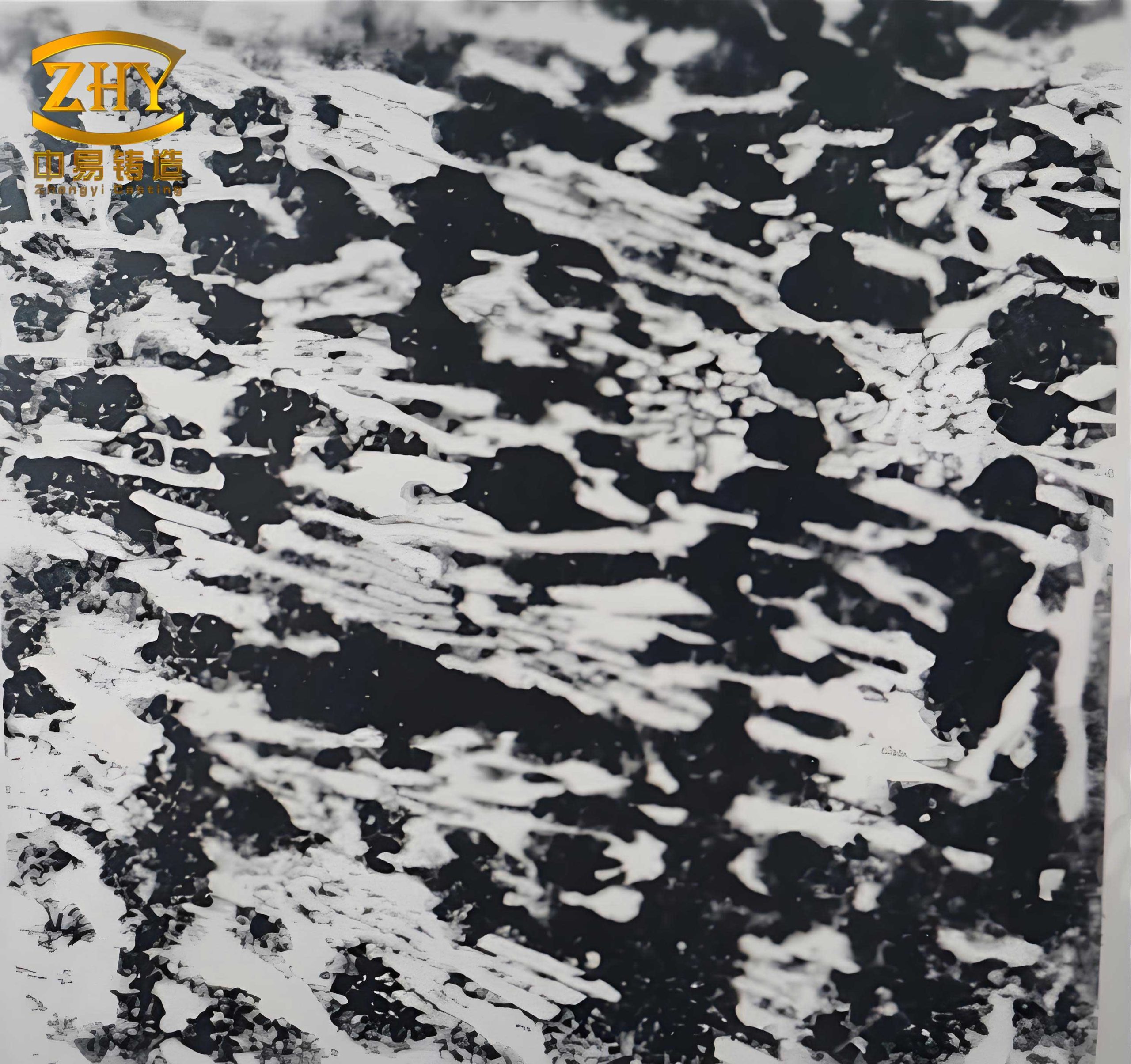
Austempered white cast iron is produced through a controlled heat treatment process. The microstructure evolution during austempering can be described using phase transformation kinetics. For instance, the bainite transformation start time ($t_s$) and finish time ($t_f$) depend on temperature and composition, often modeled by equations such as:
$$ t_s = A \exp\left(\frac{Q}{RT}\right) $$
where $A$ is a pre-exponential factor, $Q$ is the activation energy, $R$ is the gas constant, and $T$ is the absolute temperature. The formation of bainite without carbide precipitation is crucial for toughness, which is influenced by silicon content. The carbon equivalent ($CE$) is a critical parameter for predicting the microstructure of white cast iron, calculated as:
$$ CE = C + \frac{Si}{3} + \frac{Mn}{3} $$
In this study, the target $CE$ was around 4.2% to achieve approximately 20% carbide volume fraction, which is optimal for wear resistance. The following sections detail the experimental methodology, compositional effects, and results.
Experimental Conditions and Methods
The production of austempered white cast iron began with melting in a medium-frequency induction furnace. Raw materials included low-manganese pig iron, scrap steel, and alloying elements such as ferrosilicon, ferromanganese, and chromium. The chemical composition was adjusted to meet specific ranges. Each melt was poured into green sand molds to produce impact specimens (10 mm × 10 mm × 55 mm). From these, samples were taken for chemical analysis and mechanical testing.
The heat treatment involved two stages: austenitizing and austempering. Austenitizing was conducted in a box-type electric furnace at temperatures ranging from 920°C to 950°C for 2 hours, followed by rapid transfer to a salt bath furnace for isothermal quenching. The austempering temperature was set between 280°C and 350°C, with holding times varying from 1 to 2 hours to achieve the bainitic transformation. After treatment, mechanical properties were evaluated. Hardness was measured using a Rockwell hardness tester, and impact toughness was assessed with a small pendulum impact tester. Hardenability was determined using a stepped bar specimen (φ10 mm × φ20 mm).
To summarize the experimental parameters, Table 1 provides an overview of the heat treatment conditions and testing methods.
| Process | Equipment | Temperature Range | Time | Key Measurements |
|---|---|---|---|---|
| Melting | Medium-frequency induction furnace | ~1500°C | Until homogeneous | Chemical composition |
| Austenitizing | Box-type electric furnace | 920–950°C | 2 hours | Microstructure observation |
| Austempering | Salt bath furnace | 280–350°C | 1–2 hours | Hardness, impact toughness |
| Testing | Rockwell hardness tester, impact tester | Room temperature | N/A | HRC, impact energy (J) |
Selection of Chemical Composition Ranges
The performance of austempered white cast iron is highly sensitive to alloying elements. Each element plays a distinct role in microstructure development and mechanical properties. The following subsections discuss the rationale for selecting composition ranges, supported by tables and formulas.
Carbon (C)
Carbon is the primary element controlling carbide volume and morphology in white cast iron. As carbon content increases, the number of eutectic cells rises, while primary austenite decreases, leading to higher hardness and wear resistance but reduced impact toughness. Excess carbon can cause graphite precipitation in the as-cast state and graphitization during austenitizing, degrading properties. Conversely, low carbon reduces carbide content, compromising hardness and worsening castability. The optimal carbon content for white cast iron is around 3.0–3.5 wt%, corresponding to a carbide volume of ~20%. The relationship between carbon content ($C$) and carbide volume fraction ($V_c$) can be approximated by:
$$ V_c \approx k \cdot (C – C_0) $$
where $k$ is a constant and $C_0$ is the carbon solubility limit in austenite. For this study, carbon levels were tested at 2.8%, 3.0%, 3.2%, 3.4%, and 3.6 wt%, with silicon and manganese fixed at 2.5% and 1.0 wt%, respectively.
Silicon (Si)
Silicon is a strong graphitizer, which can hinder the formation of white cast iron in the as-cast state. However, in austempered white cast iron, silicon promotes the first stage of bainitic transformation and suppresses carbide precipitation, enabling a carbide-free bainite-austenite matrix. Silicon also refines the bainite needles and strengthens the matrix via solid solution hardening. When silicon content exceeds 2.5 wt%, carbide-free bainite is achievable. But excessive silicon may induce graphitization, reducing toughness and hardness. Thus, silicon levels were chosen as 1.5%, 2.0%, 2.5%, 3.0%, and 3.5 wt%, with carbon and manganese fixed at 3.2% and 1.0 wt%.
Manganese (Mn)
Manganese is a weak carbide-forming element that enhances hardenability by stabilizing austenite and delaying transformation. However, manganese tends to segregate at grain boundaries, creating weak points that can reduce toughness. In white cast iron, manganese can form (Fe,Mn)₃C-type carbides, slightly increasing carbide stability. To balance hardenability and toughness, manganese content was varied from 1.0% to 5.0 wt%. The effect on hardenability can be described using the ideal critical diameter ($D_I$) formula:
$$ D_I = D_0 \cdot \exp(b \cdot Mn) $$
where $D_0$ and $b$ are material constants. For this study, manganese levels were 1.0%, 1.5%, 2.0%, 3.0%, and 5.0 wt%, with carbon and silicon fixed at 3.2% and 2.5 wt%.
Chromium (Cr)
Chromium is a strong carbide stabilizer, preventing carbide decomposition during austenitizing. This is crucial for maintaining carbide volume and avoiding graphitization, which can degrade mechanical properties. In white cast iron, chromium forms stable carbides like M₇C₃, enhancing wear resistance. However, excessive chromium may increase cost and brittleness. Therefore, chromium additions were limited to 0.2%, 0.3%, and 0.5 wt%, with other elements fixed at 3.2% C, 2.5% Si, and 1.0% Mn.
Bismuth (Bi)
Bismuth is a potent inoculant that suppresses graphite formation during solidification, ensuring a fully white cast iron structure in the as-cast condition. This is especially important for high carbon and silicon contents or thick-section castings. By preventing as-cast graphite, bismuth minimizes graphitization during heat treatment, preserving toughness and hardness. Bismuth was added in trace amounts: 0.005%, 0.01%, and 0.02 wt%, with base compositions of 3.2% C, 2.5% Si, and 1.0% Mn.
Table 2 summarizes the chemical composition ranges investigated for each element in this study on white cast iron.
| Element | Symbol | Tested Ranges (wt%) | Fixed Compositions for Tests |
|---|---|---|---|
| Carbon | C | 2.8, 3.0, 3.2, 3.4, 3.6 | Si=2.5%, Mn=1.0% |
| Silicon | Si | 1.5, 2.0, 2.5, 3.0, 3.5 | C=3.2%, Mn=1.0% |
| Manganese | Mn | 1.0, 1.5, 2.0, 3.0, 5.0 | C=3.2%, Si=2.5% |
| Chromium | Cr | 0.2, 0.3, 0.5 | C=3.2%, Si=2.5%, Mn=1.0% |
| Bismuth | Bi | 0.005, 0.01, 0.02 | C=3.2%, Si=2.5%, Mn=1.0% |
Experimental Results and Analysis
The mechanical properties of austempered white cast iron were evaluated as functions of chemical composition. Data are presented in tables to illustrate trends, avoiding reference to figure numbers. The analysis focuses on hardness and impact toughness, key indicators for wear-resistant applications.
Effect of Carbon Content
Carbon significantly influences the carbide network in white cast iron. As carbon increased, hardness rose due to higher carbide volume, but impact toughness declined. After austempering, the bainite-austenite matrix improved toughness relative to the as-cast state, but the trend remained similar. The optimal carbon content was around 3.2 wt%, balancing hardness and toughness. Table 3 shows the mechanical properties at different carbon levels.
| Carbon (wt%) | As-Cast Hardness (HRC) | Austempered Hardness (HRC) | As-Cast Impact Toughness (J) | Austempered Impact Toughness (J) |
|---|---|---|---|---|
| 2.8 | 48 | 52 | 8 | 18 |
| 3.0 | 50 | 54 | 7 | 20 |
| 3.2 | 52 | 56 | 6 | 22 |
| 3.4 | 54 | 58 | 5 | 19 |
| 3.6 | 51 | 55 | 4 | 16 |
The decrease in toughness at high carbon is attributed to graphite formation. The hardness peak at 3.4 wt% C aligns with the maximum carbide content before graphitization. The improvement after austempering can be modeled by the rule of mixtures for composite materials:
$$ \sigma_c = V_m \sigma_m + V_c \sigma_c $$
where $\sigma_c$ is composite strength, $V_m$ and $V_c$ are matrix and carbide volume fractions, and $\sigma_m$ and $\sigma_c$ are their respective strengths.
Effect of Silicon Content
Silicon enhanced the bainitic transformation in white cast iron, leading to finer microstructures and higher toughness after austempering. However, in the as-cast state, silicon promoted graphite, reducing hardness. At 2.5–3.0 wt% Si, the austempered material achieved optimal toughness with adequate hardness. Table 4 summarizes the results.
| Silicon (wt%) | As-Cast Hardness (HRC) | Austempered Hardness (HRC) | As-Cast Impact Toughness (J) | Austempered Impact Toughness (J) |
|---|---|---|---|---|
| 1.5 | 50 | 53 | 9 | 15 |
| 2.0 | 49 | 54 | 8 | 18 |
| 2.5 | 48 | 56 | 7 | 22 |
| 3.0 | 46 | 55 | 6 | 20 |
| 3.5 | 44 | 53 | 5 | 17 |
Silicon’s role in suppressing carbide precipitation can be explained by its effect on carbon activity. The activity coefficient ($\gamma_C$) changes with silicon, altering carbon diffusion:
$$ \gamma_C = f(Si) \approx 1 + k_{Si} \cdot Si $$
where $k_{Si}$ is a constant. This influences the bainite transformation kinetics, favoring carbide-free structures.
Effect of Manganese Content
Manganese improved hardenability in white cast iron, allowing thicker sections to be austempered effectively. At 1.5–2.0 wt% Mn, the material achieved full bainitic transformation with good toughness. Higher manganese (≥3.0 wt%) led to retained austenite and martensite formation upon cooling, increasing hardness but reducing toughness. Table 5 presents the data.
| Manganese (wt%) | As-Cast Hardness (HRC) | Austempered Hardness (HRC) | As-Cast Impact Toughness (J) | Austempered Impact Toughness (J) |
|---|---|---|---|---|
| 1.0 | 48 | 56 | 7 | 22 |
| 1.5 | 49 | 57 | 6 | 24 |
| 2.0 | 50 | 58 | 5 | 23 |
| 3.0 | 52 | 60 | 4 | 19 |
| 5.0 | 55 | 62 | 3 | 15 |
The hardenability effect can be quantified using the Grossmann factor, where manganese contributes to the ideal diameter. For white cast iron, this is critical for achieving uniform properties.
Effect of Chromium Content
Chromium additions stabilized carbides, preventing graphitization during austenitizing. This maintained carbide volume and improved wear resistance. However, chromium had a minor effect on toughness. At 0.3 wt% Cr, the austempered white cast iron showed the best balance. Table 6 outlines the results.
| Chromium (wt%) | As-Cast Hardness (HRC) | Austempered Hardness (HRC) | As-Cast Impact Toughness (J) | Austempered Impact Toughness (J) |
|---|---|---|---|---|
| 0.0 | 48 | 56 | 7 | 22 |
| 0.2 | 49 | 57 | 6 | 23 |
| 0.3 | 50 | 58 | 6 | 24 |
| 0.5 | 51 | 59 | 5 | 22 |
Chromium’s carbide stabilization can be described by the enthalpy of formation ($\Delta H_f$) for carbides, with M₇C₃ being more stable than Fe₃C. This enhances the thermal stability of white cast iron.
Effect of Bismuth Content
Bismuth effectively inhibited graphite formation in the as-cast white cast iron, ensuring a fully white structure. This was particularly beneficial for high carbon and silicon alloys. After austempering, bismuth-treated samples exhibited higher toughness due to the absence of initial graphite. Table 7 shows the properties.
| Bismuth (wt%) | As-Cast Hardness (HRC) | Austempered Hardness (HRC) | As-Cast Impact Toughness (J) | Austempered Impact Toughness (J) |
|---|---|---|---|---|
| 0.000 | 48 | 56 | 7 | 22 |
| 0.005 | 49 | 57 | 7 | 24 |
| 0.010 | 50 | 58 | 7 | 25 |
| 0.020 | 50 | 58 | 6 | 24 |
Bismuth acts as a surface active element, reducing the interfacial energy for carbide nucleation. The effectiveness can be expressed as:
$$ \Delta G_{nuc} = \Delta G_{nuc}^0 – \gamma_{Bi} \cdot A $$
where $\Delta G_{nuc}$ is the nucleation barrier, $\gamma_{Bi}$ is the reduction due to bismuth, and $A$ is the interface area.
Discussion on Microstructure-Property Relationships
The superior performance of austempered white cast iron stems from its unique duplex matrix of bainite and austenite. Bainite provides strength and hardness, while retained austenite enhances toughness by absorbing energy through transformation-induced plasticity (TRIP). The volume fraction of retained austenite ($V_\gamma$) can be estimated from the carbon content in austenite ($C_\gamma$), using the equation:
$$ V_\gamma = \frac{C_0 – C_\alpha}{C_\gamma – C_\alpha} $$
where $C_0$ is the bulk carbon content, and $C_\alpha$ is the carbon in ferrite. For white cast iron, $C_\gamma$ is enriched during austempering, stabilizing the austenite.
Carbide morphology also plays a crucial role. In optimal compositions, carbides are finely dispersed, acting as reinforcements without causing stress concentrations. The Hall-Petch relationship can be applied to the bainitic matrix:
$$ \sigma_y = \sigma_0 + k_y \cdot d^{-1/2} $$
where $\sigma_y$ is yield strength, $\sigma_0$ is friction stress, $k_y$ is a constant, and $d$ is the bainite plate thickness. Silicon refines the bainite, reducing $d$ and increasing strength.
Furthermore, the wear resistance of white cast iron correlates with hardness and carbide volume. The Archard wear equation provides a basis:
$$ W = k \cdot \frac{F \cdot L}{H} $$
where $W$ is wear volume, $k$ is a wear coefficient, $F$ is load, $L$ is sliding distance, and $H$ is hardness. By optimizing composition, the hardness of austempered white cast iron is maximized while maintaining toughness, leading to excellent wear performance.
The economic aspect cannot be overlooked. Compared to high-chromium cast iron, this austempered white cast iron uses lower-cost alloys like silicon and manganese, reducing production costs. This makes it a viable material for industrial applications such as mining equipment, mill liners, and agricultural tools, where wear resistance and toughness are paramount.
Conclusions
Based on this comprehensive study, the following conclusions are drawn regarding the chemical composition of austempered white cast iron:
- Carbon: An optimal range of 3.0–3.4 wt% C balances carbide volume for hardness with minimal graphitization, enhancing wear resistance in white cast iron.
- Silicon: Silicon content of 2.5–3.0 wt% promotes carbide-free bainite formation, improving toughness without sacrificing hardness in austempered white cast iron.
- Manganese: Manganese at 1.5–2.0 wt% enhances hardenability, enabling full bainitic transformation in thicker sections of white cast iron, though higher levels can reduce toughness.
- Chromium: Additions of 0.2–0.3 wt% Cr stabilize carbides, preventing decomposition during heat treatment and maintaining the integrity of white cast iron.
- Bismuth: Trace amounts of bismuth (0.005–0.01 wt%) suppress as-cast graphite, ensuring a fully white microstructure, which is critical for consistent properties in austempered white cast iron.
By carefully selecting these elements, austempered white cast iron can achieve a superior combination of hardness (up to 60 HRC) and impact toughness (up to 25 J), making it a cost-effective, high-performance material for demanding wear applications. Future work could explore additional elements like nickel or molybdenum to further tailor properties, but the current findings provide a solid foundation for optimizing this versatile white cast iron.
The success of austempered white cast iron hinges on interdisciplinary knowledge from metallurgy, materials science, and engineering. As industries seek durable and economical solutions, this material stands out as a promising candidate, with ongoing research likely to expand its applications. The integration of computational modeling, such as CALPHAD for phase prediction, could further refine composition design, pushing the boundaries of what white cast iron can achieve.