
The production of large, wear-resistant components like crusher liners, mantle liners, and similar parts from high manganese steel is a cornerstone of heavy industry. However, for a significant period in our foundry, the integrity and service life of these critical castings were severely compromised by a pervasive and insidious defect. This issue manifested not as a simple surface blemish, but as a fundamental flaw that threatened structural reliability. The problem first presented itself glaringly between March and September of a particular year. Out of dozens of castings produced, each weighing over several tons, a staggering percentage—over half—exhibited signs of what we later definitively identified as oxide film defects.
The symptoms varied in form but were unified in their destructive consequence. Some castings displayed severe surface wrinkles, reminiscent of a crumpled sheet. Others suffered from misruns, particularly in extended sections like “ears,” where the metal simply failed to fill the mold completely. The most alarming manifestation, however, was the appearance of fine, hairline cracks. These cracks, often only visible after heat treatment or subsequent machining, ranged in length and width. Under grinding, some would disappear, suggesting a very shallow defect. Others, persisting even after significant material removal, revealed their true nature: a plane of non-metallic inclusion. In the most severe cases, components that had been sectioned and subjected to impact testing fractured with alarming ease along these lines. The fracture surface was telling—a mere sliver of fresh, metallic break, with the vast majority covered in a layered, oxidized crust. Spectrographic and chemical analysis confirmed the primary constituents of this crust: manganese oxide (MnO) and iron oxide (FeO). The presence of this brittle, ceramic-like film within the intended metallic matrix was catastrophic. In service, these fine cracks would act as initiation points for rapid wear and spalling, leading to premature failure, unscheduled downtime, and substantial financial loss from scrapped components.
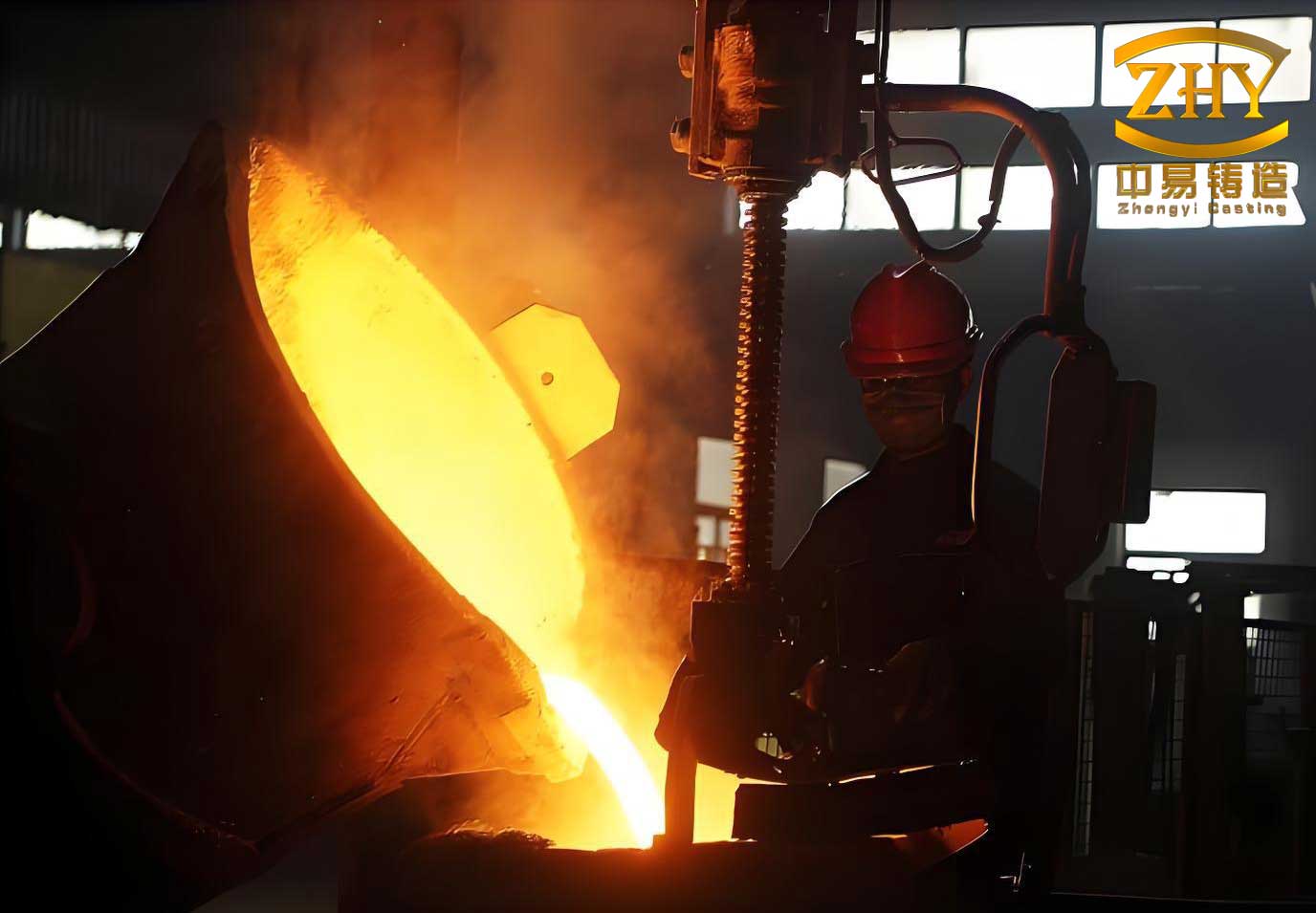
The quest to solve this problem began with intensive observation and analysis. We needed to understand the genesis of the defect during the casting process of high manganese steel. During pouring of large castings, visual inspection of the rising metal in the mold cavity, often through feeder openings, was revealing. The meniscus did not rise smoothly; it advanced in a surging, wavelike manner. More critically, the liquid surface was visibly marred by a film. This film varied in thickness, from a barely perceptible skin to a substantial layer several millimeters thick. When this film folded or became entrapped, it created the observed wrinkles and cracks. The theoretical explanation for this phenomenon is rooted in the fundamental metallurgy of high manganese steel. The alloy’s defining characteristic, a manganese content typically between 11% and 14%, is also its Achilles’ heel during pouring. Manganese has a high affinity for oxygen, especially at the temperatures involved in steel casting. The primary oxidation reaction can be summarized as:
$$ \text{Mn}_{(l)} + \frac{1}{2}\text{O}_{2(g)} \rightarrow \text{MnO}_{(s)} $$
This reaction is highly exothermic and spontaneous under standard foundry conditions. The free energy of formation, $\Delta G^\circ$, for MnO is strongly negative at pouring temperatures (e.g., ~1500°C), confirming its stability:
$$ \Delta G^\circ_{\text{MnO}}(T) \approx -RT \ln K_{\text{eq}} << 0 $$
Where $R$ is the universal gas constant, $T$ is the absolute temperature, and $K_{\text{eq}}$ is the equilibrium constant, which is very large for this reaction. The resulting MnO, often alloyed with FeO from concurrent iron oxidation, has a melting point significantly higher than the steel melt. Therefore, as soon as it forms at the air-metal interface, it solidifies into a solid, brittle film.
The formation and detrimental incorporation of this oxide film can be modeled as a multi-stage process, highly relevant to the production of robust high manganese steel castings:
- Film Genesis: As the steel stream enters the mold and the liquid meniscus advances, the high manganese content at the surface reacts with atmospheric oxygen, forming a continuous layer of solid MnO/FeO.
- Film Disruption & Entrapment (Turbulent Flow): If the flow into the mold cavity is turbulent or impinges on cores or walls, the cohesive oxide film is torn, fragmented, and engulfed into the bulk liquid. These fragments become macro-inclusions, often visible as cracks upon sectioning.
- Film Hindrance & Defect Formation (Laminar but Slow Flow): If the flow is relatively laminar but the meniscus rise is too slow, the film has time to thicken and gain mechanical strength. It acts as a “crust” or “skin,” obstructing the flow. This can lead directly to cold shuts or misruns. If the hydrostatic pressure from the gating system locally breaks through this crust, the torn edges remain attached to the mold wall or solidify in place, creating the characteristic wrinkle defects or leaving behind a discontinuous oxide seam—the hairline crack.
- Accelerated Film Growth (Interrupted Pouring): Any interruption in pouring is catastrophic. The stationary metal surface oxidizes rapidly, forming an exceptionally thick, strong film. Attempting to restart the pour often fails to remelt this barrier, leading to severe cold shuts or layered oxide cracks at the “stop-and-start” interface.
This understanding framed our counter-strategy: the goal was to minimize the time available for film formation, reduce its stability, and prevent its entrapment. The principles translated into a series of interconnected, systematic process controls for manufacturing high manganese steel castings. The core measures are summarized in the table below, which contrasts problematic and improved practices:
| Process Stage | Problematic Practice (Leads to Defects) | Corrective Measure & Principle |
|---|---|---|
| Mold & Metal Preparation | Cold molds, low metal superheat. | Hot Mold Pouring: Pre-heating molds reduces the thermal shock and cooling rate at the metal front, keeping the oxide film more fluid for longer, preventing it from sticking firmly to the mold wall. |
| Gating System Design | Restrictive (choked) systems, long runners, sharp bends. | Open, Short, & Tapered Systems: Use an unpressurized (open) gating ratio (e.g., $\Sigma A_{\text{sprue}} : \Sigma A_{\text{runner}} : \Sigma A_{\text{gate}} \approx 1 : 1.5 : 2$). Minimize total flow length to reduce air contact. Avoid flow impingement and directional changes to maintain laminar filling. |
| Pouring Practice | Slow pour rate, interrupted flow, low pouring head. | Fast & Uninterrupted Pouring: Maximize the meniscus rise velocity ($v_{rise}$) to outrun film formation. Ensure tight mold clamping to prevent run-outs and mandatory stops. Use larger bore nozzles to increase flow rate ($Q$). |
| Mold Cavity Design | Isolated pockets, blind recesses, poor venting. | Adequate Venting & Rounded Profiles: Ensure all cavity sections are vented to the atmosphere to allow air escape, preventing back-pressure. Use fillets to eliminate sharp corners that disrupt flow and trap film. |
| Atmosphere Control | Pouring in ambient air. | Inert Gas Shrouding: Flooding the pouring stream and the mold cavity with an inert gas (e.g., Nitrogen, Argon) displaces oxygen, drastically reducing the driving force for oxidation ($P_{O_2} \rightarrow 0$). |
The implementation of these measures required quantitative guidelines. For instance, the target meniscus rise velocity ($v_{rise}$) must be sufficient to prevent the oxide film from developing critical strength. While dependent on section thickness, a practical minimum for complex high manganese steel castings was established. This is linked to the flow rate $Q$ (m³/s) and the cross-sectional area $A_{cavity}$ (m²) at any point:
$$ v_{rise} = \frac{Q}{A_{cavity}} $$
To increase $Q$, we increased the pouring nozzle diameter, as flow rate is proportional to the area of the nozzle ($A_{nozzle}$) and the square root of the metallostatic head ($h$):
$$ Q = C_d \cdot A_{nozzle} \cdot \sqrt{2gh} $$
where $C_d$ is the discharge coefficient and $g$ is acceleration due to gravity. Furthermore, the concept of a “critical film formation time” $t_{crit}$ can be conceptualized. We aimed to have the filling time $t_{fill}$ be less than this $t_{crit}$ for any section. $t_{fill}$ for a volume $V$ is:
$$ t_{fill} = \frac{V}{Q} $$
The inert gas shrouding, a key breakthrough, works by lowering the partial pressure of oxygen. The rate of manganese oxidation is proportional to the oxygen potential. By creating a localized inert atmosphere, the reaction kinetics are suppressed from the moment the metal leaves the ladle.
The effectiveness of each parameter and its synergistic effect with others can be conceptualized in a defect propensity model. While a full quantitative model is complex, a simplified relationship for the tendency to form oxide film defects (OFD) in a high manganese steel casting can be expressed as a function of key variables:
$$ \text{OFD Propensity} \propto \frac{ [\text{Mn}] \cdot P_{O_2} \cdot t_{contact} \cdot f_{turbulence} }{ T_{mold} \cdot v_{rise} \cdot \text{Gas Purity} } $$
Where:
- $[\text{Mn}]$ is the manganese concentration (a fixed, high value for this alloy).
- $P_{O_2}$ is the partial pressure of oxygen in the environment.
- $t_{contact}$ is the time the metal surface is exposed to the oxidizing atmosphere.
- $f_{turbulence}$ is a factor representing flow turbulence.
- $T_{mold}$ is the initial mold temperature.
- $v_{rise}$ is the meniscus rise velocity.
- $Gas Purity$ represents the efficacy of inert shielding (higher purity lowers propensity).
Our entire corrective action plan was essentially an operationalization of minimizing the numerator and maximizing the denominator of this relationship.
The integration of these solutions yielded transformative results. Following the full implementation, the foundry produced over four dozen large high manganese steel castings, including the problematic mantle and liner types. The incidence of surface wrinkles, cold shuts, misruns, and—most importantly—the subsurface oxide crack networks, was reduced to negligible levels. The corrective actions were not isolated fixes but parts of a holistic philosophy for handling high manganese steel. The success underscored several key insights:
- The defect is fundamentally a process phenomenon, not just a melting or metallurgical one. The excellent intrinsic properties of high manganese steel are easily undermined by poor handling during the critical liquid-to-solid transition.
- Speed and continuity are paramount. A fast, uninterrupted pour is the most straightforward defense against a stable oxide film in high manganese steel casting.
- Geometry is destiny. Mold and gating design must serve the hydraulic principle of smooth, rapid, and complete filling, with no dead zones or air traps.
- Atmosphere control is a powerful tool. While more involved, inert gas protection directly attacks the root cause—the oxidation reaction itself—and provides a robust safety margin, especially for critical castings.
In conclusion, the battle against oxide film defects in high manganese steel castings is won through a disciplined, systems-based approach. It requires viewing the process from the moment the metal leaves the furnace to the point it solidifies in the mold as a continuous, vulnerable event. By controlling thermal conditions, hydraulic parameters, and atmospheric exposure in a coordinated manner, the exceptional toughness and work-hardening capability of the high manganese steel can be fully realized in the final, sound casting. The journey from pervasive failure to consistent reliability hinged on replacing empirical trial-and-error with a physics-based understanding of film formation and flow dynamics. This framework continues to guide the production of durable, high-performance high manganese steel castings capable of withstanding the most demanding abrasive and impact service conditions.