
In my extensive experience within the foundry industry, few defects are as persistent and costly as porosity in casting. This article delves deep into the specific challenge of eliminating invasive gas porosity from valve body castings, a problem that once plagued production with scrap rates soaring above 30%. The battle against porosity in casting is a fundamental one, requiring a blend of theoretical understanding and practical, hands-on process refinement. I will share the systematic approach and specific工艺措施 that proved successful, framing them within the core principles of foundry science. The defect manifested primarily in the flange’s annular hot-spot zones and beneath the roots of risers, presenting as large, pear-shaped, circular, or oblate cavities measuring 10 to 30 mm. This characteristic clearly pointed toward侵入性气孔, where gases from the mold or core invade the solidifying metal.
Understanding the root cause is paramount. According to casting formation theory, the invasion of gas from the mold into the molten metal occurs only when a specific pressure condition is met. The gas pressure in the mold cavity (Pgas) must overcome the opposing pressures. This can be expressed by the following inequality that defines the condition for gas invasion:
$$P_{gas} > P_{metal} + P_{atm} + \frac{\gamma}{r}$$
Where:
- \(P_{gas}\) is the pressure of gases evolving from the mold/core materials.
- \(P_{metal}\) is the metallostatic pressure of the molten metal.
- \(P_{atm}\) is the atmospheric pressure.
- \(\gamma\) is the surface tension of the molten metal.
- \(r\) is the radius of curvature of the pore (a smaller pore requires higher pressure to form due to surface tension).
Consequently, to prevent the formation of this type of porosity in casting, we must ensure the opposite condition holds true:
$$P_{gas} < P_{metal} + P_{atm} + \frac{\gamma}{r}$$
In this equation, \(P_{metal}\) and \(\gamma\) are largely determined by the alloy properties. \(P_{atm}\) is constant, and the \(\gamma/r\) term is often negligible for larger pores. Therefore, the most effective and controllable lever we have is to reduce \(P_{gas}\). The strategy to minimize \(P_{gas}\) rests on three interconnected pillars: 1) drastically reducing the gas generation of the mold and core, 2) significantly enhancing the permeability of the mold to allow generated gases to escape freely, and 3) implementing stringent process controls at every stage. A holistic attack on porosity in casting must address all three.
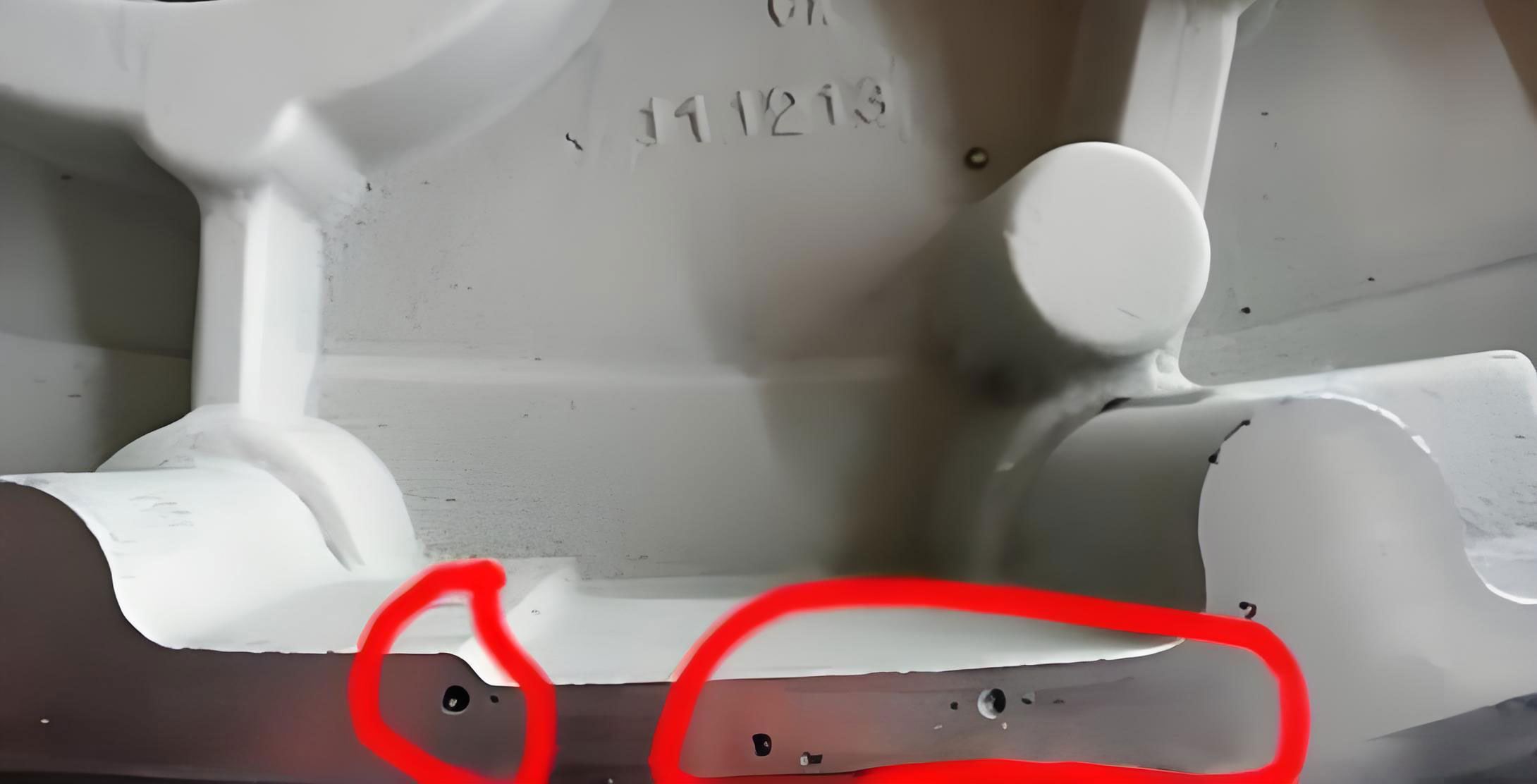
The first and perhaps most critical pillar is the reformulation of molding and core sand mixtures. The original mixes, while functional for general purposes, were suboptimal for preventing porosity in casting in these thick-sectioned valve bodies. They generated excessive gas and had limited permeability. The goal was to recalibrate the balance between strength, collapsibility, and—most importantly—gas-related properties. For the green sand used for molds, the adjustments were multi-faceted. We increased the grain size of the new sand to create larger interstitial spaces, directly boosting intrinsic permeability. The moisture content, a major driver of gas generation, was meticulously lowered. Simultaneously, we reduced the bentonite and coal dust additions, which are significant gas sources during pouring. A key innovation was the activation of the bentonite with sodium carbonate, which improved its efficiency at lower addition levels, allowing us to reduce the overall clay content without sacrificing necessary green strength. The comparative data is summarized below:
| Formulation | Sand Grain Size (AFS) | Composition (wt.%) | |||||
|---|---|---|---|---|---|---|---|
| New Sand | Return Sand | Bentonite | Coal Dust | Sodium Carbonate | Moisture | ||
| Original | 50-100 | 20 | 80 | 10 | 5 | 0 | 5.5 |
| Improved | 30-70 | 25 | 75 | 8 | 3 | 0.3 | 4.2 |
The core sand presented an even greater challenge, as cores are surrounded by hot metal and their gases have limited escape paths. The original recipe used a high amount of wood flour, a prolific gas generator. Our改进配方 drastically cut this addition. We also reduced bentonite and introduced a novel component: fine coke particles. Coke has low volatile content and its granular structure helps create a porous network within the core, acting as both a gas sink and a permeability enhancer. The changes are detailed in the following table:
| Formulation | Sand Grain Size (AFS) | Composition (wt.%) | ||||
|---|---|---|---|---|---|---|
| New Sand | Return Sand | Bentonite | Wood Flour | Coke Particles (40-70 mesh) | ||
| Original | 50-100 | 40 | 60 | 3.5 | 3.0 | 0 |
| Improved | 30-70 | 50 | 50 | 2.5 | 1.5 | 1.0 – 2.0 |
The effectiveness of these sand modifications in reducing \(P_{gas}\) can be conceptually modeled. The gas generation rate \(G\) is a function of the volatile content \(V_i\) and temperature \(T\) over time \(t\) for each component \(i\):
$$G(t) = \sum_{i} \left( m_i \cdot \int f_i(T(t)) \, dt \right)$$
where \(m_i\) is the mass fraction of component \(i\). By reducing \(m_i\) for high-volatility components like wood flour and moisture, we directly lower the integral \(G(t)\), thereby reducing the peak \(P_{gas}\). Furthermore, the enhanced permeability \(k\) facilitates gas venting. Darcy’s law gives the volumetric flow rate \(Q\) of gas through the sand:
$$Q = -\frac{k A}{\mu} \frac{dP}{dx}$$
where \(A\) is area, \(\mu\) is gas viscosity, and \(dP/dx\) is the pressure gradient. A higher \(k\) (achieved via larger grains and coke additions) allows a higher \(Q\) for a given gradient, more effectively venting gas and preventing \(P_{gas}\) from reaching the critical threshold for invasion.
The second pillar, operational工艺措施, translates these material improvements into consistent practice on the foundry floor. Molding and core-making are not merely mechanical tasks; they are precision steps in the fight against porosity in casting. In molding, we found that excessive ramming, while yielding a hard, durable mold surface, severely compacted the sand grains and crushed the precious permeability we had engineered into the mix. Through trial and error, I standardized a lower mold surface hardness, ensuring it met the minimum required for dimensional stability without choking off gas escape paths. For cores, the drying process was overhauled. The old temperature and time profile was insufficient to fully drive off combined water and volatiles from the binders. We elevated the drying temperature and extended the soaking time, ensuring a more complete dehydration and pre-burning of organic materials, thus leaving less to volatilize during pouring. The formula for the core drying process can be related to the diffusion of moisture. The drying time \(t_d\) to reach a target moisture content \(M_f\) from an initial \(M_0\) can be approximated for a slab of thickness \(L\):
$$t_d \propto \frac{L^2}{D_{eff}}$$
where \(D_{eff}\) is the effective diffusivity, which increases exponentially with temperature \(T\) according to an Arrhenius relationship: \(D_{eff} = D_0 \exp(-E_a/RT)\). By increasing the oven temperature \(T\), we dramatically increased \(D_{eff}\), which allowed for a more thorough drying in a comparable or even shorter time, or justified the extended time for very thick cores to ensure core uniformity—a crucial factor for preventing localized porosity in casting.
Venting is the physical manifestation of enhancing permeability. We systematically increased the number of vent holes pricked into both molds and cores, creating deliberate, low-resistance channels for gas to flow directly out to the atmosphere. This practice directly reduces the effective path length \(dx\) in Darcy’s law, increasing the pressure gradient and flow rate \(Q\). Furthermore, strict protocols were enforced: any core that absorbed ambient moisture was re-dried, and molds that sat assembled for more than a few hours were discouraged from use to prevent “core return,” a phenomenon where dried cores re-absorb moisture from the air, setting the stage for a massive gas surge during pouring.
The third pillar encompasses molten metal and pouring control. The metallostatic pressure \(P_{metal}\) in our foundational inequality is not a passive factor; we can influence it. \(P_{metal}\) is given by:
$$P_{metal} = \rho g h$$
where \(\rho\) is the metal density, \(g\) is gravity, and \(h\) is the height of the metal column above the point in question. To maximize \(h\), we employed taller pouring basins and sprue extensions. More critically, we focused on浇注速度. A faster pour achieves two things: first, it rapidly builds up the metallostatic head \(h\) in the mold cavity, increasing \(P_{metal}\) sooner to counteract \(P_{gas}\). Second, it creates a greater dynamic pressure, which can help force any entrapped gases back into solution or toward vents. However, this must be balanced against turbulence, which can itself entrap air. The optimal浇注时间 \(t_p\) for a given casting volume \(V\) and浇注系统 area \(A_g\) is a key parameter:
$$t_p = \frac{V}{A_g \cdot v_{ideal}}$$
where \(v_{ideal}\) is an empirically determined pouring velocity that minimizes both turbulence and gas invasion risk for the specific geometry. We calibrated our gating systems to achieve this balance.
熔炼 control was equally vital. A low superheat temperature means the metal is more viscous and has lower fluidity, making it harder for bubbles that do form to float out. More importantly, a lower temperature reduces the thermal shock to the mold, slowing the rate of gas generation. However, too low a temperature risks misruns. We established a strict minimum tapping temperature to ensure sufficient superheat, providing the thermal energy needed for dissolved gases to remain in solution or for invaded micro-bubbles to coalesce and rise into the risers. The solubility of gases like hydrogen in iron follows Sieverts’ law:
$$S = k \sqrt{P}$$
where \(S\) is solubility, \(k\) is a temperature-dependent constant, and \(P\) is the partial pressure of the gas. While this relates more to dissolved gas porosity, maintaining proper熔炼 practices minimizes all sources of gas that contribute to the overall porosity in casting problem.
The synergistic effect of these measures was transformative. Within a few production cycles, the scrap rate attributed to invasive gas porosity in the valve body castings plummeted from over 30% to below 5%. This victory was not the result of a single silver bullet but of a systematic, science-guided campaign across materials, methods, and controls. The fight against porosity in casting is perpetual, as raw material batches vary and new casting designs present fresh challenges. However, the framework remains: relentlessly attack \(P_{gas}\) by minimizing generation and maximizing venting, while supporting the defense by optimizing \(P_{metal}\) through sound pouring practice. The principles elucidated here—quantified through these formulas and implemented via the formulated mixes in the tables—form a robust foundation for addressing porosity in casting across a wide range of ferrous and non-ferrous foundry applications. Continuous monitoring and statistical process control of parameters like sand properties, moisture levels, and pouring temperatures are the final, essential layer in sustaining this low-defect regime, ensuring that porosity in casting remains a controlled variable, not a production-stopping defect.