
In my extensive experience within the foundry industry, the battle against casting defects is perpetual, with porosity standing as one of the most persistent and costly adversaries. The economic impact of scrap due to porosity in casting is significant, driving continuous improvement efforts. This narrative details a specific, in-depth technical campaign I led to suppress a high scrap rate caused by blowholes in a critical component—a 4100 series diesel engine cylinder block. The journey from diagnosis to resolution involved a holistic reassessment of our materials, processes, and tooling, underscoring the multifaceted nature of controlling porosity in casting.
The cylinder block in question was a complex gray iron (HT250) casting with varying wall thicknesses, the thinnest being approximately 5mm. Its production was carried out on a high-pressure KW molding line, using a one-casting-per-mold configuration. The molding sand was green sand, while the entire internal geometry was formed by 12 separate cores made from furan resin sand, coated and dried before assembly and placement via an automated system. The gating was a semi-choked, bottom-filling design with a pouring temperature range of 1380-1435°C. A key feature of the mold design was the inclusion of multiple vent wires and vents in the cope to facilitate the escape of gases and cooler metal during filling.
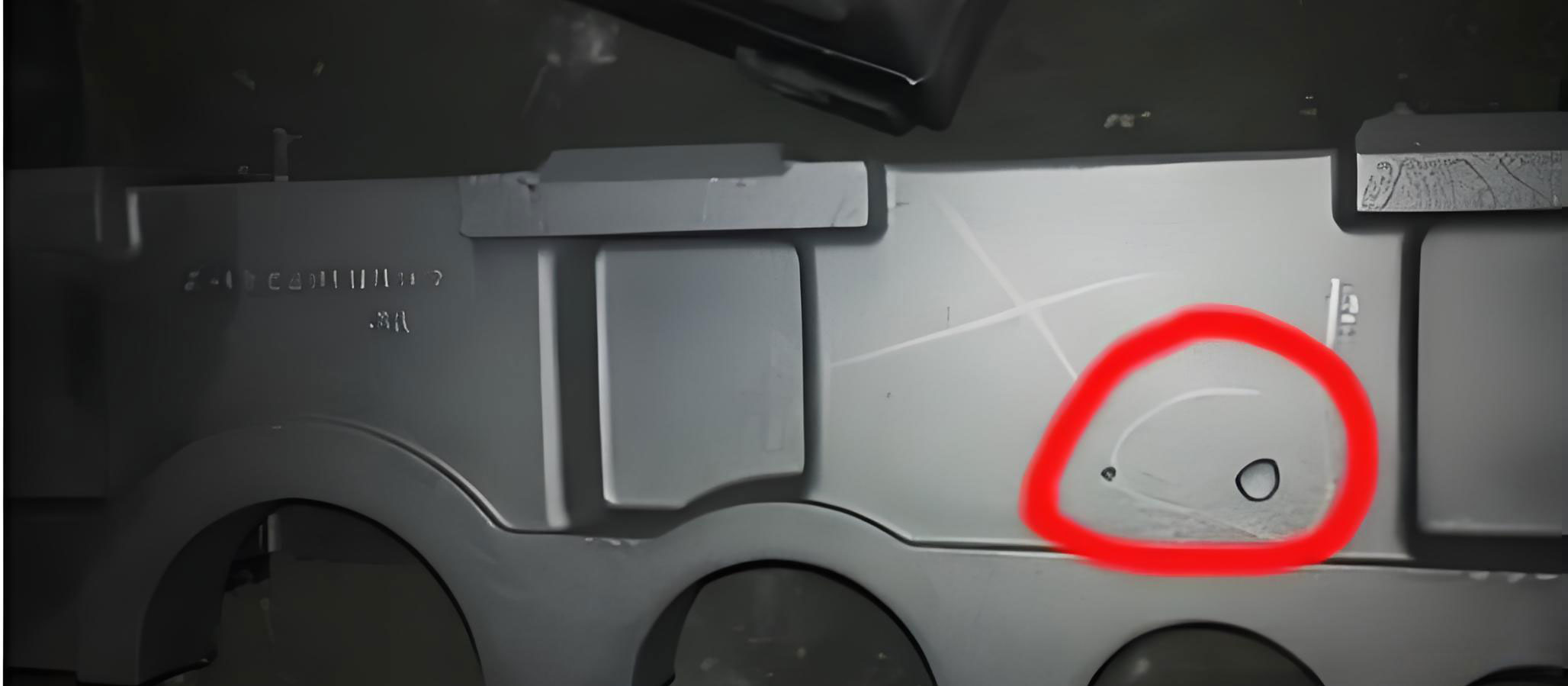
Despite this seemingly robust process, the overall scrap rate averaged 3.8%, with defects related to porosity in casting constituting a staggering 40% of that total. The majority of these blowholes were located on the water jacket face—an upper-section area furthest from the ingates. Critical analysis revealed two distinct types of porosity in casting, each with a unique formation mechanism.
Type I: Classical Subsurface Blowholes. This category, representing about 60% of the porosity defects, manifested as large, often spherical or slightly flattened cavities with smooth, shiny walls. Some exhibited a distinctive pear shape, with the narrow end pointing directly toward the core. This morphology is a textbook signature of invasive gas porosity. The mechanism is as follows: during pour, moisture, binders, and additives in the mold and cores decompose, generating vast volumes of gas. A fraction of this gas invades the liquid metal. Being buoyant, the bubbles rise with the metal flow, finally collecting at the highest point—the water jacket face. If the local solidification skin forms before the bubble can escape, it becomes trapped just beneath the surface, only to be exposed during machining. The pear shape specifically implicates gas generation from the water jacket core itself later in the solidification sequence. Ironically, the extensive venting ribs on the casting surface, intended to channel out gases, acted as cooling fins, accelerating local solidification and trapping the bubbles, thus trading external defects for internal ones.
The propensity for this type of porosity in casting was often accompanied by “water explosion” phenomena during pouring—a clear indicator of excessive moisture and/or poor permeability in the molding sand system. The core issue was the high gas generation potential of the sand system. The total gas volume $V_{gas}$ generated from a unit mass of mold material can be approximated as a sum of contributions from moisture, organic additives, and clay breakdown:
$$ V_{gas} \approx k_w \cdot W + k_c \cdot C + k_o \cdot O $$
where $W$, $C$, and $O$ are the weight percentages of water, combustible additives (like coal dust), and other volatiles in the clay, and $k_w$, $k_c$, $k_o$ are their respective gas yield coefficients. For water, $k_w$ is exceptionally high, as vaporization produces a large volume of steam.
Type II: Irregular Subsurface Porosity Beneath Vent Wires. This second type, accounting for the remaining 40%, was uniquely positioned directly beneath three large-diameter (Φ16 mm) vent wires on the water jacket face. These cavities were irregular in shape, wider at the top near the vent and tapering down toward the core, with rougher internal surfaces. This pointed to gas invasion occurring very late in solidification, when a dendritic network had already formed, restricting bubble growth and ascent. The root cause was twofold: firstly, the large vent wires created a significant “contact hot spot,” delaying solidification in that tiny zone after the surrounding area had frozen. Secondly, continued gas evolution from the core found this path of least resistance. The late-stage invasion, combined with possible gas precipitation from supersaturated iron as temperature dropped, led to this distinctive defect morphology. It highlighted a critical design flaw where a feature meant to solve a gas problem (the vent) inadvertently created a thermal condition that exacerbated porosity in casting.
The remediation strategy required a simultaneous, multi-pronged attack on the root causes of both defect types. Our primary focus was reducing the total gas load in the system and ensuring its efficient evacuation without creating new problems.
Optimization of the Molding Sand System
To combat Type I porosity and the associated water explosions, we fundamentally reformed our green sand composition. The goal was to reduce the moisture content while maintaining adequate strength and surface finish, thereby slashing the primary source of gas generation. This was achieved through two key changes:
1. Upgrading the Bentonite: We replaced the original bentonite with a higher-quality sodium bentonite. The key performance indicators are compared below:
| Property | Original Bentonite | New Bentonite |
|---|---|---|
| Methylene Blue Index (ml/10g) | 22-27 | 30-36 |
| Wet Compressive Strength of Standard Specimen (MPa) | 0.025 – 0.030 | 0.035 – 0.045 |
The higher Methylene Blue Index indicates greater clay surface activity and bonding potential. This directly translated to higher strength per unit addition, allowing us to reduce the new bentonite addition rate.
2. Replacing Coal Dust with an α-Starch Based Additive (MD Powder): Coal dust, while providing a reducing atmosphere and good surface finish, has high volatile and ash content, contributing to gas generation and sand system degradation. We substituted it with a proprietary α-starch based additive. The comparative data is revealing:
| Property | Coal Dust | MD Powder |
|---|---|---|
| Gas Evolution (ml/g) | 25-28 | 22-25 |
| Ash Content (%) | 8-10 | 4-6 |
| Volatile Matter (%) | ~30 | 46-52 |
Although the MD powder has higher volatiles, its overall gas evolution is lower, and its ash content is significantly reduced. More importantly, it enhances sand strength and plasticity, allowing for a further reduction in bentonite addition. The synergistic effect was profound.
The combined implementation led to a dramatic reformulation. The new bentonite addition dropped to 1.0-1.2% (from 1.8-2.0%), and the MD powder addition settled at 0.23-0.27% (a ~55% reduction from the coal dust addition rate). The impact on system sand properties was monitored closely through key control parameters:
| Sand Property | Original System (Bentonite + Coal) | Optimized System (Bentonite + MD Powder) |
|---|---|---|
| Used Sand LOI / Combustibles (%) | 13 – 14.5 | 10 – 11.5 |
| Used Sand Gas Evolution (ml/g) | 18 – 24 | 16 – 21 |
| Green Sand Moisture (%) | 3.5 – 4.5 | 2.7 – 3.5 |
| Green Sand Permeability | 100 – 120 | 135 – 155 |
| Green Sand Compactability (%) | 37 – 42 | 37 – 45 |
| Green Sand Wet Compressive Strength (MPa) | 0.140 – 0.170 | 0.140 – 0.170 |
The reduction in Loss on Ignition (LOI) indicates lower dead clay and fines buildup. The controlled reduction in used sand gas evolution, coupled with a significant drop in moisture content and a rise in permeability, was the direct solution to the water explosion issue. The fundamental relationship driving this improvement is the moisture-to-clay ratio. For a given green strength, a lower active clay requirement allows for lower moisture. The moisture content $M$ can be related to the active clay content $A_c$ by an empirical factor $f$ (typically between 0.25 and 0.30 for controlled systems):
$$ M \approx f \cdot A_c $$
By reducing $A_c$ through better bentonite and the strengthening effect of MD powder, we directly lowered $M$, which had the greatest impact on reducing the potential for porosity in casting from mold gases.
Modification of Venting and Gating Design
To eliminate Type II porosity, we addressed the design flaw head-on. The three large Φ16 mm vent wires on the water jacket face were identified as the culprits creating thermal hot spots. Our solution was to remove them entirely from the casting surface and replace their venting function with optimized venting ribs. To maintain adequate cavity venting, three new Φ16 mm vent wires were added on the cope mold’s top surface, connected to the casting via small, quickly solidifying bridges. This modification eliminated the local hot spot that delayed solidification, thereby removing the preferential site for late-stage gas invasion. The gas pressure $P_g$ required to invade a metal with a growing dendritic network is significantly higher than in fully liquid metal, as described by models that account for the effective surface tension $\sigma_{eff}$ and the critical pore radius $r_c$ within the mushy zone:
$$ P_g > P_{atm} + \rho_m g h + \frac{2\sigma_{eff}}{r_c} $$
By ensuring uniform solidification, we increased $r_c$ (making pore formation harder) and prevented the localized condition where $P_g$ from the core could exceed the local metalostatic pressure $P_{atm} + \rho_m g h$ plus the capillary pressure.
Core Sand and Process Control
Since the cores were a confirmed source of gas, a parallel effort focused on minimizing their contribution to porosity in casting.
1. Resin Reduction: We systematically reduced the furan resin addition levels while ensuring core handling and thermal strength were maintained. Large core resin was lowered from 2.3-2.5% to 1.9-2.1%, and small cores from 2.4-2.6% to 2.1-2.4%. This directly reduced the core gas generation potential $G_{core}$.
2. Extended Cure Time: For hot-box cores, we increased the cure cycle time. Data showed that increasing cure time from 70 seconds to 100 seconds decreased core gas evolution by approximately 0.5 ml/g, ensuring more complete polymerization and lower volatile content.
3. Strict Moisture Control: After coating with water-based paint, cores were thoroughly dried to a moisture content of <0.1%. Any residual moisture is a potent source of gas. The drying process must ensure the core temperature $T_{core}$ exceeds 100°C for sufficient time $t$ to drive off all free and adsorbed water.
4. Limited Storage Life: Coated and dried cores have a limited shelf life, especially in humid conditions, as they can re-absorb moisture. We imposed strict storage limits of 96 hours in dry conditions and 48 hours in humid conditions.
5. Sealing of Core Prints: We improved the sealing design at core print areas to absolutely prevent metal penetration into the core’s internal venting channels, which would block gas escape.
Melting and Pouring Parameter Optimization
Finally, we fine-tuned the metal-related parameters to create conditions less favorable for porosity in casting. Through designed experiments, we established optimal windows:
- Pouring Temperature: Maintained at the upper end of the range (≈1430°C). Higher temperature lowers metal viscosity $\eta$, which increases the bubble rise velocity $v_b$ according to Stokes’ law (simplified for spherical bubbles):
$$ v_b \propto \frac{(\rho_m – \rho_g) g d^2}{\eta} $$
where $d$ is the bubble diameter. This gives invading gas more time to escape before solidification.
- Carbon Equivalent (CE) and Strength: Controlled CE within 3.8-3.95%. Lower CE (below 3.8%) or excessively high tensile strength (>290 MPa) correlated with a marked increase in porosity scrap, likely due to changes in solidification mode and gas solubility.
- Pouring Speed: Optimized to be fast enough to quickly establish metallostatic pressure to suppress gas invasion, but not so fast as to cause turbulence or trap cavity gases. The final fill speed was particularly controlled.
The culmination of this comprehensive, year-long campaign was a decisive victory over the porosity in casting problem. The results, tracked through our quality management system, speak for themselves:
| Metric | Before Improvement Campaign | After Full Implementation |
|---|---|---|
| Overall Casting Scrap Rate | ~3.8% | Significantly Lower |
| Scrap Due to Porosity | ~1.5% (40% of total scrap) | < 0.5% |
| Dominant Porosity Type I | Frequent, with water explosions | Rare |
| Dominant Porosity Type II | Consistent defect under vents | Eliminated |
This case study reinforces that controlling porosity in casting is rarely about a single silver bullet. It is a systems engineering challenge requiring integrated analysis of mold sand chemistry, coremaking practice, tooling design, and metal processing. The most effective strategy is one that systematically reduces the total gas generation load from all sources while simultaneously ensuring the mold cavity and the solidifying casting itself offer the least resistance to the escape of whatever gases remain. It is a testament to the principle that in foundry engineering, profound improvements often come from the meticulous and scientific management of fundamentals.