
In my years working on the foundry floor, few challenges have been as persistent and economically damaging as the battle against porosity defects in castings, particularly in complex, thin-walled components like engine crankcases. The production of a crankcase is a lengthy, multi-stage process fraught with variables. Defects such as gas holes, shrinkage cavities, and pinholes are insidious; they often remain hidden within the casting, only revealing themselves during final machining or pressure testing, leading to costly scrap and rework. Identifying the root causes of these defects, especially porosity in casting, amidst a web of interacting factors is a core responsibility for production engineers. This account details my practical investigation and resolution of chronic porosity issues in a compact automotive engine crankcase, sharing the methodology and solutions that proved effective.
The crankcase in question was a critical, high-volume component. It was a thin-walled, complex geometry requiring high strength and pressure tightness. Key specifications demanded the absence of surface defects like shrinkage and gas holes, and it had to withstand a pressure test of 294.4 kPa for 3 minutes in both water jacket and oil galleries after machining. We used high-pressure green sand molding with coal dust additives on a BMD molding line and produced cores via the hot-box process using resin-coated sand. Melting was carried out in medium-frequency induction furnaces.
Initially, defect types were scattered and seemingly random—cold shuts, sand inclusions, core breaks, and various leaks. While sporadic defect bursts were easier to diagnose, the constant, low-level rejection rate was more troubling. To move from speculation to data-driven action, I instituted a rigorous tracking system. We categorized rejects from two sources: “Internal Rejects” (scrapped at the final casting inspection stage) and “External Rejects” (failed after machining during pressure testing or discovery of subsurface defects).
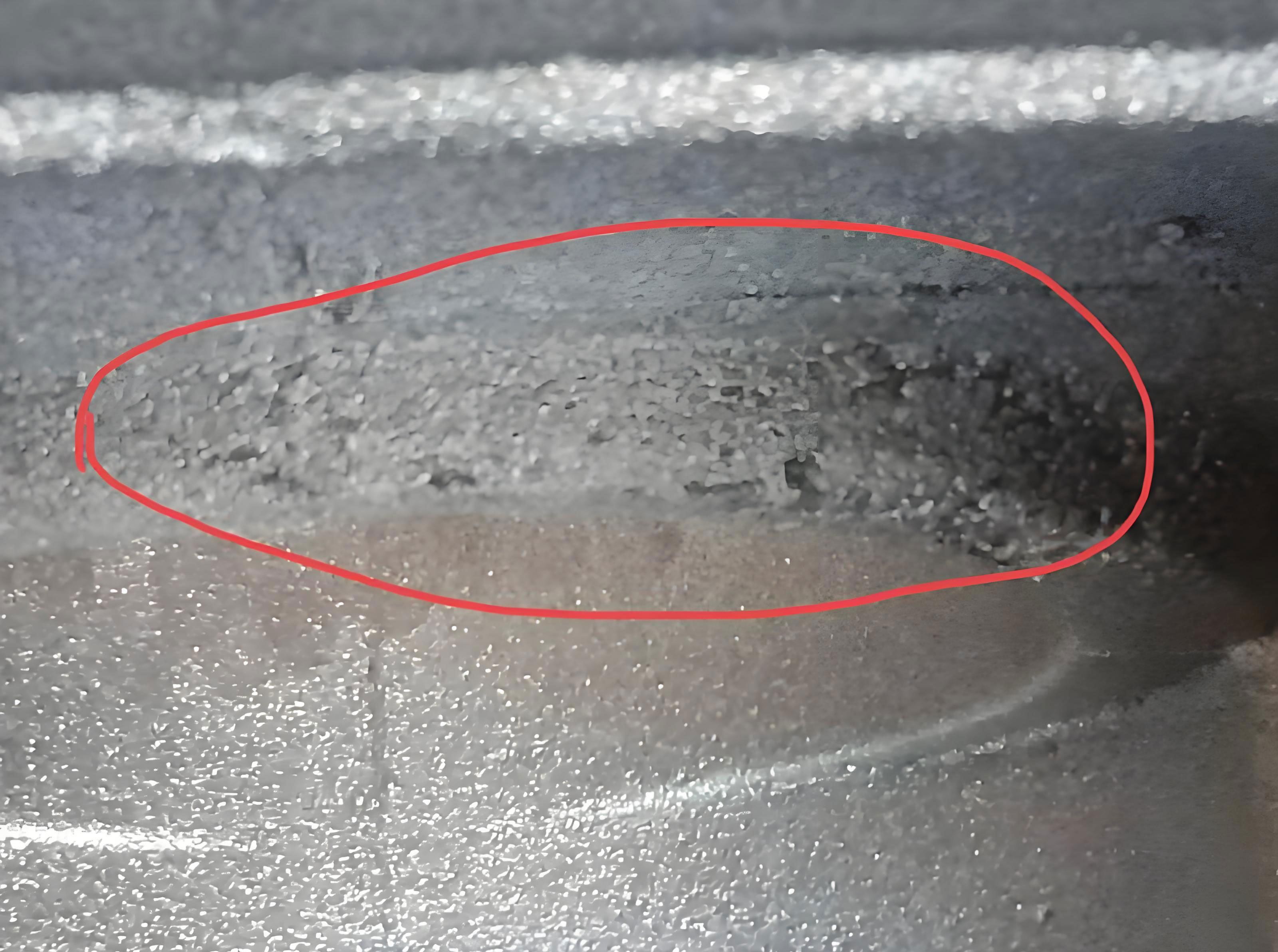
The data revealed a clear pattern. While external fails were dominated by leaks in the water jacket and oil galleries, and defects on the cylinder bore surfaces, internal scrap was overwhelmingly due to porosity in casting. A Pareto analysis of this period made the priority unmistakable.
| Defect Type (Internal Reject) | Quantity (Pieces) | Cumulative Percentage (%) |
|---|---|---|
| Gas Porosity / Blowholes | 1087 | 52% |
| Crushed Sand | 283 | 65% |
| Cold Shut | 214 | 76% |
| Core Break | 144 | 82% |
| Sand Inclusion | 107 | 87% |
| Slag Inclusion | 65 | 91% |
| Other | 197 | 100% |
| Defect Type (External Reject) | Quantity (Pieces) | Cumulative Percentage (%) |
|---|---|---|
| Cylinder Bore Defect | 1024 | 27% |
| Water Jacket Leak | 905 | 50% |
| Oil Gallery Leak | 756 | 70% |
| Gas Porosity | 314 | 80% |
| Sand Inclusion | 229 | 87% |
| Crack | 113 | 89% |
| Slag | 54 | 92% |
| Other | 251 | 100% |
Cross-sectional analysis of leaking and defective bore castings showed that the leaks originated from shrinkage porosity in thick sections, while the bore defects were primarily subsurface porosity in casting, often appearing at the parting line or upper surfaces of the cylinder barrels. The conclusion was clear: subcutaneous gas pores and micro-shrinkage were the root cause of both the internal porosity scrap and the majority of external failures. Therefore, tackling porosity in casting became the central focus for improving overall yield.
Root Cause Analysis: Isolating the Key Variables
We observed that blowholes frequently appeared on the highest points of the upper casting (like mounting bosses), near vent pins on the water jacket surface, and on the machined bore surfaces at core parting lines. Leaks occurred at heavy sections like main oil galleries. To systematically identify the primary contributors, we conducted controlled process trials.
1. The Critical Role of the Gating System
The original gating design was a middle-height system, with ingates positioned at the main bearing journals. This led to turbulent metal flow, inadequate venting of the mold cavity, and prolonged contact between the hot metal and the cylinder bore cores, creating severe thermal gradients and hot spots. This environment is a perfect incubator for porosity in casting, combining gas entrapment with conditions favorable for shrinkage.
We hypothesized that a bottom-gating system would promote laminar flow, improve thermal uniformity, and allow for better venting of gases ahead of the rising metal front. The evolution of our gating design and its impact was tested in three distinct trials, with results summarized below:
| Trial | Gating System Design | Key Characteristics | Observed Effect on Porosity |
|---|---|---|---|
| Original | Middle In-gate (Vertical) | Ingates at bearing journals. Turbulent, poor venting. | High levels of bore and boss porosity (~4% scrap). |
| Trial 1 | Step (Combination) | Added 4 bottom ingates, kept top ingates. | Improved thermal balance, reduced turbulence. Porosity decreased moderately. |
| Trial 2 | Pure Bottom-gate | Removed top ingates, increased to 6 bottom ingates. | Significantly smoother fill, excellent venting. Major reduction in porosity. |
| Trial 3 | Optimized Bottom-gate | Adjusted cross-sectional areas of 6 bottom ingates. | Optimal fill profile. Stable, low defect rates achieved. |
The cross-sectional area ratio is a fundamental design parameter. We moved from an unbalanced system to a controlled, partially choked system. The final optimized ratio was set as:
$$ F_{\text{sprue}} : F_{\text{runner}} : F_{\text{ingate}} = 1 : 0.9 : 1.15 $$
This semi-open, semi-choked design for a bottom-gate system ensured the sprue was full quickly, minimizing air aspiration, while the runner-to-ingate relationship controlled the metal velocity into the cavity.
2. The Impact of Core Moisture and Storage
Cylinder bore cores were made from resin-coated sand, dressed with a refractory coating, and dried using their residual heat. They were stored at ambient conditions without further baking. In our humid climate, especially during seasonal changes, these cores could absorb significant atmospheric moisture. When such a damp core is surrounded by molten iron, the rapid vaporization generates large volumes of gas. If this gas cannot escape through the coating and the molding sand, it leads to core-generated porosity in casting, typically at the metal-core interface.
To quantify this risk, we tracked the age of core batches used in production against the occurrence of gas defects. The correlation was stark, confirming that core storage life was a critical process parameter.
| Core Storage Time (Days) | Relative Scrap Rate due to Gas Porosity (Indexed) | Interpretation |
|---|---|---|
| 0 – 1 | 1.0 (Baseline) | Minimal moisture pick-up. Low gas generation. |
| 2 | 1.3 | Moderate increase in defect risk. |
| 3 | 1.8 | Significant increase in scrap. | >3 | >2.5 | Unacceptably high and variable scrap rates. Primary cause of defects. |
The relationship between storage time, moisture absorption \( m \), and gas pressure \( P_{gas} \) generated at the core interface can be conceptually modeled. The moisture pickup can be approximated as a function of ambient relative humidity (\( RH \)), time (\( t \)), and a core material-specific diffusion coefficient (\( D \)): $$ m \propto \sqrt{D \cdot t} \cdot RH $$ The subsequent gas pressure upon metal pouring is related to the instantaneous vaporization of this moisture: $$ P_{gas} \propto \frac{m \cdot R \cdot T_{metal}}{V_{void}} $$ where \( R \) is a constant, \( T_{metal} \) is the metal temperature, and \( V_{void} \) is the effective permeable volume in the sand system. When \( P_{gas} \) exceeds the local metallostatic pressure plus the strength of the forming metal skin, a pore is formed.
3. Pouring Temperature: A Double-Edged Sword
Pouring temperature (\( T_p \)) has a complex, non-linear relationship with porosity in casting. A higher temperature improves fluidity and can help gases float out, but it also increases the total gas solubility in the iron and, more critically, extends the solidification time (\( t_s \)). A longer solidification time in a heavy section promotes macro-shrinkage porosity. Conversely, a lower temperature can reduce shrinkage but may lead to mistruns or premature freezing that traps gas bubbles. The original specification of 1420-1460°C was found to be too high for this component with the existing gating, exacerbating shrinkage in hot spots like the main bearing areas and cylinder bridges. The solidification time for a section of modulus \( M \) can be estimated by Chvorinov’s rule: $$ t_s = k \cdot M^n $$ where \( k \) is a mold constant. Lowering \( T_p \) effectively increases \( k \) for the given metal, but more importantly, it reduces the temperature gradient, pushing the solidification mode towards a more simultaneous, directional pattern from the ingates upwards, which is less prone to isolated shrinkage cavities.
Implementing the Corrective Actions
Based on the trial data and root cause analysis, we implemented a comprehensive set of corrective measures targeting the primary drivers of porosity in casting.
1. Permanent Gating System Redesign
We permanently adopted the optimized pure bottom-gating system from Trial 3. This was the single most impactful change. The benefits were multifaceted:
- Laminar Fill: Metal entered the cavity at the bottom with minimal turbulence, preventing air entrainment.
- Progressive Solidification: The temperature gradient was reversed. The metal at the bottom (near the ingates) solidified last, creating a natural feeding path. This is the ideal thermal profile for a component with varying sections when combined with controlled cooling.
- Superior Venting: Gases from the mold and cores were pushed upward ahead of the metal front and could escape through strategically placed top vents and the permeable sand of the cope.
The elimination of direct metal impingement on the thermally sensitive cylinder bore cores drastically reduced gas generation at that critical interface.
2. Stringent Core Process Control
We moved beyond just checking the raw material specs of the coated sand. A strict “core shelf-life” policy was enforced based on the data in Table 3:
- Cylinder Bore Cores: Maximum storage time after coating was set at 72 hours (3 days).
- Complex Water Jacket & Oil Gallery Cores: These cores, which required a wash and a separate oven dry, were mandated for use on the same production day after drying. No overnight storage was permitted.
- Storage Environment: Where possible, core storage areas were dehumidified, especially during high-humidity seasons.
This discipline ensured that the gas-generating potential of every core assembly was minimized and predictable, directly attacking one source of porosity in casting.
3. Optimization of Pouring Parameters
In conjunction with the bottom-gating system, we systematically lowered the pouring temperature range. The new specification was established at 1400-1440°C, a reduction of approximately 20-30°C from the previous standard. This adjustment worked synergistically with the new gating:
- It reduced the total heat input, promoting faster formation of a solid skin on the casting surface and around the cores, which acts as a barrier to gas invasion.
- It shortened the local solidification time in thermal centers, minimizing the size and prevalence of shrinkage porosity.
- The improved thermal uniformity from bottom-gating prevented mistruns that could have otherwise resulted from the lower temperature.
The combined effect of bottom-gating and lower pouring temperature was dramatic. The scrap rate attributed to cylinder bore porosity and associated leakage defects plummeted from an initial level of around 4% to a stable 1.5% or lower.
Generalized Principles and Concluding Insights
This case study reinforces several universal principles for preventing porosity in casting in complex ferrous castings:
1. Gating Dictates Thermal Management. The design of the gating system is not merely about filling the mold; it is the primary tool for controlling the solidification sequence and temperature gradient. For components prone to both gas and shrinkage defects, a bottom or controlled fill system that promotes directional solidification towards the ingates or risers is often essential.
2. Cores are Active Process Elements. Cores must be treated as potential internal gas generators. Their quality is defined not just by geometry and room-temperature strength, but by their “hot” behavior—low gas evolution, high hot strength, and good collapsibility. Managing their shelf-life to prevent moisture absorption is as critical as controlling their manufacturing parameters. The gas evolution rate \( \dot{G} \) from a core must be less than the permeability-limited venting rate \( \dot{V} \) of the sand system over the critical solidification period: $$ \dot{G}_{core}(t) < \dot{V}_{sand}(t) \quad \text{for} \quad 0 < t < t_{skin} $$ where \( t_{skin} \) is the time for a competent metal skin to form.
3. Pouring Temperature is a Compromise Parameter. The optimal pouring temperature is the lowest temperature that reliably produces a sound casting without mistruns, given the specific gating and mold design. It should be determined empirically for each component and held within a tight range. The relationship between temperature, fluidity (\( FL \)), and shrinkage risk (\( SR \)) can be thought of as an optimization problem: $$ \text{Minimize: } SR(T_p) $$ $$ \text{Subject to: } FL(T_p) \geq FL_{\text{required}} $$
4. Data is the Compass. Systematic data collection—separating internal from external scrap, categorizing defects, and correlating them with process variables like core age, metal temperature, and batch numbers—is indispensable. It transforms anecdotal problem-solving into a directed engineering effort.
In summary, conquering chronic porosity in casting issues requires a holistic view of the process. Isolating the defect to be primarily gas-related, shrinkage-related, or a synergistic “gas-shrinkage” pore is the first step. From there, a targeted strategy involving gating redesign for better thermal and flow control, strict core management to minimize gas generation, and precise optimization of pouring parameters will yield significant and sustainable improvements in casting quality and foundry productivity. The journey with the crankcase casting proved that even in a mature production process, fundamental principles, when applied with rigorous data support, can drive breakthrough improvements.